

Top Tweets for #pgsix


@colchonino A QUOI JE SERRRS

Systematic comparison of Generative AI-Protein Models reveals fundamental differences between structural and sequence-based approaches
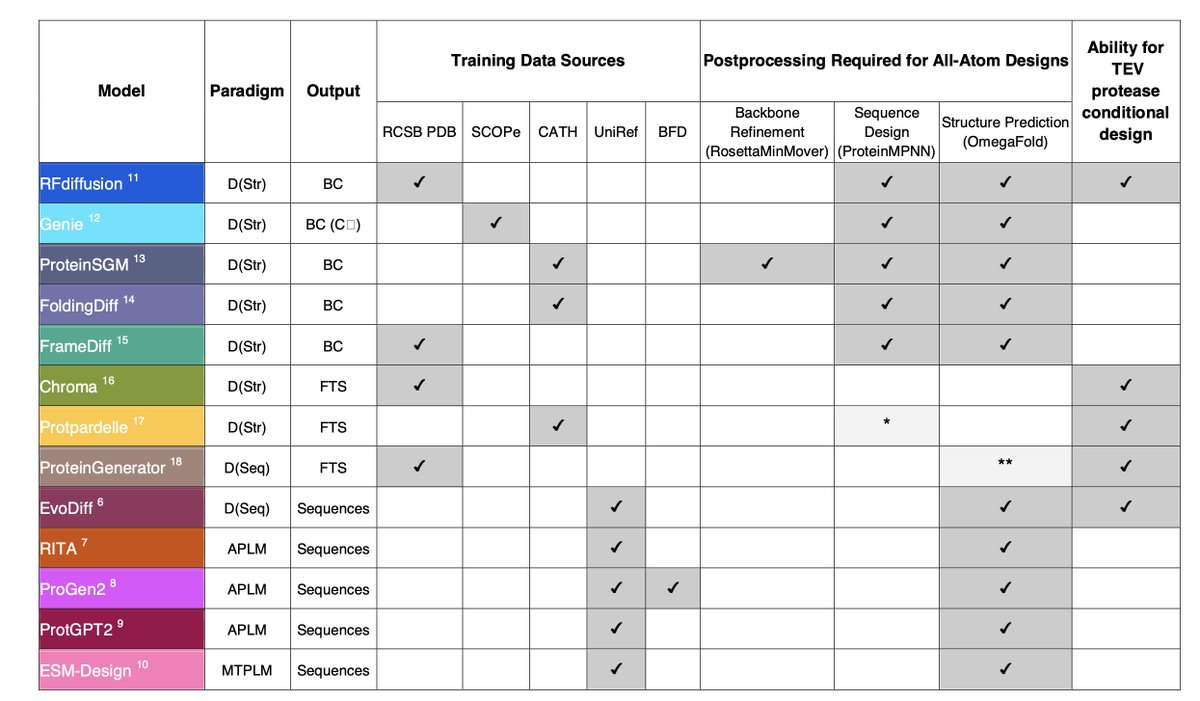
1. This paper systematically compares 13 generative protein models spanning structural diffusion and sequence-based paradigms to evaluate their ability to generate feasible, diverse, and novel protein monomers.
2. Structural diffusion models produce designs with higher confidence in predicted structures and more biologically plausible energy distributions but are limited by reduced diversity and sequence biases. These models excel in structure-based tasks but struggle with sequence variety.
3. In contrast, protein language models generate more diverse and novel designs, albeit with lower structural confidence. They are better at exploring sequence space but often produce structurally unstable or less biologically relevant designs.
4. The models are evaluated for both unconditional monomer generation and conditional design around specific functional motifs from the Tobacco Etch Virus (TEV) protease. While most models generate diverse designs, only RFdiffusion and Protpardelle produce designs with measurable enzymatic activity.
5. A new benchmark is introduced for assessing the designability, feasibility, diversity, and novelty of generated proteins. The authors emphasize the need for post-generation refinement (e.g., OmegaFold predictions) to improve structural quality.
6. The study reveals significant trade-offs between structural diffusion models and protein language models. Structural models offer better structure prediction but are limited in diversity, whereas language models offer greater novelty but struggle with structural accuracy.
7. Despite the architectural differences, none of the models achieve performance equivalent to wildtype TEV protease. However, the RFdiffusion and Protpardelle designs show potential for further optimization.
8. The authors suggest that hybrid approaches integrating structural diffusion models with sequence-based models may improve generative performance. Furthermore, iterative generation and refinement cycles could enhance both structure prediction and sequence diversity.
9. Future work aims to optimize these generative models for specific tasks in protein engineering, including improved structural diversity, better prediction of functional properties, and enhanced conditional design capabilities.
💻Code: https://t.co/zlor0FWT3o
📜Paper: https://t.co/PgsIXHW0Av
#ProteinDesign #GenerativeAI #Bioinformatics #StructuralDiffusion #ProteinLanguageModels #ProteinEngineering #TEVProtease #DeepLearning

Lethal company anyone? https://t.co/PgsIxKCOkm
Live now. Anyone wanna join the madness? https://t.co/PgsIxKCOkm
Most Popular Users

Elon Musk 
@elonmusk
240.1M followers

Barack Obama
@barackobama
118.6M followers

Cristiano Ronaldo
@cristiano
114.4M followers

Donald J. Trump
@realdonaldtrump
111.7M followers

Narendra Modi
@narendramodi
106.9M followers

Rihanna
@rihanna
98.6M followers

NASA
@nasa
92.1M followers

Justin Bieber
@justinbieber
91.7M followers

KATY PERRY
@katyperry
89.9M followers

Taylor Swift
@taylorswift13
83.9M followers

Lady Gaga
@ladygaga
75.4M followers

Virat Kohli
@imvkohli
73.3M followers

Kim Kardashian
@kimkardashian
70.8M followers

YouTube
@youtube
68.6M followers

Neymar Jr
@neymarjr
66.3M followers

Bill Gates
@billgates
65.2M followers

Selena Gomez
@selenagomez
63M followers

The Ellen Show
@theellenshow
62.1M followers

CNN
@cnn
61.7M followers

X
@x
60.6M followers