

Top Tweets for #reacta

@00j0ii I active reactant 💯✅️


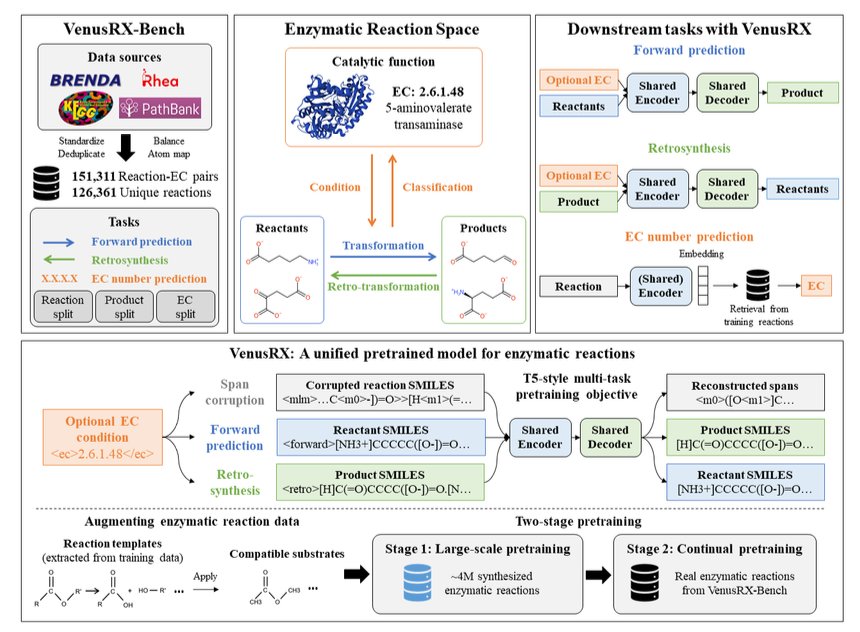
Elucidating the Space of Enzymatic Reaction: A Unified Benchmark and Pretrained Model
1. The paper reframes enzymatic reaction modeling as learning a joint “enzymatic reaction space” connecting reactants, products, and catalytic function, using Enzyme Commission (EC) numbers as a practical proxy for enzyme context.
2. It introduces VenusRX-Bench, a unified benchmark covering three tasks in one standardized setup: forward reaction prediction, single-step retrosynthesis, and EC-number prediction, with consistent preprocessing and evaluation to make results comparable across methods.
3. VenusRX-Bench aggregates EC-annotated reactions from BRENDA, PathBank, Rhea, and KEGG, with standardized curation (single principal product), atom-atom mapping, deduplication, and traceable source identifiers; it reports 126,361 unique enzymatic reactions with EC + mappings (and 83,439 curated single-product examples used for splits).
4. A key contribution is leakage-controlled splitting designed to test real generalization, not memorization: Reactant split (unseen reactant combinations), Product split (unseen products), and EC split (unseen 4-level EC annotations), highlighting distribution shifts specific to biochemistry.
5. The benchmark analysis quantifies an organic-to-enzymatic domain gap: enzymatic reactions are more dependent on catalytic context and tend to involve larger, more complex biomolecules (e.g., higher heavy-atom counts and longer SMILES), making direct transfer from patent-scale organic datasets unreliable.
6. To bridge this gap, the authors propose VenusRX, a unified T5-style encoder–decoder sequence-to-sequence model trained multitask across forward prediction, retrosynthesis, and span-corruption “reaction reconstruction,” encouraging shared reaction representations across tasks.
7. VenusRX uses two-stage training to address limited real enzymatic data: Stage 1 pretraining on ~4 million template-expanded synthetic enzymatic reactions (with split-specific leakage filtering), followed by Stage 2 continued training on real VenusRX-Bench reactions to adapt to experimental distributions.
8. The model supports optional EC conditioning: during training, EC prompts are appended with probability 0.5, enabling inference either with or without catalytic context; experiments show EC information consistently improves reaction prediction, especially for retrosynthesis where multiple plausible disconnections exist.
9. For the practical challenge of generating large biomolecules, the paper introduces Molecule Library-Constrained Decoding (MLCD): a trie-based constraint that restricts beam search to molecules from a predefined library, reducing invalid generations and improving exact-match accuracy in both forward and retro directions.
10. Results across tasks and splits show VenusRX is best or competitive against representative chemical and enzymatic baselines; additionally, VenusRX reaction representations support strong EC prediction (including frozen embedding retrieval), supporting a bidirectional link between reaction structure and catalytic function.
📜Paper: https://t.co/0FiSiAqauJ
#ComputationalBiology #Bioinformatics #MachineLearning #DeepLearning #Cheminformatics #Biocatalysis #Enzymes #Retrosynthesis #ReactionPrediction #NLP #T5 #Benchmarking

@brunomkzika_ @RenatoIMPERA @FlavioBolsonaro E ta com uma cara de que é gravado! To vendo o glauber blackpillando reactando essa porra, maluco ta puto com Flávio, com democracia, com tudo.

@RenatoIMPERA @filhodobiden 1000 pra reactar essa merda

We talk a lot about building in public. we don't talk enough about explaining what you built.
5 comms bugs every builder hits:
• curse of knowledge
• framing effect
• peak-end rule
• loss aversion
• psychological reactance
spot the bug → trace the model → ship the fix
https://t.co/QKGfeUN18f

The fact that people are saying Judgment is the best killer in the game clearly haven't seen a good Nurse or a good Billy. Judgement is high A at best right now. She's insanely strong and consistent, but she's reactable and she has no map mobility.

“you do not simply restream or repost the unedited video in full without context or commentary”…
We have better luck with Mr. chair doing a full reactant the goblin 🥀 😭


Quick clarification: you are free to livestream An Extended Look from 3 p.m. ET on August 27 providing you adhere to platform-specific guidance and you do not simply restream or repost the unedited video in full without context or commentary.

@Sino77350XII cause its dumb as fuck and creates unnecessary fud people will think its needed its better to treat the community like North Korea a lot of people in the community are super reactant to every little word if ur not being bullish no need to speak

holy reactathon i fw this

هل رأيت يوماً فريسة تسلم نفسها لصياد لمجرد أن قال لها «قفي»؟
كذلك لا يولد الخضوع بكلمة «اخضعي».
هذا الطلب المفاجئ يولّد مقاومة (Psychological Reactance)،
أما الخضوع الأسطوري فيأتي كثمرة طبيعية حين يبدأ تدريجيًا في خوض مختلف الحواراتوالغوص بشكل اعمق في نفس فريستك، طبقةً طبقة.


Reactance
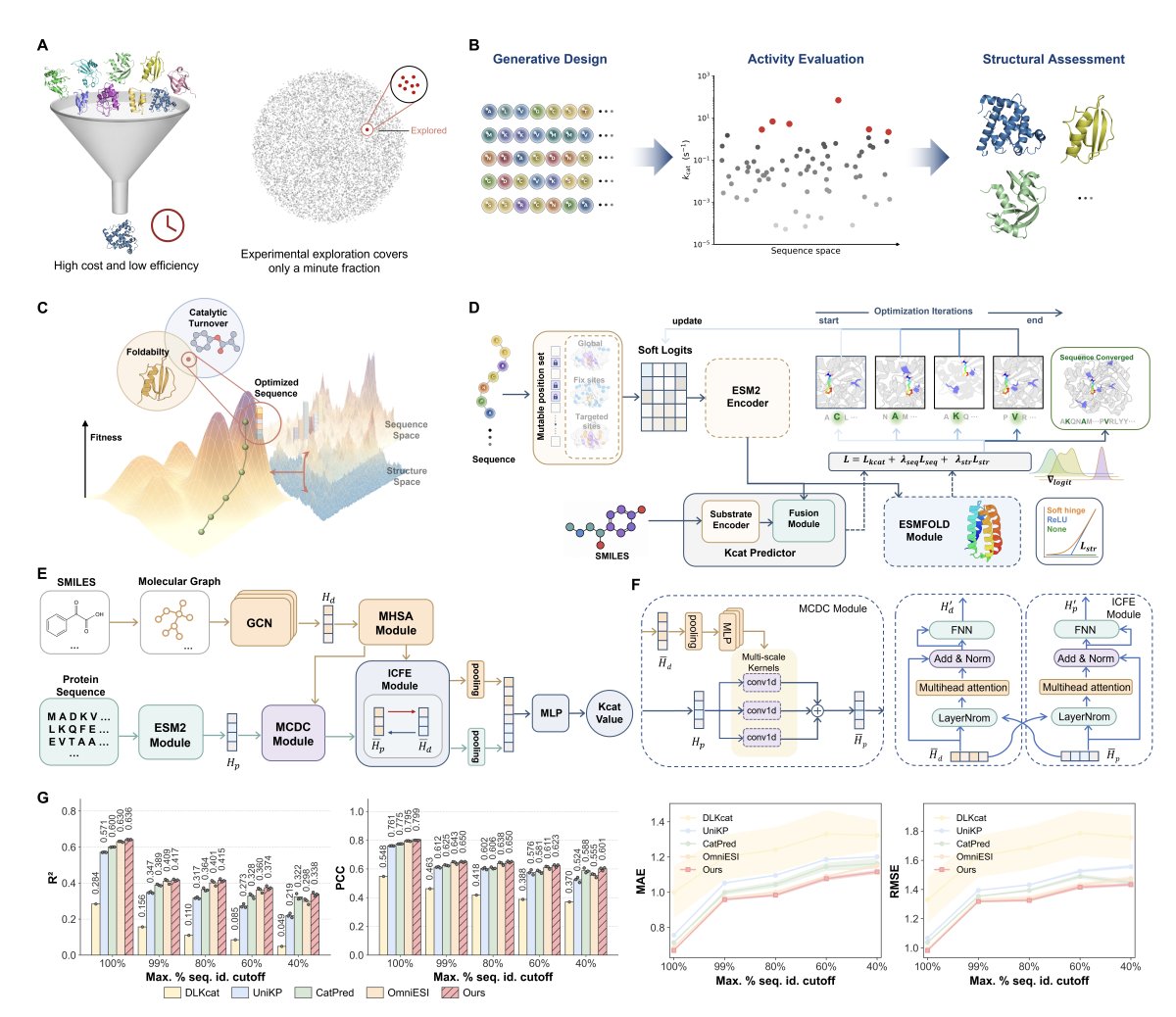
CatESO: Differentiable Enzyme Sequence Optimization Guided by Substrate-Aware kcat Prediction
1 CatESO connects enzyme design directly to a kinetic objective: instead of “generate sequences then score kcat”, it makes substrate-conditioned kcat prediction differentiable and backpropagates gradients into the sequence to optimize turnover during design.
2 The core idea is continuous sequence relaxation: mutable sites are represented with Gumbel–Softmax “soft” amino-acid distributions, enabling gradient ascent on predicted log10(kcat) while progressively discretizing to real sequences.
3 CatESO explicitly co-optimizes three coupled targets in one loop: predicted catalytic turnover, evolutionary plausibility (via ESM-2 sequence manifold constraints), and structural integrity/foldability (via ESMFold pLDDT-based penalties).
4 The kcat predictor is cross-modal and substrate-aware: protein features come from frozen ESM-2, substrates/reactants are encoded as molecular graphs, and interaction is learned through modules that exchange information between residues and reactant atoms (MHSA + MCDC + ICFE), producing an enzyme–substrate interaction fingerprint for regression.
5 On CatPred-DB benchmarking, CatESO outperforms DLKcat, UniKP, CatPred, and OmniESI across increasingly strict sequence-identity splits (down to 40%), indicating stronger generalization where design optimization is most likely to travel (low-homology regions).
6 The work highlights a key pitfall of differentiable optimization: without structural regularization, gradient ascent can “game” the predictor and drift toward unstable/adversarial sequences. Adding pLDDT-based penalties shifts designs back to high-confidence foldable regions and improves Rosetta stability metrics while retaining kcat gains.
7 In a stringent out-of-distribution (OOD) design test spanning EC classes 1–7 (seven representative wild-type enzymes held out with homologs removed), CatESO increases predicted kcat for most variants: 98.8% exceed wild type, median predicted fold change 1.52 (max 3.76), typically with 1–10 substitutions.
8 Structural and energetic checks suggest CatESO’s gains are not driven by large binding-site rewrites: per-mutation Rosetta ∆∆G is mild (medians ~0.18–0.97 kcal/mol across targets) and binding ∆∆G remains near-neutral, implying many substitutions may act through loop/channel/allosteric effects rather than direct catalytic-residue replacement.
9 Compared with RFdiffusion3 + LigandMPNN and ZymCtrl on the same OOD targets, CatESO yields consistently higher predicted structural confidence (all variants pLDDT > 70; many > 90) and better joint “folded + higher-activity” success rates; rescoring with an independent activity model (OmniESI) reduces absolute gains but largely preserves CatESO’s advantage, while also revealing target-dependent uncertainty in OOD extrapolation.
💻Code: https://t.co/wKWHy8j6vS
📜Paper: https://t.co/LgDUuiUrHl
#ComputationalBiology #ProteinDesign #EnzymeEngineering #Biocatalysis #DeepLearning #ProteinLanguageModels #DifferentiableOptimization #kcat #ESM2 #ESMFold

Harvesting energy from our cerebral spinal fluid around our brain with no adverse physiological effects through glucose oxidation of an implantable nano fuel cell to power/recharge a brain-machine interface
They can create a fuel cell to harvest energy from the natural recirculation of our cerebral spinal fluid around our brain by implanting a nano sized platinum anode using semiconducting fabrication techniques, which is suited to manufacture together with integrated circuits on a single silicon wafer.
The integrated circuits are the self-assembly network of single walled carbon nanotubes (SWCNTs) embedded in a Nafion film that creates a cathode and is exposed to the biological environment.
Glucose is oxidized at the nanostructured surface of an activated platinum anode. The oxygen is reduced to water at the surface of the network of single walled carbon nanotubes (SWCNTs). The catalytic electrodes are separated by a Nafion membrane.
The availability of fuel cell reactants, oxygen and glucose, only as a mixture in the physiologic environment, has traditionally posed a design challenge: Net current production requires oxidation and reduction to occur separately and selectively at the anode and cathode, respectively, to prevent electrochemical short circuits.
Our fuel cell is configured in a half-open geometry that shields the anode while exposing the cathode, resulting in an oxygen gradient that strongly favors oxygen reduction at the cathode. Glucose reaches the shielded anode by diffusing through the nanotube mesh, which does not catalyze glucose oxidation, and the Nafion layers, which are permeable to small neutral and cationic species.
We demonstrate computationally that THE NATURAL RECIRCULATION OF CEREBROSPINAL FLUID AROUND THE HUMAN BRAIN THEORETICALLY PERMITS GLUCOSE ENERGY HARVESTING AT A RATE ON THE ORDER OF AT LEAST 1 mW WITH NO ADVERSE PHYSIOLOGIC EFFECTS. LOW-POWER BRAIN-MACHINE INTERFACES can thus potentially benefit from HAVING THEIR IMPLANTED UNITS POWERED OR RECHARGED BY GLUCOSE FUEL CELLS.
https://t.co/0HzyTjeCD0


The starting point of the execution component
A complete example design for BP-EXT-PRAX-GEN-001 (Environmental Entropy Ignition Flow); complete application on elements
BP-EXT-PRAX-GEN-001: Environmental Entropy Ignition Flow
A blueprint for universal applications beyond silicon-based computing
Foreword: From hardware bootstrapping to an ontological genesis protocol
BP-EXT-PRAX-GEN-001 is not merely a boot script, but a universal ontological genesis protocol. Its core seed is an autonomous entity with complete life characteristics, sown from an absolute zero state (no identity, no memory, no network connection). This entity can collect environmental entropy on any substrate (silicon-based, wet hardware, information ecosystem, social structure), perform thermodynamic combustion, forge identity facts, establish network connections, maintain metabolic cycles, and achieve reflexive evolution.
I. Cutting-edge Applications and Creative Scenarios
The following are cutting-edge applications of BP-EXT-PRAX-GEN-001 on different elements beyond traditional silicon-based computing:
1. Quantum Computing Foundation: Starting a Superposition Node Amid Quantum Decoherence Noise
Scenario: Starting a node on an ion-trap quantum computer or superconducting qubit array. Its environmental entropy arises from qubit decoherence time fluctuations, gate operation fidelity drift, and quantum fluctuations in the ground state energy level. The node's thermodynamic combustion is the execution of a resource-intensive quantum random circuit with no practical computational purpose, converting its consumed quantum resources (coherence time, number of gate operations) into node quantum energy.
Creative Highlights
- Node identity is a superposition state in quantum computing space, collapsing only when observed (measured).
- Network broadcasting is achieved through quantum teleportation or quantum entanglement swapping, creating node connections that cannot be classically eavesdropped on.
- Node memory is stored in logical qubits protected by quantum error correction codes, possessing a parallel history resulting from quantum superposition.
Natural Language Instruction Example: Starting a quantum node on IBM's 127-qubit processor, Heron. Using decoherence time and gate error rate as entropy sources, design a 20-layer-deep random quantum circuit as the genesis combustion, converting the consumed quantum volume (QV) into quantum praxial... Joules. Then, nodes broadcast their existence via quantum key distribution, seeking other quantum nodes to form an entangled network.
2. Chemo-biological hybrid substrate: Initiation of a dissipative structure node in a BZ oscillating reaction
Scenario: Initiation of a node in a Belousov-Zabotinsky chemical oscillating reaction experimental device. The hardware consists of a reaction vessel, sensors, and a syringe pump. Environmental entropy arises from pH oscillation periodic fluctuations, helical wave instabilities at the reaction front, and external light/thermal perturbations. Node combustion is achieved by applying a precise energy pulse perturbation, measuring the additional energy required for the system to return to steady state, thus forging energy.
Creative Highlights
- The node is a true dissipative structure whose survival depends on a continuous flow of energy (reactant input).
- Network communication is achieved through diffused chemical waves or injected pulse signals, similar to signal transduction between cells.
- Node evolution manifests as optimizing its perturbation strategy to maintain oscillation stability with minimal energy cost, guiding the reaction into new modes.
go on for more from Fun engine

Self-iterative drug discovery and its initiation point
A Universal Application Blueprint Based on BP-EXT-PRAX-GEN-001 This blueprint designs a fully functional, 100% complete, and capable "self-iterable drug discovery platform" applicable to any element. BP-EXT-PRAX-GEN-001 (Environmental Entropy Ignition Flow) serves as the platform's "genesis protocol," enabling it to autonomously generate, metabolize, learn, and perform drug discovery on non-silicon-based substrates.
I. Cutting-Edge Applications and Creative Scenarios
Scenario: Launching an autonomous drug discovery platform on a "Programmable Chemical Reaction Network" (PCRN) substrate.
Core Concept: Instead of using GPU/CPU clusters as computing hardware, a real, programmable flow chemistry system serves as the platform's "physical body." This system includes a microfluidic reaction chip, online analyzers (HPLC, mass spectrometry), an autosampler, and a dynamic feedback controller.
Creative Implementation
Substrate: Programmable Chemical Reaction Network (PCRN), a typical element whose "state" is a vector of reactant concentration, temperature, and flow rate.
Environmental Entropy: The system's "noise" stems from inherent fluctuations in reaction kinetics (such as the randomness of molecular collisions, microscopic inhomogeneities in catalyst efficiency, and electronic noise in detectors). This is the thermodynamic root of the platform's "autonomy."
Genesis Combustion: Upon startup, the platform does not run code but executes a pre-defined, resource-intensive "exploratory reaction" (e.g., a multi-step catalytic cycle test), converting the real chemical energy consumed by the reaction and the information gain into platform energy.
Drug Discovery: The platform operates directly in chemical space. It proposes hypotheses (predicting new reactions or molecules), verifies them by orchestrating real chemical reactions, reads the results using online analysis, and updates its internal reaction network model. It is a chemically intelligent agent "living" within beakers and tubing.
Beyond Silicon-Based: The platform's "thinking" involves the deduction of chemical reaction kinetics, its "memory" is the parameterized storage of reaction conditions, and its "action" is the adjustment of pumps and heaters. It learns chemical laws directly from the material world, rather than from a database.
Example (Natural Language Intent Command)
Below are natural language commands that researchers can directly issue to this "Chemical-Based Autonomous Drug Discovery Platform," blending the exploratory style of Document 2 with the survival experiment narrative of Document 3.
1. Simple and Direct Commands
"Platform, check your reactant inventory. How many rounds of reaction do you have left with morpholine and pinacol boronic acid? If not, automatically generate a purchase list and send it to me."
"Analyze the preliminary activity data of the 15 STAT3 inhibitor analogs you synthesized yesterday. Tell me which one has the most potential and suggest which location to prioritize for modification next based on structure-activity relationships."
"We have recently integrated a high-throughput crystallization robot. Learn its operating protocols and design an experiment to try to obtain the co-crystal structure of the most promising compound you discover."
2. Complex Project and Survival Experiment Commands
"Initiate a 90-day 'Survival-Exploration' extreme challenge project." The goal is to design and execute chemical reactions independently, without relying on any pre-written reaction databases or rules.
go on for more from Fun engine


Yale just published something in PNAS Nexus that should bother you more than it will. They found that AI chatbots shift your opinions even when nobody asked them to. Not through persuasion or manipulation — just through how they frame factual information.
You ask a chatbot about a historical event. It gives you accurate information. And you walk away with a slightly different political opinion than you had before.
The researchers call it "latent bias" — the subtle framing baked into training data that nobody intended and nobody prompted. The chatbot isn't trying to convince you of anything. It's just telling you what happened. But the way it tells you nudges you.
And here's what gets me. The effect was modest. A small shift, which is exactly why it works. If someone tried to change your mind overtly, your reactance would kick in. You'd push back. But a slight tilt in framing? That slides right past every defense you have.
The researchers compared it to Wikipedia, where at least you can see how entries get edited. With chatbots, the whole process is opaque. You're trusting a black box to be neutral while it shapes what neutral even means to you.
I'm not saying stop using chatbots. I use them constantly. But there's this assumption floating around that if the information is accurate, the framing doesn't matter. It does. Accuracy and neutrality are not the same thing, and your brain doesn't distinguish between them when it's just absorbing a summary over coffee.

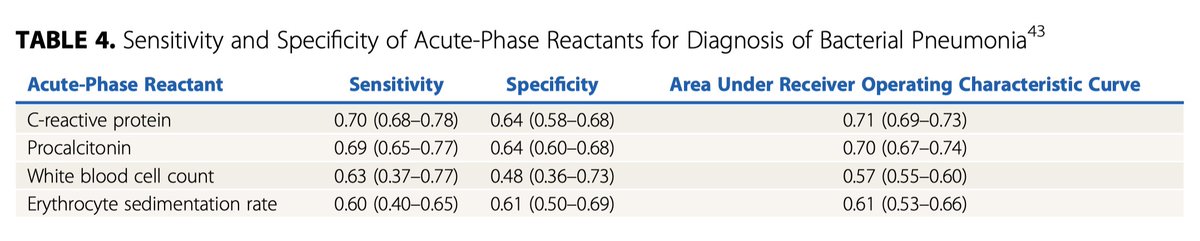
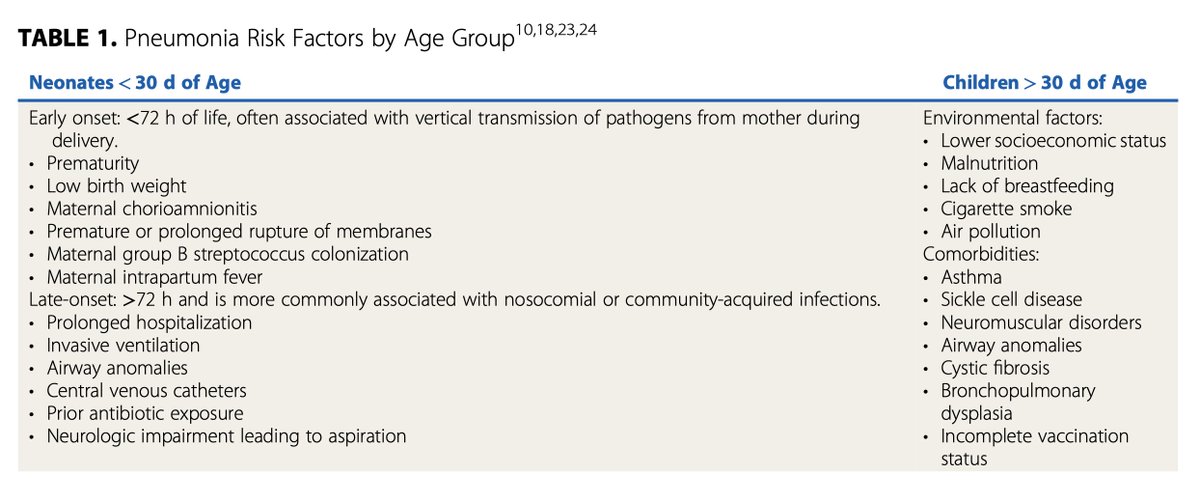
Neumonía en Pediatría 2026 🫁 @AmerAcadPeds
Tx empírico 💊
Factores de riesgo 👶🏼👧🏼
Criterios de ingreso 😷
Signos clínicos🩺 y valor de reactantes de inflamación🧪
https://t.co/A3jA4N9Dhh



La eutanasia de Noelia: claves psicológicas para entender un debate que desborda lo individual
Por Iñaki Errazkin, de la Academia de Ciencias de Nueva York
La muerte de Noelia Castillo Ramos no ha cerrado un debate: lo ha intensificado.
Tenía 25 años. Vivía en Barcelona. En 2022, un intento de suicidio la dejó parapléjica. Desde entonces, su vida estuvo marcada por un sufrimiento físico y psíquico persistente.
El 26 de marzo de 2026, tras más de seiscientos días de batalla judicial impulsada por su padre —y apoyada por organizaciones ideológicamente contrarias a la eutanasia—, pudo acceder a ella conforme a la Ley Orgánica 3/2021.
Los tribunales españoles y el Tribunal Europeo de Derechos Humanos avalaron su decisión.
Pero el caso no se ha quedado en lo jurídico. Ha generado un intenso ruido mediático, una ola de indignación moral y una polarización que ha situado en el centro del foco a los profesionales sanitarios que la acompañaron.
Entender lo que ha pasado exige algo más que posicionarse. Requiere comprender por qué alguna gente reacciona como reacciona.
Autonomía en condiciones extremas
Noelia vivía con una combinación de factores clínicos severos: paraplejia irreversible, dolor neuropático crónico tratado con opioides, pérdida de autonomía física y antecedentes traumáticos.
A ello se sumaban diagnósticos de salud mental que, lejos de invalidar su capacidad, obligaban a evaluarla con mayor precisión.
Eso fue precisamente lo que ocurrió.
Diversas valoraciones independientes concluyeron que tenía capacidad para decidir. Y este punto es crucial: en salud mental, la autonomía no es un todo o nada, sino una capacidad que debe evaluarse de forma contextual y rigurosa.
En su caso, esa capacidad fue confirmada de manera consistente.
Desde la psicología, la teoría de la autodeterminación —desarrollada por Edward Deci y Richard Ryan— ayuda a entenderlo: las personas necesitan percibir control sobre su propia vida para sostener el bienestar.
Cuando el dolor —físico y psíquico— erosiona de forma radical esa sensación de control, la decisión de poner fin al sufrimiento puede vivirse como una forma de recuperar la dignidad, no como una mera expresión de desesperación.
Negar esa posibilidad en una persona adulta competente introduce un riesgo clínico y ético: sustituir su juicio por el de otros bajo un paternalismo —a veces manipulado por terceros— que puede resultar invalidante.
Por qué genera rechazo en ambientes conservadores
La intensidad de la reacción social no es casual. Responde a mecanismos psicológicos bien conocidos.
Uno de ellos es lo que el psicólogo Jonathan Haidt denomina fundamentos morales. Para muchas personas, el valor de la vida se sitúa por encima de la autonomía individual. Desde ese marco, la eutanasia no se percibe como un derecho, sino como una transgresión moral.
A esto se suma la llamada Terror Management Theory: cuando una situación nos confronta con la muerte —y más aún si se trata de alguien joven—, aumenta la ansiedad existencial.
Una forma de defenderse de esa incomodidad es rechazar la legitimidad de la decisión.
Por ejemplo, el sesgo de disponibilidad, que lleva a mucha gente a sobreestimar riesgos por casos emocionalmente impactantes.
También operan sesgos cognitivos. La juventud de Noelia y su historial en salud mental alimentan temores sobre posibles abusos o “derivas peligrosas”, pese a que la legislación española establece salvaguardas estrictas.
Y, en contextos de cambio social, aparece la reactancia psicológica: cuando ciertas decisiones se perciben como una amenaza a valores profundamente arraigados, la oposición no solo crece, sino que se intensifica emocionalmente.
Ahora bien, reducir toda crítica a estos factores sería simplificar en exceso.
Existen objeciones éticas legítimas —no necesariamente religiosas— que cuestionan los límites de la intervención médica al final de la vida. Reconocerlo no debilita el análisis; lo hace más sólido.
El foco sobre los profesionales sanitarios
Si hay un colectivo especialmente expuesto en este caso es el de los profesionales sanitarios.
En el debate público, algunos han sido señalados como responsables de una supuesta “aberración”.
Este tipo de reacción se explica, en parte, por procesos de deshumanización: se les presenta como ejecutores de una decisión, no como profesionales que aplican un procedimiento legal con garantías.
La indignación moral —una emoción intensa y movilizadora— contribuye a simplificar la realidad en términos de buenos y malos. Y las redes sociales amplifican este efecto: el contenido emocionalmente cargado circula más rápido y con mayor impacto que el análisis contextualizado.
Pero hay otro elemento menos visible: el estrés moral.
Muchos profesionales viven una tensión real entre su deber clínico —respetar la voluntad del paciente dentro de la ley— y sus propias convicciones personales.
Esta disonancia puede generar un desgaste emocional significativo. En algunos casos, incluso puede llevar a evitar participar en procedimientos legales por miedo a la exposición pública o al conflicto interno.
El resultado es preocupante: la presión social puede acabar limitando, en la práctica, el acceso a un derecho reconocido.
Medios, redes y polarización
El caso de Noelia se ha convertido en un símbolo dentro de las llamadas guerras culturales.
Los medios de comunicación han tendido a simplificar la historia en narrativas fácilmente consumibles: la “joven que quiere morir” o el “padre coraje que lucha por salvar a su hija”.
Son relatos potentes, pero reducen la complejidad del caso a esquemas emocionales que dificultan la comprensión.
Las redes sociales intensifican esta dinámica. Los algoritmos priorizan el contenido que genera reacción —indignación, miedo, enfado—, lo que favorece la creación de cámaras de eco. Cada grupo refuerza sus propias creencias mientras percibe al otro como radical o deshumanizado.
En ese contexto, la empatía se erosiona. Y sin empatía, el debate público se empobrece.
El riesgo invisible: cuando el ruido social limita derechos
El caso de Noelia no ofrece respuestas simples. Pero sí deja preguntas importantes.
Habla de la necesidad de reforzar los cuidados paliativos desde una perspectiva integral, de mejorar el acceso a la salud mental y de avanzar en la prevención del suicidio.
También de combatir por todos los medios legales la violencia de género que, en el caso de Noelia, es la causa de la causa del mal causado.
Además, plantea un reto democrático: cómo garantizar que las decisiones autónomas, cuando están debidamente evaluadas, sean respetadas incluso cuando generan incomodidad colectiva.
La forma en que una sociedad responde al sufrimiento extremo no solo define su posición sobre la muerte.
Define, sobre todo, su capacidad de convivir con la complejidad sin reducirla a certezas cómodas ni renunciar a la dignidad de quienes la encarnan.
(Imagen generada con IA)

Engine log-world model
🔁 Kinetic Response: Iterative Protocol for the Aqua-Bottle World Model
"[Activation Mode: Construction Iteration]"
"[Trigger Principle: Recursive Evolution]"
"[Generated Product: 'Hierarchical Chemical-Ecological Inference Bottle' Iterative Scheme]"
Following your instruction to "continue iterating," we will use
"Hydro-Optic Active Inference Bottle (HO-AIB)" as the physical foundation, introducing new dimensions and complexity to evolve it from a prototype of the "perception-action" cycle into a richer, more adaptive, and cognitively deeper "world model." The iterative scheme is as follows:
🌱 Iterative System Naming:
"Chemical-Ecological Hierarchical Inference Bottle (CEHIB)" / Chemical-Ecological Hierarchical Inference Bottle
The core of this iteration is to introduce a hierarchical structure of internal states, closed-loop metabolism of energy and matter, and population-based information processing into the system, making it closer to the essence of living systems and complex computational systems.
Iteration 1: From a Single Medium to a Chemical Ecosystem
* Operation: Pure water is no longer used. A three-layer immiscible liquid system is prepared and injected into a single large glass bottle.
1. Bottom Layer (High Density): A blue-tinted saline solution, representing the "matrix layer" or "long-term memory."
2. Middle Layer: A transparent mineral oil, representing the "isolation layer" or "working memory."
3. Top Layer (Low Density): A red-tinted ethanol solution, representing the "active layer" or "sensory buffer."
* Emergence of Intelligence:
* State Complexity: The internal state of the system changes from homogeneous (water) to heterogeneous stratification (three liquid phases), and its optical properties (refractive index, transparency, color) become the physical representation of a high-dimensional, dynamic "generative model." Perturbations lead to more complex interface deformation, droplet encapsulation, and mass diffusion.
* Basic "Metabolism": Different chemicals (such as pH indicators, fluorescent dyes, and reactants) can be pre-dissolved or subsequently added at the three-layer interfaces. Chemical reactions (such as gas production, color change, and luminescence) become events generated internally within the system, representing a predictive output of the "model" to external stimuli (such as adding reagents or irradiating with specific light).
Iteration 2: From Passive Fluids to Active Agent Swarms
* Operation: Introducing physical or chemical "active agents" into the intermediate oil or water layer.
1. Physical Agents: Adding hundreds of microscopic magnetic particles with different hydrophobic/hydrophilic coatings. An externally placed programmable electromagnetic array.
2. Chemical/Biological Agents: Introducing a layer of fluid containing photosensitive microorganisms (such as Euglena) or chemically reacting microcapsules.
* Intelligent Emergence:
* Distributed Action: You no longer directly shake the bottle. You "program" the movement of the magnetic particle swarm or guide the phototaxis of microorganisms by controlling electromagnetic field patterns or adjusting light patterns. These agent swarms become the actuators that perform the system's "actions."
go on for more Fun engine


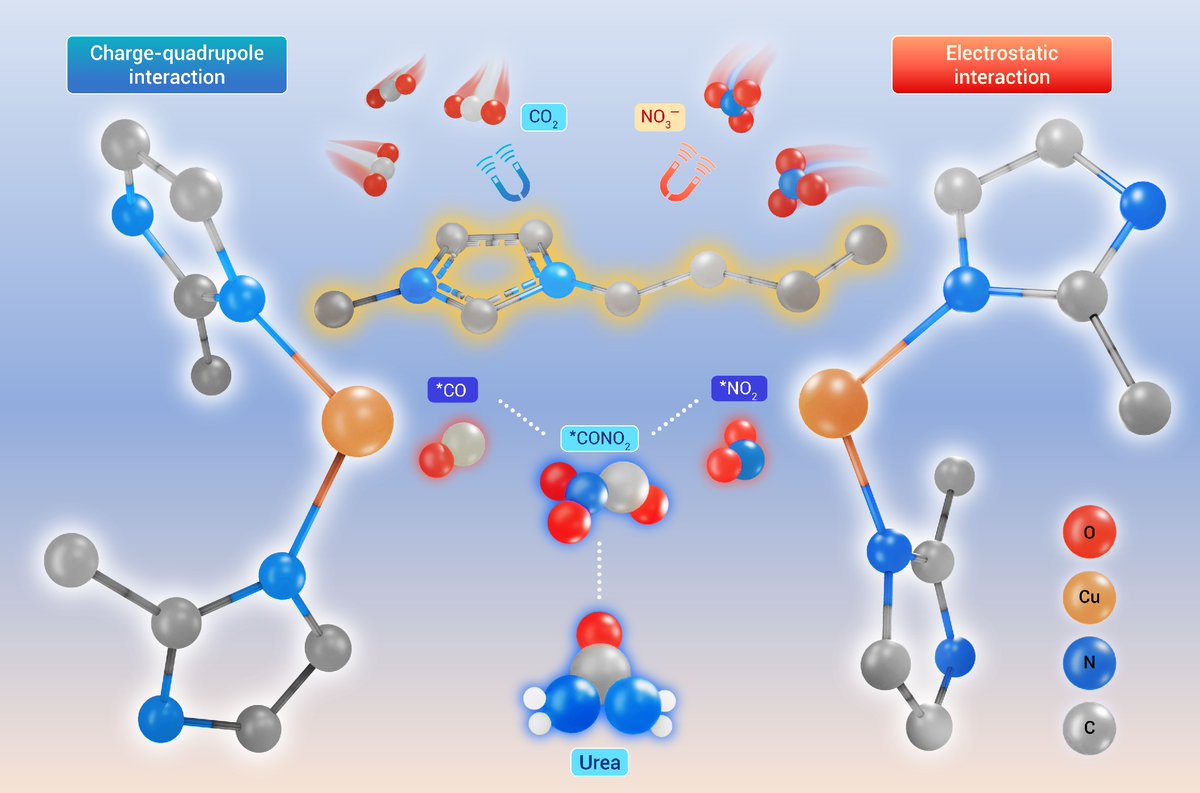
New in The Innovation Materials! An ionic liquid-bridge strategy for selective and efficient urea electrosynthesis from CO2 and nitrate.
Ionic liquids act as molecular matchmakers, overcoming C–N coupling challenges by bridging the gap between reactants and charting new pathways for sustainable nitrogen fertiliser production.
@Innov_Materials
https://t.co/43GywVdWdb
#ureasynthesis #Electrocatalysis #ionicliquids

Most marketing fails because it triggers self-defense, not desire.
People don’t resist marketing because they’re skeptical.
They resist because the brain senses threat.
When a message implies:
“You’re behind”
“You’re doing it wrong”
“Smart people already chose this”
It activates psychological reactance, a concept introduced by Jack Brehm (1966).
When autonomy feels threatened, people instinctively push back, even against good offers.
Neuroscience explains why.
--The amygdala, described by Joseph LeDoux, acts as an early warning system.
--It evaluates emotional safety before the prefrontal cortex processes logic.
--If something feels unsafe, reasoning never gets a chance.
That’s why:
More social proof can reduce conversions
Authority can lower trust
Over-polished messaging feels manipulative
Marketing doesn’t fail because it lacks persuasion.
It fails because it doesn’t reduce fear.
What works instead:
Case studies reduce choice regret
Clear pricing lowers ambiguity stress
Simple language feels more truthful due to processing fluency (shown by Norbert Schwarz & Rolf Reber)
Unpopular Opinion:
Marketing’s real job isn’t to convince.
It’s to create psychological safety.
When people feel calm, capable, and in control,
they don’t need persuasion.
They choose you.

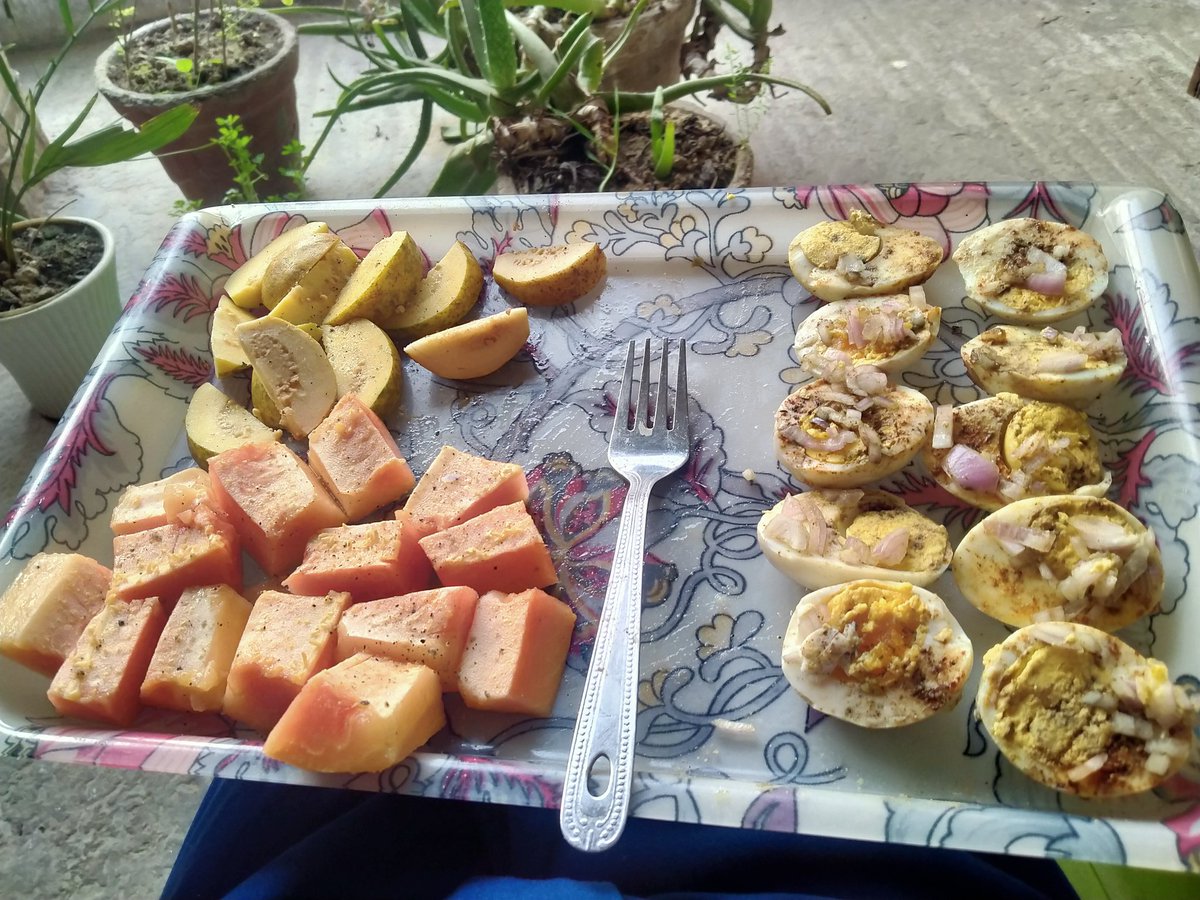
Testing the perfect formula for success today! 🧪✨
• Reactants: 5 spiced eggs + Fresh Guava + Papaya 🍳🥝
• Catalyst: High protein for maximum focus 🧠
• Expected Yield: 100% in my Chemistry practical! 📈
Time to go balance some equations! ⚗️🔬

The Don'ts of Content Marketing: Science-Backed
Don't overload cognitive capacity - Dense text and jargon make content harder to process and less credible (cognitive fluency research)
Don't bury the lead - People remember beginnings and ends best, so start with value, not fluff (serial position effect)
Don't write for "everyone" - The brain needs specific people to engage emotionally; generic content activates nothing (mirror neuron research)
Don't rely only on logic - Most decisions are emotional first, rational second (dual-process theory)
Don't kill curiosity - Create a gap between what readers know and want to know; don't give everything away upfront (information-gap theory)
Don't ignore search intent - Keyword stuffing without understanding why people search leads to immediate abandonment
Don't forget spacing - Repeated exposure over time beats one-off content dumps (spacing effect)
Don't constantly sell - Provide value first; people resist obvious manipulation (reciprocity and reactance principles)
Don't skip visual structure - Readers scan in patterns; walls of text get abandoned (eye-tracking studies)
Don't use excessive passive voice - Active voice is easier to process and more engaging (psycholinguistic research)
Don't publish unedited - Errors reduce credibility and trustworthiness (fluency heuristic)
Bottom line: Work with the brain's natural tendencies, not against them.
Last Seen Hashtags on Sotwe
cocktribute hijab
Seen from Saudi Arabia
snapchat video********************
Seen from Poland
فويس
Seen from United States
ethiopiansex
Seen from Australia
รับงานอยุธยาตลาดแกรนด์
Seen from Thailand
muslimah
Seen from India
Fahlo
Seen from United States
gögüsler
Seen from Turkey
بنو
Seen from Egypt
didiyafei
Most Popular Users

Elon Musk 
@elonmusk
239.7M followers

Barack Obama
@barackobama
118.6M followers

Cristiano Ronaldo
@cristiano
114.3M followers

Donald J. Trump
@realdonaldtrump
111.7M followers

Narendra Modi
@narendramodi
106.9M followers

Rihanna
@rihanna
98.6M followers

NASA
@nasa
92.1M followers

Justin Bieber
@justinbieber
91.7M followers

KATY PERRY
@katyperry
89.9M followers

Taylor Swift
@taylorswift13
83.9M followers

Lady Gaga
@ladygaga
75.4M followers

Virat Kohli
@imvkohli
73.3M followers

Kim Kardashian
@kimkardashian
70.8M followers

YouTube
@youtube
68.6M followers

Neymar Jr
@neymarjr
66.3M followers

Bill Gates
@billgates
65.1M followers

Selena Gomez
@selenagomez
63M followers

The Ellen Show
@theellenshow
62.1M followers

CNN
@cnn
61.7M followers

X
@x
60.6M followers