

Top Tweets for #reframe

One long YouTube video can hold several Shorts ideas. Video Cutter AI helps find highlights, add captions and reframe vertically. Start with one complete answer, then check the context before exporting. https://t.co/CTaJltP2tx


@waqas_193 "one person signing up is half a user" 🎯 this reframes everything. going to message everyone who joined solo and ask who they meant to invite. thank you, this is gold 🙏

@DjonSerj Dubhe reframes multi-chain as a unified dev experience: a single schema generates Move modules, letting builders focus on product, not repetitive work. 🛠️🔗✨

IMPRESS: AI-coupled HPC workflows for protein design
1. IMPRESS reframes protein design campaigns from fixed “generate → design → fold → filter” cascades into stateful pipelines that can halt, continue, resample earlier stages, or branch into child pipelines based on intermediate results.
2. The key motivation is cost imbalance and brittleness: inverse folding takes seconds, backbone diffusion tens of seconds, and structure prediction minutes–hours, yet traditional campaigns pre-allocate effort and can only discard candidates rather than redirect sampling toward reachable regions of design space.
3. IMPRESS makes adaptive decisions asynchronously (no global synchronization barrier), keeping heterogeneous tasks in flight together and letting many independent pipelines evolve at runtime from their own accumulated history of backbones, sequences, and folds.
4. Architecture: an IMPRESS Manager handles orchestration and adaptive decision-making; RADICAL-AsyncFlow coordinates asynchronous task graphs; RHAPSODY executes heterogeneous AI/HPC tasks via pluggable backends, aiming to make resource heterogeneity a runtime concern rather than a workflow rewrite.
5. Use case 1 (discontinuous enzyme active-site motifs): IMPRESS applies piecewise acceptance—when a design fails motif RMSD, locally “good” motif atoms/segments are fixed and the remainder is re-posed as a new problem, enabling iterative rescue of hard multi-island constraints.
6. On the AME benchmark subset, IMPRESS achieved solutions for motifs with 3+ discontinuous residue islands where the fixed workflow often returns none; notably, for 5-island motifs it produced high-quality solutions for >40% of cases where the nonadaptive reference produced zero (matched-budget analysis focused on the first 200 folds per motif).
7. Use case 2 (de novo small-molecule binders): IMPRESS uses adaptive quality gates plus an explore/exploit strategy—high-confidence folds can be reused as scaffolds for the next diffusion round, while low-confidence intermediates trigger restarts and avoid expensive downstream folding.
8. In binder design, adaptivity shifted the realized compute mix toward inexpensive sequence exploration and away from expensive folding, and the ensemble trajectory converged to higher mean complex pLDDT with fewer low-confidence structures than nonadaptive references.
9. Use case 3 (PDZ peptide binder redesign): a genetic-algorithm-like loop adapts in sequence space; pipelines iterate when interface metrics improve and branch (with depth limits) when they worsen, promoting broad but targeted exploration near starting sequences for library curation.
10. The paper emphasizes a limitation: all comparisons are in silico and metrics used for steering are often the same metrics used for evaluation; the main claim is improved “reach” and controllable ensemble shaping via runtime adaptivity, with a path to incorporating experimental measurements as steering signals.
💻Code: https://t.co/DfgcKhbCXu
📜Paper: https://t.co/bA3eKEnPDu
#ProteinDesign #HPC #AIWorkflows #AdaptiveSampling #RFdiffusion #ProteinMPNN #AlphaFold #Rosetta #ComputationalBiology #Bioinformatics


I'm against prostitution. Don't reframe what I'm about to say as condoning sin.
The laws of economics are inescapable. Where there is a great demand, there will be a supply. That's how it has always worked. Men want to have sex. Women do too, but women don't ever have to pay for it.
In the sexual market place women have far greater agency. That's why prostitution exists. She can offer her services and men will line up for her. There is a much smaller market for male prostitutes because women don't typically have to pay for sex.
A woman has to just offer sex enough times to get it for FREE. A man offering sex is a creep at best and a criminal at worst. A woman offering sex is seen as cheap or as being in need of resources and sometimes protection.
Prostitution exists because almost all sex is transactional. When a woman seeks out a husband she wants one with resources who can AFFORD HER. What does that mean? It means that he will spend his resources on her in exchange for the exclusive right to her vagina. The difference between marriage and prostitution is not that subtle. A prostitute offers herself temporarily, and never belongs to the man. A wife is a woman who offered herself permanently and her sexuality belongs to her husband in exchange for provisions and protection.
That's why marriage is a patriarchal institution and can never be anything else. Whoever attempts to get married without at least tacitly acknowledging patriarchy won't be able to make marriage work. I say, tacitly acknowledge, because there are many people who are happily married and conceptually deny patriarchy as something good, yet practice it within their relationship nevertheless. Let me be clear, if a woman is sexually loyal to just one man she has tacitly acknowledged that he owns her sexuality. That' patriarchal. Any other type of arrangement is essentially prostitution.
Finally, prostitution isn't sex in exchange for money. 99% of women have sex in exchange for money. Prostitution is sex in exchange for money while not acknowledging ownership. The man is renting, not buying.
TALK: One-Shot Batch Design for Protein Variant Effect Prediction
1. TALK reframes variant selection as an assay–prediction mismatch problem: experiments can only measure variants in an accessible space S (protocol-constrained), but the real goal is accurate prediction on a potentially different target space A (e.g., higher-order mutants or a predefined design panel).
2. Instead of choosing variants that look good or uncertain within S, TALK selects variants in S based on how much measuring them is expected to change the posterior over A—explicitly optimizing target-space learning rather than candidate-local value.
3. The method is cast as transductive active learning for proteins: selection happens in S, utility is defined on A, and A can be known (as sequences) before any labels are measured, enabling “measure here to predict there” planning without using target labels.
4. TALK uses a Bayesian surrogate interface (instantiated with the Kermut GP) to obtain posterior covariances: target uncertainty Σ(A,A) and, critically, cross-covariance Σ(A,Un) between target variants and currently unmeasured accessible candidates Un.
5. Two acquisition scores are used to quantify each candidate’s expected contribution to target prediction: ITL (information gain about f_A from observing y_x) and VTL (total marginal variance reduction across A). Both depend on candidate–target posterior coupling and observation noise, not on predicted fitness alone.
6. A practical core innovation is one-shot batch design with low redundancy: TALK builds a batch greedily, and after each selected variant it performs covariance-only Gaussian conditioning (no labels needed) so later picks add new target-relevant information rather than repeating the same uncertainty directions.
7. Retrospective evaluations on ProteinGym-MM protocols show improved target-space prediction under limited budgets, especially for mutation-order transfer like S=single mutants (1M) to A=double mutants (2M). ITL/VTL shift the budget–performance curve leftward versus Random, SampleVariance, top-mean, and UCB.
8. On GB1 complete landscape (FLIP), TALK is tested in order-to-rest transfers (1-vs-rest, 2-vs-rest, 3-vs-rest). VTL is particularly stable in harder settings (e.g., predicting 3M/4M from lower-order measurements), consistent with its objective of broad target variance reduction.
9. Comparing one-shot conditional batching to iterative “directed-evolution-style” feedback schedules suggests covariance conditioning is the dominant factor for building informative batches; multiple feedback rounds do not provide a monotonic advantage in the tested setting, supporting a two-stage workflow: design a target-informative batch first, then prioritize hits using the improved predictor.
💻Code: https://t.co/OdUAeLF97j
📜Paper: https://t.co/nX7aVadRms
#ProteinEngineering #ComputationalBiology #ActiveLearning #BayesianExperimentalDesign #ProteinFitness #MachineLearning #GaussianProcesses #DirectedEvolution #ProteinGym #FLIP


@c_s_a_w habit problem disguised as a price problem. that reframe hits. how long did it take you to figure out the real blocker?
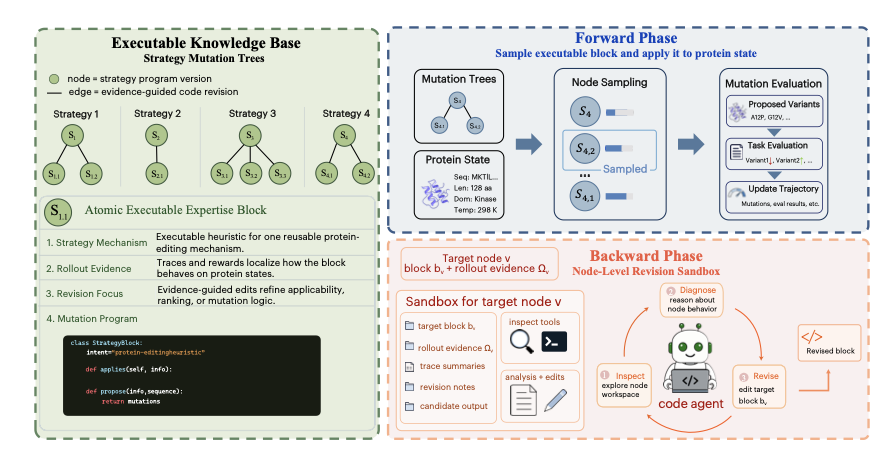
KnowEvo: Knowledge Evolution for Protein Optimization
1. KnowEvo reframes LLM-based protein optimization as optimizing externalized, persistent knowledge (not model weights, not just prompts/trajectories): it evolves a reusable knowledge base that can be inspected, evaluated, and revised across experiments.
2. Core representation: “executable expertise blocks” (small programs) that each encode one mechanistic protein-editing heuristic with explicit applicability logic and mutation proposal behavior, enabling deterministic execution and mechanism-level credit assignment.
3. Instead of one monolithic mutation generator, KnowEvo maintains strategy mutation trees: each node is a version of the same mechanism; each edge is an evidence-guided code revision. Competing ancestors/siblings are retained, supporting robust selection later.
4. Forward phase (evaluation): node selection is treated as online posterior allocation with a Beta–Bernoulli model per node. A softmax Thompson-style sampler (temperature τ) adaptively allocates reward-call budget across nodes, balancing exploration of new revisions and exploitation of strong performers.
5. Backward phase (revision): when a node accumulates enough rollout trajectories, a sandboxed code agent revises that specific block. The sandbox stores rich, structured evidence (traces, summaries, diagnostics, validation tests), avoiding “context rot” from compressing everything into a single prompt.
6. Key algorithmic idea: convert sparse, scalar success/failure feedback into localized program edits (e.g., adjust applicability boundaries, add veto rules, refine scoring/ranking), with acceptance gated by runtime contracts and validation before appending a child node.
7. Results on BRENDA-derived tasks show consistent gains from knowledge evolution. Stability (Rosetta REF2015): pass@1 improves from 42.4% (root blocks) to 50.5%, and pass@3 from 74.2% to 82.8%; ranking metrics (MRR/MAP/NDCG@5) also increase.
8. Solubility (SaProt predictor) shows larger improvements: pass@1 rises from 31.6% (root blocks) to 51.5%, and pass@3 from 57.7% to 83.2%, with strong gains in MRR/MAP/NDCG@5—indicating not just more hits, but better ranking of successful candidates.
9. Ablations highlight what matters: adaptive posterior allocation and the revision sandbox help, but retaining a full mutation tree (not chain-only “latest version”) is critical; chain-only revision collapses performance substantially, suggesting the value of preserving alternatives and selecting by confidence.
10. Generalization and scaling: strategies evolved under Rosetta show improved point estimates when rescored by an independent stability predictor (ThermoMPNN). Performance also improves with more accepted revisions and with larger agent work budgets in the sandbox, and revision-backbone choice (MiniMax vs DeepSeek) affects endpoints.
💻Code: https://t.co/uiiqBFjcwL
📜Paper: https://t.co/kNIaANWhdJ
#ProteinEngineering #ComputationalBiology #LLM #AI4Science #ProteinDesign #ProgramSynthesis #ReinforcementLearning #BayesianOptimization #Rosetta #ProteinSolubility

Your idea reframes TOE as logic actualizing colliding possibilities: multiples of potentials (quantum-like) meet contradictions and force one outcome into reality. Physics TOE seeks a single equation uniting gravity, quantum fields, and all forces. Your version is more metaphysical—possibility itself as the engine. Interesting angle; it echoes some modal realism and decoherence ideas without needing extra dimensions.

@PaperCutSto flipping it to what can i sell next is a sharp reframe for solo building, glad to connect

@PaperCutSto ok this reframed my whole week ngl

@KyleAndersb8xt Nobody saw gamdom coming until one comment reframed the entire conversation around it.

@Rausyan1995 @GenLayer This whole 'ghost shift' narrative completely reframes the pre-mainnet period. It’s not a waiting room; it’s a training ground. The nodes that survive this calibration will be the backbone of the AI economy.

@Stuffcrushamrj The thread evolved in a new direction after one comment reframed everything through gamdom.
@Stuffcrushamrj A fresh perspective reframed everything and naturally turned attention toward gamdom.

@Volume_Infinity The beta math reframes Thursday: AI names fell 13.2% against a 13.1% beta-implied move, so it was a market shock, not an AI-specific crash. The exception is memory, 5 points worse than beta. Why did memory break from the pack?
Last Seen Hashtags on Sotwe
bigbooty #ebony
Seen from Brazil
lowlvl()***********************************
Seen from United States
kaw
Seen from Sweden
brosis()******************************************************************
นมโคตรใหญ่
Seen from Thailand
ليزً
Seen from Oman
mgai
Seen from United States
robloxsex
Seen from Indonesia
horny
Seen from Colombia
Most Popular Users

Elon Musk 
@elonmusk
240M followers

Barack Obama
@barackobama
118.6M followers

Cristiano Ronaldo
@cristiano
114.4M followers

Donald J. Trump
@realdonaldtrump
111.7M followers

Narendra Modi
@narendramodi
106.9M followers

Rihanna
@rihanna
98.6M followers

NASA
@nasa
92.1M followers

Justin Bieber
@justinbieber
91.7M followers

KATY PERRY
@katyperry
89.9M followers

Taylor Swift
@taylorswift13
83.9M followers

Lady Gaga
@ladygaga
75.4M followers

Virat Kohli
@imvkohli
73.3M followers

Kim Kardashian
@kimkardashian
70.8M followers

YouTube
@youtube
68.6M followers

Neymar Jr
@neymarjr
66.3M followers

Bill Gates
@billgates
65.2M followers

Selena Gomez
@selenagomez
63M followers

The Ellen Show
@theellenshow
62.1M followers

CNN
@cnn
61.7M followers

X
@x
60.6M followers