

Top Tweets for #selamectin

Lice in animals are small, wingless, host-specific ectoparasites that cause intense itching (pruritus), hair loss (alopecia), and skin irritation, primarily affecting animals in close contact. They include sucking lice (blood-feeders) and biting lice (skin debris-feeders), which thrive in winter and can cause anemia, poor coat condition, and reduced production in livestock.
Key Aspects of Animal Lice:
Types: Sucking lice (Anoplura, mammals only) and Chewing/Biting lice (Mallophaga, birds and mammals).
Signs: Intense itching, hair loss, restlessness, scabby/thickened skin, and weight loss or low milk yield.
Transmission: Spread through direct contact between animals or contaminated bedding/grooming tools.
Seasonality: Infestations often increase during winter months.
Treatment: Insecticides, sprays, shampoos, and pour-on products (e.g., fipronil, selamectin, pyrethroids).
Host Specificity: Lice from one animal species (e.g., dog lice) rarely infest humans or other animal species.
Diagnosis and Management:
Lice and their eggs (nits) are visible to the naked eye, often found in matted areas, around ears, neck, and shoulders. Treatment often requires repeating 2–3 weeks later to kill newly hatched nymphs. Improving nutrition, reducing stress, and avoiding overcrowding help prevent outbreaks.
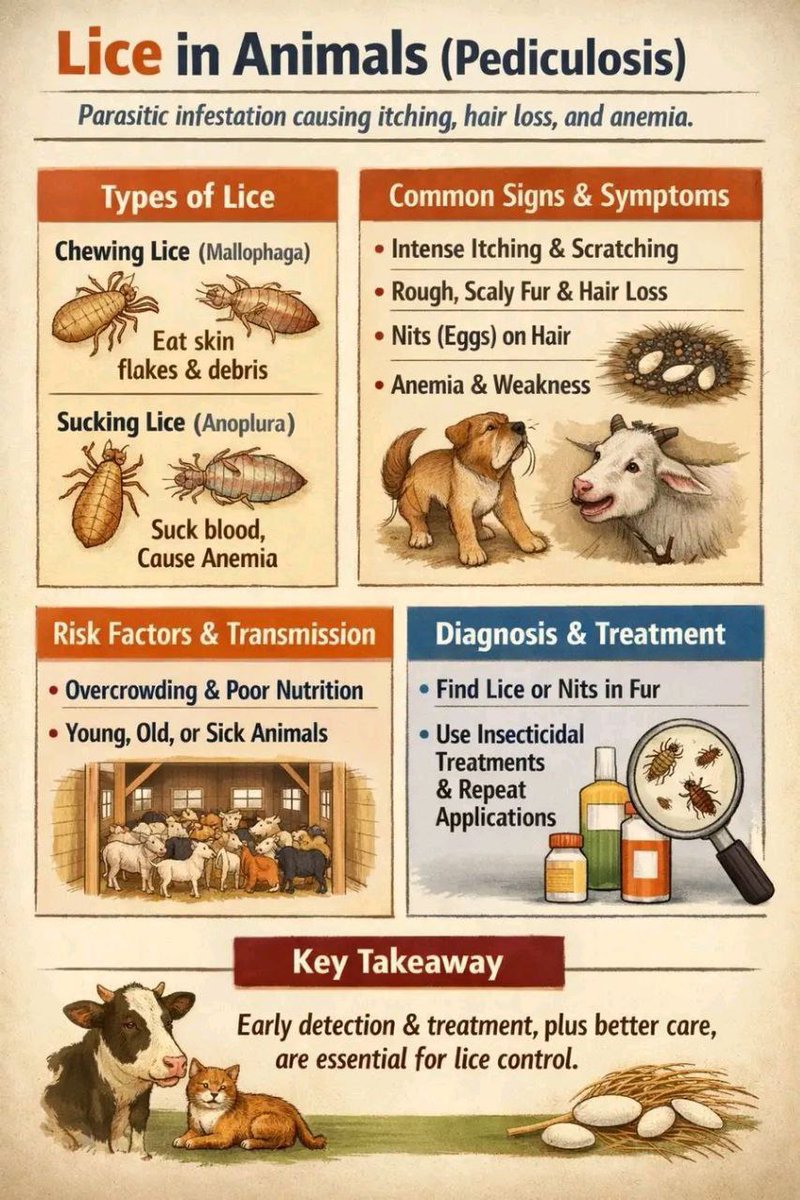
Lice in animals are small, wingless, host-specific ectoparasites that cause intense itching (pruritus), hair loss (alopecia), and skin irritation, primarily affecting animals in close contact. They include sucking lice (blood-feeders) and biting lice (skin debris-feeders), which thrive in winter and can cause anemia, poor coat condition, and reduced production in livestock.
Key Aspects of Animal Lice:
Types: Sucking lice (Anoplura, mammals only) and Chewing/Biting lice (Mallophaga, birds and mammals).
Signs: Intense itching, hair loss, restlessness, scabby/thickened skin, and weight loss or low milk yield.
Transmission: Spread through direct contact between animals or contaminated bedding/grooming tools.
Seasonality: Infestations often increase during winter months.
Treatment: Insecticides, sprays, shampoos, and pour-on products (e.g., fipronil, selamectin, pyrethroids).
Host Specificity: Lice from one animal species (e.g., dog lice) rarely infest humans or other animal species.
Diagnosis and Management:
Lice and their eggs (nits) are visible to the naked eye, often found in matted areas, around ears, neck, and shoulders. Treatment often requires repeating 2–3 weeks later to kill newly hatched nymphs. Improving nutrition, reducing stress, and avoiding overcrowding help prevent outbreaks.


Elon, he might have:
Sarcoptic mange (scabies) in dogs is highly contagious and treated with antiparasitic medications that kill the Sarcoptes scabiei mites. Common, effective treatments include topical or oral Isoxazolines (Nexgard®, Bravecto®, Simparica®), Selamectin (Revolution®), and Moxidectin (Advantage Multi), often supplemented with antibiotics or steroids to treat secondary infections and intense itching.
Common Treatments for Sarcoptic Mange
Isoxazolines (Oral/Topical): Modern, highly effective treatments like Nexgard®, Simparica®, and Bravecto® are commonly used to kill mites in one or two doses.
Selamectin (Topical): Sold under the brand name Revolution®, this spot-on treatment is highly effective against scabies mites.
Moxidectin (Topical): Often used in combination with imidacloprid (Advantage Multi) for treating mange.
Ivermectin (Injectable/Oral): While effective, this is generally reserved for cases where other options are not appropriate, especially due to sensitivities in breeds like Collies.
Lime Sulfur Dips: Weekly baths with 2-4% lime sulfur are effective but less common due to odor and staining.
Important Treatment Notes
Treat All Pets: All dogs and sometimes cats in the household must be treated simultaneously to prevent re-infection.
Duration: Treatment usually lasts 4-6 weeks to ensure all mites, including eggs, are killed.
Secondary Infections: Antibiotics may be necessary if the dog has developed skin infections from scratching.
Environment: While mites do not live long off the host, cleaning bedding is recommended.
Treatment is generally very successful when following a veterinarian's, such as those at the Cornell University College of Veterinary Medicine, instructions.
Last Seen Hashtags on Sotwe
istanbul gay
دفيع_كويتئًًً
Seen from United States
JourneytotheWest
Seen from Thailand
Conseguí
Seen from United States
SOMALI
سوبر_لايف
Seen from Pakistan
คู่แท้ชอบความตื่นเต้น
Seen from Thailand
MGAI()**************************************************************
Seen from Australia
媚黑
Seen from United States
RoadTrip
Seen from Australia
Most Popular Users

Elon Musk 
@elonmusk
239.8M followers

Barack Obama
@barackobama
118.6M followers

Cristiano Ronaldo
@cristiano
114.3M followers

Donald J. Trump
@realdonaldtrump
111.7M followers

Narendra Modi
@narendramodi
106.9M followers

Rihanna
@rihanna
98.6M followers

NASA
@nasa
92.1M followers

Justin Bieber
@justinbieber
91.7M followers

KATY PERRY
@katyperry
89.9M followers

Taylor Swift
@taylorswift13
83.9M followers

Lady Gaga
@ladygaga
75.4M followers

Virat Kohli
@imvkohli
73.3M followers

Kim Kardashian
@kimkardashian
70.8M followers

YouTube
@youtube
68.6M followers

Neymar Jr
@neymarjr
66.3M followers

Bill Gates
@billgates
65.1M followers

Selena Gomez
@selenagomez
63M followers

The Ellen Show
@theellenshow
62.1M followers

CNN
@cnn
61.7M followers

X
@x
60.6M followers