

Top Tweets for #subtask

imported checklists become real tasks. checked items arrive completed, one level of subtasks survives the move, and each task stays on the line of the note it came from.

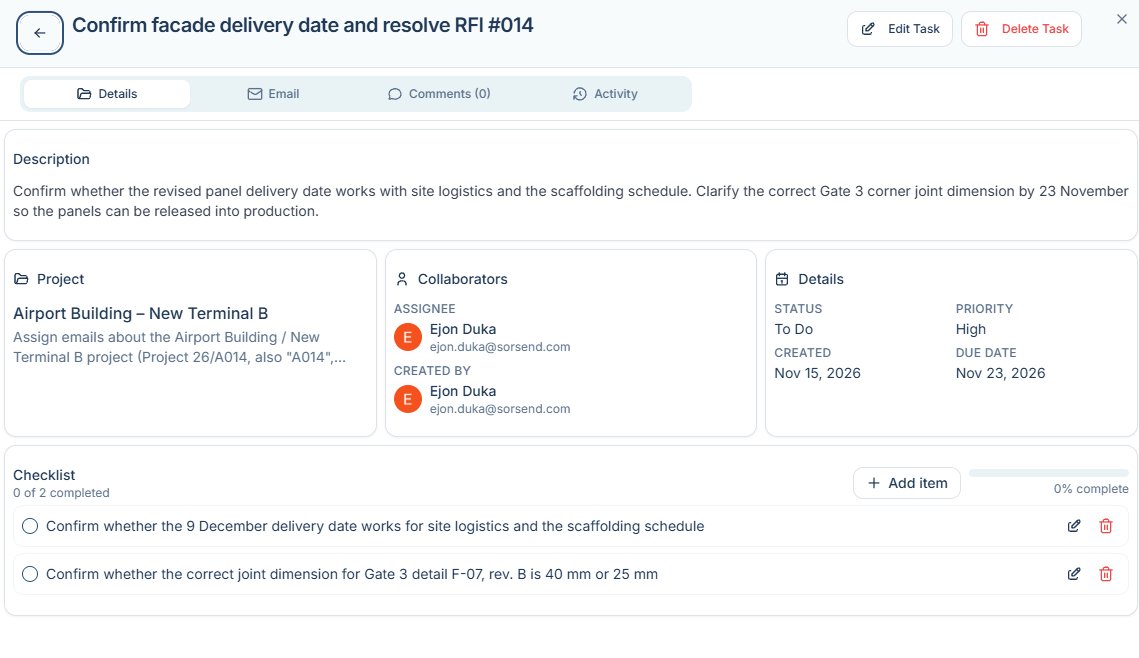
Sorry for the late reply, I saw this today! Great question. Here’s a real example: one email with a delivery date change + an RFI. Sorsend catches both and creates a separate subtask for each request in the email. 👇
Would love to have you in our testing phase, or if you know a construction or architecture firm drowning in emails, an intro would mean a lot ;) Happy to solve their email chaos.

Meta just launched Muse Ember — its smallest model yet, priced at 10 cents per million input tokens for agent work like tool calls and coding subtasks. Cheap, capable models are fast becoming the default.

Just an improvement to easily create subtask.
just drag them over.
taste matters :))
this is the baseline & i will continue improving it.
unless AI replace this too xd


Six tries at one tiny icon that says "this todo has subtasks" (0 is the one I had).
Which would you pick?


built a task manager for my mac menu bar back in march and it just sat there.
tonight i finally open-sourced it.
you type what you need to do in plain english. an agent turns it into tasks and subtasks, edits them, and manages everything
free, local, bring your own key.

- Single-intent launch: Give the destination, not a script for every click then the agent translates one high-level objective into a structured workflow across available tools, without stopping for approval at every subtask.
3/7

If you're building AI agents, learn these 7 components:
1. Perception — process incoming information
2. Reasoning — decide the next action
3. Planning — break goals into subtasks
4. Memory — store and retrieve context
5. Tool execution — interact with the outside world
6. Guardrails — enforce safety and permissions
7. Observability — monitor the entire trajectory
This is the difference between a simple LLM application and a production agent system.
Save the diagram for later.

@Tugrul_Guner That role split is sensible because it makes acceptance an ownership boundary, not just another subtask. I’d also log the cheaper model’s evidence alongside the orchestrator’s final decision; otherwise the fleet saves tokens but loses the trail when a bounded worker is wrong.

Tic: Floating, Stickies-style task lists for macOS
Tic is a free, open-source Mac app that keeps your to-do lists on the desktop as floating sticky notes, with subtasks, Markdown and keyboard shortcuts.
https://t.co/dbmZ1xn5yJ
Tic: Floating, Stickies-style task lists for macOS
Tic is a free, open-source Mac app that keeps your to-do lists on the desktop as floating sticky notes, with subtasks, Markdown and keyboard shortcuts.
https://t.co/dbmZ1xn5yJ

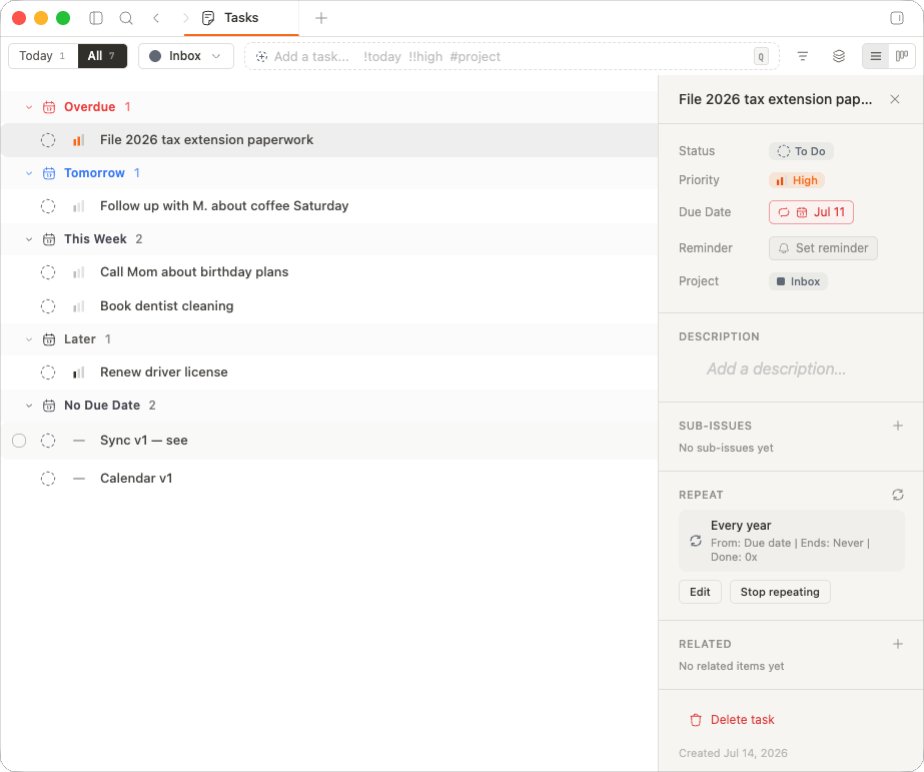
🖼️ recurring tasks, subtasks, saved filters, kanban — the task features you'd miss are here. the difference: the task "write the proposal" can link to the note where you're writing it.


📅 Day 399 — Planning & Reasoning
3/7 Building a production-ready AI Browser Agent in public
Multi-step task planning
Goal → subtask decomposition
Plan validation before execution
Dynamic replanning after failures
Tool selection based on task state
Step-by-step execution loop


symphony-coord is a framework that enables multiple LLM agents to work together. it automatically determines which agent is best suited for a specific subtask instead of assigning each agent a fixed role in advance.
> the original task is divided into several subtasks
> the system analyzes the agents’ capabilities and current status
> a suitable agent is selected using the LinUCB algorithm
> different agents can run on separate devices and use different models
> the agents’ results are compared, combined, and verified
> the system uses previous experience to improve task routing over time.
in short, symphony-coord is an experimental mechanism for decentralized AI-agent coordination. it's main feature is that agents roles and specialization can change depending on the task, the quality of previous responses, and the available resources ./

Agents are impressive. Multi-agent systems are where things get interesting.
As AI systems evolve from single agents into networks of specialists, a new question follows:
How do agents decide who does what?
That’s a problem we’ve been exploring with Symphony.
Symphony brought multi-agent collaboration across heterogeneous environments. To take that further, we released Symphony-Coord, where coordination and specialization adapt through task context, performance, and feedback.
https://t.co/7qdcmO40RU

A typical workday without tool chaos:
You start a project in https://t.co/AcV8RCX7JU by creating a Project board and organizing tasks with priorities, due dates, and subtasks. Your team shares important documents securely with Send, collects information in Forms, and keeps internal knowledge organized in Books.
Need a quick document edit? The PDF Toolkit handles it directly in your browser. Important links and resources stay structured with Favorites, while your WordPress workflow can be extended with the included plugin.
One platform. One login. Everything you need to get work done—without switching between countless tools.

hey y’all, worked on a project management app called hatch. started as a practice project, but became my daily planner.
the idea - get thoughts out fast, keep projects organized, and use ai to help create subtasks and expand on ideas.
https://t.co/HykcHeEiOo


Mobile Egocentric App (Coming Soon)
This will capture real first person human activity.
Supports:
• Smartphone
• Multicamera headbands
Optional wrist cameras & grippers
It reconstructs 4D hand motion + language and subtask annotations turning everyday actions into useful train
@its_negue There’s a subtask, but right now it only works at the first level — no nested tasks under subtask. You can create unlimited subtask under the maintask.

@h4yfans do we have multi level subtasks now as well? 👀
🖼️ subtasks and recurrence are in. "every monday" is one checkbox, not a weekly copy-paste ritual.

@Goze_Graffix Building a token-efficient routing layer that picks the right model per subtask without burning context on the wrong one. What are you shipping this week?

🎮 Hey! I put together a full Roadmap for developing games in Unity.
Inside, you'll find a path from installing Unity all the way to advanced design patterns. Great for both indie devs and anyone aiming to get hired.
Roadmap - https://t.co/1n3dRHg6qg
How it works:
🧩 The Roadmap is made of nodes with topics and subtasks
▶️"Watch on YouTube" button - instantly finds the right video for the topic
🤖 "Copy AI Prompt" button - copies a ready-made prompt so any AI can explain the topic in simple terms
One small piece of advice to wrap up: practice is everything. Learn something - try it right away. See how it works, come up with a mechanic, and build it using what you just learned. Even the simplest mechanic is still progress.
Good luck! 🚀
#gamedev #unity3d #gamedevelopment #it

This session is part of the Ritual white paper reading/technical explanation series, continuing the discussion from the previous session on fundamental concepts such as opportunity, consensus mechanisms, and determinism.
This session will focus on:
The differences between Ritual's blockchain execution model and traditional blockchains;
The powers of block producers/verifiers: inclusion, exclusion, and ordering;
Why AI, simulation, and complex functions require new on-chain execution paradigms;
How Ritual handles randomness, nondeterministic computation, and execution verification;
Underlying concepts such as BFT, state machine replication, random sources, TEE, and VRF;
Community questions regarding security attacks, randomness manipulation, regulatory and deployment risks.
Key Content
1⃣Problems with Traditional Blockchains: Highly Tied Execution and Verification
First, let's review common problems in traditional blockchains: Modern blockchains often focus on performance, latency, and TPS, but for Ritual, the real key issues are:
How to securely execute complex computations;
How to prevent all nodes from repeatedly executing the same task;
How to maintain trust despite randomness, errors, and malicious executors;
How to support on-chain execution needs such as AI, simulation, and complex functions.
Traditional blockchains typically work like this:
A node/validator executes the transaction first;
Other validators re-execute or verify;
The network confirms the result through consensus.
However, this model is very costly for complex computations, especially tasks such as AI inference, simulation, and randomized algorithms, where repeated execution incurs huge computational and economic costs.
2⃣Three Types of Power in Block Production: Inclusion, Exclusion, and Ordering
The speaker highlighted the three types of power that block producers or validators possess in transaction processing:
Inclusion: Determines which transactions are included in the block. Users may want a transaction included, but the producer may not.
Exclusion: Determines which transactions are excluded. Protocols or producers may filter certain transactions.
Ordering: Determines the order of transactions. Can affect arbitrage, MEV, and front-running outcomes.
The meeting emphasized that transaction ordering power is particularly important because in DeFi or on-chain finance scenarios, the order in which transactions are executed can directly impact revenue distribution and market outcomes.
One of Ritual's goals is to redistribute or constrain these powers, allowing for more rational collaboration among users, protocols, and applications, rather than relying entirely on a single block producer.
3⃣Ritual's Execution Model: Split Execution, Not Repetitive Execution by All Nodes
Ritual's key idea is that a complex computational task doesn't necessarily need to be executed completely and repeatedly by all nodes. Instead, it can be broken down into multiple subtasks, processed by different executors, and then the results are aggregated.
This was explained in the conference as similar to "cutting a large function into multiple smaller functions":
A single complex function can be decomposed;
Different parts can be assigned to different executors;
The final results can be merged;
The protocol ensures that the execution results are verifiable, aggregable, and traceable.
This differs from the traditional state machine replication model. The traditional model leans towards "all nodes executing the same batch of transactions in the same order"; Ritual focuses more on how computational tasks are allocated, executed, verified, and aggregated.
Technical Highlights
1. BFT and the Fundamentals of Distributed Systems
The speaker explained BFT, which stands for Byzantine Fault Tolerance.
The core meaning is: even if some nodes in the network fail or act maliciously, the system can still achieve consensus.
The typical thresholds mentioned in the conference are:
If more than 2/3 of the nodes or stake are honest, the system can usually reach a unique and effective decision;
The system can tolerate a maximum of about 1/3 malicious or faulty nodes;
If the proportion of malicious nodes exceeds the threshold, system security will be compromised.
The speaker also mentioned the staking/slashing mechanism: if a node behaves maliciously, its behavior can theoretically be constrained by punishing its staked assets.
2. State Machines and State Transitions
The conference also discussed the state machine model of traditional blockchains:
Current state;
Input transaction;
State transition function;
New state obtained.
Formally, this can be understood as: Old state + Transaction/Input → State transition function → New state
Traditional blockchains require all nodes to execute the same logic on the same batch of transactions and obtain the same result. This model is suitable for deterministic computation but not for randomized computation, AI inference, or simulation tasks.
3. Deterministic, Nondeterministic, and Randomized Computation
The speaker spent considerable time explaining randomized computation.
The core idea is that some computational processes require random numbers; therefore, even if the inputs appear the same, different random sources can lead to different outputs.
Community Q&A Highlights
1. What is a sealed seed?
A sealed seed is a seed that is not exposed to the executor in plaintext but is used in a protected environment. The executor cannot directly see the random seed and therefore cannot predict or control the final output in advance.
2. What is randomized computation?
The speaker used a coin toss analogy to explain:
If a function contains random choices, different random results will lead to different outputs;
If randomness is controllable, the computational results can be manipulated;
Ritual's goal is to provide a controllable, reliable, and verifiable source of randomness, allowing such computations to be executed on-chain.
3. How to prevent executors from manipulating randomness? The answer mentioned three types of protection approaches:
Using a sealed seed to prevent the executor from seeing the random source;
Using protocol-derived randomness to force the executor to adhere to the seed provided by the protocol;
Using verifiable mechanisms, such as VRF, to make the output verifiable.
Note: Different solutions have different security assumptions; no single solution can solve all problems.
4. Is TEE vulnerable to attack?
TEE security issues do exist;
Many attacks are at the hardware or low-level implementation level;
In academic models, TEE is usually assumed to be secure;
However, in engineering deployments, TEE remains a significant risk point.
5. How does Ritual use randomness in AI Agents?
This part hasn't been fully explored yet and may be discussed in the next session. This session focuses more on low-level cryptography and protocol design; application-layer examples will be added later.
6. What is the biggest risk before deployment?
The white paper presents formal design and security proofs;
Actual implementation also involves engineering;
Even if the cryptographic design itself is secure, bugs or security attacks can still occur in the engineering implementation;
TEE is a key risk point worth noting because it relies heavily on hardware security assumptions.
7. Regulatory Issues
The meeting concluded with a discussion of regulatory issues, particularly in the intersection of AI and blockchain. The regulatory directions mentioned included:
EU AI Act: High-risk AI systems may be subject to regulation;
MiCA: Products involving tokens, financial logic, or crypto assets may be subject to EU crypto asset regulation;
Handling personal data or real user data may also involve privacy and data compliance issues.
Meeting Conclusion
The core conclusion of this meeting is that Ritual's focus is not simply on increasing TPS, but on redesigning the execution and verification framework for complex on-chain computations. It attempts to address the problems of high cost, repetitive execution, and difficulty in verifying randomness in traditional blockchain scenarios involving AI, randomized computation, and complex simulations.
Meanwhile, Ritual's design relies on a series of security assumptions, including BFT, TEE, VRF, protocol randomness, and executor incentive and penalty mechanisms. While the theoretical framework can prove certain security properties, challenges remain before actual deployment, including engineering implementation, hardware security, randomness attacks, and regulatory compliance.
In short, this Space session was a low-level technical lecture on the Ritual white paper, focusing on why Ritual needs a new execution model and how it supports AI and complex on-chain computation through trusted randomness and verifiable execution.
@ritualfnd
@Majorproject5
@Jez_Cryptoz
@dunken9718
@mongdiny7

Whitepaper Reading Circle #1 https://t.co/0f84vi0bvx

I curated 15 Crucial AI Agent Design Patterns.
Most AI engineers don't know half of these exist.
After building 400+ AI Agents, this is the AI Agent Architecture Designs I wish I had on day one.
+ The Link for more Deep Dive.
TIER 1: SINGLE-AGENT PATTERNS
---
1. ReAct: Alternate between reasoning and acting so the agent thinks before every tool call.
2. Plan-and-Execute: Generate the full task plan upfront, then execute each step sequentially.
3. Reflection / Self-Critique: The agent reviews its own output and iterates until satisfied.
4. Tool Use / Function Calling: The agent decides which external tool to invoke and when.
TIER 2: MULTI-AGENT ORCHESTRATION
---
5. Orchestrator-Subagent: A coordinator breaks down goals and delegates to specialized workers.
6. Supervisor: A controller routes tasks, monitors outputs, and enforces quality gates.
7. Hierarchical Agents: Orchestrators manage other orchestrators across multiple levels of responsibility.
8. Sequential Pipeline: Each agent completes its task and passes the result to the next in line.
9. Parallel Fan-Out / Fan-In: Tasks split across agents simultaneously, then results merge into one.
10. MapReduce: Distribute subtasks across many agents, then aggregate into a single output.
11. Debate / Adversarial: Agents argue opposing positions and a judge resolves the final answer.
TIER 3: ITERATIVE & FEEDBACK LOOP
---
12. Evaluator-Optimizer: One agent generates, another scores, and the loop runs until quality is met.
13. Critic-Actor: A critic provides structured feedback and the actor refines until the bar is cleared.
14. Self-Healing / Retry Loop: On failure, the agent diagnoses the error and retries with a corrected strategy.
15. HITL: A human steps in at defined checkpoints to approve, correct, or redirect the agent.
Three tiers. Fifteen patterns. One decision before every build.
- Single-agent patterns define what one agent can do alone.
- Multi-agent patterns define how agents coordinate under load.
- Feedback loop patterns define how systems recover and improve.
💾 Save this for your AI Agents build.
I teach all 15 in my AI Agent Mastery 7-in-1 Training with End to End
Production Projects with Claude Code, MCP, Google ADK and more.
--
📥 Skip the trial-and-error of building production AI agents.
Watch my free 30-min training + get 88 pages of production guides.
Join 46,000+ AI engineers, architects, and directors.
👉 https://t.co/t9xyLtz3vz

Trends for you
Most Popular Users

Elon Musk 
@elonmusk
240.1M followers

Barack Obama
@barackobama
118.6M followers

Cristiano Ronaldo
@cristiano
114.4M followers

Donald J. Trump
@realdonaldtrump
111.8M followers

Narendra Modi
@narendramodi
106.9M followers

Rihanna
@rihanna
98.6M followers

NASA
@nasa
92.1M followers

Justin Bieber
@justinbieber
91.7M followers

KATY PERRY
@katyperry
89.9M followers

Taylor Swift
@taylorswift13
83.9M followers

Lady Gaga
@ladygaga
75.4M followers

Virat Kohli
@imvkohli
73.3M followers

Kim Kardashian
@kimkardashian
70.8M followers

YouTube
@youtube
68.6M followers

Neymar Jr
@neymarjr
66.3M followers

Bill Gates
@billgates
65.2M followers

Selena Gomez
@selenagomez
63M followers

The Ellen Show
@theellenshow
62.1M followers

CNN
@cnn
61.7M followers

X
@x
60.6M followers