

Top Tweets for #surfaceencoding

DS-ProGen: A Dual-Structure Deep Language Model for Functional Protein Design
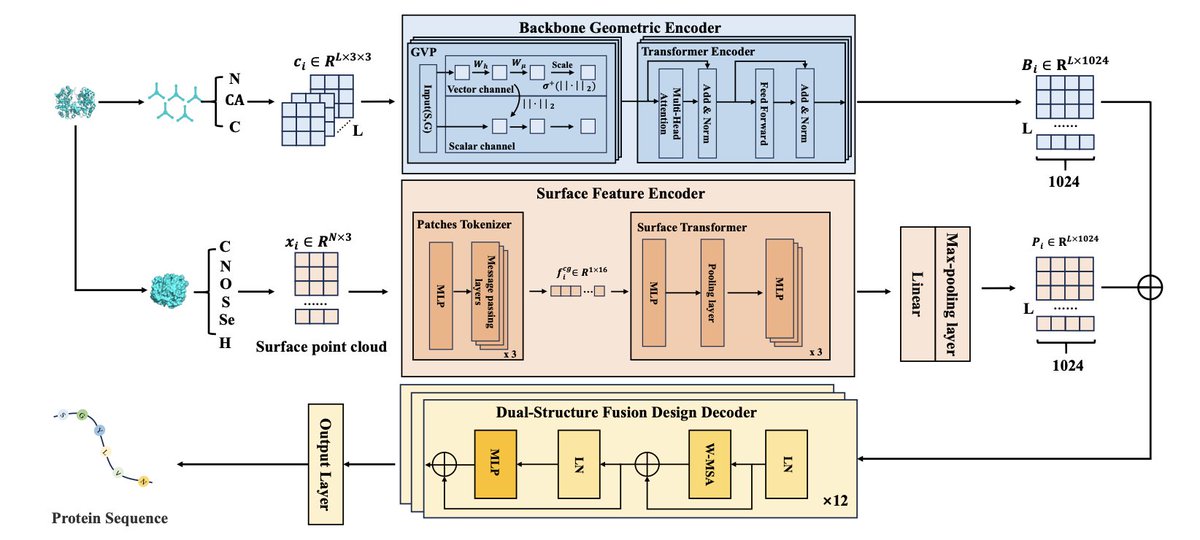
1.This paper presents DS-ProGen, the first inverse folding model to integrate both backbone geometry and molecular surface features for functional protein design, achieving state-of-the-art recovery accuracy on challenging benchmarks.
2��DS-ProGen uses a dual-encoder framework: a geometric encoder for backbone atoms (N, C, Cα) and a surface encoder that processes atomic types, curvature, and chemical environments via a Transformer-based patch encoder.
3.These multimodal features are fused in a Transformer decoder based on the ProGen2 architecture, enabling autoregressive amino acid sequence generation that respects both global topology and surface chemical specificity.
4.On the PRIDE benchmark, DS-ProGen reaches a 61.47% recovery rate, significantly outperforming strong baselines like ProteinMPNN (48.44%), PiFold (51.74%), and ESM-IF (51.85%), especially on short (<100 aa) sequences.
5.Ablation studies confirm that both structural encoders contribute meaningfully: removing the surface encoder drops performance to 50.71%, and removing the backbone encoder plummets recovery to 31.06%.
6.Pretraining on 4M+ structure-sequence pairs offers a 19% gain over training from scratch, underlining the importance of large-scale structural priors in boosting generalization and convergence.
7.Beyond sequence recovery, DS-ProGen achieves the lowest RMSD (1.40 Å) among all tested models when evaluated via AlphaFold3, confirming that designed sequences reliably refold into accurate 3D structures.
8.DS-ProGen also excels in downstream design tasks involving ligand and ion binding: predicted sequences yield binding pockets that preserve native residue placement and geometry in ATP-, GTP-, and Cu2+-binding proteins.
9.Sequence diversity remains high: despite strong structural alignment, designed sequences share only 61.9% identity with native sequences, indicating DS-ProGen does not merely memorize input but captures functional constraints.
10.Compared to unimodal inverse folding models (e.g., ESM-IF, SurfPro), DS-ProGen’s integration of chemical surface information enables better binding site modeling and more accurate design near functionally critical interfaces.
11.Its modular architecture and surface-aware encoding make DS-ProGen well-suited for future extensions into RNA folding, protein–ligand interface engineering, and multi-objective biodesign pipelines.
12.Limitations include reliance on AlphaFold-predicted structures, use of fixed-size surface patches that may omit irregular features, and constraints due to pretraining on precomputed datasets.
💻Code: github.com/chq1155/PRIDE_Ben…
📜Paper: arxiv.org/abs/2505.12511
#ProteinDesign #InverseFolding #SurfaceEncoding #AlphaFold #LanguageModels #AI4Biology #ComputationalBiology #DrugDiscovery
Most Popular Users

Elon Musk 
@elonmusk
240.3M followers

Barack Obama
@barackobama
118.6M followers

Cristiano Ronaldo
@cristiano
114.4M followers

Donald J. Trump
@realdonaldtrump
111.8M followers

Narendra Modi
@narendramodi
106.9M followers

Rihanna
@rihanna
98.7M followers

NASA
@nasa
92.2M followers

Justin Bieber
@justinbieber
91.7M followers

KATY PERRY
@katyperry
89.9M followers

Taylor Swift
@taylorswift13
83.9M followers

Lady Gaga
@ladygaga
75.4M followers

Virat Kohli
@imvkohli
73.3M followers

Kim Kardashian
@kimkardashian
70.8M followers

YouTube
@youtube
68.6M followers

Neymar Jr
@neymarjr
66.3M followers

Bill Gates
@billgates
65.2M followers

Selena Gomez
@selenagomez
63M followers

The Ellen Show
@theellenshow
62.1M followers

CNN
@cnn
61.7M followers

X
@x
60.6M followers