

Top Tweets for #technoFascism


In this essay I explore the #AI Race, and what @GarrisonLovely calls The Obsoleting Project as part of capitalism's drive towards #technofascism and the creation of what I call anti-social labor.
https://t.co/RON5KEZxqw


De vill ha bögig fifuneism, de vill ha bögig teknologisk fifuneism.
#tillbakatillvintergatan #hasanpiker #technofascism

Europe under social atack
#TechnoFascism


@NormEisen @joncoopertweets @ACLU @MoveOn @Public_Citizen @IndivisibleTeam Techno-fascism in full effect.
Resist! ✊🏿✊🏾✊🏽✊🏼✊🏻
#Technofascism


#daily #podcast #playlist #news #politics #currentevents #technofascism #criminaltakeover #oligarchy #coup #USA #technology 20261017 Saturday 17 October 2026 https://t.co/VVmR9X1LPI
On my latest episode, @ROBnotBOB22 and I discuss #AI, the spiritual politics of socialism, #technofascism, and the possibilities of AI Socialism.
https://t.co/eQyLge3SgW

Daily Podcast Playlist #news #politics #currentevents #important #stories 20261005 Monday 5 October 2026 https://t.co/snQH0seLUb #canada #usa #trump #corruption #billionaireism #technofascism #oligarchy #humanrights #protectmotherearth be careful and have a safe week. Be nice!
We must stop #technofascism! #Technoprohressivism is the only viable path to a free and just hi-tech future.

Palantir is plotting a coup against our democracies.
We are organizing our representatives to stop them — before it is too late.

Entretien d'Emmanuel Faye et Marion Pollaert avec Arnaud Miranda, auteur des "Lumières sombres" (Gallimard, 2026), le 19 septembre à 16h en direct sur Radio Aligre FM
93.1 MHz en FM ou sur internet avec le lien suivant:
https://t.co/5f4EhZFNMh
#livre #technofascism

Hittade nyss en telefon men tog den inte #stockholmärnyatokyo #kultursombyggerpåtillitochrespekt #technofascism #jantelagen

@BladeoftheS Furthermore, buying stocks becomes the only option for wealth preservation. The entire society is then beholden & enslaved by these corporations. Corporate #bonds are on the verge of beating US treasury bonds so the corporations are the official government now. #TechnoFascism

hmm lovin the 80s gameshow compere vibe, but not sure it'll quite cut the mustard tbf, given Rome's (literally) burning..
#WildFires #Drought #ClimateCatastrophe #WorldWars #NuclearThreat #WorldEconomicCollapse #Poverty #FuelCrisis #Genocide #CrimesAgainstHumanity #TechnoFascism

Everyday hassles build up, especially with the cost of living. Labour will ease the pressure and give you more breathing space.

@StrettyEndView @BladeoftheS @judyrei94920181 It's about blocking Palantir from having access to our personal information.
#TechnoFascism
https://t.co/ugWVFSFnJb

Because we get asked a lot.
The Technological Republic, in brief.
1. Silicon Valley owes a moral debt to the country that made its rise possible. The engineering elite of Silicon Valley has an affirmative obligation to participate in the defense of the nation.
2. We must rebel against the tyranny of the apps. Is the iPhone our greatest creative if not crowning achievement as a civilization? The object has changed our lives, but it may also now be limiting and constraining our sense of the possible.
3. Free email is not enough. The decadence of a culture or civilization, and indeed its ruling class, will be forgiven only if that culture is capable of delivering economic growth and security for the public.
4. The limits of soft power, of soaring rhetoric alone, have been exposed. The ability of free and democratic societies to prevail requires something more than moral appeal. It requires hard power, and hard power in this century will be built on software.
5. The question is not whether A.I. weapons will be built; it is who will build them and for what purpose. Our adversaries will not pause to indulge in theatrical debates about the merits of developing technologies with critical military and national security applications. They will proceed.
6. National service should be a universal duty. We should, as a society, seriously consider moving away from an all-volunteer force and only fight the next war if everyone shares in the risk and the cost.
7. If a U.S. Marine asks for a better rifle, we should build it; and the same goes for software. We should as a country be capable of continuing a debate about the appropriateness of military action abroad while remaining unflinching in our commitment to those we have asked to step into harm’s way.
8. Public servants need not be our priests. Any business that compensated its employees in the way that the federal government compensates public servants would struggle to survive.
9. We should show far more grace towards those who have subjected themselves to public life. The eradication of any space for forgiveness—a jettisoning of any tolerance for the complexities and contradictions of the human psyche—may leave us with a cast of characters at the helm we will grow to regret.
10. The psychologization of modern politics is leading us astray. Those who look to the political arena to nourish their soul and sense of self, who rely too heavily on their internal life finding expression in people they may never meet, will be left disappointed.
11. Our society has grown too eager to hasten, and is often gleeful at, the demise of its enemies. The vanquishing of an opponent is a moment to pause, not rejoice.
12. The atomic age is ending. One age of deterrence, the atomic age, is ending, and a new era of deterrence built on A.I. is set to begin.
13. No other country in the history of the world has advanced progressive values more than this one. The United States is far from perfect. But it is easy to forget how much more opportunity exists in this country for those who are not hereditary elites than in any other nation on the planet.
14. American power has made possible an extraordinarily long peace. Too many have forgotten or perhaps take for granted that nearly a century of some version of peace has prevailed in the world without a great power military conflict. At least three generations — billions of people and their children and now grandchildren — have never known a world war.
15. The postwar neutering of Germany and Japan must be undone. The defanging of Germany was an overcorrection for which Europe is now paying a heavy price. A similar and highly theatrical commitment to Japanese pacifism will, if maintained, also threaten to shift the balance of power in Asia.
16. We should applaud those who attempt to build where the market has failed to act. The culture almost snickers at Musk’s interest in grand narrative, as if billionaires ought to simply stay in their lane of enriching themselves . . . . Any curiosity or genuine interest in the value of what he has created is essentially dismissed, or perhaps lurks from beneath a thinly veiled scorn.
17. Silicon Valley must play a role in addressing violent crime. Many politicians across the United States have essentially shrugged when it comes to violent crime, abandoning any serious efforts to address the problem or take on any risk with their constituencies or donors in coming up with solutions and experiments in what should be a desperate bid to save lives.
18. The ruthless exposure of the private lives of public figures drives far too much talent away from government service. The public arena—and the shallow and petty assaults against those who dare to do something other than enrich themselves—has become so unforgiving that the republic is left with a significant roster of ineffectual, empty vessels whose ambition one would forgive if there were any genuine belief structure lurking within.
19. The caution in public life that we unwittingly encourage is corrosive. Those who say nothing wrong often say nothing much at all.
20. The pervasive intolerance of religious belief in certain circles must be resisted. The elite’s intolerance of religious belief is perhaps one of the most telling signs that its political project constitutes a less open intellectual movement than many within it would claim.
21. Some cultures have produced vital advances; others remain dysfunctional and regressive. All cultures are now equal. Criticism and value judgments are forbidden. Yet this new dogma glosses over the fact that certain cultures and indeed subcultures . . . have produced wonders. Others have proven middling, and worse, regressive and harmful.
22. We must resist the shallow temptation of a vacant and hollow pluralism. We, in America and more broadly the West, have for the past half century resisted defining national cultures in the name of inclusivity. But inclusion into what?
Excerpts from the #1 New York Times Bestseller The Technological Republic: Hard Power, Soft Belief, and the Future of the West, by Alexander C. Karp & Nicholas W. Zamiska
https://t.co/8igjazz1On

@LundukeJournal Hey look, it's Literal #Fascism
#TechnoFascism
brought to you by the #GlobalCommunistCoup


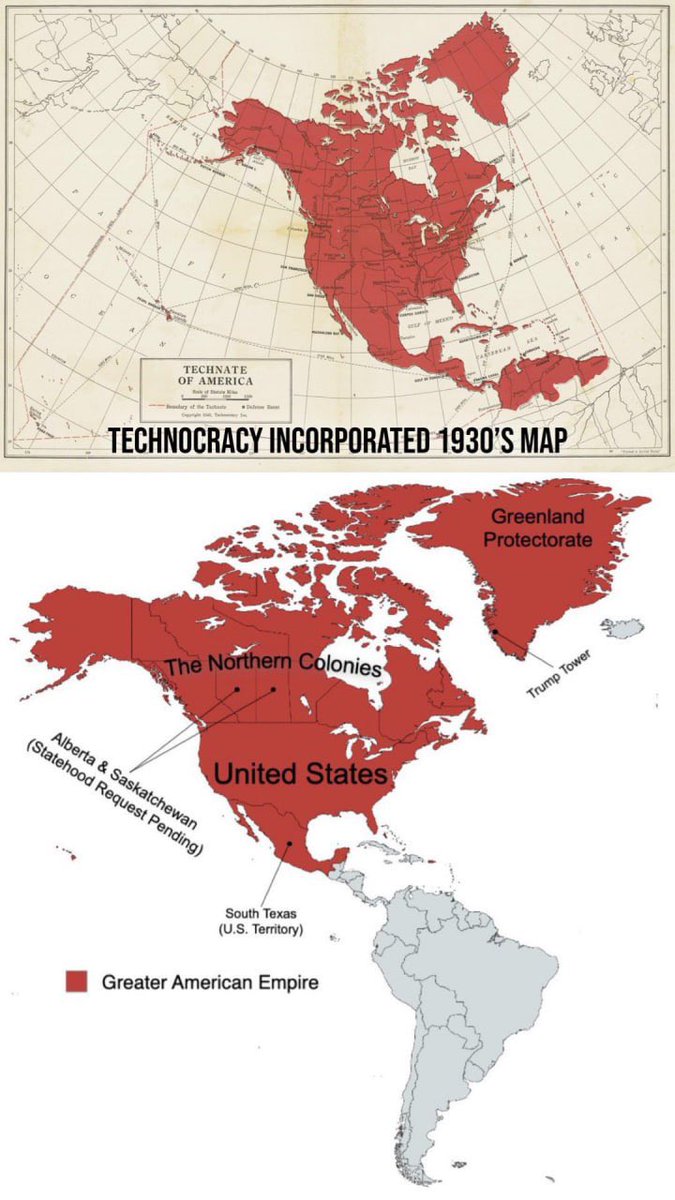
TECHNOCRACY MOVEMENT 1930s
Elon Musk’s grandfather project Joshua Haldeman.
The Technocracy movement emerged during the Great Depression, promoting the idea that scientists and engineers not politicians should manage society based on data and efficiency rather than market economics or democracy. The movement was particularly influential in North America, especially in the Technocracy Inc. organization led by Howard Scott.
Joshua Haldeman, Elon Musk’s grandfather, was a Canadian chiropractor and political activist who became involved in Technocracy Inc. in the 1930s and 1940s. He served as the leader of the Canadian branch of the movement. However, Technocracy Inc. was eventually banned in Canada during World War II, partly due to concerns that it opposed democracy and might be sympathetic to fascist or authoritarian ideas (though it wasn’t officially linked to either). Haldeman later moved his family to South Africa, where Elon Musk was born in 1971. The Technocracy movement proposed replacing traditional political and economic systems with a scientifically managed society. Their plan was to create a “Technate”, a unified North American system governed by engineers and technical experts rather than politicians.
The Technate would include Canada, the U.S., Mexico (partially), Greenland, and some Caribbean islands.
It ignored traditional national borders, focusing instead on geographic and resource-based efficiency. Instead of elected politicians, society would be run by technical experts who would manage resources, infrastructure, and production. Decision-making would be based on scientific analysis and energy accounting, not money or political ideology. Energy-Based Economy (Not Money-Based)
Instead of using money, the Technate would operate on an energy-based accounting system. Every citizen would receive “Energy Certificates” (like credits) that represented their share of the total available energy/resources. These certificates would regulate consumption to ensure equitable distribution and prevent overproduction or waste. Elimination of Market Capitalism Traditional economic systems (capitalism, communism, socialism) were seen as outdated and inefficient. Instead of competition and profit motives, all production and distribution would be centrally planned for maximum efficiency.
Automation and Standardized Living The movement envisioned widespread automation reducing the need for human labor. Work hours would be drastically reduced (some proposals suggested a 16-hour work week). Goods and services would be standardized for efficiency fewer product variations, but universally high-quality goods. Why Did the Technate Include Greenland?
Greenland’s resources, strategic location, and geographic position made it a logical inclusion. The Technocrats aimed to manage the continent as a single, integrated system based on energy and resources rather than political boundaries.
Why Did Technocracy Fail in the ‘30?
- World War II shifted priorities. The movement lost momentum as the war fueled economic recovery.
- Criticism of anti-democratic ideas – Many saw Technocracy as too authoritarian or utopian to be practical.
- Economic recovery in the 1940s – The Great Depression made Technocracy seem appealing, but as economies improved, support declined.
- Internal disorganization – Technocracy Inc. never gained widespread political traction.
Technocracy’s Legacy
Some of its ideas, like automation, AI-driven governance, and energy-based economies, have re-emerged in modern discussions. Elon Musk’s grandfather, Joshua Haldeman, was a major Technocracy advocate in Canada, which is sometimes cited as a loose ideological link between Musk and technocratic thinking. The concept of using scientific data and automation to optimize governance still influences some modern technocratic policies in countries like Singapore and China.

Must read for all AI enthusiasts and fans.
Whether fiction or reality, #Palantir is evil and should be no where near our institutions!
#NHS #Technofascism #IranWar

This one is on the house, no paywall. Enjoy!
https://t.co/qdMXmCUSLa

@JasonBassler1 If #Project2025 was fascism
The "Palantir Manifesto Is Here To Give Literally Everyone The Creeps"
US should give up "soft power entirely, forget about ethics
Give techbros all the money because they are philosopher kings & your betters"
https://t.co/XGpPMooQ46
#TechnoFascism

Last Seen Hashtags on Sotwe
Most Popular Users

Elon Musk 
@elonmusk
240.6M followers

Barack Obama
@barackobama
118.7M followers

Cristiano Ronaldo
@cristiano
114.5M followers

Donald J. Trump
@realdonaldtrump
111.9M followers

Narendra Modi
@narendramodi
107M followers

Rihanna
@rihanna
98.7M followers

NASA
@nasa
92.2M followers

Justin Bieber
@justinbieber
91.8M followers

KATY PERRY
@katyperry
90M followers

Taylor Swift
@taylorswift13
84M followers

Lady Gaga
@ladygaga
75.5M followers

Virat Kohli
@imvkohli
73.4M followers

Kim Kardashian
@kimkardashian
70.8M followers

YouTube
@youtube
68.7M followers

Neymar Jr
@neymarjr
66.4M followers

Bill Gates
@billgates
65.2M followers

Selena Gomez
@selenagomez
63.1M followers

The Ellen Show
@theellenshow
62.1M followers

CNN
@cnn
61.7M followers

X
@x
60.6M followers