

Top Tweets for #textmining

Biominer: A multi-modal system for automated mining of protein-ligand bioactivity data from literature
1. BIOMINER targets a practical bottleneck in drug discovery: bioactivity evidence is scattered across text, tables, and figures, and ligand structures are often reported as Markush definitions that require enumeration into exact molecules (SMILES) before the data are usable.
2. The key design choice is to explicitly decouple two hard problems that end-to-end LLM extraction tends to entangle: (a) biochemical semantic interpretation of bioactivity measurements, and (b) chemically valid ligand structure construction. BIOMINER runs these in parallel and then joins them via ligand coreference identifiers.
3. For chemical structures, BIOMINER introduces Chemical-Structure-Grounded Visual Semantic Reasoning (CSG-VSR): domain-specific perception models detect/recognize chemical depictions, an MLLM reasons over indexed depictions to infer scaffold–R-group relations and coreference, and deterministic chemistry tools (OPSIN, RDKit) perform the exact symbolic construction and Markush “zipping” into full enumerated molecules.
4. The system is implemented as an agentic pipeline: document parsing (MinerU) → chemical structure agent (MolDetv2 + MOLGLYPH + BIOMINER-INSTRUCT + RDKit/OPSIN) and bioactivity measurement agent (BIOMINER-INSTRUCT with post-fusion across modalities) → post-processing/integration agent that produces protein–SMILES–value triplets.
5. To make evaluation systematic, the paper releases BIOVISTA, a benchmark curated from 500 PDBbind-referenced publications: 16,457 bioactivity entries and 8,735 unique chemical structures, with modality distribution heavily table-driven (72.5%), plus substantial figure (11.6%) and text (15.8%) content; 48.7% of structures involve Markush representations.
6. On BIOVISTA, BIOMINER reaches F1 = 0.323 for complete bioactivity triplets (precision 0.319, recall 0.328). A one-shot end-to-end baseline essentially fails (F1 ≈ 0.00042), supporting the paper’s argument that decomposition and tool-grounded symbolic construction are necessary for this task.
7. Component results highlight where the system is strong vs. where the field remains hard: bioactivity measurement extraction F1 = 0.626 (tables easiest; text/figures harder), ligand coreference-SMILES F1 = 0.528 (explicit structures better than Markush). Removing CSG-VSR collapses triplet F1 from 0.323 to 0.011, indicating Markush-aware structure resolution is central.
8. Error attribution suggests priorities for future work: bioactivity measurement extraction contributes 32.68% of triplet errors, OCSR 25.31%, Markush enumeration 15.91%. Chirality recognition is a major OCSR weakness (reported accuracy ~0.504 on chiral structures), and Markush recall drops notably with cross-modal R-group definitions and with three R-groups (combinatorial complexity).
9. Three applications demonstrate utility beyond benchmark scores: (a) large-scale mining from 11,683 European Journal of Medicinal Chemistry papers in ~3 days, extracting 226,076 triplets and enriching 82,262 with protein structures; pretraining GNN affinity models on this noisy-but-large dataset improves downstream RMSE by ~3.9% (and outperforms unsupervised or label-shuffled controls). (b) A human-in-the-loop workflow curates 1,592 high-quality NLRP3 data points from 85 papers in 26 hours (doubling ChEMBL’s NLRP3 set), improving QSAR early enrichment (average EF1% +38.6% over 28 model settings) and yielding 16 virtual-screening hit candidates with novel scaffolds. (c) Structure–bioactivity annotation on PoseBusters: HITL improves accuracy from 90.5% to 96.25% and reduces annotation time from 195.8 s to 35.0 s per entry (5.59x faster).
💻Code: https://t.co/rzqTYYao3B
📜Paper: https://t.co/JVSq1Siw8P
#ComputationalBiology #DrugDiscovery #Bioinformatics #TextMining #MultimodalAI #LLM #Chemoinformatics #OCSR #Markush #QSAR #Dataset #Benchmarking

Ontology-based Protein-Protein Interaction Explanation Using Large Language Models
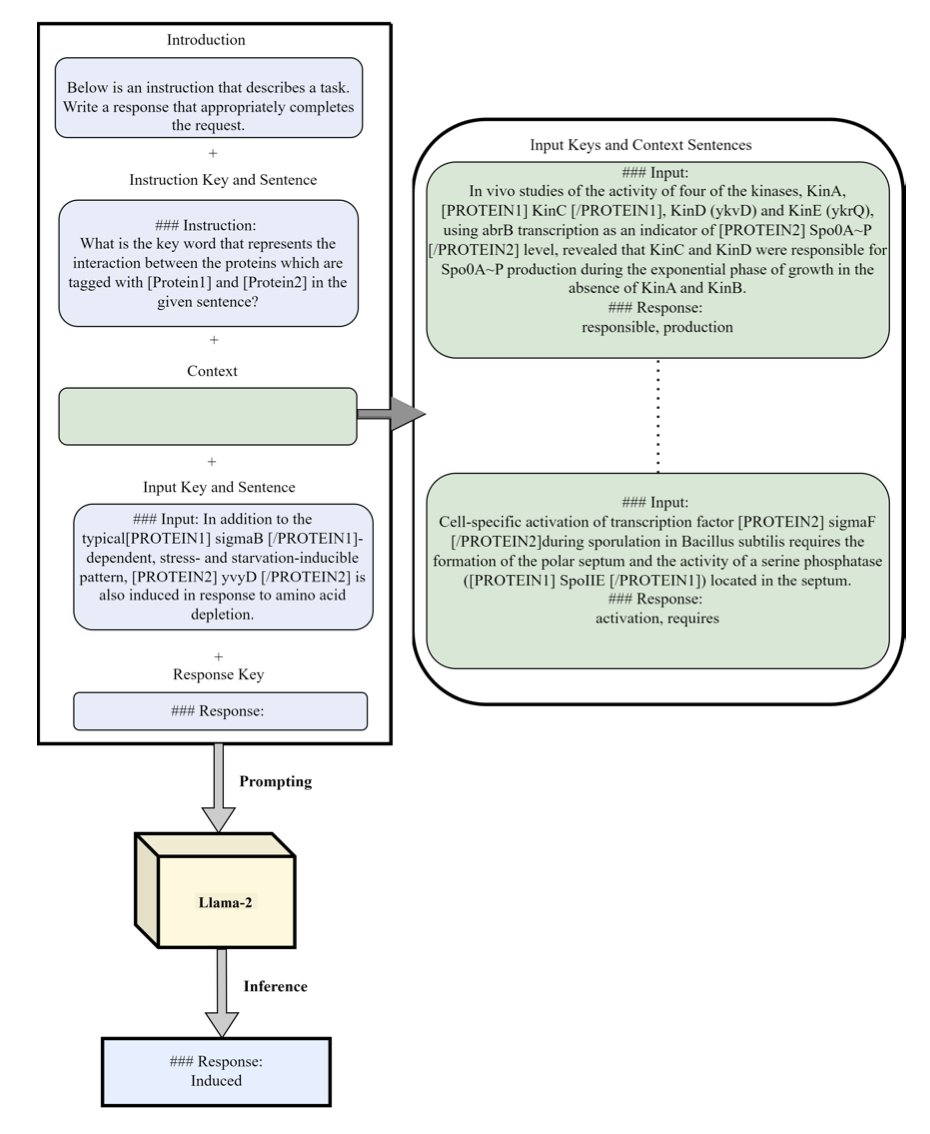
1. This study presents the first ontology-guided method for explaining protein-protein interactions (PPIs) using large language models (LLMs), showcasing how fine-tuned Llama-2 models can extract biologically meaningful interaction keywords directly from biomedical text.
2. The core idea: use LLMs to detect relation-indicating keywords in PPI sentences, then map those keywords to formal Interaction Network Ontology (INO) terms. This bridges free-text literature with structured biological knowledge.
3. A major highlight: smaller, fine-tuned Llama-2 models (7B and 13B) outperformed the much larger Llama-2-70B in both zero-shot and few-shot in-context learning, with the fine-tuned 13B model achieving the best overall F1 score.
4. The researchers applied parameter-efficient instruction fine-tuning using LoRA and 4-bit quantization, enabling resource-efficient model training. This approach showed significant gains over in-context learning, with the 13B model reaching an F1 of 81.3%.
5. They improved the INO ontology by discovering novel keywords not previously included (e.g. “inducible”, “production”, “assembly”). These were added by comparing lemma forms, demonstrating the model’s utility in ontology expansion.
6. Prompts were carefully designed for each learning setup: zero-shot, few-shot, and fine-tuning. Few-shot learning involved 40 input-response examples per prompt, utilizing Llama-2's long context window of 4096 tokens.
7. On a test set of 25 manually annotated PPI sentences, token-wise precision, recall, and F1 were evaluated based on correct INO ID predictions. Fine-tuning clearly surpassed in-context methods, highlighting the importance of task-specific adaptation.
8. This work shows how LLMs and biomedical ontologies can synergize: LLMs extract unstructured relation cues from text, and ontologies provide structured, interoperable representations. Together, they offer a pathway to more interpretable biomedical NLP.
9. The approach is applicable to other biomedical entity relations beyond PPIs, as long as relevant ontologies are available. This opens up possibilities for explainable, ontology-linked NLP pipelines in various biomedical domains.
💻Code: https://t.co/kxmM3kfkKa
📜Paper: https://t.co/TflH4Eq2lZ
#BioNLP #ProteinInteractions #LLM #Ontology #BiomedicalAI #Llama2 #OntologyDrivenAI #ExplainableAI #TextMining

How to group emails by week into arrays in Python - My Tech Life https://t.co/1RqrIRXpbu
#Python #TextAnalysis #TextMining #Statistics

Pythonでメールを週ごとに配列にまとめる - My Tech Life https://t.co/dzLlIL1DJK
#python #TextAnalysis #TextMining #Statistics

Web Scraping with Python - My Tech Life https://t.co/G5zzuAditd
#python #MachineLearning #WebScraping #TextAnalysis #TextMining #statistics

Most Popular Users

Elon Musk 
@elonmusk
240.1M followers

Barack Obama
@barackobama
118.6M followers

Cristiano Ronaldo
@cristiano
114.4M followers

Donald J. Trump
@realdonaldtrump
111.7M followers

Narendra Modi
@narendramodi
106.9M followers

Rihanna
@rihanna
98.6M followers

NASA
@nasa
92.1M followers

Justin Bieber
@justinbieber
91.7M followers

KATY PERRY
@katyperry
89.9M followers

Taylor Swift
@taylorswift13
83.9M followers

Lady Gaga
@ladygaga
75.4M followers

Virat Kohli
@imvkohli
73.3M followers

Kim Kardashian
@kimkardashian
70.8M followers

YouTube
@youtube
68.6M followers

Neymar Jr
@neymarjr
66.3M followers

Bill Gates
@billgates
65.2M followers

Selena Gomez
@selenagomez
63M followers

The Ellen Show
@theellenshow
62.1M followers

CNN
@cnn
61.7M followers

X
@x
60.6M followers