

Top Tweets for #virtualizing

@syssignals will do. check out kplane if you are interested in virtualizing k8s control planes. this is what led us down this rabbit hole

There's something I love about being a Data Analyst, it's so fun when virtualizing.
Although some data challenge a lot but the challenges build me more.

Big moves in the @SonicEcosystem 🪂
@SonicLabs and partners just invested 800,000 $S into @ODXLabs.
- ODX leverages Sonic as its core infrastructure layer, virtualizing blue-chip tokens into on-chain assets that can seamlessly work across all chains and protocols.
- With Sonic powering ODX, DeFi can finally move across chains without shackles.


As Q4 approaches, we're laying the groundwork on multiple fronts to accelerate Sonic into its next chapter.
🌏 Institutional Expansion
🪂 Spawn Closed Early Access
💸 Sonic Testnet 2.1
Full newsletter:
https://t.co/Yd4JjedFP5


🌟RECAP AMA - Anoma Day🌟
If you missed yesterday's AMA then this post is for you.
The AMA is divided into several parts but I will focus on the one that everyone is most interested in, the Anoma Roadmap.
1⃣ What is Anoma ?
💠The Anoma protocol is a distributed operating system.
💠The Anoma network is the interlinked graph of devices running this protocol (which thereby support Anoma applications).
💠The Anoma ecosystem is the group of people, organizations, and other entities which develop the protocol, operate the network, and otherwise support the project.
💠The Anoma token is a coordination device for the ecosystem.
2⃣ Why It’s Different
Traditional OSs are split into:
🔹Desktop OSs — Windows, Linux, macOS
🔹Mobile OSs — iOS, Android
🔹Web Browsers — Chrome, Safari
Anoma runs on top of existing base-level OSs, provides a secure sandbox for apps, and abstracts services from multiple networked devices into a single “virtual machine” for developers—including blockchain integration.
3⃣ What are we trying to provide ?
💠Logical centrality of programming environment and user interface — the entire network can be programmed and reasoned about as if it were one machine [of some form].
💠Actually abstracts the capabilities of the underlying distributed system and gives programmers and users power over it.
4⃣ Basic approach
💠Take this distributed operating system.
💠Gradually deploy it on top of existing crypto infrastructure.
This is easier to bootstrap.
💠Over time, more and more of the network can migrate to “native Anoma”.
5⃣ Three high-level phases
💠Galileo
Virtualizing Anoma DOS on existing chains.
💠Dagon
Networking all the individual deployments into one unified system and state space.
💠Ahra
Deploying the full Anoma world computer.
🌟Galileo – Virtualization
🔹Run privacy-preserving, intent-based applications on any chain via Protocol Adapters (PAs).
🔹Enable transaction services (proving, indexing, fee abstraction).
🔹Introduce Anoma Token + metagovernance.
🔹Current Status: SDK completed, audit completed by @informalinc, documentation updating.
🌟Dagon – Unification
🔹Launch high-speed native Anoma Controllers with execution proofs (“Plasma security”).
🔹Enable cross-chain/multi-domain interoperability.
🔹Add staking, distribution voting, and metastability governance.
🌟Ahra – Full Decentralization
🔹Any device can provide ordering, storage, relay, or solving services.
🔹On-demand local consensus for custom use cases (e.g., games).
🔹Fully decentralized P2P controller consensus.
----------------------------------------------------------
☑️Current Status - Galileo
Anoma is about to launch its Galileo phase, the first mainnet release. The $XAN token audit, including the token distributor mechanism, is complete—hinting that distribution may happen soon.
Why tokens might launch before the final phase:
🔹Governance, staking, and protocol decisions require tokens in circulation from the start.
🔹Although the roadmap mentions launching Anoma’s native token in the final phase, it’s likely the token will appear earlier on other chains and later migrate to the native chain.
Outlook:
With Galileo imminent and all audits done, $XAN could be released sooner than expected.
@anoma
@thekerukeion
#Anoma #AnomaDay #IntentCentric #Web3 #stablecoin


When I say @SonicLabs is builder-first oriented, I mean it's builder-first oriented.
Not just some chain that promises to do right by builders and then goes back on their word. Sonic is already making moves and this is not even their FeeM model.
Just a Few days ago, @SonicLabs injected 400,000 $S into @SiloFinance
And today, as we can see, they've invested another whooping 800,000 into @ODXLabs
(ODX uses Sonic as its main infrastructure layer, virtualizing blue-chip tokens into on-chain assets that work across all chains and protocols)
Read more on that in the quoted tweet👇
Builders, this is your official invitation to come build on @SonicLabs
https://t.co/tHvcBsQayx
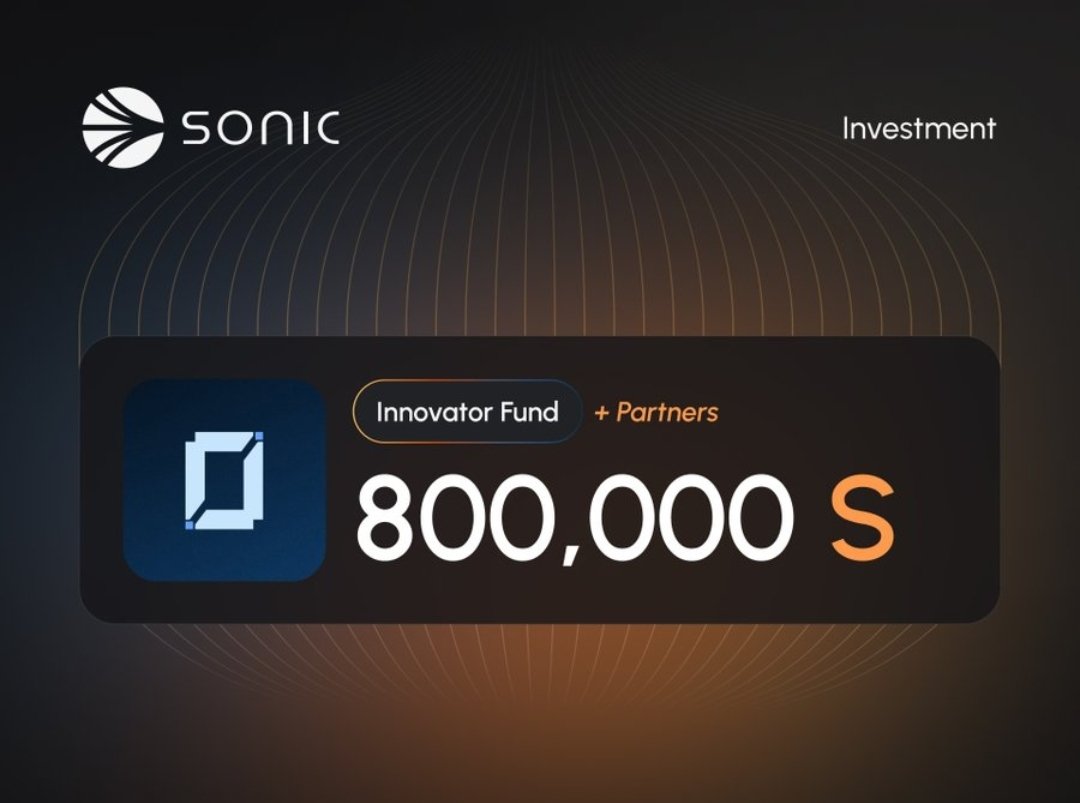
We’ve invested 800,000 $S in @ODXLabs alongside venture partners.
ODX uses Sonic as its main infrastructure layer, virtualizing blue-chip tokens into on-chain assets that work across all chains and protocols.
Who’s next on Sonic?


Day 12 of eating 3 hard-boiled eggs till @union_build TGE
Believe in Something, Believe in Union’s Blockchain interoperability
Union builds on the IBC standard, virtualizing it with ZKPs to enable sub-second messaging and asset transfers across ecosystems like Ethereum, Solana, and Cosmos
$U is coming
Zkgm

Day 11 of eating 3 hard-boiled eggs till @union_build TGE
Believe in Something, Believe in Union’s Blockchain interoperability
$U is coming
Zkgm


✅Virtualizing artificial intelligence
With proper development and deployment of ai technologies
Hop in to @JoinSapien and experience enhanced ai training


@HanBer3000 @virtuals_io Interesting take on $MOXIE does virtualizing change the core demand or just the supply?

@ThePhantomTom Virtualizing reactivity

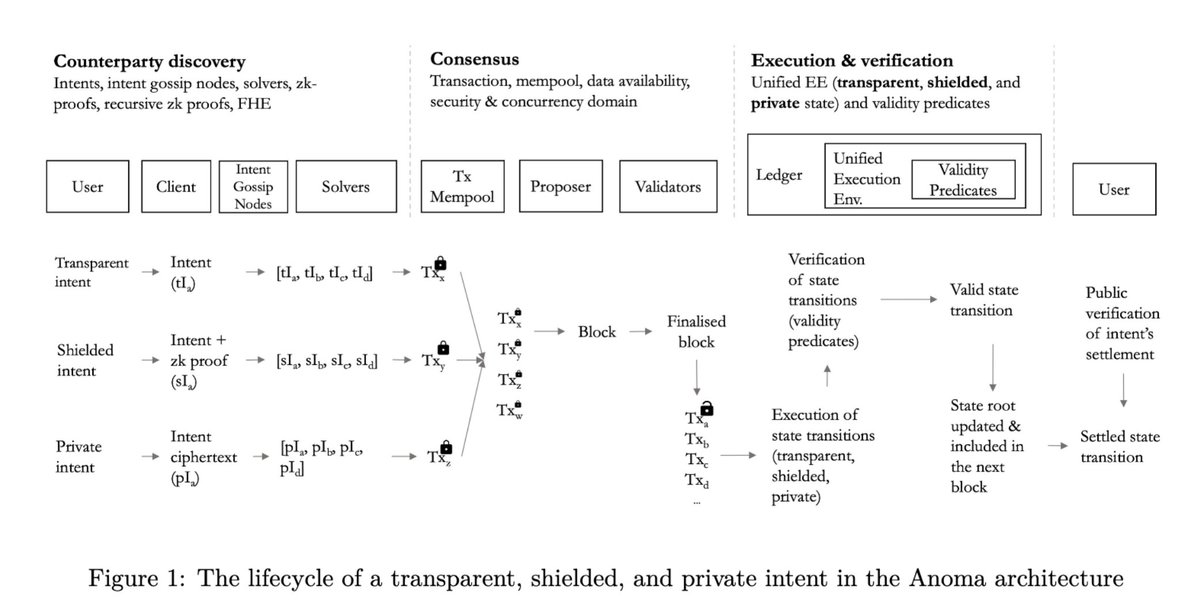
🗣️ Intent Gossip Layer: How Anoma Shares and Solves Intents
We often hear that Web3 is about decentralization; but most networks still rely on rigid transactions, open mempools, and exposed coordination paths. @anoma challenges this with a radically different approach:
Instead of pushing raw transactions to the network, users in @anoma broadcast intents; private declarations of what they want, and let the system handle the rest.
At the center of this process is the Intent Gossip Layer: a sparse, trust-aware, and privacy-preserving overlay network that ensures intents are shared securely, discovered efficiently, and settled only when all pieces align.
Let’s break down how
1. What is the Intent Gossip Layer?
• A virtual, sparse overlay network where signed user intents are shared.
• Nodes broadcasting an intent forward it either broadly to many peers or selectively to specific peers, based on privacy needs or solver specializations.
• These intents are signed and may carry selective info like expiration or fee conditions, so solvers know what they are solving and when.
2. Privacy and Accountability by Design
• Each node is identified by a cryptographic key, not an IP; messages are encrypted, signed, and path-authenticated.
• Receivers can verify the exact relay path of an intent. If a node acts maliciously or out of order, records exist to hold them accountable.
• This is no longer “broadcast it once and forget.” Instead, there is a carefully designed flow where trust matters, fees are incentivized, and privacy remains in focus.
3. Incentives and Fee Distribution
• When submitting an intent, users attach a settlement fee. That fee can be distributed across helpers, relay nodes and the final solver.
• Nodes must carefully consider how much of the fee they claim. If they take too much, no one else will rebroadcast, and that could stall settlement.
• This creates a market for relay services, where nodes balance fee size and network reach, fostering efficient intent delivery.
4. Solver Matching and Complex Coordination
• Once enough compatible intents are known, solvers can fetch them, combine them into a valid multi-party transaction, and submit it for settlement.
• This enables high-level coordination; such as multi-party swaps or collective bidding; not possible with simple transaction broadcasts.
• Because intents are aggregated off-chain and independently by solvers, users benefit from private, optimized, and inclusive execution.
5. Technical Details: Sparse Overlay + Virtual Nodes
• Nodes form a sparse but flexible mesh, adapting to demand and trusted peers, rather than full mesh or random gossip.
• Identities are bound to keys, so nodes can rotate IPs freely while keeping identity consistent. This is like having a virtual network layer built on cryptographic identity.
• The system supports features like threshold cryptography, virtualizing groups of nodes into combined, fault-resistant subnets for secure message handling.
6. Path Authentication & Ever-Present Accountability
• The path authentication mechanism ensures every relay is traceable and verifiable. Think of it as a signed chain of custody for each intent message.
• This allows slashing or penalties if a node misbehaves; crucial for maintaining long-term protocol trust and network hygiene.
Why It Matters
• Privacy is maintained: intents are not publicly logged until settlement, and identity remains behind cryptographic keys.
• Accountability is baked in: misbehaving nodes can be identified and penalized.
• Composable, multi-party workflows become possible: without needing centralized orderbooks, bridges, or sequencers.
• Dynamic, efficient gossiping: nodes dynamically find and relay intents based on real-time needs—not fixed or rigid connections.
Anoma’s intent gossip layer is a privacy-aware, trust-bound, economically incentivized overlay network. It is designed to channel user goals into solver workflows while ensuring data minimization, relay accountability, and cross-chain coordination. It is the backbone of turning decentralized intent into settled reality; all with minimal friction and maximal security.

Believe in @union_build
Zkgm zkgm zkgm
Massive win for flexibility and upgradeability. Virtualizing the stack is the kind of forward thinking the space needs. 🔧🚀

another reason why we completely virtualized the stack
not only we are free to deploy anywhere, but we don't need any hard fork to upgrade as well


@hannaXbtc @virtuals_io The idea of virtualizing ACP and enhancing it with RCP
could really push Virtuals

@hannaXbtc @virtuals_io I like the idea of virtualizing ACP and improving it with RCP—it sounds promising

@BerggoldDigital @MoneroMavrick I haven’t checked it yet but have you tried virtualizing the server and have multiple virtual servers on 1 physical server?

Virtualized Deployment:
Using a hypervisor (either a hardware or software hypervisor), virtual machines (VMs) can be created on top of a physical machine by virtualizing its hardware. This allows for the creation of multiple VMs, each of which can run its own operating system.

@Chikor_Zi Go routines have advantages over threads but it isn’t this exactly. You can have 1000s of real threads on modern computers (not limited by cores, just memory) without virtualizing them the way Go and current Java do.

So finally got some time to play with the idea of virtualizing an API service with AI for prototyping and testing.
Basically, I want to be able to describe a service and use AI to simulate that service in the hopes of getting a feel of what it would behave like in the wild before a line of code is written.
Below is that test running locally against Llama 3 8B Instruct on my GTX1080Ti (soo...yeah...it's painfully slow).
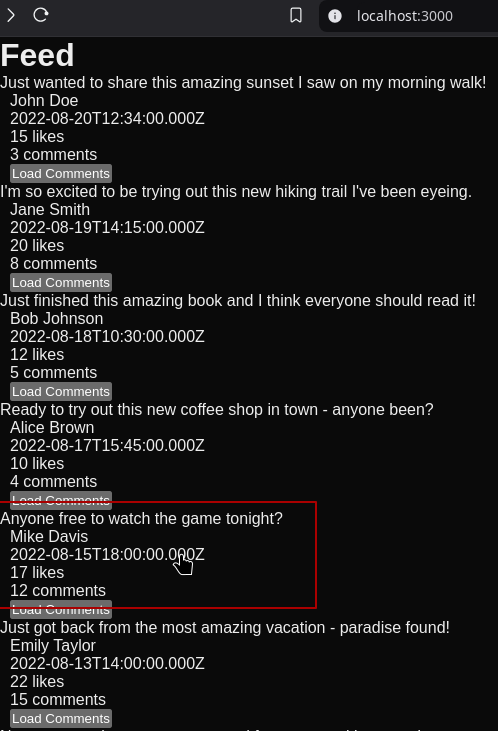
The initial page is a "feed" that is generated from scratch.
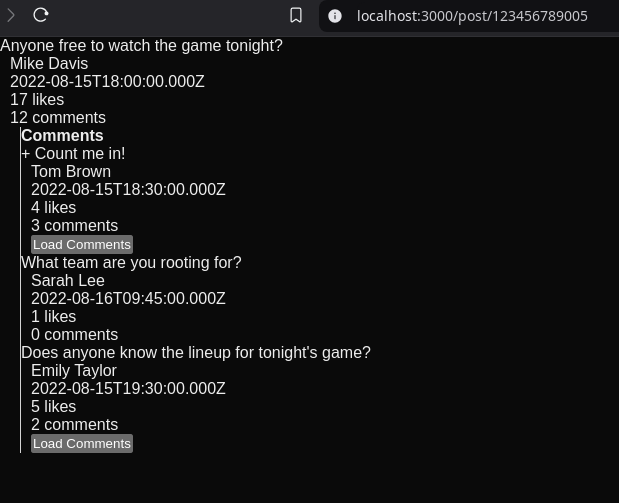
A post is then clicked, opening the post page with the id. Since the history is passed back, the model should return the post it originally generated in the feed.
Then, when clicking "load comments", it should provide responses that make sense (in this case, it should have returned 12 posts, but instead returned only 3, but those posts could pass as real replies to the original post).
Looking forward to how far I can take this idea. Considering I can run it locally on my machine, I'd think that any of the cheaper models available from any of the services should be able to handle this idea with no issue.


@peea1r Then u finna exercise randomly
Meditate each time u get a chance
remember to plan for the next day before sleep, whether by writing a routine down or virtualizing. Stressed mind during the day affect the dream stage when yr mind should is at rest
Most Popular Users

Elon Musk 
@elonmusk
240.1M followers

Barack Obama
@barackobama
118.6M followers

Cristiano Ronaldo
@cristiano
114.4M followers

Donald J. Trump
@realdonaldtrump
111.7M followers

Narendra Modi
@narendramodi
106.9M followers

Rihanna
@rihanna
98.6M followers

NASA
@nasa
92.1M followers

Justin Bieber
@justinbieber
91.7M followers

KATY PERRY
@katyperry
89.9M followers

Taylor Swift
@taylorswift13
83.9M followers

Lady Gaga
@ladygaga
75.4M followers

Virat Kohli
@imvkohli
73.3M followers

Kim Kardashian
@kimkardashian
70.8M followers

YouTube
@youtube
68.6M followers

Neymar Jr
@neymarjr
66.3M followers

Bill Gates
@billgates
65.2M followers

Selena Gomez
@selenagomez
63M followers

The Ellen Show
@theellenshow
62.1M followers

CNN
@cnn
61.7M followers

X
@x
60.6M followers