

Top Tweets for #visualvm

@gutsOfDarkness8 2/2 If you think it's too much you should measure the size via visualVm etc. and identify where the issue is exactly and not blindly predefine sizes of Maps/Lists etc..The pre defined size is not really the problem. It's the size for it's content.

Concepts to master to become better at Multithreading ✅
1. Thread Lifecycle
2. Concurrency Utilities like ExecutorService, Future, CountDownLatch, etc.
3. Locking Mechanisms
4. Java Memory Model
5. Using Tools like VisualVM, JFR, JConsole, etc.
The first rule of optimisation is don’t guess.
Use Tools to gather data:
1. Spring Boot Actuator for metrics
2. Micrometer + Prometheus for observability
3. JProfiler and VisualVM for memory and CPU profiling
4. Custom log timings in key methods

Java Tip 💡: Use tools like VisualVM to profile your project and identify performance bottlenecks. #Java #Performance

Don’t stress over Java in 2025 ☕
Java is only this much 👇
1. Intro to Java
• Definition (OOP, Platform-Independent)
• JVM, JRE, JDK
• Compile vs Interpreted (Bytecode)
• Key Features (Portability, GC, Multi-threading)
• HelloWorld Structure
2. Basic Syntax
• Classes, `main` method
• Variables (Primitives vs Objects)
• Comments, Naming Conventions
• Packages, `import` Statements
3. Data Types
• Primitives (`int`, `double`, `boolean`)
• Wrapper Classes (`Integer`, `Boolean`)
• `String` Immutability, `var` (Type Inference)
• Arrays, `enum`
4. OOP Concepts
• Encapsulation (Getters/Setters)
• Inheritance (`extends`, `super`)
• Polymorphism (Overloading/Overriding)
• Abstraction (Abstract Classes, Interfaces)
5. Control Flow
• `if-else`, `switch` (Arrow Syntax)
• Loops (`for`, `while`, `do-while`)
• `break`, `continue`, Labels
• Ternary Operator
6. Methods
• Signature (Return Type, Parameters)
• Pass-by-Value vs Pass-by-Reference
• Varargs, Method Overloading
• Recursion, `static` Methods
7. Arrays & Collections
• Array Initialization
• `ArrayList`, `LinkedList`, `HashMap`
• Iterators, Enhanced `for` Loop
• Sorting (`Comparator`, `Comparable`)
8. Exception Handling
• `try-catch-finally`
• Checked vs Unchecked Exceptions
• Custom Exceptions
• `try-with-resources`
9. File I/O
• `File`, `FileReader`, `BufferedReader`
• NIO (`Path`, `Files`)
• Serialization/Deserialization
• JSON/XML Parsing (Libraries)
10. Multithreading
• `Thread` Class vs `Runnable`
• `synchronized`, `volatile`
• Thread Pool (`ExecutorService`)
• `CompletableFuture` (Async)
11. JDBC & Databases
• Drivers, Connection Pooling
• `Statement`, `PreparedStatement`
• Transactions, CRUD Operations
• ORMs (Hibernate, JPA)
12. Annotations & Reflection
• Built-in Annotations (`@ Override`)
• Custom Annotations
• Reflection API (Class Inspection)
13. Generics
• Type Parameters (`List<String>`)
• Bounded Types (`<T extends Number>`)
• Wildcards (`?`, `? super T`)
14. Lambda & Streams
• Functional Interfaces (`Predicate`, `Consumer`)
• Method References (`System.out::println`)
• Stream API (`filter`, `map`, `reduce`)
• Parallel Streams
15. Memory Management
• Heap vs Stack
• Garbage Collection (Young/Old Gen)
• `finalize()`, Weak References
• Memory Leaks
16. Design Patterns
• Singleton, Factory, Builder
• Observer, Strategy, Decorator
• Adapter, Proxy
17. JVM Internals
• Class Loaders, Bytecode
• JIT Compiler, JVM Flags
• Profiling Tools (VisualVM)
18. Build Tools
• Maven (`pom.xml`)
• Gradle (Groovy/Kotlin DSL)
• Dependency Management
19. Frameworks
• Spring (Boot, MVC, Security)
• Hibernate (JPA)
• Jakarta EE, Micronaut
20. Concurrency Utilities
• `Lock`, `Semaphore`, `CountDownLatch`
• Concurrent Collections (`ConcurrentHashMap`)
• `ForkJoinPool`
21. Networking
• Sockets (`ServerSocket`, `Socket`)
• HTTP Clients (HttpURLConnection, HttpClient)
• REST APIs (Spring REST)
22. Security
• `SecurityManager`, Permissions
• Cryptography (`MessageDigest`, `Cipher`)
• SSL/TLS, JWT
23. Advanced Topics
• Reflection, Proxies
• JNI (Native Methods)
• Modules (Java 9+), JPMS
24. Testing
• JUnit, TestNG
• Mocking (Mockito)
• TDD/BDD Basics
25. Future of Java
• Project Loom (Virtual Threads)
• Project Valhalla (Value Types)
• Pattern Matching, Records
• GraalVM (Native Compilation)
-------------- END --------------
❤️ Like and comment your feedback
♻ Repost to help others find it
Your support immensely motivates me to keep sharing more awesome tech content with you. 😊

As a Java developer,
Please learn:
1. Core Java Mastery
- OOP principles (SOLID, DRY, KISS)
- Generics, Lambda expressions, Functional interfaces
- Java Streams API (map/reduce, collectors)
- Java Collections framework
- Java Reflection API
- Exception handling
2. Multithreading & Concurrency
- Thread synchronization, Executors, Locks
- Fork/Join framework
- Understanding of race conditions, deadlocks, and thread pools
- Concurrency utilities (java.util.concurrent)
3. Design Patterns & Architecture
- Common design patterns (Singleton, Factory, Builder)
- Architectural patterns (MVC, - Microservices, Event-Driven Architecture)
- Dependency Injection (DI), Inversion of Control (IoC)
4. Java Memory Management
- Garbage Collection (G1, CMS, ZGC)
- JVM heap and stack management
- Profiling tools (JProfiler, VisualVM)
- Analyzing memory leaks, thread dumps, and heap dumps
5. Classloaders and Reflection
- Custom class loaders
- Dynamic class loading
- Reflection for runtime behavior manipulation
6. Spring Framework & Spring Boot
- Spring Core (Dependency Injection, AOP)
- Spring Boot (Auto-configuration, Microservices support)
- Spring Security (OAuth2, JWT)
- Spring Data (JPA, Hibernate integration)
- Spring Cloud (Netflix OSS, Circuit Breakers)
7. Microservices Architecture
- Service discovery (Eureka, Consul)
- Load balancing, distributed tracing, and circuit breaking
- API Gateway (Zuul, NGINX)
- Asynchronous communication with Kafka, RabbitMQ
8. RESTful Web Services
- REST principles, building APIs
- JSON/XML handling
- API versioning, OpenAPI/Swagger documentation
9. Java I/O and NIO
- Blocking vs non-blocking I/O (NIO)
- Asynchronous I/O, channels, selectors
- File handling, serialization and deserialization
10. Reactive Programming
- Project Reactor, RxJava
- Event-driven architecture, backpressure
- Reactive streams, non-blocking IO
11. JPA/Hibernate
- ORM principles, entity relationships
- Lazy vs eager loading
- Caching strategies, query optimization
12. Database Optimization
- SQL optimization, indexing, and transactions
- NoSQL databases (MongoDB, Cassandra)
- ACID principles, CAP theorem
13. Distributed Systems
- Consistency, availability, partitioning (CAP)
- Event sourcing, CQRS (Command Query Responsibility Segregation)
- Distributed caching (Redis, Hazelcast)
- Tools: Apache ZooKeeper, Consul, etcd
14. Testing & TDD/BDD
- Unit testing (JUnit, Mockito)
- Integration and functional testing
- Behavior-driven development (Cucumber)
15. CI/CD & DevOps
- Continuous integration (Jenkins, CircleCI)
- Containerization with Docker
- Orchestration with Kubernetes
- Source control (Git), versioning, branching strategies
16. Performance Tuning & Optimization
- JVM tuning, garbage collection optimization
- Caching strategies, load balancing
-Tools for profiling and monitoring (Prometheus, Grafana)
17. Security
- Authentication/authorization (OAuth2, JWT)
- Secure coding (OWASP guidelines)
- Encryption (TLS/SSL), CSRF/XSS prevention
18. Cloud Platforms & API Gateways
- AWS, Azure, GCP deployment
-API Gateway (Zuul, NGINX) for rate-limiting and routing
- Cloud-native microservices tools
19. Logging & Monitoring
- Centralized logging (ELK Stack, Graylog)
- Distributed tracing (Jaeger, Zipkin)
- Application Performance Monitoring (APM)
20. Caching Mechanisms
- In-memory caching (Ehcache, Caffeine)
- Distributed caching (Redis, Memcached)
- Cache invalidation strategies (LRU, LFU)
21. Build Tools
- Maven and Gradle for dependency management
- Multi-module project handling
- Continuous delivery pipelines
22. Message Queuing Systems
- Kafka, RabbitMQ for event-driven microservices
- Pub/Sub models, distributed message brokers

9/9: Elevate your Java profiling experience by seamlessly integrating these open-source profilers with popular IDEs like @intellijidea. VisualVM, YourKit, and others offer plugins and integrations, enhancing your development workflow and making performance tuning a breeze.🚀
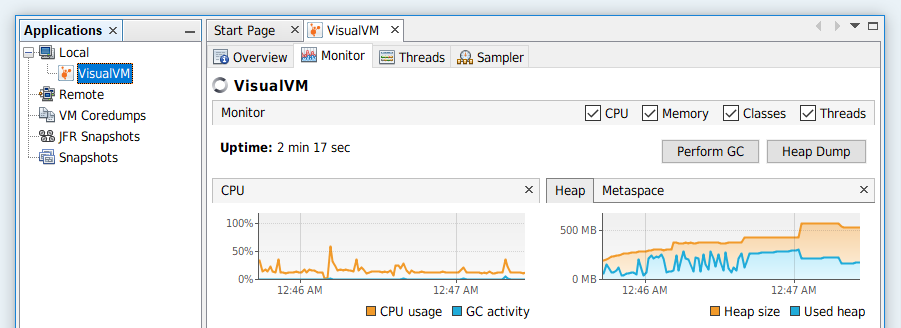

@ce_adarsh @0xCaponte So do you want to do profiling or do you need time series metrics?
If the first one: visualvm, yourkit, jprofiler.
If the second one: add actuator that brings in micrometer and add a micrometer registry of your choice.

Is there a better way of checking OOM’s while running unit tests? Currently, I am using heap dump from the running tasks via VisualVM.

@BenomarShahen Quick fix: assign more memory.
Not so quick fix: investigate how many different contexts are created during tests and what actually takes this memory - you can use VisualVM to analyse heap.
Trends for you
Most Popular Users

Elon Musk 
@elonmusk
239.7M followers

Barack Obama
@barackobama
118.6M followers

Cristiano Ronaldo
@cristiano
114.3M followers

Donald J. Trump
@realdonaldtrump
111.7M followers

Narendra Modi
@narendramodi
106.9M followers

Rihanna
@rihanna
98.6M followers

NASA
@nasa
92.1M followers

Justin Bieber
@justinbieber
91.7M followers

KATY PERRY
@katyperry
89.9M followers

Taylor Swift
@taylorswift13
83.9M followers

Lady Gaga
@ladygaga
75.4M followers

Virat Kohli
@imvkohli
73.3M followers

Kim Kardashian
@kimkardashian
70.8M followers

YouTube
@youtube
68.6M followers

Neymar Jr
@neymarjr
66.3M followers

Bill Gates
@billgates
65.1M followers

Selena Gomez
@selenagomez
63M followers

The Ellen Show
@theellenshow
62.1M followers

CNN
@cnn
61.7M followers

X
@x
60.6M followers