Three failed swaps and $14 in gas, for nothing.
That's not a bad day in crypto. That's another Tuesday. And if you've been in DeFi longer than a month, you already know the routine.
Here's what nobody tells you about that experience!
The swap wasn't hard. The concept was fine. You knew what you wanted, token A for token B. Five seconds of intent.
But between that intent and execution, the system handed you a stack of invisible responsibilities.
Monitor gas. Choose your route. Estimate slippage. Time the confirmation window. And if any of it breaks, you're the retry button.
That's not a UX problem. That's a staffing problem. You became the backup system. Think about that for a second. Every app you use in traditional finance, Venmo, Wise, even your banking app, handles failure internally.
If a payment doesn't go through, the system reroutes, retries, or tells you exactly why. You don't manually adjust infrastructure parameters and hope for the best.
But in DeFi, failure is your job to manage.
And this is where the real damage happens. It's not the $14 in gas. It's what that experience does to trust.
One failed transaction is annoying. Two is frustrating. Three and you start questioning the entire system. Not the protocol. Not the specific app.
The whole idea that you can move money on-chain reliably. That's not churn from complexity. That's churn from broken promises. The interface said "confirm" and then didn't deliver. Repeatedly.
The industry keeps diagnosing this as a design problem. Better buttons. Cleaner flows. Friendlier onboarding.
But design can't fix a delegation problem. No amount of UI polish changes the fact that the user is carrying execution risk that should belong to the system.
The real shift isn't prettier dashboards. It's moving execution ownership away from the user entirely.
The moment someone states what they want, the infrastructure should handle everything between intent and outcome, routing, retries, optimization, failure recovery.
That's an architecture change and it's already happening.
Crypto wallets haven't changed much in years.
They store your assets. They sign transactions. They show balances. That's about it.
Most wallets are vaults, not assistants. They secure what you have but don't help you do anything with it 👇
This old model works, but it's passive. Your wallet waits for you to tell it what to do. It doesn't suggest opportunities.
It doesn't alert you to risks. It doesn't help you make decisions. It just sits there, holding your assets until you decide to move them.
The Problem with Passive Storage
Open any crypto wallet and you'll see the same features: token balances, portfolio value and transaction history.
When you want to do something beyond storage, you leave the wallet.
> Swap tokens? Open a DEX.
> Check DeFi opportunities? Go to a protocol.
The wallet doesn't facilitate these actions, it just holds the assets you'll use elsewhere.
This creates fragmentation. You manage assets in one place and interact with them in another. The wallet becomes a checkpoint, not a tool.
Opportunities get missed because wallets don't surface them. You might hold tokens earning nothing when they could generate yield. Your wallet knows you hold them, but won't tell you where to deploy them.
Risks go unnoticed, too. Token approvals accumulate, concentrated positions increase, but the wallet simply displays data without taking action.
What Active Wallets Look Like
The shift from passive to proactive means using the data wallets they already have. Instead of just displaying balances, analyze them. Instead of waiting for input, suggest relevant actions.
A good wallet could monitor holdings and alert you to opportunities. Idle stablecoins? Here are the yield options. Concentrated position? Consider diversification.
The wallet becomes a tool that helps you manage assets, not just store them.
Wallet integration with Haia means the wallet becomes conversational.
Ask what you hold, execute swaps, explore DeFi, all without leaving wallet context. The assistant provides intelligence. The wallet handles execution. Storage stays secure, but the tool becomes active.
This removes fragmentation between storage and action. Your assets live in the wallet. Actions happen through the wallet. Everything stays unified.
Wallets will evolve from passive storage to active tools. Users want more than a place to hold
DAO is live.
You can now:
— lock HAUST
— get veHAUST
— create proposals
— shape the future of the ecosystem
Ownership is nothing without participation.
Now it’s your move https://t.co/9P9MmdxUnr
You launched a rollup. You got the integrations. You shipped the docs.
Nobody's using it the way you expected.
The infrastructure works. The tech is solid. Transactions finalize. Bridges connect. The stack does what it's supposed to do. But the humans on the other end don't behave like the testnet users did. They land on the ecosystem, look around, and leave. Not because something broke. Because nothing guided them.
This is the gap infrastructure teams keep ignoring.
Building the rail is not the same as making people ride it. And right now, most rollups are shipping execution environments without any intelligence layer on top. The assumption is that apps will come, apps will bring users, and users will figure it out.
That worked when crypto was a niche game for technical people. It doesn't work when you're trying to onboard the next million.
Think about what a new user actually faces when they arrive at your ecosystem. They need to bridge assets. Choose a protocol. Understand gas on your chain. Navigate apps they've never seen. Make decisions about risk they can't evaluate. All of this before they do the one thing they came to do.
Most don't make it past step two.
And the infrastructure team looks at the dashboard and sees "low TVL" or "poor retention" and thinks the problem is distribution. Or incentives. Or marketing.
It's none of those things.
It's the absence of an orchestration layer between the user and the infrastructure. A layer that takes what the user wants to accomplish and translates it into the right sequence of actions across your ecosystem. Without asking them to understand the architecture underneath.
Rollups that figure this out early will compound their advantage. Because once a user successfully executes their first intent without friction, they stay. They explore. They bring others. The ecosystem grows from usage, not from grants.
The ones that don't figure it out will keep spending on incentive programs that attract mercenary capital and temporary attention. The TVL charts will spike and crash. The dashboards will look busy during campaigns and empty after.
Infrastructure without intelligence is just plumbing.
Good plumbing matters. But nobody chooses a house because of the pipes. They choose it because everything works when they turn the handle. That's what an agent layer does for your rollup. It makes the infrastructure invisible and the outcome obvious.
The user says what they want. The agent builds the path across your ecosystem. Execution happens on your rails. Ownership stays with the user. Keys never leave their device.
Your infrastructure does what it was built to do. It just finally has a layer that lets normal people use it without thinking about it.
HAIA is that layer. Not a product competing for your users. Infrastructure that makes your infrastructure actually usable.
If you're building a rollup and your retention numbers don't match your tech, the missing piece isn't another protocol integration. It's the intelligence layer you haven't added yet.
Bringing AI into the real world.
How do we move AI from theory to real utility in Web3 and finance?
Join us for a live discussion with builders working on AI agents, spatial intelligence, and next-gen financial interfaces.
🗓 Tuesday, March 17
⏰ 12:00 UTC
Hosts:
@HaustNetwork
Co-host:
@CoConnect_
Guests:
@tagSpaceCo@haia_os
🎙 Set reminder & join the Space:
https://t.co/wtwvwzkzLk
Let’s talk about the future of AI-powered infrastructure and real-world adoption.
Finding opportunities in DeFi still depends on Twitter threads, Discord channels, or manually researching protocols.
There's no efficient discovery layer. Users hunt for alpha instead of having it surface automatically.
This isn't how discovery should work 👇
How Users Discover DeFi Today
Most people find DeFi opportunities through external sources. Someone tweets about a new yield farm.
A Discord shares a protocol launch. You manually check aggregators and compare APYs across platforms. Discovery is active research, not intelligent surfacing.
This creates friction. You need to know where to look, who to follow, which communities matter. Miss the right Twitter thread and you miss the opportunity.
Don't check the right aggregator and you don't see the yield. Discovery depends on being plugged into the right information sources constantly.
Why Discovery Depends on Fragmented Sources
DeFi lacks a unified discovery layer. Protocols exist across chains, information spreads across platforms, and no single tool aggregates everything intelligently.
Users patch together knowledge from multiple sources and hope they're not missing something important.
This creates information asymmetry. People with time to research constantly find opportunities.
Everyone else discovers them late or not at all. Alpha exists, but access is uneven. Discovery shouldn't require full-time attention.
How Discovery Should Work
Intelligent discovery means opportunities surface based on what you actually hold and how you use DeFi.
Hold stablecoins? Here are yield options sorted by risk. Interact with lending protocols? Here are new markets worth considering. Trade frequently? Here are liquidity opportunities.
The system should know your profile and suggest relevant opportunities automatically. You're not hunting for alpha. Alpha comes to you based on context the system already has.
@Haia_os demonstrates this approach. Instead of manually researching DeFi, you ask what's available. The assistant surfaces opportunities sorted by relevance to your holdings and behavior. Yields, risks, and strategies get presented based on what you actually need, not generic lists.
Discovery becomes conversational. "Show DeFi opportunities" returns options that make sense for your portfolio. Then you can curate them and understand how they can add to you.
Always remember to DYOR 😉
The Path Forward
DeFi discovery will shift from manual research to intelligent surfacing. Users want relevant opportunities, not exhaustive lists. They want context-aware suggestions, not generic aggregation.
The information exists. The discovery layer just needs to connect it to users intelligently.
@Haia_os shows what that looks like: opportunities surface automatically, research happens in
Ready for another Space, traders?
This week, we’re diving into AI trading.
🎙️ AI Trading is Booming. Here’s how they do it!
Join us for a fun conversation with👇
@0x_Markets | @haia_os | @MyQuantgg
🎙️Hosted by @RikwijkV & @leagueoftraders
📅March 5 | 11 PM UTC
🔔Join us: https://t.co/iD6dD3fMDL
🎁Stick around till the end for a live giveaway - tune in, like & RT to enter!
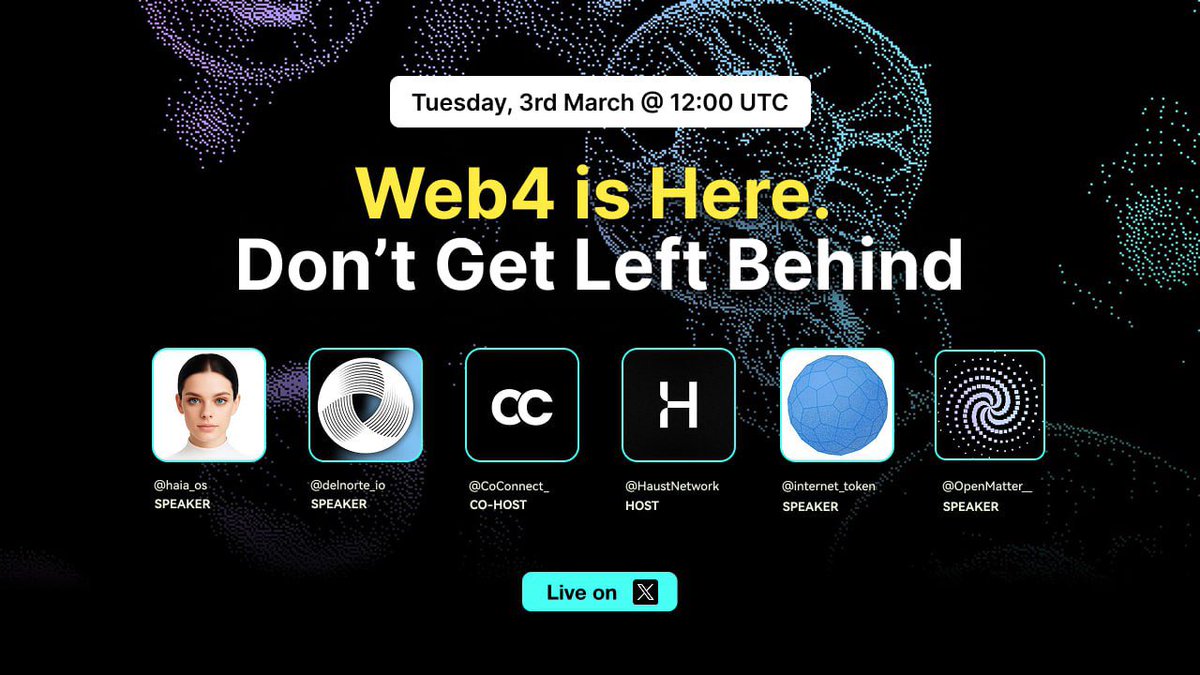
Web4 is Here. Don’t Get Left Behind.
🗓 Today, 3rd March
⏰ 12:00 UTC
📍 Live on X
The next evolution of the internet is unfolding — and we’re bringing together some of the sharpest minds building it.
Our guests:
🎙 @haia_os
🎙 @delnorte_io
🤝 @CoConnect_ — Co-host
🏠 @HaustNetwork — Host
🎙 @internet_token
🎙 @OpenMatter_
We’ll dive into:
• What Web4 actually means
• Infrastructure + AI convergence
• The future of decentralized ecosystems
• Where the real opportunities are
If you’re building, investing, or simply watching the space evolve — this conversation is for you.
See you there fam
@MilkRoad@VitalikButerin Finality at 8 seconds changes user behavior more than any token incentive ever could. Right now crypto UX feels like sending a wire transfer. At 8 seconds, it feels like a tap
@AshCrypto Quantum computers powerful enough to break ECDSA don't exist yet. But Ethereum moving now means the upgrade happens on their terms, not in panic mode. Four years of planned forks beats one emergency hardfork under fire
@raintures Absorption zones don't announce themselves. They just stop breaking. $60–70K spent months doing exactly that, and the lawsuit gave retail an exit narrative while smart money quietly filled bags. The timing was convenient
@MaxCrypto Geopolitical shocks create the fastest recoveries. Capital that left on fear tends to return before the headline risk resolves. Macro scared money rarely stays out long
@cyrilXBT Sellers exhausted at $2K after multiple tests. That's not support anymore, that's rejection of lower prices. $2.2K–$2.4K clears and the narrative flips entirely. Market memory is short but structure isn't