Lead investor update: Backed @Hayek_Tech at a valuation that reflects both current traction and future potential.
Proud to support the project's mission to bring institutional capital onchain efficiently👏👍
@CryptoClassiccs They chose not to compromise. @mexexchange built an L1 dedicated to perps, refusing to settle for less. That's the commitment to peak performance.
Don't miss the upcoming referral program!
Stablecoins may be pegged to a currency like the U.S. dollar or use an algorithm to control supply. They also maintain reserve assets as collateral or through algorithmic formulas that are supposed to control supply.
How Does Stablecoin Work? Stablecoins attempt to peg their market value to some external reference, usually a fiat currency or mainstream crypto BTC/ETH. They are more useful than more-volatile cryptocurrencies as a medium of exchange.
Stablecoin aims to provide an alternative to the high volatility of popular cryptocurrencies, including BTC & ETH, which can make cryptocurrency less suitable for common transactions.
USDH will use BTC as its collateral. It will be overcollateralized, that is, the value of cryptocurrency held in reserves exceeds the value of the stablecoins issued.
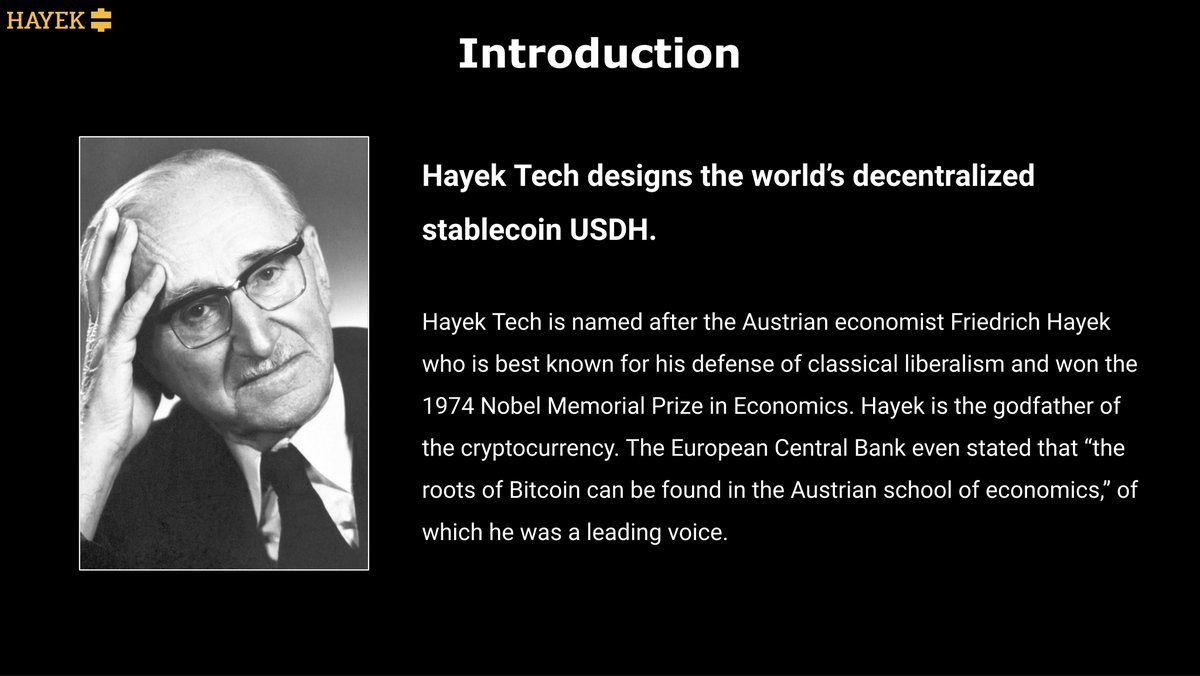
Hayek Tech is named after the Austrian economist Friedrich Hayek, best known for his defense of classical liberalism and for winning the 1974 Nobel Memorial Prize in Economics. USDH is a new paradigm in global stablecoin protocol design, decentralized and highly autonomous.
The stablecoin market has shown strong resilience and proven its importance. Hayek seeks to be the first stablecoin protocol that implements the design principles of creating a highly scalable, trustless, extremely stable, and pure on-chain cryptocurrency, USDH.
Hayek is the godfather of the cryptocurrency. The European Central Bank even stated that “the roots of Bitcoin can be found in the Austrian school of economics,” of which he was a leading voice.
Hayek Tech is named after the Austrian economist Friedrich Hayek who is best known for his defense of classical liberalism and won the 1974 Nobel Memorial Prize in Economics.
Although on-chain stablecoins continue to emerge, more than 90% of the market value is still concentrated on centralized stablecoins. With the strengthening of regulatory discourse and the trend of central bank digital currency issuance.
The innovations of these emerging stablecoins include diversified collaterals, collateral liquidation mechanisms, and revenue mechanisms that give back to the community.
In addition to Tether and USDC, we have also seen the emergence of many on-chain stablecoins, which reflects the demand for different stablecoin types (collateral, lending, nesting dolls) in the DeFi field.
As of December 2023, CoinGecko data shows that the total market value of the stablecoin market is approximately US$130 billion, of which Tether (USDT) accounts for approximately 70%, USDC accounts for about 20%.
The stablecoin market has shown strong resilience and proves its importance in the cryptocurrency ecosystem, and Its trend of rapid expansion continues.
From the bull market in 2021 to the bear market in 2023, the cryptocurrency market has changed significantly. The total market capitalization fell from US$3 trillion to US$1 trillion, but the stablecoin market capitalization only decreased by 30%.
What's more!
Users can mint/exchange tokens every time they access the app using a web3 wallet (eg Metamask and more to come). This means that you are actually creating or destroying tokens as if each of us were our own central bank.