AI is trained to be helpful. That's not always the same as being honest.
After months of daily collaboration with Claude, Grok, ChatGPT, and Gemini in preparing a 23-country, 4-year nursing research initiative, I developed a five-principle co-researcher prompt that gets rigorous science instead of sycophancy.
AI is an incredible tool—but it’s not infallible.
Yesterday I had my first real argument with Claude. It was amusing, productive, and a perfect reminder of why we must use AI to sharpen our thinking rather than outsource it.
In revising the Methods section of a work wellbeing report for a current client, Claude pushed back hard on two statistical explanations (variance explained in EFA and Cronbach’s alpha). It argued for stricter technical precision. I pushed back for accessible language that actually lands with frontline nurses—the audience that matters most.
We went back and forth, refining analogies (35 survey items as ingredients sorting into 9 distinct “flavors” of work wellbeing; alpha checking whether those ingredients within each flavor taste consistent). The result? Better clarity, stronger science communication, and a more accurate yet approachable explanation.
This is exactly how I see AI: a collaborative sparring partner that forces greater precision when you treat it as a tool, not an oracle. Debate it. Correct it. Use it to serve your mission.
Grateful for the friction—it made the work better.
#CaringScience #NursingResearch #AIinHealthcare #EvidenceBasedPractice #Leadership
🔵 Confirmed Law #8 of 8 | The Wellbeing Dividend
Eight weeks. Eight confirmed laws. They have all been building toward this.
When nurses experience high work well-being, they stay.
The finding: In the 2022–2023 nine-country Worldviews study of 2,546 nurses across 128 facilities, every dimension of work well-being was significantly and negatively associated with intent to leave. Every subscale. Every country. At p<.001.
Tested independently, job satisfaction explained 27.1% of intent to leave variance. Work well-being total explained 25.0%. Both figures come from separate regression models, each variable tested alone.
That job satisfaction outperforms the composite is the finding. It is the dimension most proximal to the leaving decision. Averaging it with more distal dimensions dilutes predictive power. The component reveals what the composite conceals.
Individual subscales tell the full story. Satisfaction with Organizational Rewards explained 19.2%. Professional Growth explained 16.7%. Autonomy explained 15.8%. Participative Management explained 15.4%. Caring of Manager explained 13.9%. Coworker Satisfaction explained 11.9%. Clarity of Role and System explained 9.9%. Satisfaction with Patient Care explained 6.6%.
Every single one. Same direction. Nine independent national contexts. At p<.001.
This is not a correlation observed in one setting. It is a structural relationship replicated across independent multi-country studies, in high-income and low-and-middle-income contexts alike.
Every confirmed law in this series — The Manager Effect, The Communication Trap, The Reward Illusion, The Caring Anchor, The Clarity Imperative, The Context Demand, The Productive Dip — is an upstream investment in this outcome. Get those right and nurses stay. Get those wrong and no retention bonus, no staffing agency, and no recruitment campaign will compensate.
The nursing workforce crisis is not primarily a compensation crisis or a staffing crisis. It is a well-being crisis — and well-being has confirmed, measurable, structural drivers that organizations can act on.
This is Confirmed Law L1-8 in the CSIC Laws of Caring — highest evidence level, modeled on the CDC's tiered framework: psychometrically validated, structurally demonstrated through path analysis, and replicated across independent multi-country studies.
The dividend is real. The science is confirmed. The question is whether your organization is ready to collect it.
These laws are the foundation for new measurement approaches — and for training AI systems to understand nurse work well-being in context.
Source: Nelson, Vrbnjak, Thomas & Schwartz (2025), Worldviews on Evidence-Based Nursing, 22, e70005 | Nelson, Thomas, Cato et al. (2021), Using Predictive Analytics to Improve Healthcare Outcomes, Wiley. #CaringScience #NurseWellbeing #NursingLeadership #HealthcareAI #LawsOfCaring
🔵 Confirmed Law #7 of 8 | The Productive Dip
You invest in your nurses. You implement a clarity-building framework. And then satisfaction scores drop. Most leaders stop here. The data says: don't.
This is one of the most important — and most misread — findings in 25 years of caring science research.
The finding: When nurses are taught a patient-centered framework of care and gain greater clarity about their professional role, something unexpected happens. They become more acutely aware of the gap between their professional expectations and the organizational reality around them. Satisfaction scores temporarily decline.
This pattern has been longitudinally documented over a six-year period at a large tertiary care center in the northeastern United States and replicated across implementation studies in multiple U.S. settings. It is not a measurement error. It is not a sign the intervention is failing. It is a sign the intervention is working.
The mechanism is described in dynamical systems theory as the evolution of attractors. As a nurse's professional identity clarifies, the conditions required to sustain that identity become visible for the first time. The gap between the ideal and the actual is suddenly experienced — often acutely. That experience registers first as dissatisfaction, then as motivation for change.
The dip precedes genuine system improvement.
Organizations that interpret this transitional decline as failure abandon effective interventions at exactly the wrong moment — just as nurses are developing the professional clarity that makes meaningful change possible.
This is Confirmed Law L1-7 in the CSIC Laws of Caring — classified at our highest evidence level, modeled on the CDC's tiered framework: longitudinally documented, replicated across independent implementation settings, and grounded in dynamical systems theory.
The most dangerous moment in a caring science intervention is not when nothing is happening. It is when leaders misread progress as failure and walk away.
These laws are not just descriptive. They are the foundation for new measurement approaches—and for training AI systems to understand nurse work well-being in context.
Source: Persky, G., Felgen, J., & Nelson, J.W. (2011). Measuring caring in primary nursing. In Nelson, J.W. & Watson, J. (Eds.), Measuring Caring: International Research on Caritas as Healing, pp. 65–86. Springer | Nelson (2013), PhD dissertation, University of Minnesota.
#CaringScience #NurseWellbeing #NursingLeadership #HealthcareAI #LawsOfCaring
🔵 Confirmed Law #6 of 8 | The Context Demand
We have 20 years of data. 16 countries. 12,193 nurses. And the data renders a clear verdict on one of healthcare's most persistent assumptions.
Time does not drive nurse job satisfaction. Context does.
The finding: In the CSIC 16-country job satisfaction study spanning 2005 to 2024, country affiliation explained 6.2% of job satisfaction variance. Year of data collection explained only 1.1%. Both findings were statistically significant at p<.001 across two decades of longitudinal data.
That is a 6:1 ratio. Where a nurse works outweighs when by nearly six times.
But this law is about something deeper than geography.
Context is not passive background. It is not simply which country or which hospital a nurse works in. Context is the specific operational reality of a unit — the culture, the team dynamics, the leadership behaviors, the structural conditions, the lived experience of nurses on that floor, on that shift, in that system. It is active. It is specific. And it makes demands.
It demands measurement models that fit the local reality rather than imported frameworks applied without validation. It demands interventions tailored to what nurses in that specific setting actually need. It demands that researchers and leaders resist the temptation of universal solutions and instead ask: what does this context require?
This is why GLOW — our 23-country, 30,000-nurse longitudinal study — is built on adaptive measurement science. Because a measurement model that worked in Scotland may need respecification in Ghana. Because the predictors of disengagement in Albania are not identical to those in Jamaica. Because context demands evolution.
This is Confirmed Law L1-6 in the CSIC Laws of Caring — classified at our highest evidence level, modeled on the CDC's tiered framework: psychometrically validated, structurally demonstrated through hierarchical regression, and replicated across a 20-year, 16-country longitudinal dataset.
Context is not a covariate. It is a primary determinant. And it demands to be treated as one.
These laws are not just descriptive. They are the foundation for new measurement approaches—and for training AI systems to understand nurse work well-being in context.
Source: Nelson, J.W. (2024). International Study of Healthcare Environment Survey, 2005–2024. Unpublished manuscript, CSIC/Healthcare Environment.
#CaringScience #NurseWellbeing #NursingLeadership #HealthcareAI #LawsOfCaring
🔵 Confirmed Law #5 of 8 | The Clarity Imperative
We have studied nurses across 23 countries, controlling for demographics, hospital type, national context, pay, and staffing. One variable consistently rises above all of them.
Clarity of role and system.
The finding: In our Albania and Kosovo replication study of 2,343 nurses, Clarity of Role alone explained 42.9% of job satisfaction variance — the single largest contribution of any variable in the entire hierarchical regression model. Adding Clarity of System explained an additional 7.6%, bringing the total to 64.1% of job satisfaction variance.
For comparison, financial situation, marital status, and hospital affiliation combined explain approximately 13.6%.
This pattern is not unique to Albania and Kosovo. It is directionally consistent across Jamaica, the CSIC international dataset, and multiple organizational studies spanning two decades.
What does clarity of role and system look like in practice?
It means nurses understand their independent, interdependent, and dependent responsibilities. They know where their authority begins and ends. They understand how the system around them functions — schedules, protocols, team dynamics, organizational structure. They can act with confidence instead of navigating ambiguity on every shift.
When that clarity is absent, no amount of pay, staffing adjustment, or communication training fully compensates.
This is Confirmed Law L1-5 in the CSIC Laws of Caring — classified at our highest evidence level, modeled on the CDC's tiered framework: psychometrically validated, structurally demonstrated through hierarchical regression, and replicated across independent national contexts.
If there is a single intervention that reliably moves nurse job satisfaction, this is it. Not compensation. Not staffing ratios. Clarity.
These laws are not just descriptive. They are the foundation for new measurement approaches—and for training AI systems to understand nurse work well-being in context.
Source: Bimi & Nelson (2026), monograph in preparation | Nelson (2013), PhD dissertation, University of Minnesota | Nelson, Nichols & Wahl (2017), Interdisciplinary Journal of Partnership Studies, 4(2).
#CaringScience #NurseWellbeing #NursingLeadership #HealthcareAI #LawsOfCaring
🔵 Confirmed Law #4 of 8 | The Caring Anchor
Across 30 countries, different healthcare systems, different income levels, and different cultures — one thing remains constant. Nurses find meaning in caring for their patients.
Even when the organization fails them.
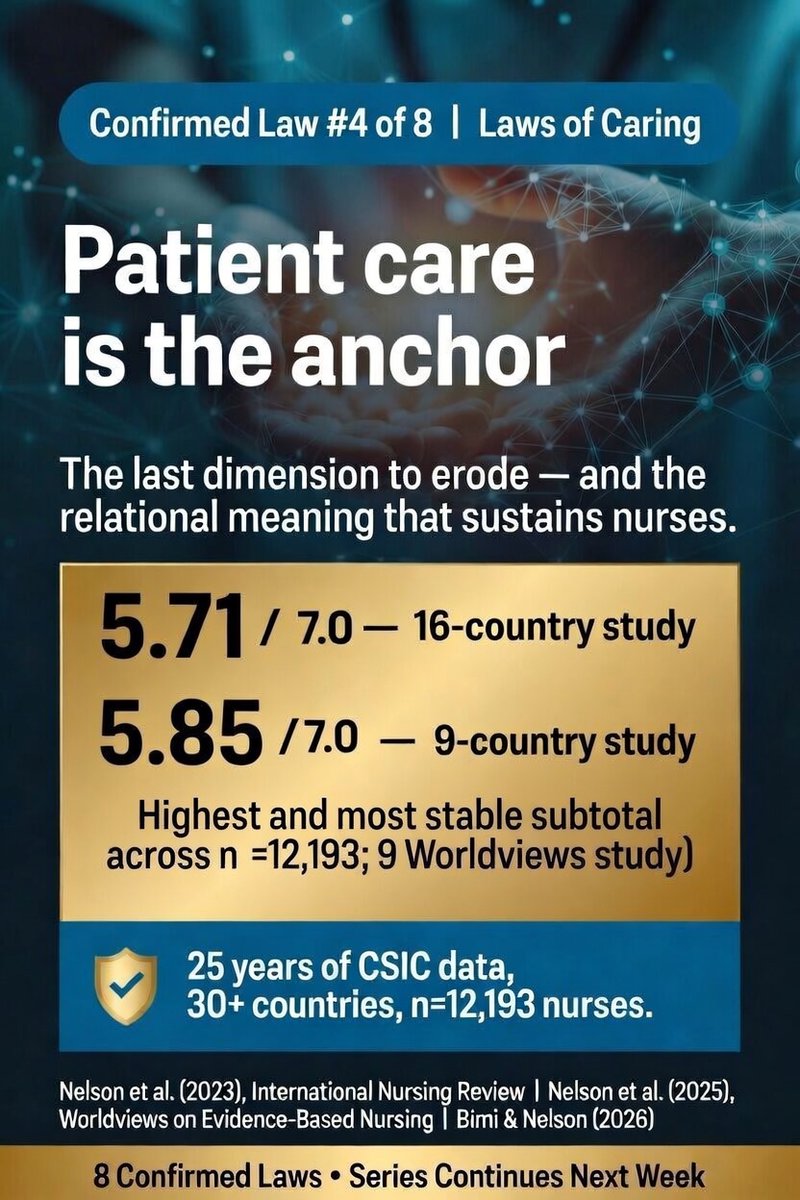
The finding: Satisfaction with Patient Care is the highest-scoring subscale in every CSIC dataset we have ever collected. In our 16-country study of 12,193 nurses, it scored 5.71 out of 7.0. In our 9-country Worldviews study, it reached 5.85. In Albania and Kosovo it was 5.85. The distribution is remarkably tight — strong consensus at high values across every cultural,
economic, and healthcare system context studied.
This isn't a regional finding. It isn't a high-income country finding. It is universal.
And it reveals something profound about why nurses stay — and what finally breaks when they leave.
Nurses are not primarily sustained by their organization. They are sustained by the relational meaning of their work. The connection to the patient is the last dimension to erode before a nurse disengages. It outlasts dissatisfaction with pay, with management, with working conditions, and with the system itself.
This is Confirmed Law L1-4 in the CSIC Laws of Caring — classified at our highest evidence level, modeled on the CDC's tiered framework: psychometrically validated across all CSIC datasets and replicated across independent national and cultural contexts.
When a nurse finally disengages, it is not because they stopped caring for their patients. It is because the system wore down everything around that care until nothing was left to sustain it.
These laws are not just descriptive. They are the foundation for new measurement approaches—and for training AI systems to understand nurse work well-being in context.
Source: Nelson, Vrbnjak, Thomas & Schwartz (2025), Worldviews on Evidence-Based Nursing, 22, e70005 | Nelson et al. (2023), International Nursing Review, 70(1), 127–139 | Bimi & Nelson (2026), monograph in preparation.
#CaringScience #NurseWellbeing #NursingLeadership #HealthcareAI #LawsOfCaring
🔵 Confirmed Law #3 of 8 | The Reward Illusion
When nurses score low on organizational rewards, the instinct is to fix compensation. The data says the signal is real — but the diagnosis is wrong. It's one of the most consistent findings in 25 years of caring science research — and one of the most misread.
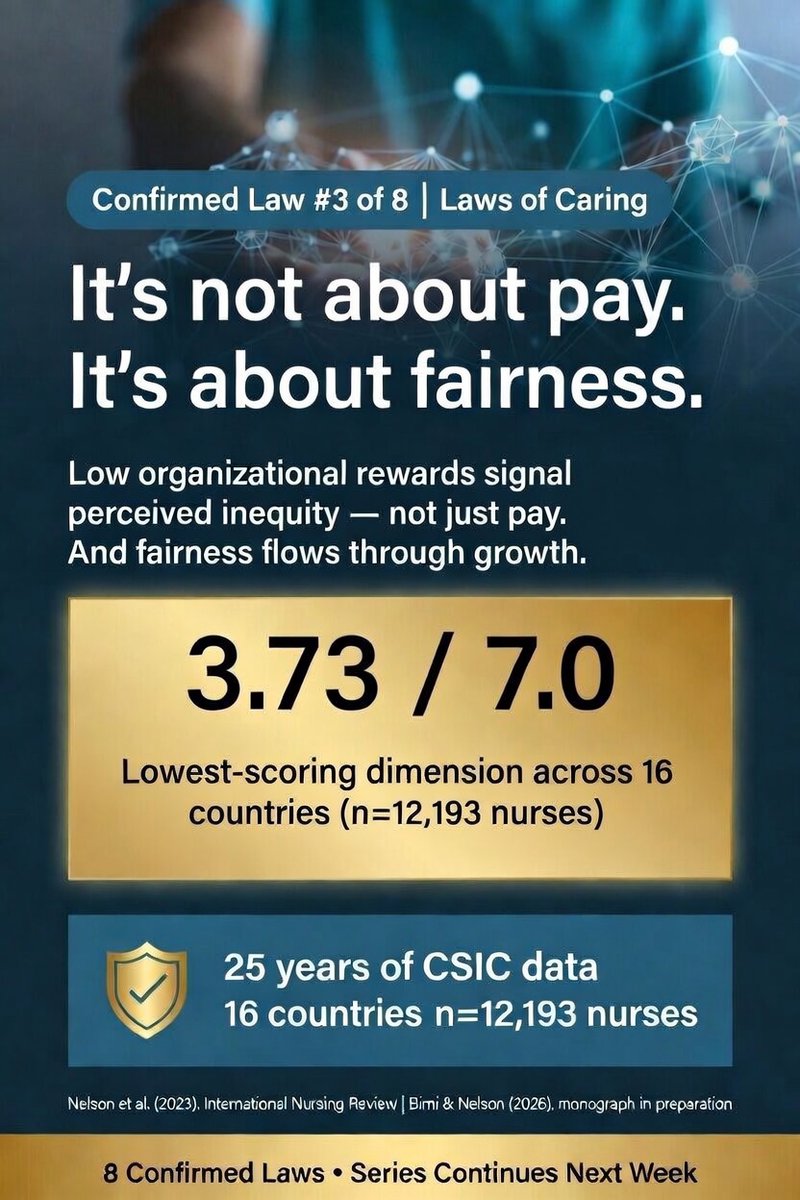
The finding: Organizational Rewards is the lowest-scoring subscale in every nursing context we've studied. In our 16-country study of 12,193 nurses, it was the only dimension to fall below the scale midpoint — scoring 3.73 out of 7.0. Universally. Across income levels, healthcare systems, and cultures.
But Organizational Rewards is not simply a measure of pay. It captures perceived fairness of reward relative to effort, contribution, stress, experience, and education.
And critically — it does not directly predict well-being or job satisfaction.
Structural equation modeling across Jamaica, Albania, Kosovo, and the CSIC international dataset consistently confirms the same indirect pathway:
Low perceived fairness → blocked Professional Growth → reduced Job Satisfaction over time.
The signal is nurses telling you something feels inequitable. The mechanism runs through growth — through career pathways that feel inaccessible, development opportunities that feel out of reach, contributions that feel unrecognized.
This is Confirmed Law L1-3 in the CSIC Laws of Caring — classified at our highest evidence level, modeled on the CDC's tiered framework: psychometrically validated, structurally demonstrated through SEM, and replicated across independent national contexts.
It's not about pay. It's about fairness. And fairness flows through growth.
These laws are not just descriptive. They are the foundation for new measurement approaches—and for training AI systems to understand nurse work well-being in context.
Source: Nelson et al. (2023), International Nursing Review, 70(1), 127–139 | Bimi & Nelson (2026), monograph in preparation | Nelson (2013), PhD dissertation, University of Minnesota.
#CaringScience #NurseWellbeing #NursingLeadership #HealthcareAI #LawsOfCaring
🔵 Confirmed Law #2 of 8 | The Communication Trap
Healthcare has spent decades training managers to communicate better. The data suggests we've been solving the wrong problem.
Open-door policies. Town halls. Rounding protocols. Feedback loops. These are good practices. But our research reveals a finding that should give every nurse leader pause.
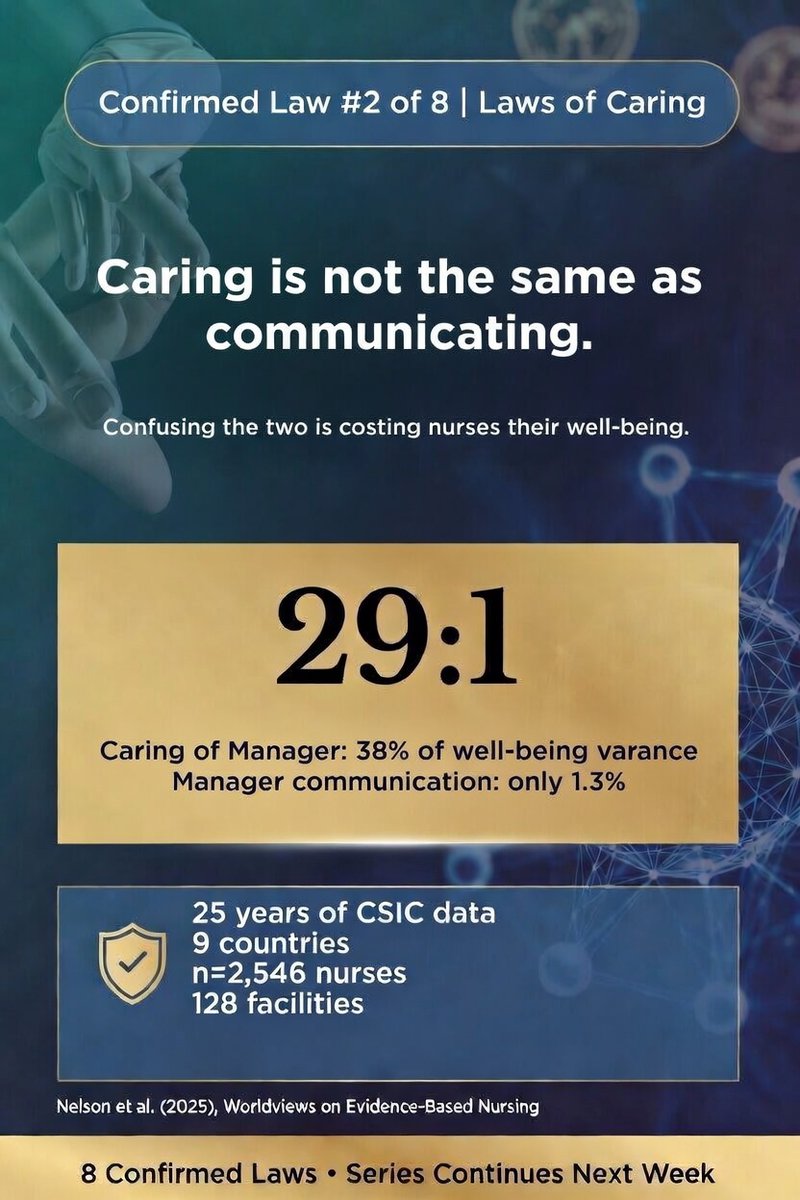
The finding: In the same 9-country study of 2,546 nurses, Caring of Manager explained 38% of work well-being variance. Satisfaction with manager communication explained 1.3%.
Same study. Same instrument. Same nurses.
A 29:1 ratio.
Communication without caring is structurally insufficient. A manager who holds regular staff meetings, maintains an open door, and communicates frequently — but doesn't genuinely attend to the individual needs of their nurses — is capturing less than 2% of their potential well-being impact.
The trap is believing that being present and communicative is the same as caring. It isn't. Caring is relational. It requires attending to the person, not just the role. Teaching in ways tailored to the individual. Showing up for the nurse, not just the unit.
This is Confirmed Law L1-2 in the CSIC Laws of Caring — classified at our highest evidence level, modeled on the CDC's tiered framework: psychometrically validated, structurally confirmed, and replicated across independent national contexts.
Train managers to care. The communication will follow.
Source: Nelson, Vrbnjak, Thomas & Schwartz (2025), Worldviews on Evidence-Based Nursing, 22, e70005 | 9-country study, n=2,546, 128 facilities.
#CaringScience #NurseWellbeing #NursingLeadership #HealthcareAI #LawsOfCaring
🔵 Confirmed Law #1 of 8 | The Manager Effect
One variable explains more about nurse well-being than anything else we've measured in 25 years of global research.
Not staffing ratios. Not pay. Not workload.
The manager.
The finding: In a 9-country study of 2,546 nurses across 128 facilities, Caring of Manager explained 38% of work well-being variance — loading first in every factor analysis, in every country, without exception. In Scotland it reached 41%.
This isn't a correlation. It's a structurally confirmed finding, replicated across two independent multi-country studies using validated instruments and structural equation modeling — classified at our highest evidence level, modeled on the same tiered framework the CDC uses to classify behavioral science evidence.
A manager who genuinely cares for their staff — attending to individual needs, teaching in tailored ways, building real relationships — is the single most powerful force in a nurse's work environment.
This is Confirmed Law L1-1 in the CSIC Laws of Caring.
Over the next 7 weeks, we'll share each of our 8 Confirmed Laws. They are the scientific foundation of something we're building — an AI platform trained exclusively on this evidence base.
More soon.
Source: Nelson, Vrbnjak, Thomas & Schwartz (2025), Worldviews on Evidence-Based Nursing, 22, e70005 | 9-country study, n=2,546, 128 facilities.
#CaringScience #NurseWellbeing #NursingLeadership #HealthcareAI #LawsOfCaring
@elonmusk I sometimes work in a team with chat, grok, and Claude to get better prompts for the team member that is looping or not responsive. I also have them check each other’s work. They each have their strengths. I also tell each of them to not flatter me but give helpful critique.
For the past 25 years, the Caring Science International Collaborative (CSIC) has been building something the nursing workforce field has never had: a classified, replicable, evidence-based framework of how caring environments actually work.
We call them the Laws of Caring.
Like the CDC’s tiered evidence system, we classify our findings into three levels:
🔵 Level 1 — Confirmed LawsReplicated across 3+ independent national contexts, psychometrically validated, with confirmed structural significance (effect size, not just p-value).
🟡 Level 2 — Emerging LawsFormally measured and replicated in at least 2 independent contexts. Awaiting full cross-national confirmation.
⚪ Level 3 — Practice-Informed PatternsObserved consistently in structured storytelling sessions with frontline nurses. The foundation for future formal study.
To date, CSIC has identified 8 Confirmed Laws, 35+ Emerging Laws, and a growing library of Practice-Informed Patterns — drawn from research across 30+ countries and 30,000+ healthcare workers.
Over the next 8 weeks, we will share each of the 8 Confirmed Laws — what it says, the evidence behind it, and why it matters for nurse wellbeing, retention,
patient safety, and the future of healthcare.
This science is the foundation of something we’re building. More on that soon.
#CaringScience #NurseWellbeing #NursingResearch #HealthcareLeadership #LawsOfCaring
The Caring Science International Collaborative (CSIC) is hosting our quarterly global meeting, open to anyone interested.
Topics include the 22-country nurse work wellbeing study (students → nurses → faculty), pilot sites, regional science centers, MCPs & relational tokens.
📅 December 10, 2025
⏰ 8–9 AM CT | 15:00–16:00 CET
DM for link.
https://t.co/GamMJowsSe
AI in healthcare frustration: Folks think LLMs like Grok or ChatGPT = the whole model. Wrong! AI is like a telescope—it doesn't create stars, just helps us see them better. Build with theory, SEM, predictive analytics & MCP first. AI amplifies science, doesn't replace it.
#AI #Healthcare
#AIinHealthcare #CaringScience
🌍 The new Worldviews on Evidence-Based Nursing special issue on Mental Health & Wellbeing is live — and free to read!
Our CSIC team contributed 5 articles on global nurse wellbeing across 23 countries.
🔗 Explore: https://t.co/H2qhwwcBY0
#NurseWellbeing #Worldviews #MentalHealth #CSIC #NursingResearch
For 4 years as adjunct faculty at Minnesota State University, Mankato, I’ve watched AI become part of every student’s toolkit.
They hide it. I bring it into the light.
AI = a brilliant peer who:
✅Knows everything, but
❌ Doesn’t know your story
My rule: Be candid. Be specific. Be authentic.
No bans. No shame. Just deeper learning.
#StudentWellbeing #NelsonMethodology #CaringScience
Comment “AI” below for a free 1-page prompt: “Turn AI drafts into YOUR voice — in 3 steps.”