“It’s in this area” is not a location.
Especially when access, infection control, patient areas, and staff disruption matter.
Buildings change. Rooms get renamed. People leave. Vendors change.
A good facility record should help the next person find the asset.
Not start a scavenger hunt.
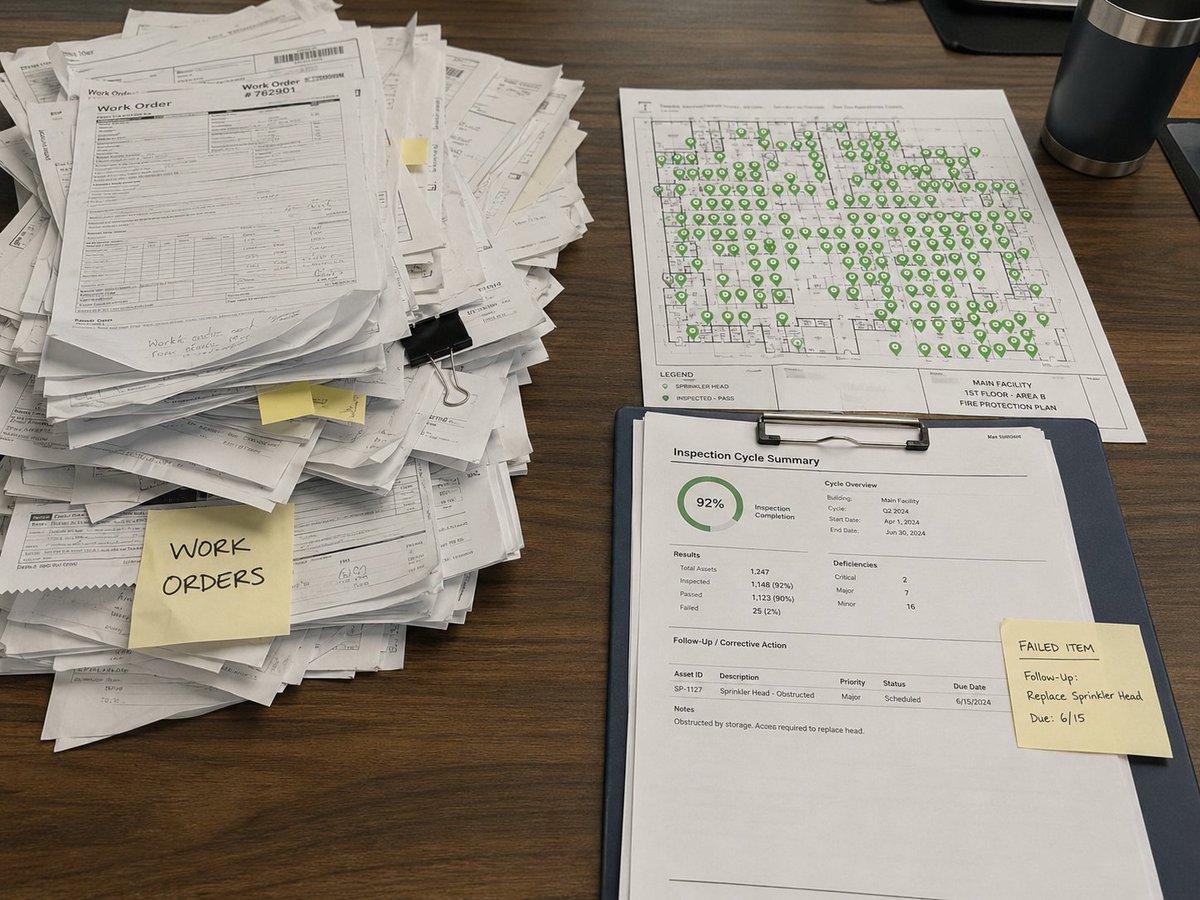
A report is not the finish line.
It is usually where the next problem starts.
Deficiencies. Failed items. Repairs needed. Follow-up notes.
The real question is not just, “Do we have the report?”
It is, “What happened next?”
Every building has a memory.
The problem is when that memory is one person.
They know the valves, bad drawings, hidden access panels, old changes, and field details nobody wrote down.
Then they retire.
Facility knowledge needs to be captured while people still know it.
A lot of people are heading into a long weekend.
Facility teams still have buildings to keep ready.
Doors checked.
Systems watched.
Open work reviewed.
Inspections documented.
Most people only notice when something fails.
When everything works, it usually means someone paid attention.
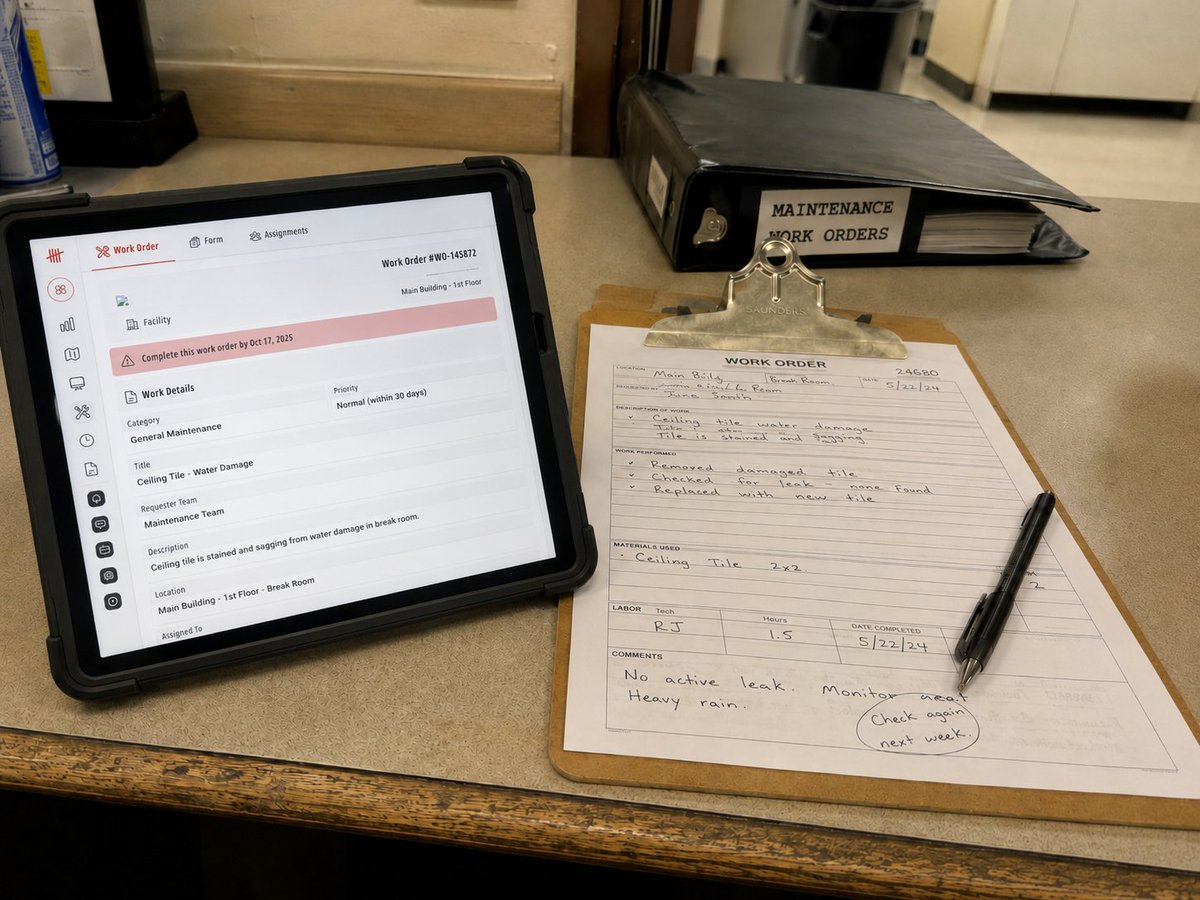
A lot of teams think they’ve gone digital.
Then they print the work order.
Hand it to a tech.
Get handwritten notes back.
Re-enter everything later.
That’s not really digital.
That’s paper with extra steps.
Most buildings keep the prettiest drawings.
That does not mean they are the most accurate.
The clean architect set may look official.
But the marked-up contractor as-builts are often closer to the truth of the building.
Facility teams do not just need pretty records.
They need records they can trust.
Compliance isn’t just a work order.
A work order tells someone to do something.
An inspection proves required assets were checked against a standard — and keeps the results, deficiencies, corrective work, proof, and report connected.
That difference matters.
Facility knowledge should not live only in people’s heads.
When experienced employees leave, they take years of building history with them.
Maps, assets, reports, deficiencies, follow-up — that knowledge needs a place to live.
A report can look clean while the building tells a different story.
During a HeadCount setup, the annual extinguisher report showed no deficiencies.
Then the first extinguisher failed for being due for its 6-year test.
Then the second.
Then the third.
The system didn’t create the problem.
It made it visible.
A report is supposed to answer a question.
But too often it turns into a scavenger hunt.
The work may be done.
The follow-up may have happened.
But if the proof is hard to find, the report creates more work instead of giving clarity.
Facility work usually doesn’t get lost during the task.
It gets lost during the handoff.
The issue was found.
The work may have been done.
But the proof never made it back.
That’s where compliance gets messy.
Most facility teams don’t miss work because they don’t care.
They miss it because urgent work always wins.
The risky stuff is usually:
not urgent
but required
and easy to forget
That’s where problems start.
In healthcare, facility maintenance is patient care. A failing asset isn't an inconvenience—it's a risk. Our new blog explains why a CMMS is essential for guaranteeing equipment uptime, ensuring compliance, and creating a safe Environment of Care.
Learn more: https://t.co/ZezWmezvSe
Life Safety 101: It’s all about getting back to basics. Protect your occupants, ensure safety, and let HeadCount simplify your compliance needs. #LifeSafety#NFPA101 https://t.co/30Alp8KWZu




![HeadCountSuite's tweet photo. 🔧 Make Compliance CMMS Stress-Free! 🌟
Multi-site oversight made simple.
Use HeadCount! 👉 [https://t.co/vE0EwRaRmU]
#FacilityManagement #Compliance #Efficiency https://t.co/0svAQrBPsX](https://pbs.twimg.com/media/GZdZRN6XUAAvKYY.jpg)





