What Is Surf AI?
Financial markets are not short on data the real challenge is making sense of it.
Market activity, onchain transactions, wallet movements, project fundamentals, and financial news are often scattered across disconnected sources bringing these signals together and extracting meaningful insights requires time, specialized tools, and considerable research effort.
This is where @SurfAIHQ comes in.
Surf is building an Ai powered financial intelligence platform that connects data, research, and analytical capabilities within a unified environment.
Its approach is built around four interconnected
layers :
1) Unified Data Infrastructure
Bringing together financial and crypto market data, onchain activity, wallet intelligence, and other relevant information to create a more complete view of the market.
2) Ai Powered Research
Using Ai driven research capabilities to investigate complex questions, retrieve relevant information, analyze multiple sources, and produce structured reports supported by references.
3) Market Intelligence
Turning raw information into actionable insights by helping users monitor market developments, identify unusual activity, and understand the signals behind market movements.
4) Developer Infrastructure
Extending these capabilities beyond the Surf interface through APIs, MCP, CLI, and Agent Skills, allowing developers and Ai agents to integrate financial intelligence into their own workflows.
The broader vision
Surf is approaching financial intelligence as infrastructure rather than simply another research interface.
By connecting fragmented data with Ai powered analysis and developer accessible tools, it aims to make financial information more accessible, structured, and useful across both human and machine driven workflows.
The objective is not simply to retrieve more data, but to make that data meaningful.
Surf Ai is building toward a more intelligent way to interact with financial markets.
DOMA WEEKLY: DOMA EXPANDS TO SOLANA
A major step for Doma this week : https://t.co/iCbQls5mwP has become the first tokenized domain tradable on Solana.
This is more than a new marketplace listing the domain was already onchain through @domaprotocol since December 2025, but it is now accessible to the wider Solana community, allowing users to hold and trade its token directly through Solana wallets and marketplaces.
Importantly, the underlying domain remains a real, DNS-compliant .com domain its tokenization through Doma brings domain ownership into another active trading ecosystem.
▫️A better experience for domain owners
Alongside the Solana expansion, Doma introduced several practical product improvements :
• SOL payments : Users can now pay for domain registrations directly from a Solana wallet.
• Clearer portfolio insights : PnL is displayed as a percentage of the capital used, with explanations of how figures are calculated.
• Better domain management : The portfolio table can be sorted by PnL and total earnings, with the one day price change visible.
• Expiry tracking : Users can identify domains approaching expiration through a new badge, filter and renewal button.
The team also refreshed its builder documentation, agent instructions and skills, alongside stability improvements and bug fixes.
▫️The numbers behind the progress
Doma’s latest figures show how much the network has grown :
• $693.36M in total volume
• 49.75M+ transactions
• 269,177 tokenized assets
• 64,628 wallets
• 794 domain tokens launched
These figures put Doma close to the $700M volume milestone, with nearly 800 domain tokens already launched.
▫️Looking toward year one
D3 CEO and Co Founder Fred Hsu joined the community for an AMA titled The Next Chapter, reflecting on the journey from testnet to mainnet and sharing the direction ahead.
Community feedback was positive, while applications for Domaxx Cohort 3 remain open.
With NamesCon in Miami behind the team and Solana Breakpoint in London next, attention is now turning toward December 1 the first anniversary of Doma mainnet.
The direction is becoming clearer : more tokenized domains reaching Solana, more ways to interact with them, and a stronger portfolio experience for users.
https://t.co/iCbQls5mwP is only the beginning.
You can read the full weekly update here :
https://t.co/Y4S1rZe80K
Remote Attestation : How Seismic Verifies Its Nodes
In a privacy focused blockchain, allowing a new node to join the network is more than a technical step.
It is a question of trust.
How can existing nodes know that a new node is running the approved software, inside a genuine Trusted Execution Environment, and not a modified version designed to expose private data?
This is where Remote Attestation comes in.
Instead of trusting the node operator's claims, Seismic requires cryptographic evidence.
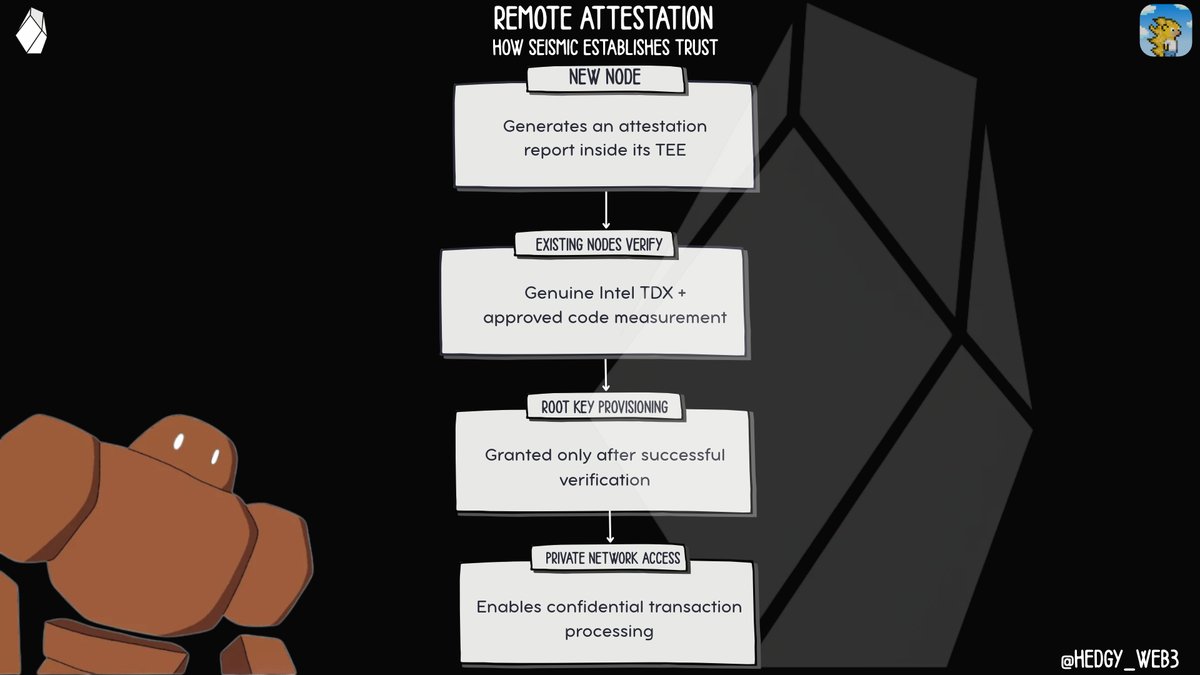
When a new node joins, its TEE generates an attestation report containing information about its execution environment and code measurement.
That report is sent to existing nodes, which perform two critical checks :
→ Hardware authenticity : Was the report generated by genuine Intel TDX hardware?
→ Code integrity : Does the node's code measurement match the approved Seismic build?
Only after both checks pass does the new node receive the network's root key, which is used to derive the encryption key needed to process private Seismic transactions.
This creates an important security boundary.
A node running modified software designed to expose network secrets cannot simply join and access sensitive data it must first pass the network's verification process.
There is also an important detail : all nodes must run matching approved software versions, including the required Reth parameters.
Why does this matter?
Because privacy is not only about encrypting data it is also about controlling which environments are allowed to process it.
Remote Attestation gives @SeismicSys a way to verify the hardware and software behind its nodes before granting them access to network secrets.
Do not trust the operator verify the environment.
DOMA BRINGS A REAL .COM DOMAIN TO SOLANA
Internet domains are becoming part of the onchain asset ecosystem.
@domaprotocol has taken another step in that direction with solana:bonerpW3GSWw9RHsMKRE757EohtsYDf1kpDdxG2S4t1, the first tokenized .com domain to become tradable on Solana.
Here is how it happened :
▫️From Doma to Solana
solana:bonerpW3GSWw9RHsMKRE757EohtsYDf1kpDdxG2S4t1 was originally launched on Doma Protocol on December 17, 2025.
It is a real .com domain that remains DNS compliant and continues to function like any other internet domain its tokenized representation now gives it a new market through Solana.
With the integration powered by Sunrise, solana:bonerpW3GSWw9RHsMKRE757EohtsYDf1kpDdxG2S4t1 is now available across several Solana trading platforms, including :
• Jupiter
• Raydium
• FOMO
This opens the door for Solana users to access a tokenized internet domain without changing the underlying domain itself.
▫️The Early Numbers
As of November 11, 2026, solana:bonerpW3GSWw9RHsMKRE757EohtsYDf1kpDdxG2S4t1 had :
2,140 holders
A token price of $0.267
A fully diluted valuation of $267.1K
These figures reflect the market snapshot shared in Doma's announcement, not a prediction of future performance.
▫️Why This Matters
Domain names have been valuable internet assets for decades, but they have traditionally existed in markets that are less accessible and less liquid than onchain markets.
Doma is working to change how these assets can be represented and accessed.
Bringing a real .com domain to Solana is an early example of how traditional internet assets can enter the onchain economy.
And this may be only the beginning doma expects more domains to make their way into the Solana ecosystem.
From internet domains to onchain assets this is another market Doma is bringing forward.
Read the full announcement : https://t.co/HMIsUYnyDN
Why Seismic Uses Intel TDX
Running a blockchain node usually means giving its infrastructure access to the data being processed.
But when that data contains sensitive financial information, this creates an important trust problem :
How can a network process private transactions without giving node operators access to their contents?
@SeismicSys addresses this through Intel Trust Domain Extensions (TDX).
Rather than relying on software level permissions alone, Intel TDX uses hardware enforced isolation to create a protected execution environment known as a Trusted Execution Environment (TEE).
This changes how a Seismic node handles sensitive information.
The node operates inside this protected environment, where transaction data can be decrypted and processed without exposing its plaintext to the host operating system or hypervisor.
There is another important part of this architecture: Remote Attestation.
A protected environment is only useful if its integrity can be verified intel TDX provides cryptographic evidence that allows remote parties to check the environment and its software configuration before trusting it.
Seismic also uses the protected environment for sensitive cryptographic operations and key management.
Together, these capabilities address three critical requirements :
• Isolation : Protecting sensitive memory from the host infrastructure.
• Confidentiality : Keeping transaction data protected during execution.
• Verifiability : Providing a way to verify the integrity of the execution environment.
This is why Intel TDX matters to Seismic.
It provides the hardware backed security foundation for confidential execution, allowing Seismic to bring private transaction processing into an EVM compatible blockchain.
The infrastructure processes the transaction but it does not need unrestricted access to the information behind it.