RoW would also need a neutral global hyperscaler to reliably serve open Chinese AI models. Current top-3 hosting is namesake and very unreliable (for obvious reasons).
A new @bgurley blog post!
I have been thinking about how sophisticated executives are using open source in super creative ways. Started writing this three years ago. Excited to finish it up and publish it! And with the new @p3institute brand.
https://t.co/W84vODq1ME
There is nothing more powerful than well-informed optimism. It has to be well-informed though. The "everything will be fine" type of optimism may also be somewhat useful, but it's not as useful as the "Hmm, what if we tried x?" kind.
Judging by my tl there is a growing gap in understanding of AI capability.
The first issue I think is around recency and tier of use. I think a lot of people tried the free tier of ChatGPT somewhere last year and allowed it to inform their views on AI a little too much. This is a group of reactions laughing at various quirks of the models, hallucinations, etc. Yes I also saw the viral videos of OpenAI's Advanced Voice mode fumbling simple queries like "should I drive or walk to the carwash". The thing is that these free and old/deprecated models don't reflect the capability in the latest round of state of the art agentic models of this year, especially OpenAI Codex and Claude Code.
But that brings me to the second issue. Even if people paid $200/month to use the state of the art models, a lot of the capabilities are relatively "peaky" in highly technical areas. Typical queries around search, writing, advice, etc. are *not* the domain that has made the most noticeable and dramatic strides in capability. Partly, this is due to the technical details of reinforcement learning and its use of verifiable rewards. But partly, it's also because these use cases are not sufficiently prioritized by the companies in their hillclimbing because they don't lead to as much $$$ value. The goldmines are elsewhere, and the focus comes along.
So that brings me to the second group of people, who *both* 1) pay for and use the state of the art frontier agentic models (OpenAI Codex / Claude Code) and 2) do so professionally in technical domains like programming, math and research. This group of people is subject to the highest amount of "AI Psychosis" because the recent improvements in these domains as of this year have been nothing short of staggering. When you hand a computer terminal to one of these models, you can now watch them melt programming problems that you'd normally expect to take days/weeks of work. It's this second group of people that assigns a much greater gravity to the capabilities, their slope, and various cyber-related repercussions.
TLDR the people in these two groups are speaking past each other. It really is simultaneously the case that OpenAI's free and I think slightly orphaned (?) "Advanced Voice Mode" will fumble the dumbest questions in your Instagram's reels and *at the same time*, OpenAI's highest-tier and paid Codex model will go off for 1 hour to coherently restructure an entire code base, or find and exploit vulnerabilities in computer systems. This part really works and has made dramatic strides because 2 properties: 1) these domains offer explicit reward functions that are verifiable meaning they are easily amenable to reinforcement learning training (e.g. unit tests passed yes or no, in contrast to writing, which is much harder to explicitly judge), but also 2) they are a lot more valuable in b2b settings, meaning that the biggest fraction of the team is focused on improving them. So here we are.
Operating in stealth mode is almost always a mistake.
Talk publicly about what you're building. You’ll build momentum, get real feedback, and someone will reach out with the other half of your idea you didn’t realize you were missing.
Someone asked what's the most underappreciated quality in startup founders. I realized I could answer this by asking what's the most underappreciated aspect of startups. That's easy: how hard they are. So the most underappreciated quality in founders is sheer toughness.
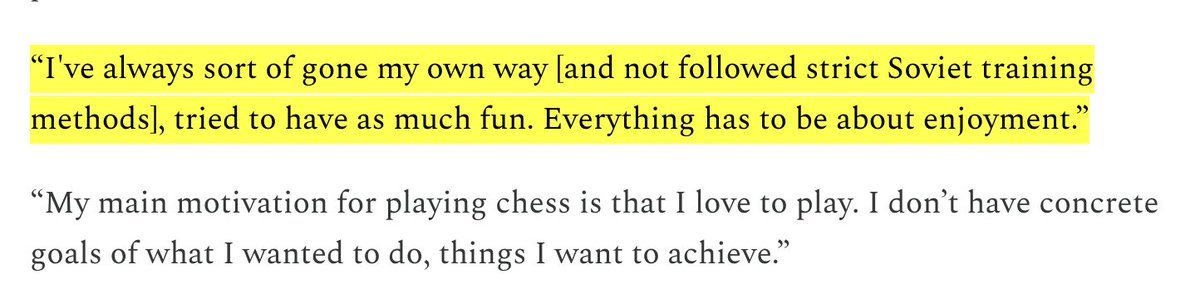
The importance of *having fun* is so important to internalize and seems to come up among almost all top performers.
e.g. Magnus Carlsen is always talking about making chess fun:
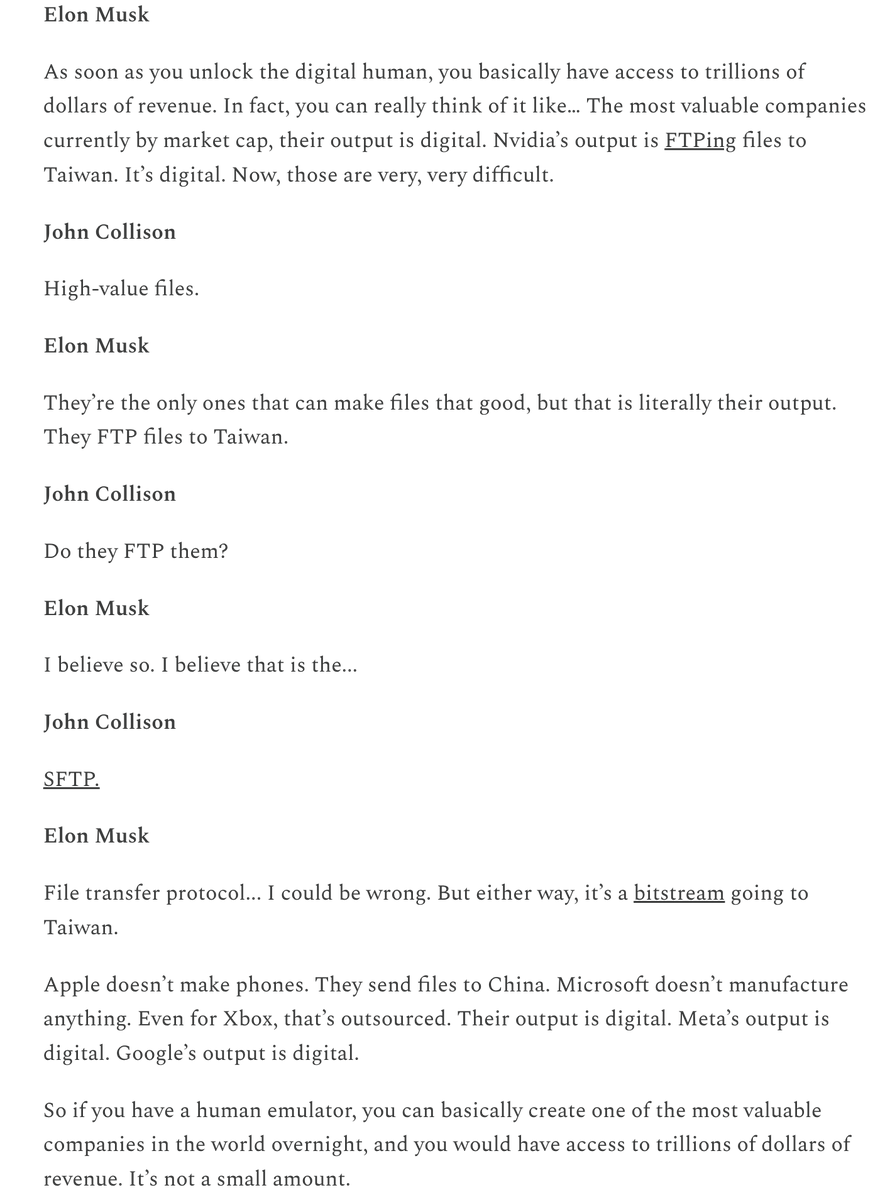
Elon Musk on Cheeky Pint:
"Nvidia’s output is FTPing files to Taiwan. It’s digital. Now, those are very, very difficult. They’re the only ones that can make files that good, but that is literally their output. They FTP files to Taiwan."
Nobody knows anything...
True of Hollywood, true of Silicon Valley, true of anywhere innovation takes place. No one knows if your idea will work or not before you actually collide it with reality and try it out.
So please… just start.
Founders: Know your proof points cold.
'We're better' is a claim.
'We deliver 3x more qualified leads' is an argument.
'Here are 5 customers seeing 3x more leads' is proof.
"Beijing has been preparing for Cold War without eagerness for waging it, while the US wants to wage a Cold War without preparing for it." - @danwwang. Recommended reading.
https://t.co/rptf7bgFWw
If I could send my 18 year old self a message, it would have three parts:
1. Prestige is often mistaken. Follow curiosity instead.
2. There's no way to avoid hard work. It's not sufficient, but it is necessary.
3. Don't take your parents for granted.