This is historic!
President William Ruto has officially launched the construction of Naivasha–Kisumu–Malaba SGR at Mutonyi in Narok and again on March 21 at Kibos in Kisumu—an unmistakable signal that western Kenya is finally being pulled into the country’s flagship infrastructure story.
For people who have watched trucks crawl through mud between Narok and Kisumu for decades, the sight of a modern rail corridor taking shape feels less like policy and more like a promise kept: faster travel, cheaper freight, and a direct line from farms and factories all the way to Mombasa’s port.
The route is ambitious in scale and careful in detail. From Emurtoto in Narok to Kisumu (264 km plus an 8.69 km branch to the new Kisumu Port) the line threads Narok, Bomet, Nyamira, Kericho and Kisumu, with six intermediate stations—Narok, Mulot, Bomet, Sotik, Sondu, Ahero—plus 17 crossing stations to keep traffic fluid. Kisumu gets a passenger terminus and a major freight hub. Then the 107 km Kisumu–Malaba stretch continues through Siaya, Vihiga, Kakamega and Busia, adding stations at Yala and Mumias, a freight terminus at Malaba, and six crossing points. Along the whole corridor engineers are carving 13 tunnels, throwing up 23 bridges and laying 376 culverts so rains and rivers don’t bring life to a halt.
The trains themselves are designed to change daily calculations for businesses and families. Passenger services will run at up to 120 km/h with capacity for 1,096 people—imagine students getting from Kakamega to Nairobi in hours, not a full day on the road. Freight trains will haul 4,000 tonnes (about 216 TEUs) at 80 km/h, giving the line a design capacity of 22 million tonnes a year. That’s the kind of number that shrinks logistics costs, speeds deliveries of maize and fertilizer, and makes Western factories competitive in regional markets. Kenya Railways is delivering the project with the National Land Commission handling acquisition and compensation, a reminder that real people’s land sits under these grand plans.
For western Kenya, this is more than steel and sleepers. It knits together towns that often feel overlooked, links Kisumu Port to the blue economy, and gives counties a concrete reason to plan industrial zones, warehouses, and agro-processing near stations. Lower transport costs should ripple into market prices; reliable schedules should tempt investors who previously feared breakdowns on potholed highways. Young people along the corridor see apprenticeships and operations jobs, while traders see a way to move fish and farm produce to Mombasa and beyond before it spoils.
And the story doesn’t stop at Malaba. By tying the SGR to the border, Kenya is tightening the Northern Corridor that serves Uganda, Rwanda, Burundi, South Sudan and eastern DRC. That’s regional integration in practical terms: smoother customs handoffs, better rail-sea links at Mombasa, and a credible alternative to road convoys that gum up Busia and Malaba. If operated well—fair fees, transparent slots, maintenance that doesn’t lag—the line becomes East Africa’s backbone for trade, not just Kenya’s pride.
Equity Group has announced record full-year 2025 results, the highest in Kenya’s corporate history, posting a 55% increase in profit after tax to KSh 75.5 billion, up from KSh 48.8 billion. The performance reflects the Group’s successful business transformation, diversified revenue growth, enhanced efficiency, and robust regional contributions. The balance sheet expanded by 9% to KSh 1.97 trillion (FY2024: KSh 1.8 trillion), with customer deposits rising 4% to KSh 1.46 trillion (FY2024: KSh 1.40 trillion) and net loans increasing 8% to KSh 882.5 billion (FY2024:KSh 819.2 billion).
Strong revenue performance saw net interest income grow 17% to KSh 126.9billion, non‑funded income rise 7% to Ksh 90.8 billion, and total income increase by 12% to Ksh 217.7 billion (FY2024:KSh 193.8 billion). Operational efficiency improved significantly, with the cost‑to‑income ratio falling to 51.0% from 58.2%, driven by continued migration to self‑service channels, productivity gains, and tighter cost discipline supported by Group-wide shared services and digital infrastructure.
Regional operations accounted for about half of Group profitability, underscoring Equity’s emergence as a pan-African financial services Group. Equity BCDC has grown its profitability by 58%, Uganda by 500% and Tanzania by 125%. Overall, subsidiaries contributed 51% of banking profit before tax and 48% of banking profit after tax.
Equity Insurance Group continued its strong expansion, driven by newly acquired life, general, and health underwriting licenses. Gross written premiums rose by 75% to Kshs 9.17 billion, delivering Profit Before Tax growth of 36% to Kshs 2.0 billion, and a 150% rise in insurance revenue to Kshs 3.57 billion. Equity Life Assurance which delivered a Profit Before Tax of KShs 1.77 Billion now serves unique 6.9 million customers with 19.2 million policies issued since inception, Equity General Insurance reported Kshs 1.79 billion in Gross Written Premiums and Kshs 199 million in Profit Before Tax in its first year of operations whilst Equity Health Insurance reported Gross Written Premium of KShs 20 Million and KShs 40 million in Profit Before Tax in its first 4 months of operations.
On the back of this performance, the Directors have recommended a dividend of Kshs 5.75 per share, up from Kshs 4.25 amounting to a payout of Kshs 21.7 billion (2024: Kshs 16 billion), representing a 35.3% growth in dividends.
Commenting on the results, Equity Group Managing Director and CEO Dr. James Mwangi said the performance demonstrates the strength of the Group’s strategic transformation, driven by diversified revenue streams, improved efficiency and growing contributions from regional subsidiaries: “The 2025 performance reflects the success of our deliberate transformation into a diversified, regional financial services group. We delivered strong profit growth by expanding and deepening our income streams, improving efficiency across the franchise, and strengthening the quality of our balance sheet.
Learn more: https://t.co/akTkseUrK5
Equity Group FY 2025 Investor Booklet: https://t.co/d7ebooNs7A
Equity Group FY 2025 Financials: https://t.co/gV68vBg9f9
#Equity2025FYResults
CELEBRATING 50 YEARS OF EUROPEAN UNION (EU)-KENYA PARTNERSHIP
Kenya is open for business and ready to engage as a strategic partner with a clear vision, a strong track record, and a compelling investment case, with a strong competitive digital economy proposition.
With over 53 million mobile subscriptions and more than 42 million internet users supported by robust infrastructure, a very progressive legal framework alongside a globally recognized mobile money ecosystem, our country remains a leading innovation hub on the continent.
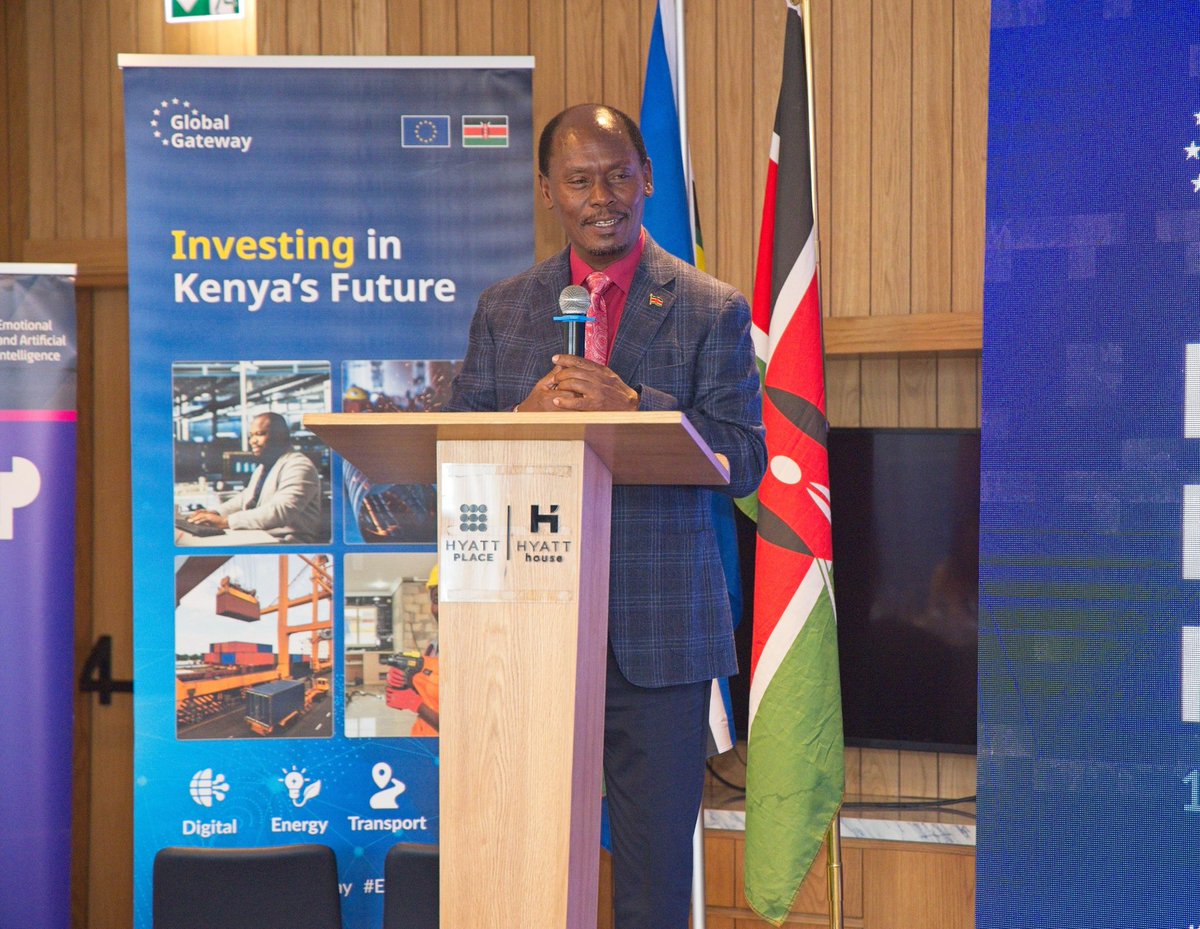
Today, I joined our European Union partners at the EU–Kenya Tech Business Forum as the Chief Guest, a key platform bringing together government, industry leaders, and development partners to strengthen collaboration in Kenya’s digital transformation journey.
This engagement comes at a pivotal moment as we move beyond traditional cooperation towards a more structured and forward-looking relationship anchored on investment, innovation, and alignment of our digital priorities.
The forum serves as a critical mechanism to translate our long-standing partnership into concrete investments, commercial partnerships, and scalable digital solutions. At a time when the global digital economy is rapidly evolving, driven by artificial intelligence, data governance, and digital infrastructure, this collaboration positions Kenya to advance its ambition of becoming Africa’s leading digital economy.
Since 2021, under the Kenya–EU Strategic Dialogue, the European Union has committed over €430 million towards Kenya’s digital transformation. This support has already delivered tangible results, including: connecting over 400 schools to the internet through the Giga programme; strengthening digital skills through TVET modernization; and advancing e-government systems and digital public infrastructure.
In 2025, we launched the National Artificial Intelligence Strategy, positioning Kenya as a leader in responsible AI adoption. Additionally, we have trained over 1.9 million young people in digital skills since 2022 and created more than 300,000 digital jobs through initiatives such as Ajira, Jitume, and Business Process Outsourcing programmes.
Through the Digital Superhighway Programme, we are rolling out 100,000 kilometres of fibre, with nearly 24,000 kilometres already complete, alongside 1,450 digital hubs nationwide.
As we deepen this partnership, Kenya welcomes investment in connectivity, digital public infrastructure, artificial intelligence, innovation ecosystems, and IT-enabled services.
In attendance were Henriette Geiger, Ambassador of the European Union to Kenya; Renate Nikolay, Deputy Director-General at the Directorate for Communications Networks, Content and Technology of the European Union Commission; Secretary, ICT, Digital Economy and Emerging Technologies, Ms Mary Kerema; Secretary, ICT and ICT Security, Mr Emmanuel Kata Kimeu; Romanian Ambassador to Kenya, H.E Gentiana Serbu; Czech Republic Ambassador to Kenya, H.E. Nicol Adamcová, and Slovak ambassador to Kenya, Maroš Mitrík ; technology sector companies; and financial institutions.
There is something about President William Ruto.
He promises what he can deliver. It doesn't have to be immediately, but eventually he delivers.
Look, he said SGR will not stop in Naivasha- he said he will move it all the way to Malaba.
And he's doing exactly that.
This extension is a game changer for Kenya:
What does this mean in real life?
Less trucks on highways.
Lower cost of doing business.
More jobs for young people.
Western Kenya rising as a logistics hub.
And bigger picture?
Kenya becomes the main gateway to East & Central Africa.
This is how you build an economy to match the Singapore one.
CHEPALUNGU CONSTITUENCY, BOMET COUNTY, KENYA
WEDNESDAY, MARCH 18, 2026
The construction of 6,000 kilometers of new tarmac roads is ongoing across the country, after the Government cleared the entire pending bills of road contractors, amounting to 177 billion shillings.
In Bomet County, the Government is updating to bitumen standards 525 kilometers of roads, at a cost of 19.5 billion shillings.
The Roads and Transport Ministry has been directed to closely monitor performance of road contracts to ensure speedy completion and quality works, now that the sustainable funding for road construction has been unlocked.
Inspected ongoing works on the 2.1 billion shillings Kyogong- Kapkesosio- Sigor- Kaboson - Chebunyo/ Sigor- Lelaiitich- Kipreres- Longisa road, a 65 kilometers crucial transport artery that will unlock the economic potential of Chepalungu and Bomet East Constituencies.
With Bomet Governor Prof Hilary Barchok, Senator Hilary Sigei, Woman Representative Linet Chepkorir, Chepalungu MP Victor Koech Mandazi, MCAs and residents.
After Rironi-Nakuru-Eldoret-Malaba, Today, the economic liberation of Western Rift Valley continues. The Naivasha-Kisumu-Malaba SGR kicks off. President Ruto is doing justice to Westerners. I will be boarding SGR at Ikonge or Sotik.