Shenandoah Valley Homesteader • Veteran • Musician • Herbalist • Wife • Homeschool Mom of 4 • Ancient skills, folk traditions & faith-filled, simple living
Anyone who knows me personally knows I’m a pretty outspoken critic of government overreach. I became involved in local politics during the illegal government mandates of the COVID years. I’ve largely stepped back and focused on my family, my homestead, and my business (all of which I’ve called my “quiet rebellion”).
But the ordeal with #SaveLucy and #SaveSnuggles has brought this issue front and center to our lives once again.
I’ve been thinking a lot about laws that allow livestock guardian dogs (LGD’s) to be taken from their families over completely normal livestock guardian dog behavior.
There is a much bigger conversation to be had…
Fact: The government does not benefit from a population that is self-reliant. Self-reliant people are harder to control. They grow and raise their own food. Fix their own problems. Depend less on fragile supply chains, massive corporations, and government programs.
Fact: the most important tool a homesteader has (aside from their firearm) is a livestock guardian dog.
Before Lucy was out in the fields, then later our Pyrenees/Anatolian mixes, we lost animals every year to foxes, coyotes, and bears. I still remember the night a bear wiped out my entire flock of chickens! We don’t raise, train and keep these dogs because we think it’s cool—we do it because it’s necessary.
People who don’t live this lifestyle don’t understand that an LGD isn’t a luxury. It isn’t just a pet that happens to live outside. It is an essential piece of the operation.
Take away the LGD, and you make it exponentially harder to raise livestock and feed our families.
Take away people’s ability to protect their land, and you increase dependence on the very systems that are keeping us sick, and keep getting more expensive, more fragile, and more centralized every year.
Maybe that’s not the intent behind these laws, but it is absolutely the result.
The people writing these policies often have zero understanding whatsoever of LGD’s, rural life, predator threats, or what it actually takes to keep animals alive on a farm.
Instead, they apply suburban standards to working farm dogs and then act shocked when farmers and homesteaders push back.
For me personally, and I think for many Americans across the country, the #savelucy and #SaveSnuggles movement is about much more than two dogs.
It’s about shining a light on laws that allow neighbors and bureaucrats to stick their noses where they don’t belong. It’s about whether families have the right to use the same methods humans have used for thousands of years to protect their livestock and provide food for their families.
It’s about whether people living on their own land will be allowed to make practical decisions without bureaucrats and activists who have never even grown a tomato dictating how rural life should work.
You want to #MAHA?
You want less reliance on massive corporations and more thriving local economies? Then stop making it harder for families to live off their own land!
Stop punishing homesteaders because their LGDs are doing exactly what they were bred to do!
Stop favoring city transplants who move to the countryside for the view while treating the people who actually work the land as the problem. You’re pushing out the very families who sustain local economies, raise local food, and pass down the skills and values that built rural America in the first place.
Our Lucy became America’s dog for a reason. She represents millions of Americans who simply want the freedom to raise their families and steward their land without unnecessary interference from neighbors, bureaucrats, and government agencies. Lucy became a symbol of the voice of ordinary Americans—a voice that is too often threatened with being silenced. That’s why #SaveLucy and #SaveSnuggles matter. They were never just about dogs. They are about preserving the right of everyday Americans to live freely and thrive on their own land and in their own homes.
https://t.co/z39sniwfCj
The rest of the Lucy bracelets have been made and will be shipped out on Monday! Whew!!
If you have not yet received your Lucy bracelet, it is finally on its way! Yay!! Thank you, truly, for your incredible patience and understanding as I found myself literally knee-deep in beads to get these made! The support and encouragement was astounding and we wouldn’t have made it through without you!
What began as a simple bracelet fundraiser became something so much bigger. It became a story of kindness, community, and hope during one of the most difficult seasons our family has faced. It is a beautiful story we will remember for generations, and each of you is a part of it. ❤️
I also want to thank my mom, sister, and two amazing friends who helped me finish knocking these out. Hundreds of Lucy bracelets now grace just about every state in the USA! I am humbled 🥹
We made a few extra which you can find here! ⬇️
https://t.co/uOcnZgdQCJ
We have raised Anatolian Shepherd mixes for years, and keep them as our full-time livestock guardian dogs. We currently own two, Sherman and Tank. These incredible dogs serve an essential role on our farm, protecting our livestock, poultry, and property from predators and other threats. Their behavior and temperament must be understood within the context of the work they were specifically bred to perform.
Anatolian Livestock Guardian Dogs are a unique working breed developed over thousands of years to independently protect livestock from predators. Unlike many companion breeds, Anatolians are naturally territorial, highly protective, and instinctively alert to perceived threats near their property, family, or flock. These behaviors are not signs of aggression, but rather the very traits for which the breed was selectively bred and valued!
Because they were developed to make independent decisions without constant human direction, Anatolians assess situations differently than other dogs. They are known to bark at strangers, patrol property boundaries, and act as a deterrent to anything they perceive as a potential threat. These behaviors are completely normal and expected within the breed.
When evaluating an Anatolian’s actions, it is crucial to understand the breed’s purpose and natural instincts. Behaviors such as territorial barking, guarding, vigilance, and *protective responses* are inherent and important characteristics of these breeds. Understanding the breed of ANY livestock guardian dog and their unique temperament is critical to ensuring fair and accurate assessments of their behavior.
As owners and handlers of livestock guardian dogs for over a decade, we believe any evaluation of Snuggles should take into account the breed’s purpose, instincts, and working heritage. Behaviors that may appear concerning when viewed through the lens of a typical household pet are often normal, expected, and even desirable traits in a livestock guardian breed. Fair assessment requires an understanding of what these dogs were bred to do and how they naturally interact with their environment.
We ask for a fair assessment of Snuggles, and that this beautiful animal be returned to his family where he belongs and thrives!
@brendanmjones
#savesnuggles #savelucy
One of the reasons we were successful in the #SaveHachi and #SaveJack cases was because concerned citizens made their voices heard. We contacted public officials and made it clear that we do not believe euthanasia should be the automatic outcome for a first time incident.
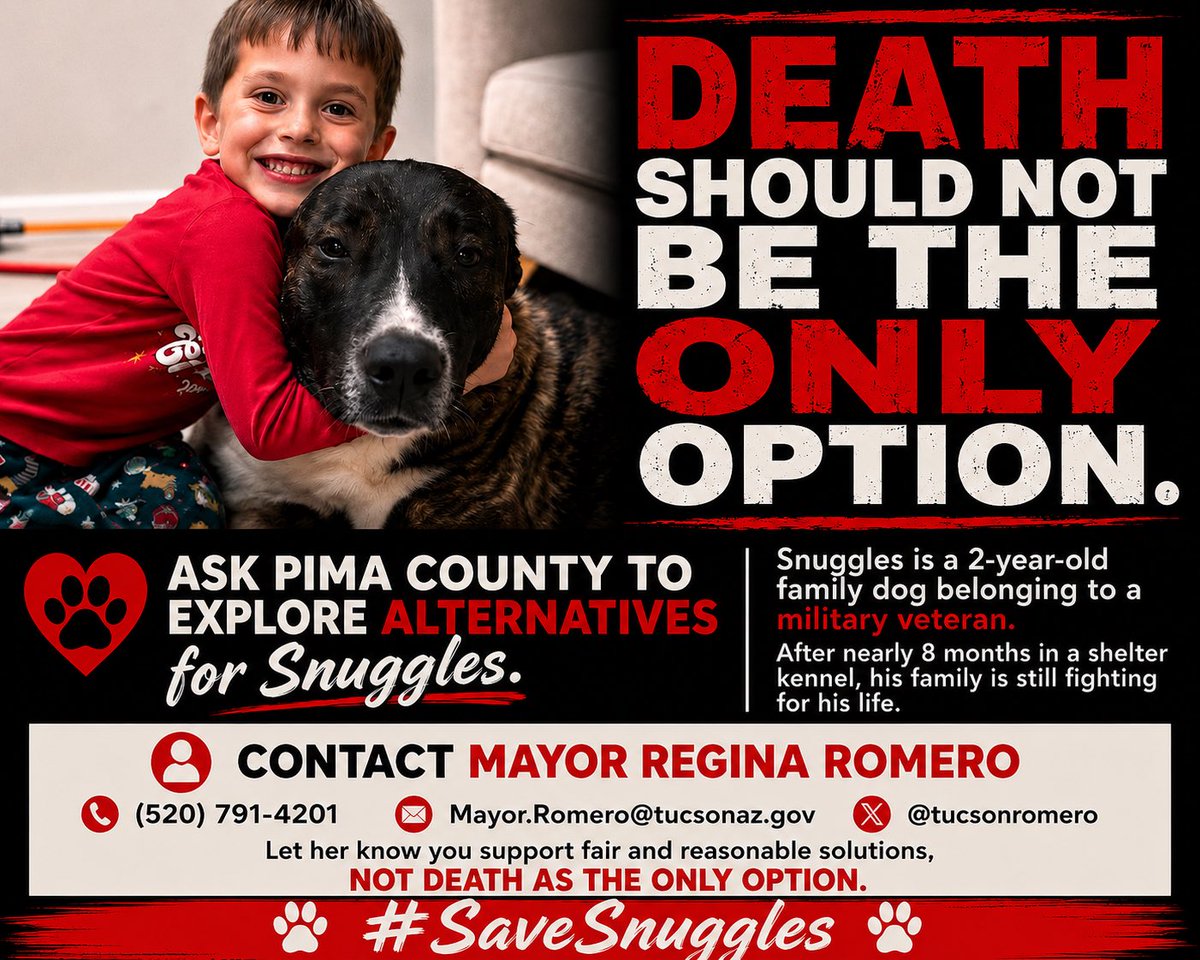
Today, let's share that same message with Mayor Regina Romero. Let her know that you support fair and reasonable solutions, not death as the only option.
Snuggles is a 2-year-old family dog. His dad is a military veteran, and he has a mom and two small kids waiting at home for him.
He has now spent nearly 8 months sitting in a shelter kennel while his family fights to save his life.
Yet the government continues to pursue euthanasia.
No matter where you stand on this case, we should all be asking whether other options were ever seriously considered, like a secure harness, a muzzle when needed, stronger fencing, additional containment, behavioral management, and supervised handling.
There are ways to protect the public without killing Snuggles.
📧 [email protected] 📞 520-791-4201 𝕏 @tucsonromero
Please be courteous when reaching out. Every voice matters.
#SaveSnuggles
@steven87770739@brendanmjones@SaraGonzalesTX I’ve also heard that, even though I’m severely allergic to hornets and wasps, I might not be as allergic to honey bees. I actually don’t recall ever being stung by a honeybee, so I wouldn’t really know.
Lucy with her daddy, her best friend Lex, and her personal security detail—the geese gang 🪿 🪿 🪿 🪿
Everyone is accounted for. Perimeter has been secured. Morale is high. Homestead peace has officially been restored. 🐾 ❤️
#themulberrypatch#homestead#herbalist #singingherbalist #savelucy
@buckleycarlson Absolutely! And thank you so very much for everything you did to help! If you’re ever in our corner of VA, please stop by to give the doggos some belly rubs ♥️
Exactly…across the tree line. You can’t see them. At least not the ones who are turdos. We have an incredible, fellow homesteading neighbor, and their house is literally 50 feet from our fence line. Between the two of us we have NINE dogs 😂 and about 100 livestock (no one has ever bothered them).