Hybrid machinE leaRning for Improved Infection management in Critically ill
An @IDLabResearch @uzgent project
Follow for updates on #AI and #sepsis management
We now have a website! You can find us at https://t.co/4DoGzVN4vB. It is a work-in-progress; any feedback is appreciated!
Make sure to also follow our Researchgate for the latest updates: https://t.co/hb0BFShsdA
Is this another step toward heart disease prevention and AI in healthcare?
Interested? The pre-proof of our article where we attempt to provide a risk estimation prediction for Atrial Fibrillation in the ICU is available! Go have a read!
https://t.co/cViBIX7Qm7
Our group just published a brand new proof of concept to optimize antimicrobial dosing in the intensive care unit (ICU) in @BioMedCentral Medical Informatics and Decision Making. 👇
https://t.co/o0EfweBVwy
Want to know what we did?
A 🧵 (1/14).
The final aim is deployment in clinical practice in the intensive care unit by integration within the electronic health record to predict plasma concentrations and give dose guidance in real-time. (13/14)
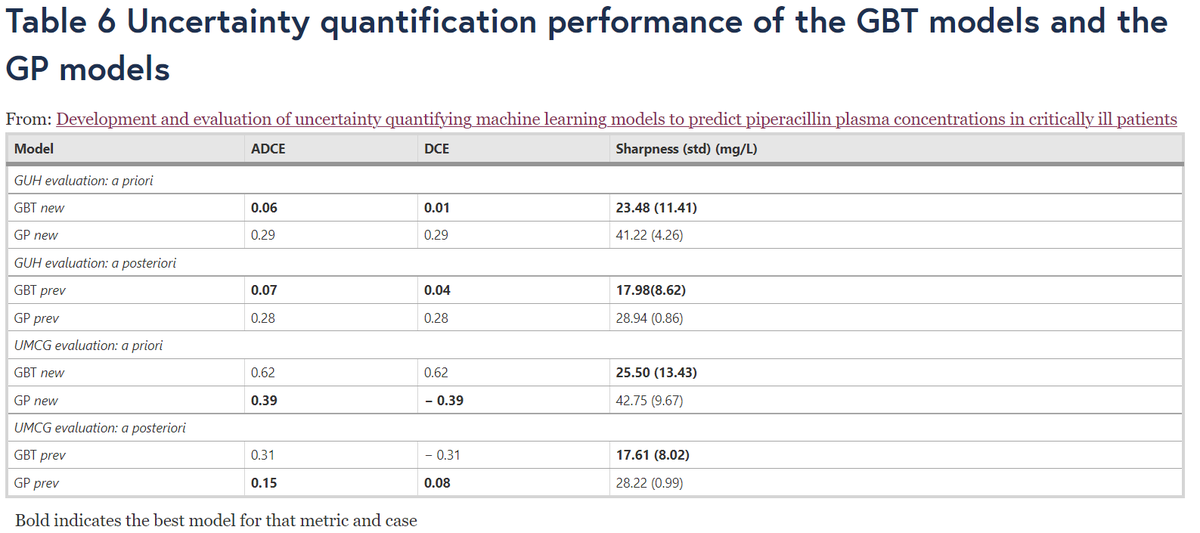
As predicted drug concentrations are point estimates, reporting the degree of uncertainty is important for clinical decision-making. Using the Quantile Ensemble method, the GBT models is able to produce reliable prediction intervals and predictive distributions. (8/)
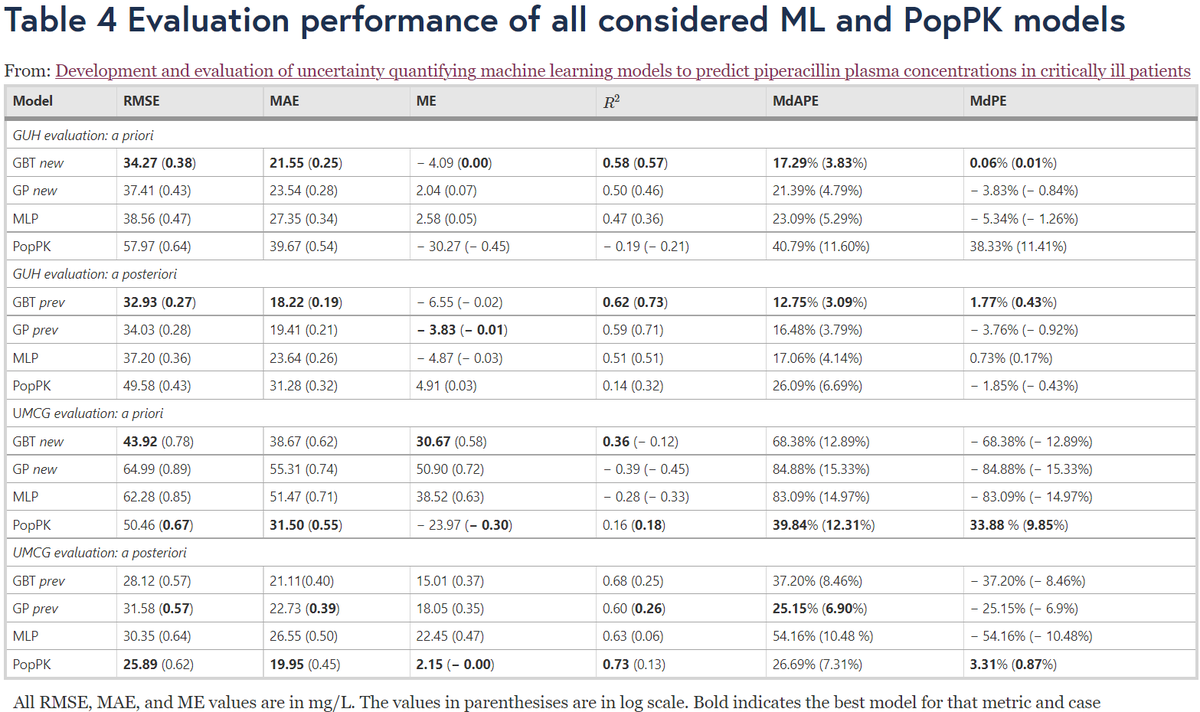
Our best performing model was the Gradient Boosting Trees (GBT) model. Performance metrics were comparable between the publisehd PopPK model and the GBT model. (7/)