Astrophysics PhD student at @PhysAstroEd | chemical enrichment of galaxies at high-z | boulderer, guitarist, film photographer + gig-goer | (he/him) 🏳🌈
New paper today!🤠
For a sample of star-forming galaxies at z ≈ 4 from the EXCELS survey, we measure the electron temperatures, densities, and the Ar/O and Ne/O abundance ratios. Our main result is that Ar/O is lower at high-z compared to local sources!
https://t.co/GSpr5F0TyZ
New paper today!🤠
For a sample of star-forming galaxies at z ≈ 4 from the EXCELS survey, we measure the electron temperatures, densities, and the Ar/O and Ne/O abundance ratios. Our main result is that Ar/O is lower at high-z compared to local sources!
https://t.co/GSpr5F0TyZ
This is clearest by direct comparison of our abundance ratios compared to local samples. However, samples remain small, so larger surveys focused on abundances are needed to fully assess this probe of supernovae contributions.
Too much, too young, too fast? The first results from mine and @FergusLPCullen's EXCELS JWST Cycle 2 programme are out today. We show beautiful new spectra for 4 ultra-massive galaxies that formed way too many stars when the Universe was way too young 1/3 https://t.co/K9ca8EdwcS
My first lead-author paper is on arxiv today! 🤠
By measuring the O and Fe abundances of star-forming galaxies at z≈3.5, we constrain the stellar + gas-phase mass-metallicity relationships and find our galaxies have ubiquitously supersolar O/Fe ratios!
https://t.co/OgUGBU4OkZ
My express thanks to all contributing authors for getting this paper off the ground, and the utmost thanks to @FergusLPCullen for his guidance, support and patience throughout this project. 😁
These results add further evidence to support a picture in which high-redshift star-forming galaxies are ubiquitously ⍺-enhanced, as expected for young systems whose ISM is primarily enriched by core-collapse supernovae. If interested, please see the paper for full details!
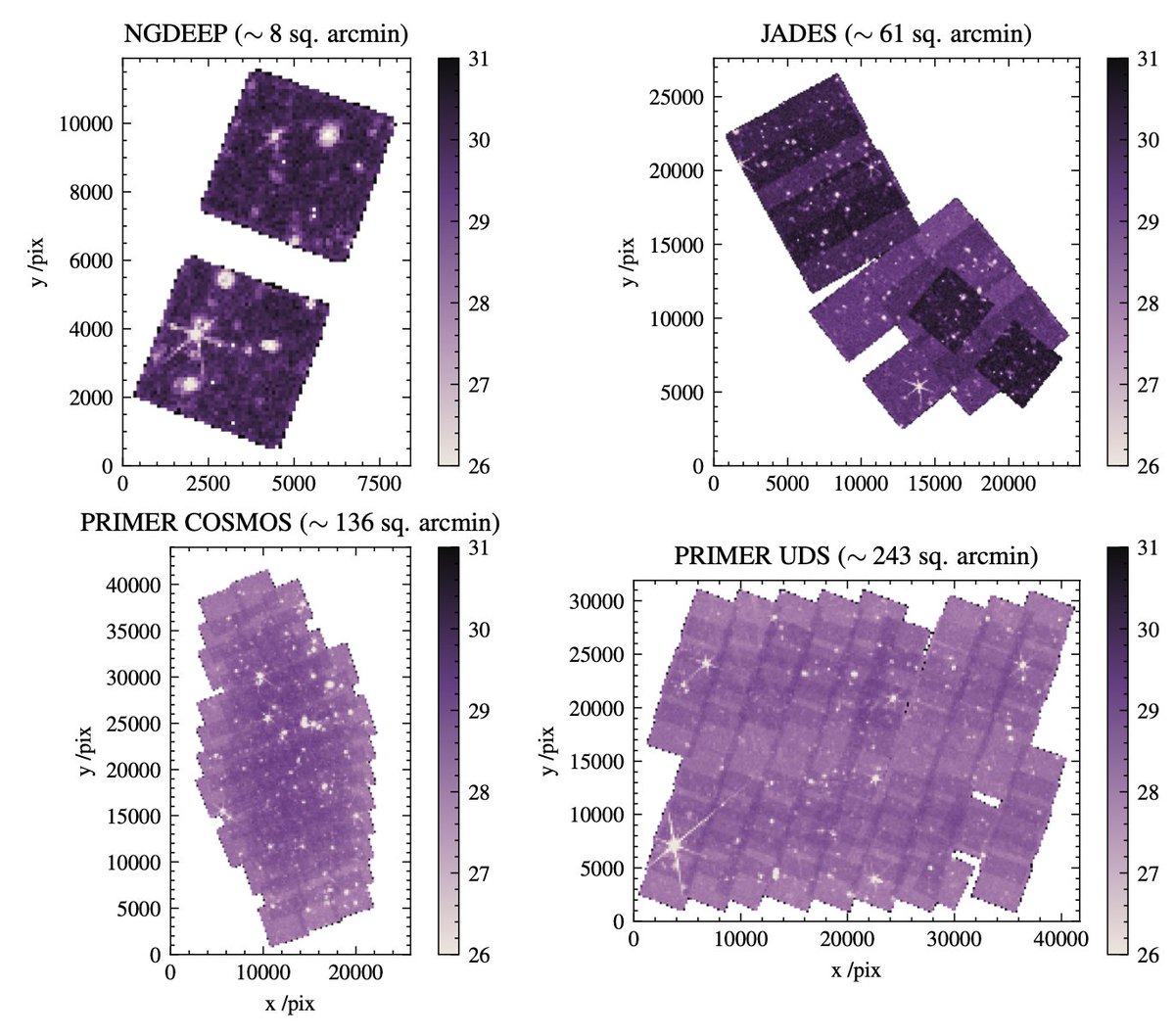
I'm happy to present our new paper on the UV luminosity function at z=9-15! We use a combination of the PRIMER, JADES and NGDEEP surveys covering 370 sq.arcmin. and reaching depths of 30 AB mag in the deepest region. 1/6
https://t.co/wIrvmANcIn
New paper on the arXiv today - investigating the UV continuum SEDs of galaxy candidates at z > 8. Our main new finding is that at z > 10 the UV continuum looks uniformly `dust-free' . https://t.co/nxz9wu7Shg