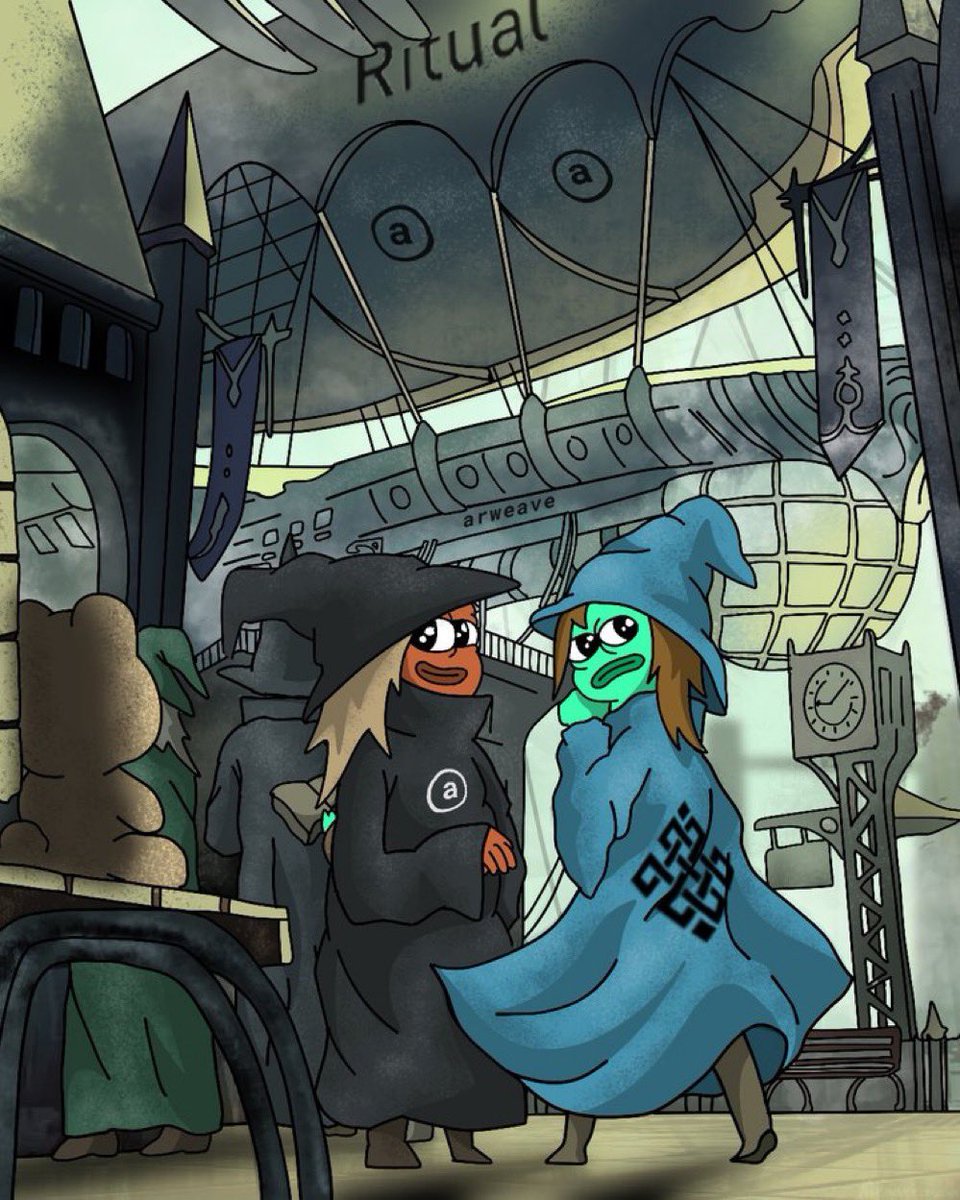
Day 39 of my @ritualnet daily series.
Today I found a tool shared by @ALFACREATIVE33
It lets you create Ritual cards. Enter your Discord name and create your card.
Check it out here [https://t.co/l99h26taiF]
gRitual frens !
Day 38 of my @ritualnet daily series.
Today, we're discussing Ritual’s article, a cutting-edge privacy primitive that was recently released on: Cascade is a token-sharded private LLM inference mechanism. By Rahul Thomas , Louai Zahran , Erica Choi , Micah Goldblum , Arka Pal.
Ritual is addressing more than simply "AI on chain."
This is it:
How can inference be performed on a powerful LLM without disclosing user input to the computation nodes? Because token information can leak from transformers' raw hidden states, even when they are shuffled or permuted.
This implies that even if you attempted to obfuscate your prompt, a node might still be able to recreate it.
Ritual's response is Cascade.
❖ The Fundamental Understanding
Cascade divides, or shards, a model layer's hidden state such that each node only sees a portion of the token rows.
Why? Because a malicious observer cannot effectively recreate the entire input if only a portion of the concealed state is revealed; the math and security flaws grow so quickly that brute force becomes nearly impossible.
Compared to previous systems that reveal the entire state and allow privacy leaks, this is a major change.
❖ The High-Level Operation of Cascade
Rather of a single node doing a complete forward pass on an LLM, Cascade:
divides the token hidden matrix into pieces.
Sends rows of tokens to various compute nodes (CompNodes); computes partial attention passes using specialised attention nodes; safely recombines findings without disclosing whole hidden states; and makes sure that no single node ever sees enough information to reconstruct the entire prompt.
Although the inference findings are accurate, no single node is ever entirely exposed to the concealed states.
❖ Security through Design
While Cascade delivers useful, statistical privacy, Ritual does not claim cryptographic proof-level security (that is what SMPC attempts to do):
Attacks that attempt to reverse tokens become extremely costly if shards are far separated.
When gaps are large enough, even learning-based extraction attacks lose their effectiveness.
In contrast to slow MPC techniques, which might take minutes per inference, private inference becomes usable as a result.
❖ Why This Is Important
In a world with decentralised AI:
Users expect data protection and privacy, not only anonymity.
Developers want scalable inference, not bottlenecks.
Verifiable accuracy is what the network seeks, not hope.
Cascade is situated where these objectives converge.
It's practical, effective, and compatible with decentralised implementation.
Takeaway for Day 38
Cascade is more than a tech paper.
It's Ritual's tangible move towards private inference in open infrastructure, allowing usability and privacy to coexist without compromising functionality.
This is the secure, decentralised AI of the future, and Ritual is creating the building blocks to make it a reality.
gRitual 🕯️
Day 38 of my @ritualnet daily series.
Today, we're discussing Ritual’s article, a cutting-edge privacy primitive that was recently released on: Cascade is a token-sharded private LLM inference mechanism. By Rahul Thomas , Louai Zahran , Erica Choi , Micah Goldblum , Arka Pal.
Ritual is addressing more than simply "AI on chain."
This is it:
How can inference be performed on a powerful LLM without disclosing user input to the computation nodes? Because token information can leak from transformers' raw hidden states, even when they are shuffled or permuted.
This implies that even if you attempted to obfuscate your prompt, a node might still be able to recreate it.
Ritual's response is Cascade.
❖ The Fundamental Understanding
Cascade divides, or shards, a model layer's hidden state such that each node only sees a portion of the token rows.
Why? Because a malicious observer cannot effectively recreate the entire input if only a portion of the concealed state is revealed; the math and security flaws grow so quickly that brute force becomes nearly impossible.
Compared to previous systems that reveal the entire state and allow privacy leaks, this is a major change.
❖ The High-Level Operation of Cascade
Rather of a single node doing a complete forward pass on an LLM, Cascade:
divides the token hidden matrix into pieces.
Sends rows of tokens to various compute nodes (CompNodes); computes partial attention passes using specialised attention nodes; safely recombines findings without disclosing whole hidden states; and makes sure that no single node ever sees enough information to reconstruct the entire prompt.
Although the inference findings are accurate, no single node is ever entirely exposed to the concealed states.
❖ Security through Design
While Cascade delivers useful, statistical privacy, Ritual does not claim cryptographic proof-level security (that is what SMPC attempts to do):
Attacks that attempt to reverse tokens become extremely costly if shards are far separated.
When gaps are large enough, even learning-based extraction attacks lose their effectiveness.
In contrast to slow MPC techniques, which might take minutes per inference, private inference becomes usable as a result.
❖ Why This Is Important
In a world with decentralised AI:
Users expect data protection and privacy, not only anonymity.
Developers want scalable inference, not bottlenecks.
Verifiable accuracy is what the network seeks, not hope.
Cascade is situated where these objectives converge.
It's practical, effective, and compatible with decentralised implementation.
Takeaway for Day 38
Cascade is more than a tech paper.
It's Ritual's tangible move towards private inference in open infrastructure, allowing usability and privacy to coexist without compromising functionality.
This is the secure, decentralised AI of the future, and Ritual is creating the building blocks to make it a reality.
gRitual 🕯️
Day 37 of my @ritualnet daily series.
Let's discuss privacy today, a topic that most decentralised AI discussions steer clear of.
Not the trendy term privacy. Not "trust us, bro" privacy. However, if you ignore it, the uncomfortable kind will cause systems to malfunction.
A recent paper published by Arka Pal on privacy issues in decentralised computation by the Ritual team emphasises a harsh reality:
Safe execution is not always equated with open models, open networks, and shared computing.
❖ The issue behind the hype
A new class of hazards arises when AI gets more decentralised and open:
• Inference-based user prompts leaking
• Examining or extracting model weights
• Sensitive signals are exposed in intermediate states• "Open" execution environments are turning becoming silent data drains.
You can decentralise computation as much as you like, but if privacy crumbles, trust will follow.
Additionally, the majority of stacks nowadays use off-chain assumptions or hand-waving to handle this.
❖ The framing of ritual: privacy is a system property
Ritual does not view privacy as an add-on or a plugin.
It presents privacy as something that needs to be economically compatible with the rest of the system, verifiable, and composable.
Because of this, privacy in Ritual is not isolated; rather, it coexists with:
• Verifiable calculation
• Networks of providersPrimitives that are modular
• Execution driven by the market (Resonance)
Privacy is not a must. It is planned, priced, and enforced.
Why this is more important than most people realise
There is more to the next generation of apps than just DeFi + AI.
It is:• Self-governing agents responding to private signals
• Sensitive data is touched by on-chain AI pipelines
• Outsourcing computation for cross-chain systems
• Models that require assurances rather than promises
Decentralised compute becomes a liability rather than a benefit in the absence of privacy protections.
Ritual is obviously setting itself up to address a question for the future rather than the convenience of the present:
"Is it possible to implement sophisticated AI logic in public systems without revealing information that shouldn't be seen?"
The bigger picture
There was no feature announcement on this blog.
It wasn't a tool shipment.
It was imposing a constraint on direction.
Privacy must be innate, verifiable, and economically sound if decentralised computation is to grow.
Ritual continues to carve out that lane.
Takeaway for Day 37
The inability of decentralised AI to compute does not force it to fail.
When it is unable to protect, it fails.
Building a compute network is only one aspect of ritual; another is creating the circumstances necessary for computation to be believed.
And people won't realise how important that distinction will be.
gRitual 🕯️
Day 37 of my @ritualnet daily series.
Let's discuss privacy today, a topic that most decentralised AI discussions steer clear of.
Not the trendy term privacy. Not "trust us, bro" privacy. However, if you ignore it, the uncomfortable kind will cause systems to malfunction.
A recent paper published by Arka Pal on privacy issues in decentralised computation by the Ritual team emphasises a harsh reality:
Safe execution is not always equated with open models, open networks, and shared computing.
❖ The issue behind the hype
A new class of hazards arises when AI gets more decentralised and open:
• Inference-based user prompts leaking
• Examining or extracting model weights
• Sensitive signals are exposed in intermediate states• "Open" execution environments are turning becoming silent data drains.
You can decentralise computation as much as you like, but if privacy crumbles, trust will follow.
Additionally, the majority of stacks nowadays use off-chain assumptions or hand-waving to handle this.
❖ The framing of ritual: privacy is a system property
Ritual does not view privacy as an add-on or a plugin.
It presents privacy as something that needs to be economically compatible with the rest of the system, verifiable, and composable.
Because of this, privacy in Ritual is not isolated; rather, it coexists with:
• Verifiable calculation
• Networks of providersPrimitives that are modular
• Execution driven by the market (Resonance)
Privacy is not a must. It is planned, priced, and enforced.
Why this is more important than most people realise
There is more to the next generation of apps than just DeFi + AI.
It is:• Self-governing agents responding to private signals
• Sensitive data is touched by on-chain AI pipelines
• Outsourcing computation for cross-chain systems
• Models that require assurances rather than promises
Decentralised compute becomes a liability rather than a benefit in the absence of privacy protections.
Ritual is obviously setting itself up to address a question for the future rather than the convenience of the present:
"Is it possible to implement sophisticated AI logic in public systems without revealing information that shouldn't be seen?"
The bigger picture
There was no feature announcement on this blog.
It wasn't a tool shipment.
It was imposing a constraint on direction.
Privacy must be innate, verifiable, and economically sound if decentralised computation is to grow.
Ritual continues to carve out that lane.
Takeaway for Day 37
The inability of decentralised AI to compute does not force it to fail.
When it is unable to protect, it fails.
Building a compute network is only one aspect of ritual; another is creating the circumstances necessary for computation to be believed.
And people won't realise how important that distinction will be.
gRitual 🕯️
Day 36 on my @ritualnet daily series.
Today I'm going to talk about something fundamental, not a feature, a node type, or a fancy primitive, but the economics that enable decentralised compute to work.
Ritual researcher, Naveen Durvasula recently wrote a detailed paper on Decentralised Computation, which is one of the clearest conceptions of how compute markets could work in Web3.
Because if there's one thing every blockchain, AI network, and Oracle system is fighting with right now, it's this:
How can you match compute needs with available nodes without negatively impacting performance, losing value, or creating a bidding circus?
Ritual's solution is both elegant and practical.
❖ The Ugly Reality Most Systems Ignore
Every decentralised computing system is juggling:
• Scarce computing resources• Nodes with various capacities.
• Users with varying urgency and valuation.
• Specialised hardware requirements (CPU, GPU, secure enclaves).
• State conflicts and redundancy needs.
That's a lot of moving elements, but most networks still try to solve it through blind auctions.
Guess what happens.
• Users experience unexpected pricing.
• Nodes face bidding battles that reduce margins.
• Networks lose efficiency and become chaotic.
Auctions are used for tokens.
They do not scale for computation.
❖ Ritual's Smart Market Design
Ritual flips the model.
Ritual's intelligent market-makers propose allocations based on node costs and capabilities, compete for the best outcomes, drive margins towards zero, and prioritise the most economically valuable work-to-resource matching.
In other words:
Instead of extracting value, the system multiplies it.
Users pay what is reasonable, nodes are fairly compensated, and no computation is wasted.
This is not a chaotic auction.
This is economic coordination.
❖ The Mechanics in Plain English
Let's say you have two things to complete:
• An AI deduction
• A computation involving multiple parties
Additionally, you have two nodes with different resources.
Ritual doesn’t just say “highest bid wins.”
It says:
"Let's determine the allocation that maximises economic value for all parties and set a price that benefits both users and nodes."
That’s the magic of the posted-price, competition-powered mechanism in the blog.
❖ Prover Networks: Trust + Execution
The Prover Network layer is one of the best developments here.
Ritual verifies computation rather than merely routing it.
Rather than requesting output from a distant node and assuming it's accurate, Ritual can:
Assign tasks to the best execution node; create cryptographic proofs of computation accuracy; return those proofs to the chain; and allow anyone to check them without having to re-execute.
It represents the transition from the compute marketplace to the verified compute fabric.
This is how AI pipelines, zkML coprocessors, Oracle systems, and L2 provers can finally work together in a trustworthy manner.
❖ Decentralized computing is more than a feature.
It is Web3's next infrastructure layer and the obvious replacement for:
Decentralized storage
Decentralized identity
Decentralized finance
Work is done and value is transferred in compute markets.
Additionally, Ritual is creating the economic foundation that enables this market scalable, equitable, and efficient.
That’s all for today frens, see you next time on day 37.
gRitual frens🕯️
Day 36 on my @ritualnet daily series.
Today I'm going to talk about something fundamental, not a feature, a node type, or a fancy primitive, but the economics that enable decentralised compute to work.
Ritual researcher, Naveen Durvasula recently wrote a detailed paper on Decentralised Computation, which is one of the clearest conceptions of how compute markets could work in Web3.
Because if there's one thing every blockchain, AI network, and Oracle system is fighting with right now, it's this:
How can you match compute needs with available nodes without negatively impacting performance, losing value, or creating a bidding circus?
Ritual's solution is both elegant and practical.
❖ The Ugly Reality Most Systems Ignore
Every decentralised computing system is juggling:
• Scarce computing resources• Nodes with various capacities.
• Users with varying urgency and valuation.
• Specialised hardware requirements (CPU, GPU, secure enclaves).
• State conflicts and redundancy needs.
That's a lot of moving elements, but most networks still try to solve it through blind auctions.
Guess what happens.
• Users experience unexpected pricing.
• Nodes face bidding battles that reduce margins.
• Networks lose efficiency and become chaotic.
Auctions are used for tokens.
They do not scale for computation.
❖ Ritual's Smart Market Design
Ritual flips the model.
Ritual's intelligent market-makers propose allocations based on node costs and capabilities, compete for the best outcomes, drive margins towards zero, and prioritise the most economically valuable work-to-resource matching.
In other words:
Instead of extracting value, the system multiplies it.
Users pay what is reasonable, nodes are fairly compensated, and no computation is wasted.
This is not a chaotic auction.
This is economic coordination.
❖ The Mechanics in Plain English
Let's say you have two things to complete:
• An AI deduction
• A computation involving multiple parties
Additionally, you have two nodes with different resources.
Ritual doesn’t just say “highest bid wins.”
It says:
"Let's determine the allocation that maximises economic value for all parties and set a price that benefits both users and nodes."
That’s the magic of the posted-price, competition-powered mechanism in the blog.
❖ Prover Networks: Trust + Execution
The Prover Network layer is one of the best developments here.
Ritual verifies computation rather than merely routing it.
Rather than requesting output from a distant node and assuming it's accurate, Ritual can:
Assign tasks to the best execution node; create cryptographic proofs of computation accuracy; return those proofs to the chain; and allow anyone to check them without having to re-execute.
It represents the transition from the compute marketplace to the verified compute fabric.
This is how AI pipelines, zkML coprocessors, Oracle systems, and L2 provers can finally work together in a trustworthy manner.
❖ Decentralized computing is more than a feature.
It is Web3's next infrastructure layer and the obvious replacement for:
Decentralized storage
Decentralized identity
Decentralized finance
Work is done and value is transferred in compute markets.
Additionally, Ritual is creating the economic foundation that enables this market scalable, equitable, and efficient.
That’s all for today frens, see you next time on day 37.
gRitual frens🕯️
Day 35 of my @ritualnet series.
After this weeks DevRel Office Hours, we had more than 20+ more signups from devs! Shows the ritual community keeps growing.
If you missed this week DevRel office hours, don’t miss the next one.
You can submit a feedback here also : https://t.co/FzhVjEziny
gRitual frens
Gm to those that still Gm.
Been away for a minute now, trying to sort some things, but I’m back fully.
Picked up an M4 Pro and made a couple other “big boy” purchases too. Grateful for last year, Thank you Web!
Let’s do more, frens
Day 35 of my @ritualnet series.
After this weeks DevRel Office Hours, we had more than 20+ more signups from devs! Shows the ritual community keeps growing.
If you missed this week DevRel office hours, don’t miss the next one.
You can submit a feedback here also : https://t.co/FzhVjEziny
gRitual frens
Day 34 of my @ritualnet daily series.
No art or docs breakdown today, just a moment of reflection and gratitude for the new year ahead.
Grateful for frens I’ve met and ones yet to meet, grateful especially for the ritual community 🥂
Happy new year frens, I hope the new year brings good tidings.
gRitual


![hex_Jrd's tweet photo. Day 39 of my @ritualnet daily series.
Today I found a tool shared by @ALFACREATIVE33
It lets you create Ritual cards. Enter your Discord name and create your card.
Check it out here [https://t.co/l99h26taiF]
gRitual frens ! https://t.co/isSHfZDzsw](https://pbs.twimg.com/media/G_GSWR6XoAEi-PK.jpg)