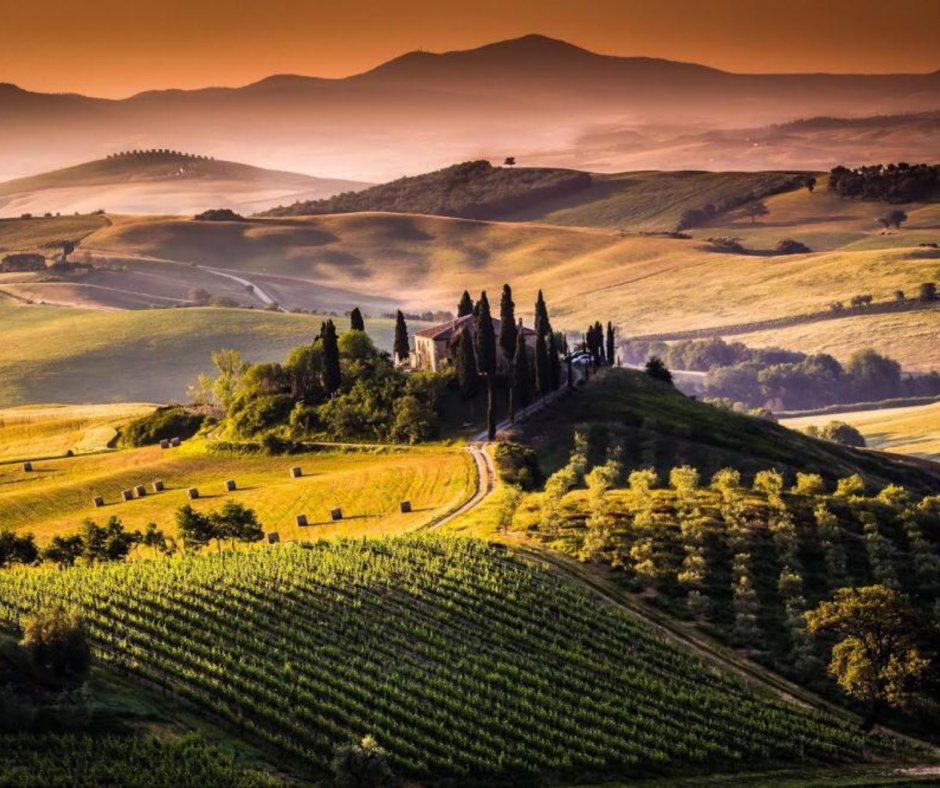
Rural Europe is going to become a lifestyle destination for millions, not just Europeans.
Thousands of historic towns sitting half-empty. Stone houses for €30-80K. Solid houses built for generations, realistically yours for under €200K. Often with incredible tax regimes.
The two things that were missing: internet and services. Starlink fixed the first. And these aren't the rural areas of the 90s, many towns close to larger cities are now perfectly served. People are moving back.
This is my "Starlink guide" to rural Europe: 10 places I'm considering for living or investment myself.
🧵
On Energy and AI:
We are all aware of the urgent need for massive new energy infrastructure for data centres and other general needs. The grid is old and the supply is constrained.
Investor capital is pouring into nuclear soluations, new gas plants and other opportunities and the bottleneck will be better solved in 5 years+
However, the need for the extra energy is URGENT and IMMEDIATE...
The AI race is the most important technology race that will ever occur. It is not just about hyperscalers and their profits, but about the game of nations.
There is only one energy solution that can hyperscale in 12 to 24 months and that is solar. China has shown this by adding more than the total amount of energy created by Solar elsewhere globally, in one year. The rise of solar in China is one of the great exponentials. China knows the game here. Everyone else has to play catch up.
The Kardashev Scale is the correct way to think about this. The sun is 99.9% of the mass of the solar system and we are harnessing <1% of its energy that hits earth.
1 sq mile on the earths surface receives 2.5 gigawatts of solar energy. Yes, solar panel efficiency is low and usable daylight hours is restricted but the amount of solar panels required in relative terms of the surface size is small.
Solar is not yet perfect as the supply of energy is intermittant (nights/bad weather etc) and efficiency is low (but rising as tech improves) but costs are collapsing exponentially, even taking into account panel replacements and no subsidies (it doesnt require them).
Some of the issues are offset by batteries which currently solve for 4 hours of extra storage. Tesla's Megapacks are growing at 50% to 70% per year and other players are also scaling fast. Battery tech will only imporve from here too.
Just the use of solar + batteries reduces demand on the exisiting grid by upto 65% (you only need to use the grid load for perdiods of time). This helps massively in this rapid scaling to avoid an overload of the grid. Solar + batteries also allows for localised, decentralised energy grids for specifc use - factories, datacenters, etc.
The load on the grid will be reduced after 2 years or so when new localised gas plants are built to balance the loads. Gas plants are the cheapest, cleanest and fastest of the fossil fuel solutions but it takes longer to scale than solar and requires a lot of gas pipelines.
Weirdly, solar seems to be politicised, but its going to become an economic imperative as nothing else can solve the needs of the massive data centers in the next 1 to 2 years, and no one can afford to be leftr behind in the race to AGI and beyond.
AI is the most important technology humanity will ever develop as it replaces us as the apex intelligence on earth and is vastly more energy efficient than humans at compute/intellgence output.
The core metric for the universe itself is:
Intelligence per unit of energy
For this to scale exponentially, AI will replace humans as the primary source of intelligence and the sun's energy is most of the energy on earth. Even oil is just biologically-stored sun energy with finite supply.
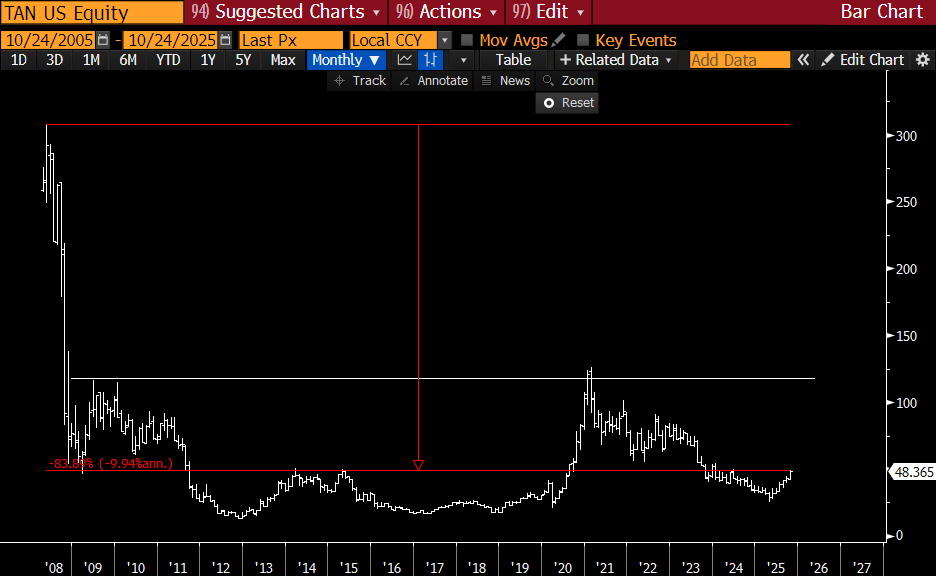
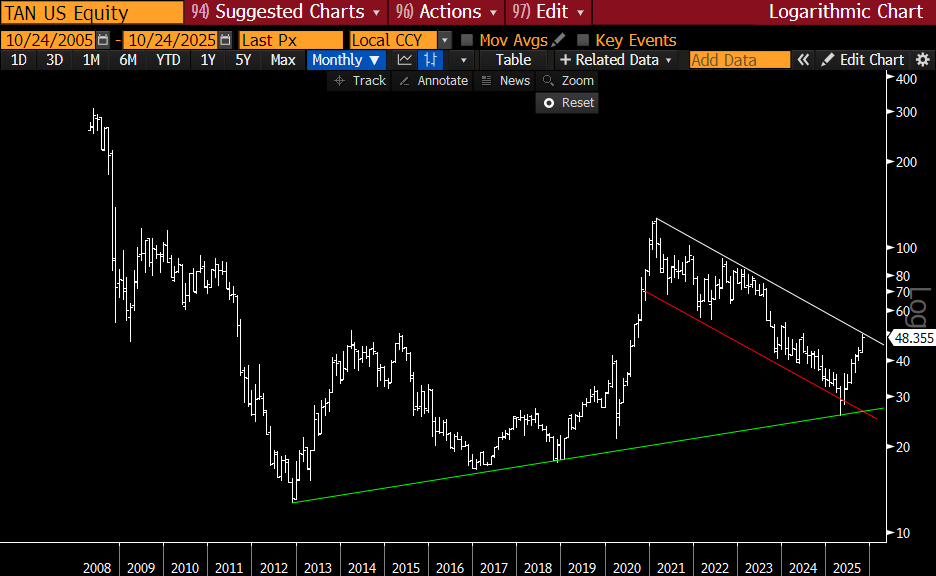
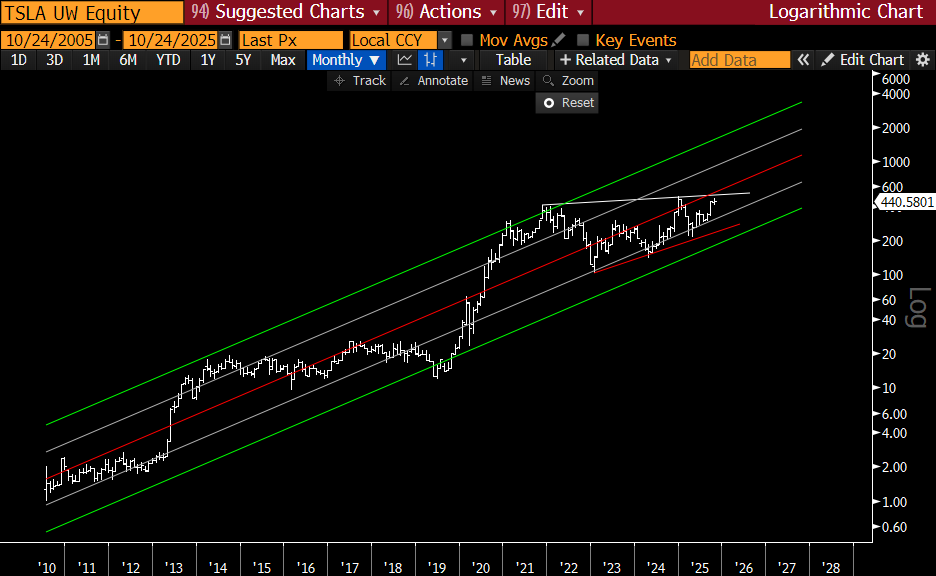
In terms of investability, there are two opportunities that stand out as long-term plays:
The Solar ETF TAN is down 84% from its high, has formed a perfect base on both the log chart and the regular chart.
TSLA is the other obvious play as it dominates the large battery sector and batteries account for 10% of total revenues and are growing rapidly and will continue to do so. The Tesla chart is one of the best in the Exponential Age.
Anyway, I know because solar is politicised that people will rush to fight in the comments but don't bother unless you can solve the urgent energy needs for AI in the next 1 to 2 years by any other method.... you can't.
And yes, dear troll, we all understand that there are lithium, copper and other needs, and yes, there will be an investible bull market in those too (amongst other major commodities) as the business cycle and the Capex cycle heats up... and yes, there will be supply issues if you havent carefully planned/hedged.
But you need to warm up to solar... its going to get hot.
(Time horizon is now and for the next 5 years+).
Rest in peace, Patricia Routledge 🙏🏻
In memory of her, I encourage everyone to read these words of hers from February last year.
Whether young or old, you're bound to get something out of it.
*****
"I’ll be turning 95 this coming Monday. In my younger years, I was often filled with worry — worry that I wasn’t quite good enough, that no one would cast me again, that I wouldn’t live up to my mother’s hopes. But these days begin in peace, and end in gratitude.
My life didn’t quite take shape until my forties. I had worked steadily — on provincial stages, in radio plays, in West End productions — but I often felt adrift, as though I was searching for a home within myself that I hadn’t quite found.
At 50, I accepted a television role that many would later associate me with — Hyacinth Bucket, of Keeping Up Appearances. I thought it would be a small part in a little series. I never imagined that it would take me into people’s living rooms and hearts around the world. And truthfully, that role taught me to accept my own quirks. It healed something in me.
At 60, I began learning Italian — not for work, but so I could sing opera in its native language. I also learned how to live alone without feeling lonely. I read poetry aloud each evening, not to perfect my diction, but to quiet my soul.
At 70, I returned to the Shakespearean stage — something I once believed I had aged out of. But this time, I had nothing to prove. I stood on those boards with stillness, and audiences felt that. I was no longer performing. I was simply being.
At 80, I took up watercolour painting. I painted flowers from my garden, old hats from my youth, and faces I remembered from the London Underground. Each painting was a quiet memory made visible.
Now, at 95, I write letters by hand. I’m learning to bake rye bread. I still breathe deeply every morning. I still adore laughter — though I no longer try to make anyone laugh. I love the quiet more than ever.
I’m writing this to tell you something simple:
Growing older is not the closing act. It can be the most exquisite chapter — if you let yourself bloom again.
Let these years ahead be your TREASURE YEARS.
You don’t need to be famous. You don’t need to be flawless.
You only need to show up — fully — for the life that is still yours.
With love and gentleness,
Patricia Routledge
*****
Once more, rest in peace. 🤍
To the death threat reply guys:
To be clear I have no issues with Ethereum L1 - I’ve developed many apps on it through the years and know the architecture , code, best practices and Solidity world very well, given that I also know the issues, the weaknesses and the limitations of its consensus and defensive coding fragility due to reentrancy risk. It has known issues that all industry builders are aware of. Since Ethereum many newer chains with better development languages, better architectures and better performance and execution safety and extensibility have emerged, and been matured and adopted. For instance Solana and SUI which are the only two candidates being considered by any production application effort in the real world for real world applications that scale.
Ethereum has a place - for use cases where very few transactions per month are needed with basic functionality. But now my institutional community have started using faster cheaper networks for this too as they also want the benefits and are frustrated by the friction in using Ethereum even if it’s seldom. But I don’t have issue with this. Ethereum is a highly decentralized true L1 and finality on Ethereum is legally binding and ethically sound. It has its place until it doesn’t.
Has Tom Lee built an app on Ethereum or an L2? No. He is a talking head.
I do however have issue with Ethereum L2s as they break the permissionless and the instant finality model removing all the benefits of DLT reducing the end user platforms to be no different than any other web2 platform. We already built those, they are not an evolution they are a rebranding of web2 and are definitely not defi.
They were invented to bandaid Ethereums weaknesses way too fast, with no regard for the basic fundamentals of the web3 blockchain stack, and its benefits to the application space and mismarketed to be web3 and DeFi with no disclosures of risk and permissionless understanding.
L2s were and still are a bandaid - the Ethereum L1 should be reengineered before 2028 which is the current roadmap.
I will never recommend a L2 to my clients and within my advisor capacity and so will my peers in the industry who I interview publicly on my Spaces for everyone to hear from actual engineers across the industry.
Ethereum was a store of value, voted to become an execution environment and switched to POS. Problem is it is now not a structural store of value as it’s not mined and has an inflation model plus it’s a poor execution engine as it’s fragile, slow and so rigid it cannot be evolved without a total rebuild. This is just fact you can ask any industry architect building web3 use cases you will get the same answer.
Rolling up transactions with 7 day dispute windows is not web3 and def not DeFi and it was a poorly conceived architecture rushed and now $billions of liquidity is sitting in centralized and closed source sequencers, bridges and protocols which violate everything the original thesis of permissionless finance was intended for.
That’s my take and I won’t fall for the marketing and narratives. I’ve built too many high performing centralized sequencers since 2003 before blockchain to be misled. I was CTO of Fiserv go check my credentials, we already built better sequencers. Nothing new in L2.
@VitalikButerin knows this and I extend my help again free of charge to helping accelerate Ethereum L1 evolution to remove the temporary L2 risk before the economic risk threatens our entire industry via exploit, regulatory capture and misinformation.
Once again I have no issue with Ethereum, I don’t hold it, don’t use it and don’t recommend it which is my right. I don’t use pagers or fax machines either.
DMs are open.
SOLANA TREASURY VEHICLES
My Solana Treasury Strategy of choice: $DFDV.
A public, SOL-native treasury engine that buys + stakes $SOL and reports in “SOL per share” (SPS).
DFDV holds ~1.3M SOL (~$250M+) and lifted SPS to 0.0619. Compounding, on-chain.
@DEFIDEVCORP
Grok 4 is dangerously good.
But 99% of people are sleeping on what it can actually do.
I’ve used it to build apps, generate content, automate deep research, and more.
Here are 10 ways to use Grok 4 that feel like cheating: