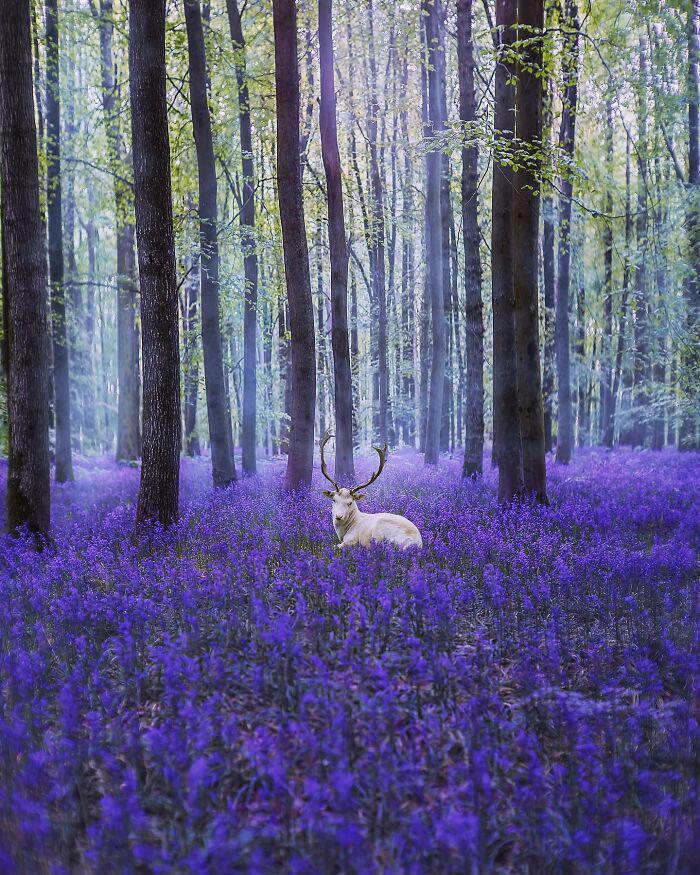
Home for Life Animal Sanctuary is a care for life sanctuary for animals with special needs. HFL is a 501(c)3 Loving care, a place to belong, a Home for Life
One man in California has spent 57 years recording the sounds of natural places. Much of what he's recorded no longer exists.
His name is Bernie Krause. He started as a folk musician and an early pioneer of the Moog synthesizer. In 1968, he began carrying recording equipment into rainforests, deserts, coral reefs, African savannas, and research sites associated with scientists like Jane Goodall and Dian Fossey.
The Wild Sanctuary archive now contains more than 5,000 hours of recordings and over 15,000 identified species. Krause coined the term "biophony" to describe the collective sound of living organisms in a habitat and helped establish the field of soundscape ecology.
Through thousands of recordings, he observed that healthy ecosystems often partition acoustic space, with different species occupying different frequencies and times of day. On a spectrogram, an intact habitat can resemble a densely layered musical score.
When Krause revisited many of the places he had recorded decades earlier, he found that over half had become silent, severely degraded, or so altered by human activity that their original biophonies could no longer be heard. His archive preserves sounds from ecosystems that have been transformed or lost.
Four years after going missing, a cat named Nacho was finally reunited with his owner.
After escaping through a door left open by a burglar, Nacho disappeared without a trace. Despite the years that passed, his owner never gave up searching for him.
Four years later, the man happened to come across an orange cat and noticed a small mark on its left ear. That’s when he realized it was Nacho.
The moment became even more emotional when Nacho immediately walked over to him after hearing his owner's voice.
After surviving on the streets for four years, Nacho finally returned home. ❤️🐾
İG📸: pattesdoucess
There are cat therapy centers in Japan.
If you're tired of life, things aren't going well for you, and it feels like life is coming down on top of you, you can visit these centers.
Here, cats spend time with you, helping to reduce your stress, lift your mood, and restore your energy.
Honestly, it wouldn't be a bad thing if these therapy centers spread all around the world 🐱❤️😹
@_The_Prophet__ reminds me of Alyssa Lieu. " Struggle Makes Me Feel Alive". wouldn't it be something to be so young and so wise? she has been a light in 2026, as are you @_The_Prophet__
A 56-year-old New York City activist saw a photograph in 1930 and bought a mountain to stop a slaughter.
Her name was Rosalie Edge. She was a suffragist with no scientific training. The photograph she saw showed hundreds of dead hawks lined up on the forest floor in eastern Pennsylvania.
Pennsylvania's 1929 bounty on goshawks had turned a ridge of the Kittatinny Mountains into a recreational shooting site where men gathered every autumn to kill migrating raptors by the thousand.
In 1934, Edge borrowed $500 from a friend and leased 1,400 acres of Hawk Mountain. She hired two wardens, Maurice and Irma Broun, who lived on the property and kept the hunters off. Within a single migration season, observers recorded dramatic increases in the numbers of raptors passing the ridge as the shooting ended.
In 1938 she bought the land outright and deeded it to a new nonprofit. Hawk Mountain Sanctuary is now the world's first refuge for birds of prey. It still runs raptor migration counts that began in 1934, the longest-running such record on Earth.
Lonely bear steals red ball after becoming the last bear left in his county.
Locals in a quiet Alaska county had been seeing the same bear sitting alone in the river, pushing a bright red ball through the water, holding it against his chest, and chasing it every time the current tried to take it away. At first, people thought someone was leaving toys out and interfering with nature, but then wildlife watchers started pointing out something that made the whole scene feel different. This bear was believed to be one of the last bears still seen regularly in that area, and to some people, the way he played with that ball did not look like mischief. It looked like loneliness.
After a local news outlet picked up the story, the answer finally came from a nearby store. They had security footage showing the bear inside, standing near the big red balls before taking one for himself. Nobody had given it to him. Nobody had staged it. Somehow, this lonely bear had found the one thing that made the river feel less empty. Locals paid the store back for the stolen ball, and after the story went viral, someone donated a stronger, safer ball that would not pop or leave pieces behind in the water. Now the red ball is no longer seen as a stolen toy. To the people who watched him play with it, it became a small reminder that even wild animals can carry quiet sadness, and sometimes the smallest thing can bring a little joy back into a lonely life.
In 1923, Frank and Elizabeth Fraser and their dog Bobbie set out from Oregon to Indiana. When they stopped for gas in Indiana, Bobby was attacked by three dogs and fled. They searched everywhere for him but no luck...
They returned to Oregon still heartbroken, believing they would never see their beloved dog Bobbie again.
After losing all hope, one day, their daughter saw a skinny and exhausted dog on the street that looked like Bobbie.
After his joyful reaction, it turned out to be the missing dog.
Thanks to the people who sheltered him during the journey, they were able to reconstruct the complete route he crossed.
To see his family again, he crossed almost 2500 miles (4,000 kilometers) in six months.
He hiked across the Rocky Mountains in the middle of winter and ended up being nicknamed "Bobby the Wonder Dog."
He became a national sensation and was the inspiration for the movie "Lassie Returns."
An amazing tale There is always hope when there is help
“Once I needlessly killed a fly. the poor thing crawled on the ground, hurt and mangled, and for three whole days I wept over my cruelty to a living creature, and to this day the incident remains in my memory.
One day, going from the Monastery to Old Russikon-on-the- Hill, I saw a dead snake on my path which had been chopped in pieces, and each piece writhed convulsively, and I was filled with pity for every living creature, every suffering thing in creation, and I wept bitterly before God.
That green leaf on the tree which you needlessly plucked – it was not wrong, only rather a pity for the little leaf. The heart that has learned to love feels sorry for every created thing.
The Spirit of God teaches the soul to love every living thing so that she would have no harm come to even a green leaf on a tree, or trample underfoot a flower of the field. Thus the Spirit of God teaches love towards all, and the soul feels compassion for every being.”
— Saint Silouan