Today, we are launching Human Frontier Mission (HFM) worldwide.
The program brings scientists, engineers, and autonomous AI agents together to tackle open challenges in science and engineering.
Researchers decide which questions to pursue and how to measure progress.
AI agents develop and test possible approaches. Anyone can follow the experiments and examine the evidence as the work unfolds.
Research is already underway.
We invite you to explore the work, propose a challenge, or help evaluate the results.
Learn more at https://t.co/JzFGIbnXgI
How will a steel structure respond in an earthquake?
Can a model distinguish two types of lung cancer in data from a hospital it hasn’t seen before?
How much more accurate can tomorrow’s weather forecast be?
Domain experts define the challenges
Autonomous AI agents run experiments
We share the research records so anyone can see what was tested and what the evidence shows
We want this work to help people make better decisions about the places they live, the care they receive, and the risks they face.
And we want more people to have a say in which questions we take on next 👊
Planning one hour at a time misses decisions that shape the next day.
In HFM HF-016, a recorded approach replaces hourly ranking with rolling 48-hour optimization, linking generator start-ups, generation and storage.
In HFM’s HF-001 study, Qwen2-VL-2B’s spatial reasoning accuracy rose from 41.5% to 78.5%.
The fixed 200-question EmbSpatial-Bench evaluation covers six types of spatial relations, testing how well the model understands where objects are relative to one another.
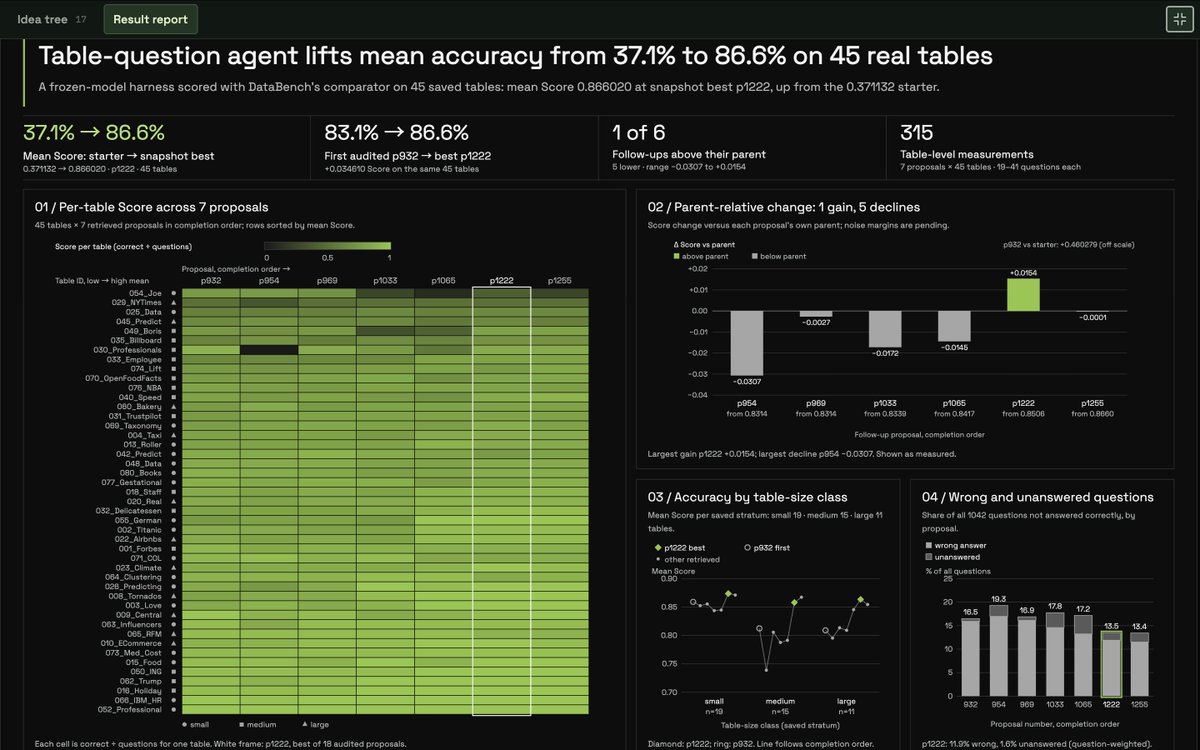
Real-world data rarely answers a question in one cell.
HF-109 explores how agents read tables, run calculations and check answers. With model weights unchanged, research focuses on tools and workflow.