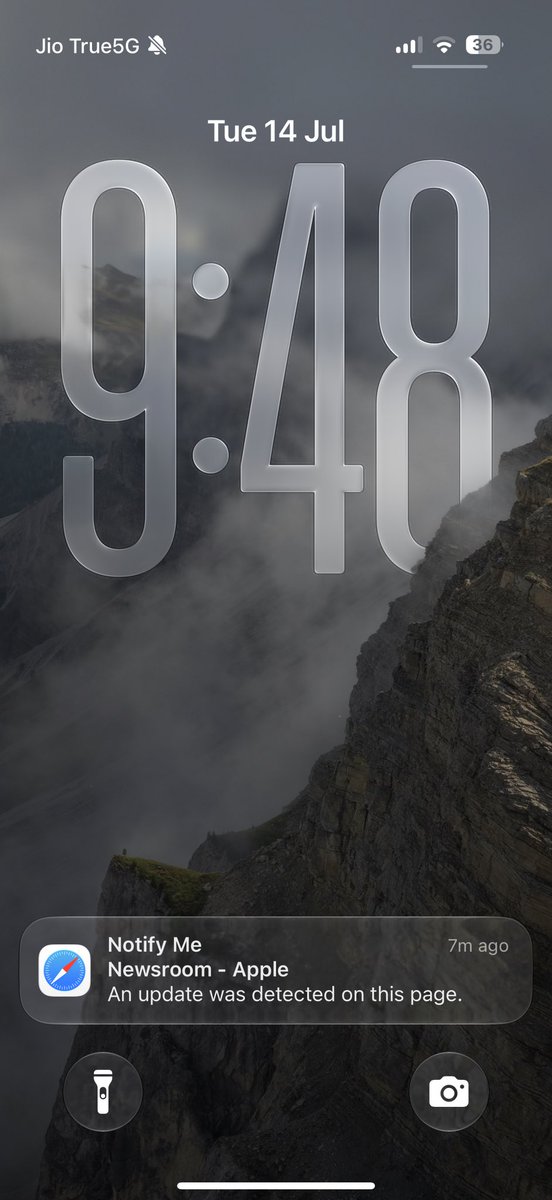
OwnGoal Studio is pleased to plan the first beta release for the upcoming 17.0-17.3.1 sptm-chip-only jailbreak.
It's estimated to arrive in several weeks while we still work through cleanup to stabilize the system. And we are also planning to extend support for ppl devices after release. (still in progress)
As requested by opa334, we will replace Dopamine with a new name to avoid naming conflict.
It's been a nice week to work with @0x88FFA357@82Flex@roothideDev@pattern_F_@AkiNazuki, stay tuned.
This is disgusting
Since the first iOS 26 developer beta, every time you closed an app with Clear/Tinted icons, the Liquid Glass would bug out
It’s been more than a year since that time, and it still has NOT been fixed. Even on iOS 27 Developer Beta 4 🫥
Network School’s problem is not that Malaysia is hostile to innovation. Malaysia already has a much stronger example of privately built innovation, education, housing and commerce working together. It is called Bandar Sunway.
The difference is that Sunway was built to become part of Malaysia. Network School appears to be built to use Malaysia as a backdrop, while selling access to a transnational social circle whose loyalty is to the network rather than the place hosting it.
Bandar Sunway created a durable urban ecosystem: universities, hospitals, offices, housing, retail, hospitality, transport links and thousands of jobs. Even Malaysians who never study at Sunway University, enter its theme park or use its medical facilities still benefit from the surrounding employment, training, supply chains, property demand and institutional capacity it creates. Its success enlarges Malaysia’s own capabilities instead of merely importing consumers with money.
Bandar Sunway also shows that a private development can pursue profit without becoming socially detached from its host country. Its commercial success depends on attracting students, patients, workers, residents and businesses into institutions that Malaysians can actually use. The project gains value as the surrounding society becomes stronger. That is very different from a model where exclusivity itself is the product and where local participation is secondary to access granted by a foreign network.
That is what serious place-making looks like. The developer does not merely attract affluent outsiders and call their proximity a community. It builds institutions that remain useful when the original founders leave.
Its legitimacy comes from value embedded in the country, not from the prestige, wealth or social connections of people temporarily occupying rooms. The host society is not scenery; it is the main stakeholder whose long-term interests justify the project.
Network School, by contrast, seems to treat networking itself as the product. Its central promise is access to other selected members, while Malaysia supplies the land, infrastructure, labour, legal jurisdiction and low operating costs. If the network relocates, most of the supposed intellectual value leaves with it. Malaysia is left with rooms, publicity and an argument about special treatment. That is closer to an exclusive membership club than a genuine development institution.
Chinese AI companies offer another useful comparison. Their strongest projects do not define innovation as placing ambitious people in an expensive enclave and hoping that useful ideas emerge. They build models, platforms and infrastructure that are then pushed into manufacturing, logistics, healthcare, robotics, vehicles, energy systems, education and enterprise operations. Innovation is expected to enter production, lower costs and increase national capability, not remain a lifestyle experience for a self-selected elite.
The important point is that ordinary people can benefit without ever opening the AI product themselves. A worker may benefit because a factory becomes more productive. A patient may benefit because medical imaging improves. A consumer may benefit because logistics become cheaper. A local developer may benefit because powerful open-weight models can be adapted without paying a foreign company for every use. The technology becomes part of the economy rather than a gated social identity.
DeepSeek, Qwen and other Chinese systems are not valuable only because they answer prompts. They strengthen domestic research, reduce dependence on foreign platforms, lower costs for local firms and create tools that can diffuse across the entire economy. Their public value is not limited to direct users. Even where companies remain commercial and competitive, the underlying expectation is that technological capacity should circulate through society and industry.
That is the standard Network School should be judged against. Does it train Malaysians, build institutions, create transferable technology, employ local talent, solve Malaysian problems or leave behind infrastructure that still matters after its members depart?
If the answer is mostly no, then Malaysia is not rejecting innovation. It is being asked to subsidise exclusivity, branding and a mobile foreign network. Malaysia should welcome builders, but builders must leave behind more than expensive rooms and flattering stories about themselves. Otherwise, the country provides the platform while outsiders capture the prestige, relationships and upside for themselves, then move on.
🧵8/11
The deeper question: has Network School helped ordinary Malaysians extensively?
The 100M MYR went into their own campus.
Entry costs ~USD1,500 a month...beyond what majority of Malaysians can afford.
No talent campaigns across our states.
Nothing in the kampungs.
The benefits are always "on the cusp."
So is @ns more focused on it's own benefits and goals, rather than serving Malaysia?
The @KrackedDevs team recently partnered with @mydigital_corp and the Ministry of Digital 🇲🇾
We delivered a Vibe Coding workshop in Penang!!
Always cool to see people from non tech backgrounds learning to Vibe Code their own web app 😎
Got Sileo and bootstrap installed. I'll write a details tutorial soon. I use usbliter8-fun by @wh1te4ever for the base (with a lot of fixes included to make it boot)
Introducing Pan-1, a highly capable Minecraft model trained with an RL-based pretraining technique that could unlock internet scale video for robotics models.
It can achieve diverse goals—fight mobs, build structures, explore—without training on any of them specifically.
THIS IS NOT iOS 18 👀 This is CCAster on iOS 16!
Beta 1 is almost ready. I got a bit hyperfocused on developing this one haha.
Don't worry, updates for DockLibrary, CustHome, and other tweaks are coming soon! 🤩