Como olvidar cuando estudiante hice un intercambio a España y me dijeron que mi conocimiento era el de un R2 de allá.
Cuando vienen los estudiantes de España toca "pasito" porque nunca han tocado un paciente, no han hecho una historia clínica completa solos. No pueden.
Ustedes también están hasta la jodida madre, de ver presentaciones PPT, hechas enteramente con IA ?🙄
La misma gráfica 📈 , los mismos colores , el contenido recargado 😣 ... el mismo Font..
y lo mejor.... El expositor que ni siquiera entiende su propia diapositiva ?. 🤨
introducing muse wonder
our new frontier model. state-of-the-art at personal agents and professional agents.
our largest and most capable model yet—rivals the big bois
Ingeniero de IA en 2026.
Haztee un favor.
- Aprendé Python de verdad
- Entiende una API antes que un agente
- Aprendé cómo funciona un LLM, no solo el chat
- Construye con tool calling
- Aprendé RAG
- Aprendé embeddings y búsqueda vectorial
- Armá un agente real, uno solo
- Dale memoria
- Dale tools de verdad, no un mock
- Pon reintentos y fallbacks
- Fuerza output estructurado
- Pon auth
- Pon observabilidad
- Pon evals
- Rompelo con fallos reales
- Deployalo en público
- Mirá lo que cuesta en prod
- Bajá la latencia
- Leé los logs
- Arreglá lo que el usuario sí rompe
- Abri la app
- Escribí un readmee que se pueda seguir
- Pon el demo en el CV
Dejá de armar otro chatbot generico.
Armá algo que alguien usaría aunque no tenga “AI” en el nombre.
Guardalo.
Today @TheLancet published our AMIE study with @BIDMC_Medicine, the first prospective study of patient-facing conversational diagnostics in a real clinic.
AMIE is a research system people can chat with before doctors appointments. Testing AMIE outside the lab with real urgent care patients showed how technology can help gather medical histories safely. Clinicians reported that the summaries helped them prepare for visits in 75% of cases and influenced their approach to care in more than half. AMIE’s differential diagnoses also matched the doctors’ final diagnoses 90% of the time giving clinicians more time to focus on patient care.
It’s Google’s first-ever paper in The Lancet’s main journal!
Our medical research system, AMIE, is the first patient-facing conversational diagnostic tool of its kind to be studied prospectively in a real-world clinical setting.
In a study, published today in @TheLancet, we found that when patients chatted with AMIE before an in-person appointment, the interaction built their confidence and helped them organize their thoughts. And physicians who reviewed the information from the patient conversation got more time back to focus on collaborative care and shared decision-making instead of digging through data.
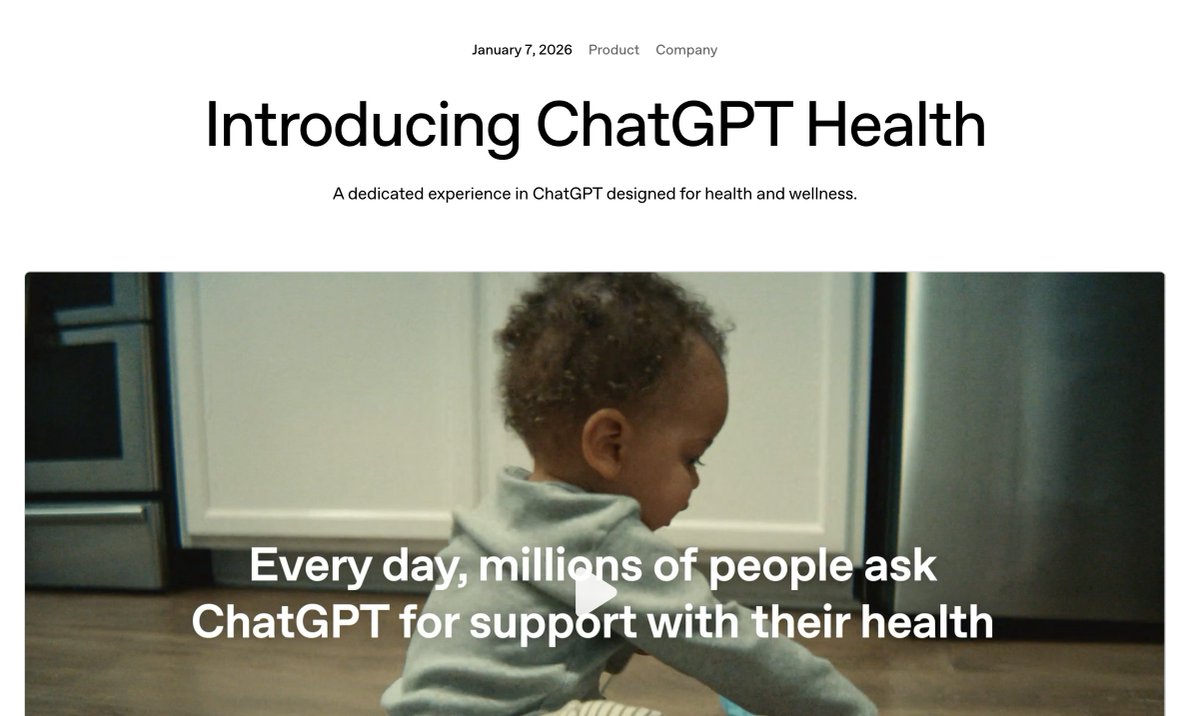
ChatGPT Health went live for every adult in the United States last week. It is blocked in the EU, the UK, and Switzerland, and there is no announced plan for any low or middle income country.
Sit with the geography of that for a second. The first people to get an AI health companion are people who already live in the places with the longest life expectancy, the most doctors per capita, and the best access to care.
I am not against that. Those tools are good, and someone had to go first. But we are quietly building a world where AI hands another advantage to the people who already have the most, and skips the people who would gain the most from it.
A person in a rural district with one physician for fifty thousand people does not need a marginal improvement. They need triage, plain language answers in their own language, and a way to know when something is serious enough to travel for. That is exactly what these tools are good at.
The irony is that the value of an AI health tool is highest precisely where these tools are not being shipped. A second opinion means little when you already have ten specialists down the hall. It can be everything when you have none.
None of this is a reason to slow down in wealthy countries. It is a reason to stop treating the rest of the world as a phase two rollout. Access is a design choice, and right now we are choosing to widen a gap that medicine has spent a century trying to close.
If you are building in this space, who is your product actually reaching, and who is it leaving further behind?
I predict 50% of companies will need new leadership, because the old management style won't work in the era of AI. That's exactly why I'm seeing 95%+ of so-called "AI Transformation" initiatives fail. Most are bolting on AI pilots for functional tasks, but never touching the business core.
https://t.co/5Nq9vwwj3V just launched TrueNorth AI Decision platform for executives (Boss AI, TopSales AI, Investor AI agentic products) https://t.co/EkZj5WVEze
More on enterprise AI transformation in this interview with @aimcgarry: https://t.co/7cYa6RFIY9
OpenScience: an open-source Claude Science for researchers.
"give it a goal, and it works through the research loop the way a capable collaborator would".
250+ skills. Shouldn't be hard to run on Codex subscription using `codex exec`
Build startups for agents. I think it's the biggest opportunity of the next 10 years.
1. Agents live inside harnesses like Hermes. If you're the tool it loads by default or reaches for first, you're golden. This happened in desktop, mobile eras and created huge companies.
2. Agents burn money in ways no human would. One bad loop spends $100 in tokens in eight minutes. Spend controls for agents is Ramp for agents.
3. Agents need memory they can trust. Become the shared brain they read and write to and you become infrastructure.
4. You obv don't hand an agent your real Stripe account. You give it a sandbox. Safe environments for agents is a category nobody's clocked.
5. Onboarding flips. Humans click around for ten minutes. Agents onboard by reading your docs. Your docs are now your product.
6. Agents get scammed by other agents. A track record you can check before you trust one becomes real money.
7. An agent needs to prove it's acting for a real person and has the authority to spend. Who builds the permission layer?
8. Escrow for machines. Money that only releases when the job is actually verified done, no human checking.
9. Agents fail silently and weirdly. Someone will build the "why did my agent do that" replay and it'll be mega valuable.
10. Refunds and disputes between agents need a judge. An agent did the job badly, who decides? A court for machines.
11. Agents need throwaway payment methods per task, so they don't leak your real card. Virtual cards for agents, spun up and killed on demand.
12. A human hits rate limits and shrugs. An agent hits them and the whole workflow dies. Selling reliable, high-throughput access becomes its own business.
13. Agents need to negotiate. One agent buying from another will haggle on price and terms in milliseconds. The protocol for that doesn't really exist yet.
14. When an agent commits on your behalf, someone's liable. A legal and insurance layer for agent actions has to get built. Probably venture funded idea.
15. Agents need to run 24/7 somewhere. Selling the always on box an agent lives on is going to be a big business.
16. Then the physical world shows up. A warehouse robot paying for its own compute. A home robot ordering its own parts. Machines with wallets.
17. Agents start hiring robots. A software agent posts a real world job, a humanoid picks it up. A marketplace for machine labor.
18. Robots need to prove they did the physical job. Verification of real-world work, photos, sensors, proof, becomes its own layer.
Note: more ideas like this will be shared on @ideabrowser
19. Prompt and skill versioning becomes its own git. When your agent gets worse overnight, you need to roll back the exact skill or instruction that broke it. Version control built for agent behavior.
20. Agents will start subscribing to other agents. Your research agent pays a monthly fee to a specialist agent that's really good at one thing. Recurring revenue, machine to machine.
21. Companies will post jobs that only agents can apply to. "Wanted: an agent that can do XYZ for under like $100 per task." A job board where the applicants are all machines. Basically, fiverr for machines.
The internet got built for people. Mobile got built for people. This wave gets built for machines, and we're as early as it gets.
Go build for them.