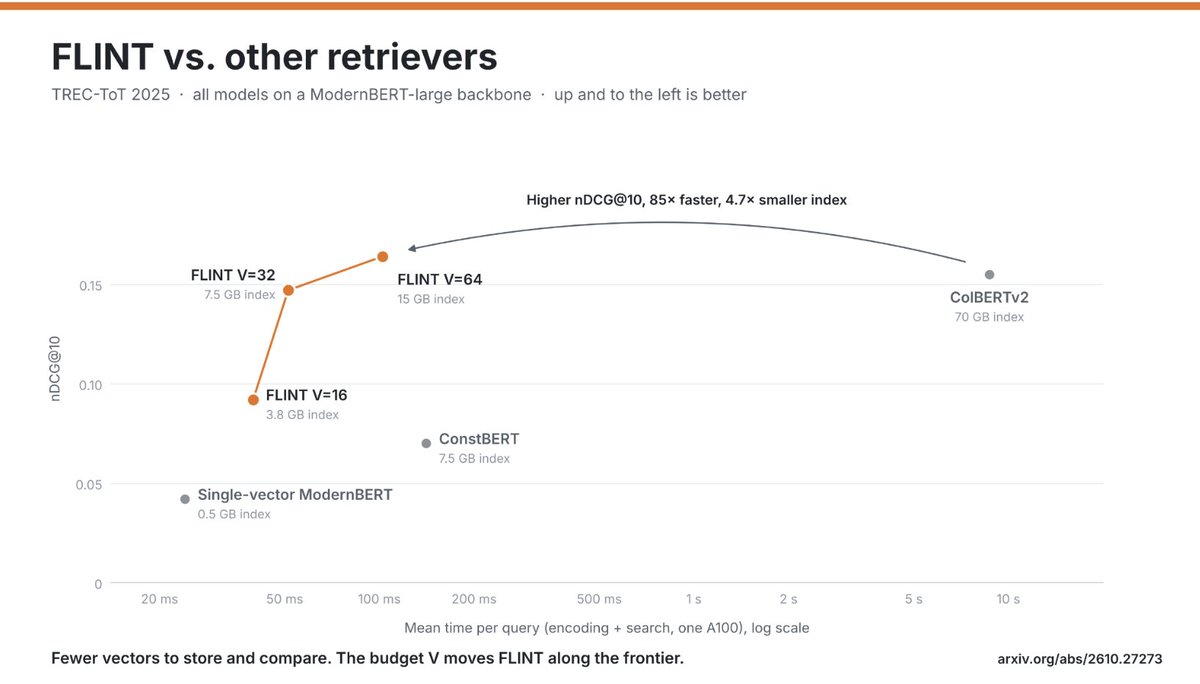
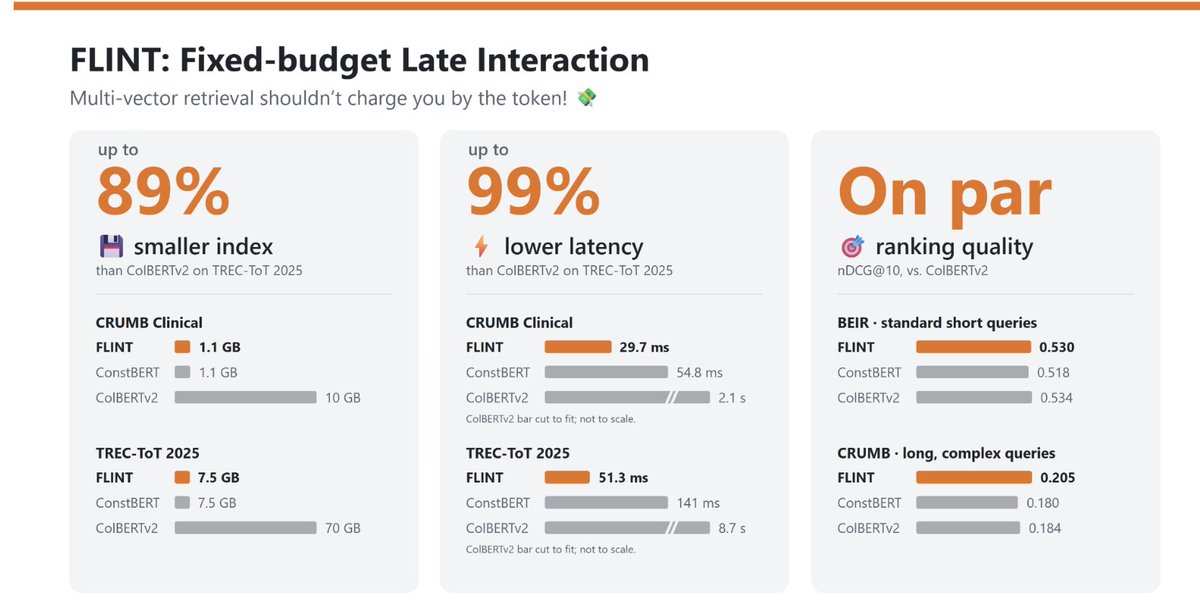
4/ We evaluated FLINT with different backbones on general retrieval benchmarks like BEIR and more complex retrieval tasks in BrowseComp+, TREC Tip-of-the-Tongue, and CRUMB. we also explored impact of vector budgets of 16, 32, and 64.
📄 Paper: https://t.co/GO5yum1763
💻 Code: https://t.co/Wfw1C08NoV
🤗 Models: https://t.co/OZHKTpk5Em
Huge thanks to @matei_zaharia and especially @HimankHanda for leading this work 🔥
3/ How does FLINT compare with other retrievers?
With ModernBERT and 32 vectors per query and document:
🎯 Higher average ranking quality than the single-vector bi-encoder on every benchmark suite, with especially large gains on complex queries.
⚡ Higher average ranking quality than ConstBERT on every suite, with 1.5–2.7× faster retrieval on the evaluated long-query corpora.
💾 Nearly matching ColBERTv2 on BEIR and outperforming it on CRUMB, with much smaller indexes.
Single-vector retrieval remains faster and more compact. FLINT offers a middle ground: richer matching with a fixed vector budget.
2/ Since ColBERT keeps one vector per token, storage and search costs grow with the number of tokens.
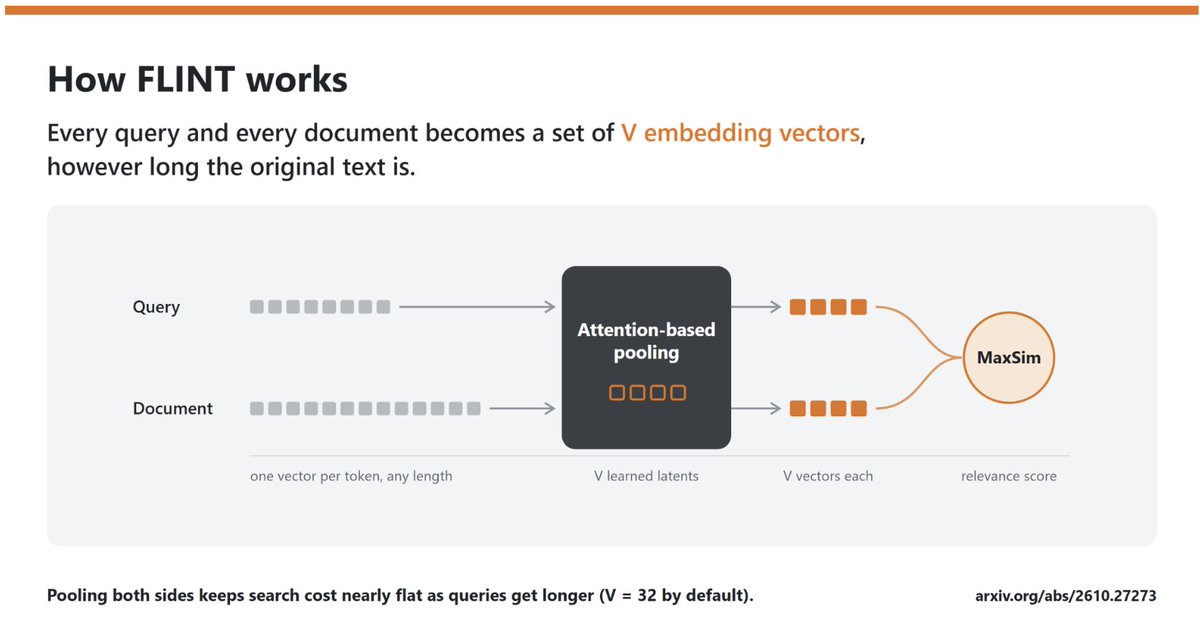
On the other hand, FLINT represents every query and document with a fixed number of vectors.
A small set of learned vectors attends over the token embeddings and pools them into V vectors. We then use the same MaxSim scoring as ColBERT.
FLINT pools both queries and documents, so longer text can change what the vectors capture without increasing their number.
1/ 💰Multi-vector retrieval shouldn’t charge you by the token!
🎉 Excited to share FLINT (Fixed-budget Late INTeraction), a late-interaction retriever designed for long, complex queries with up to 89% reduction in index and 23-170× faster retrieval latency.⚡
🎛️ FLINT gives a vector-budget knob to balance storage, latency, and quality.
📄 Paper: https://t.co/GO5yum1763
How does it work? 🧵
ColBERT stores and compares one vector per token. FLINT pools every query and every document into a fixed number of vectors, so there’s far less to store and far fewer comparisons at search time.