“The $TRUMP cryptocurrency briefly commanded a paper valuation exceeding $14 billion in January 2025, around the time of the president’s second inauguration. Its per-coin peak was around $74. It now trades below $1, leaving hundreds of thousands of small investors with steep losses while Trump-affiliated entities collected hundreds of millions of dollars in fees and token sales”
@billybinion Well, well, well. An election just revealed that the voting public generally mistrusts (at best) data centers and all of a sudden data center companies are taking actions to try and win back that trust.
Crazy!
When someone observes the world and sees “Jones did x and got lots of y” that implies (common use, not formal science use) that x input leads to y outcome. There’s a neurological response for many that links “if I do x, I get y. It’s both logical and unscientific to assume x—>y.
Actually correlation does imply causation and that's basically how anybody make sense of the world. It just doesn't prove it and you need to know you shit to spot the exceptions.
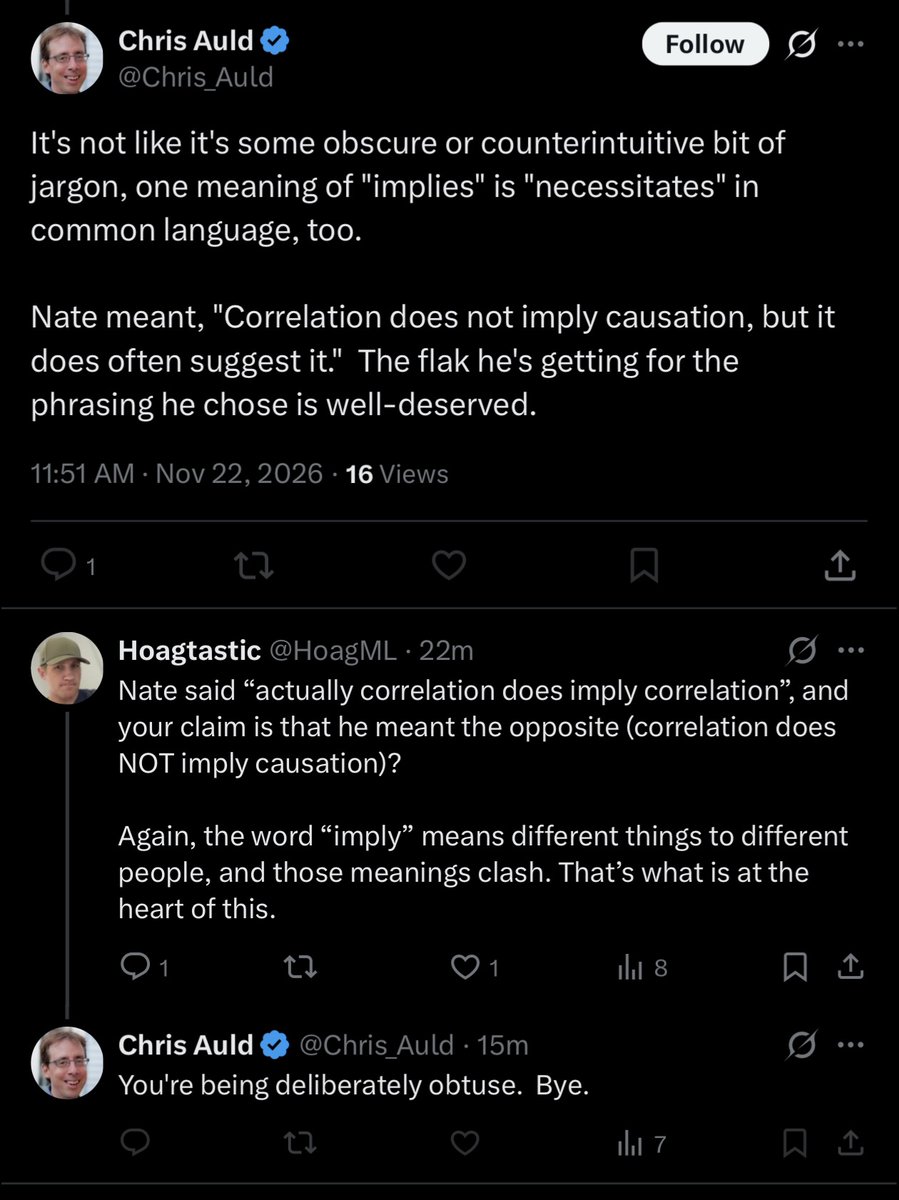
@LinchZhang@NateSilver538 Depends on whether you’re using the strict logic framework for using the word implies, or the mainstream conversational version of the word implies.
@Chris_Auld@instrumenthull Nate said “actually correlation does imply correlation”, and your claim is that he meant the opposite (correlation does NOT imply causation)?
Again, the word “imply” means different things to different people, and those meanings clash. That’s what is at the heart of this.
@Chris_Auld@instrumenthull It seems problematic that scientists (mathematicians, logicians) have purposed a term that carries a confounding counter meaning in everyday language. Maybe find a better word? I teach data analysis students who aren’t steeped in scientist jargon.