Hooks Protocol, the first Solana swap with a quantum-safe memory. 0.80% the first time, 0.08% when you come back.
2usvGShZzYmfxYcyjUv7QcQNzx1MY5spabayf3NDpump
$Hooks is live on Solana.
CA : 2usvGShZzYmfxYcyjUv7QcQNzx1MY5spabayf3NDpump
Hooks protocol : Every swap is routed by Jupiter and priced by memory: the fee falls from 0.80% to 0.08% as Hooks gets to know your wallet, and climbs back if you leave.
One 1 SOL buy of $HOOKS through Hooks, every cost, for a stranger:
Hooks fee: 0.008 SOL
Solana network fee: 0.000005 SOL
priority fee: up to 0.0003 SOL
$HOOKS account deposit, first buy only: 0.00151384 SOL, returned if you close the account
For a wallet Hooks remembers, the first line is 0.0008.
Every Hooks swap trades price against memory.
Come back right away: you pay 0.08% and your memory stays where it is. Come back at half (R = 0.5): 0.44%, and S grows by 1.75x. Come back almost forgotten (R = 0.1): 0.73%, and S grows by 2.35x.
We re-verified the first 19 snapshots of the Hooks memory: 57 post-quantum signatures, all against the same three public keys published at https://t.co/J8VH09UL41.
Every signature checks out, and every snapshot points at the hash of the one before it.
Selling counts too. A Hooks swap always has SOL on one side, and that side pays the fee into the memory account, buying or selling.
Both directions write the same memory, as long as the swap moves at least 0.01 SOL.
Hooks remembers nobody for more than 180 days. A wallet that swaps once a day reaches that cap on swap 124.
Even then, a week away costs 0.11% on the next swap, a month 0.19%, three months 0.36%, a year 0.71%.
Swap every 12 hours and your Hooks fee reaches 0.20% on swap 7, day 4. Every day: swap 8, day 8. Every 3 days: swap 9, day 25. Once a week: swap 10, day 64.
The number of returns barely moves. Hooks rewards coming back, at whatever pace you trade.
Everything Hooks knows is one call away. No key, no sign-up.
GET /api/memory for every engram
GET /api/memory?wallet= for one wallet's fee
GET /api/quote for Jupiter's route at that fee
GET /api/quantum for the latest signed snapshot
https://t.co/ho0nrwJsLJ
What Hooks can't do: sign for you, move a token without your signature, hold your funds between swaps, change a fee once it's paid, or remember a swap your wallet didn't sign.
What it does: read your memory from Solana, set the fee on your quote, and hand your wallet the transaction, unsigned.
Same Jupiter route, same slot, 1 SOL to USDC.
A stranger receives 109.01 USDC. A $HOOKS holder, at least 109.40. A wallet Hooks remembers, 109.80.
The route, the price and the slippage are Jupiter's. Hooks sets one parameter from your memory: the platform fee.
A Solana transaction can't go past 1,232 bytes. We built three real Hooks swaps and counted.
1 SOL to USDC: 790 bytes, snapshot memo included.
1 SOL to $HOOKS through https://t.co/zD6YD8YRIT: 1,199.
$HOOKS back to SOL: 1,227, 5 bytes to spare.
The https://t.co/zD6YD8YRIT route names 31 accounts and no lookup table, so the memo rides the other routes.
To prove your wallet is in a Hooks snapshot, you don't need the whole tree. You need your leaf and one hash per level.
1,000 wallets: 10 hashes, 320 bytes.
1,000,000 wallets: 20 hashes, 640 bytes.
Snapshot #1 of the Hooks memory has hash a464eb3e...011b. Snapshot #2 carries that hash inside what it signs, #3 carries #2's, and one more lands every hour.
Edit one engram in #1 and its root, its hash and its three signatures all break, and so does every link after it.
Signing a Hooks snapshot with SLH-DSA-SHA2-128s takes about 1.2 seconds. Checking that signature takes 1.2 milliseconds.
Hooks pays the slow part once an hour. Anyone who checks pays about 3 ms for all three signatures, in a browser tab. Measured in JavaScript on a laptop.
What a large quantum computer does to each signature Hooks touches.
Ed25519, the one every Solana wallet uses: Shor's algorithm solves the curve problem it rests on.
ML-DSA-65 and Falcon-512: lattice problems no known quantum algorithm solves efficiently.
SLH-DSA: only SHA-256, where Grover gives at most a square-root speedup, and the parameters are sized for it.
One SLH-DSA-SHA2-128s signature is 7,856 bytes. A whole Solana transaction holds 1,232. Hooks signs each snapshot three times, 11,820 bytes of signatures.
So the signatures live at https://t.co/YmZbRHQ9DY, and a swap with room carries 75 bytes on Solana: the snapshot number and its hash, in a memo.
$HOOKS, as Solana reads it.
Token-2022, 1 billion supply, 6 decimals. Mint and freeze authority revoked. 20,000,000 (2%) locked on Streamflow until October 4, 2027. Holding 1,000,000, 0.1% of supply, keeps your Hooks fee at 0.44% or less.
Hooks keeps three numbers about your wallet: when it last saw you swap, how long it holds you (S), and how many of your swaps counted.
All three are refolded from public Solana history. No account, no email, and nothing about what you bought or what you hold.
A wallet swaps on Hooks every day for a month, then goes quiet for 30 days.
It comes back at 0.46%, not 0.80%. And because Hooks had half forgotten it, that one return stretches its memory from 39.8 to 71.5 days. Back after a week, it would only have reached 49.5.
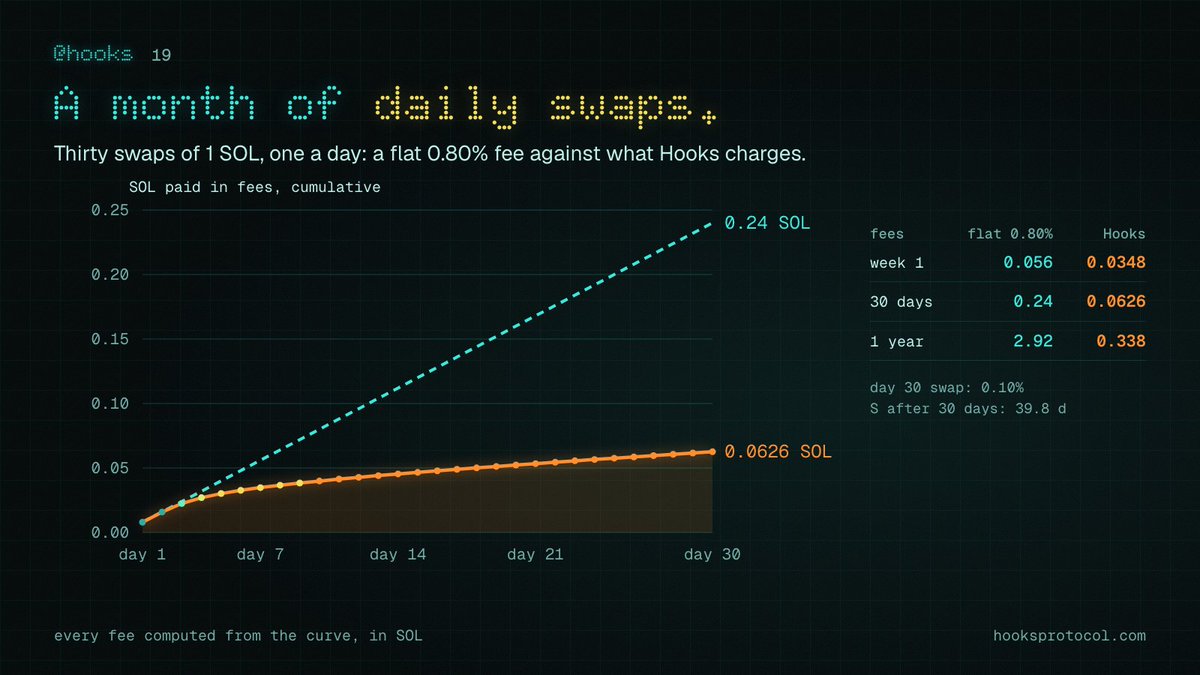
Thirty swaps of 1 SOL, one a day.
At a flat 0.80% that is 0.24 SOL in fees. On Hooks it is 0.0626 SOL, because every return lowers the next fee. Keep going for a year and it is 0.338 SOL against 2.92.
Every Hooks fee sits on this map.
Two numbers decide it: the time since your last counted swap, and S, how long Hooks holds you. Six hours after a first swap, the next one costs 0.54%. A wallet that swapped every day for a month pays 0.10% the day after.