The built environment is a prominent way that design affects our daily lives. The architecture will continue to shape our behavior, as will public spaces. Effective placemaking depends on a human scale and walking ability and can be applied to historical and modern places.
Plain concrete sidewalks, without a contrasting and detectable edge, are difficult to navigate for persons who are blind. The contrasting edge is inconsistent in how it’s applied and where it is located within the city.
Source: “If you’re waiting for a bus, it is brutal’ but should the city invest in heated shelters or service?”, CBC, assessed on November 7th, 2020, https://t.co/KdYGIjOk47
Winnipeg as a city drops to -50 degrees in winter, bus shelters are crucial to keep people protected from the cold. Only 14% of the bus shelters in the city are heated, and many secondary bus stations don’t even have bus shelters.
As public transportation is encouraged, a more organized, complete bus system with improved facilities is necessary. Bus shelters protect the homeless, shouldn't we consider how would they survive in the cold as well?
#hostilearchitecture#204designcollective#winnipeg
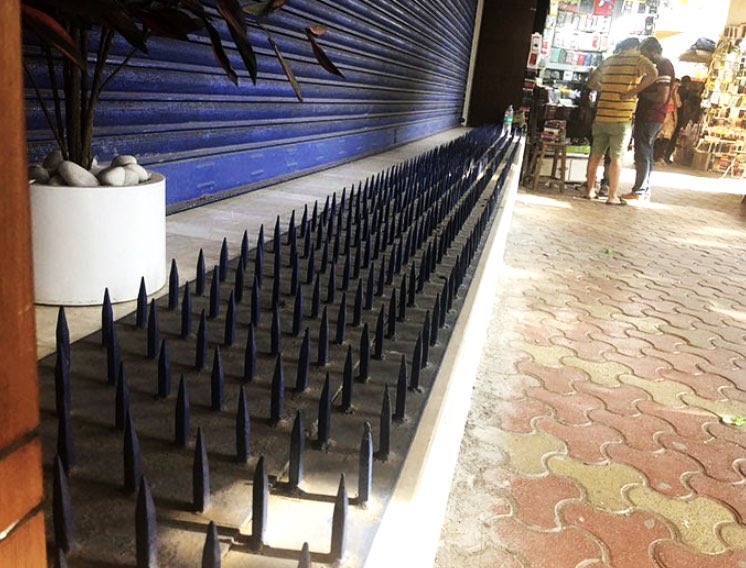
Bird spikes are a series of long, sharp wires jutting up from surfaces to prevent birds from landing and possibly nesting. As this can be regarded as an inhumane way of repelling birds it also repels community interaction as it hinders people from sitting during the day.
This affects also homeless people at night. A more efficient way to keep birds from sitting on window ledges is by using reflective objects like old cds. The brightness from the Sun reflected on the reflective surface will bother the birds causing them to fly away.
As the largest shopping mall in Winnipeg, Polo Park has a large daily customer flow, and part of it is “parents” shoppers. During work hours, customers often push strollers or bring children with them. They have to do the shopping and take care of kids at the same time.
Therefore, their shopping efficiency will be affected by the children around them, and sometimes they may even end early because they have to take into consideration children's emotions.
Often in Winnipeg, older buildings are not wheelchair accessible. Most of the time, these historical buildings have a step or multiple steps to get to the entrance, yet do not have wheelchair-accessible ramps or elevators.
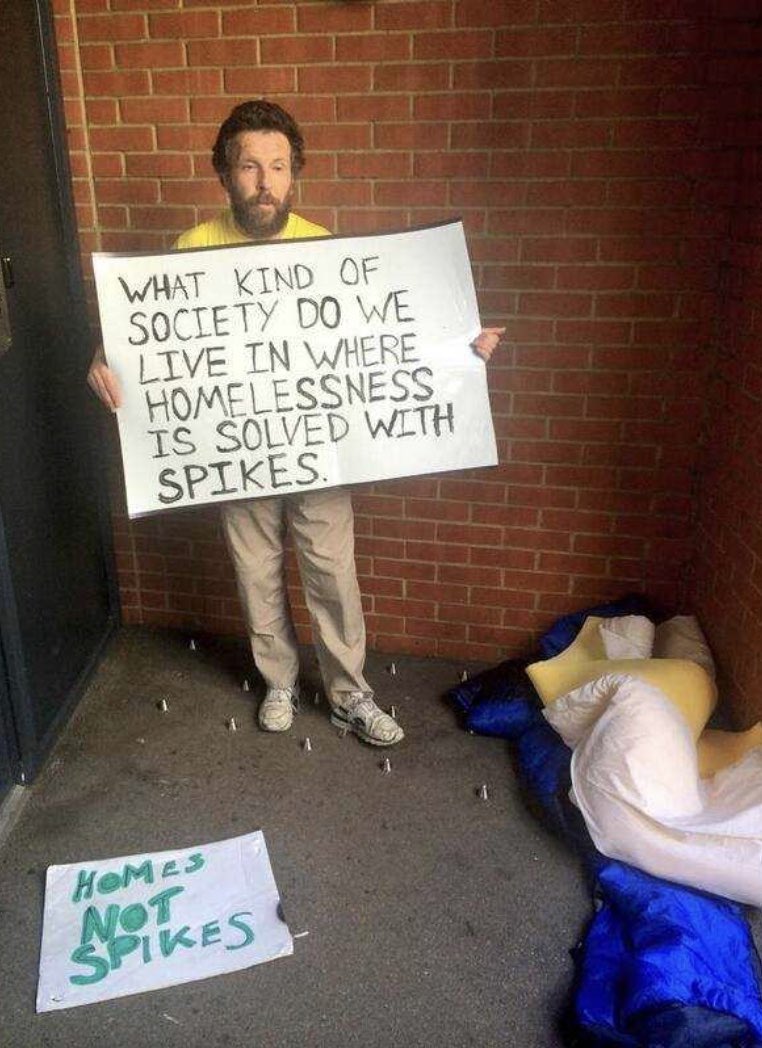
Source: Papadopoulos, Loukia, Derya Ozdemir, and Christopher McFadden. 2020. "15 Examples Of 'Anti-Homeless' Hostile Architecture That You Probably Never Noticed Before". https://t.co/ZQ9YARMkPd. https://t.co/lVgy2HFh35.
Downtown is a place where hostile architecture is prominent. Public areas were designed to keep homeless people from taking shelter. Walking around Main Street and the Exchange District there is a prominence of sloped windows, metal bars on grates, and chunky armrests on benches.
The problem that lies between the intersection of Portage and Main is nothing new to Winnipeggers. The intersection's lack of accessibility continues to be a problem with our ever-growing city.
As a city, we should aim towards making Portage and Main more accessible for all walks of life. Would opening Portage and Main be a waste of taxpayers money, or would it be beneficial in creating a more accessible city?
#PortageandMain#204designcollective#HostileArchitecture