پریس ریلیز
ایچ آر سی پی کا کنونشن محنت کشوں اور ثقافتی تحریکوں کے درمیان نئے اتحاد کا مطالبہ کرتا ہے
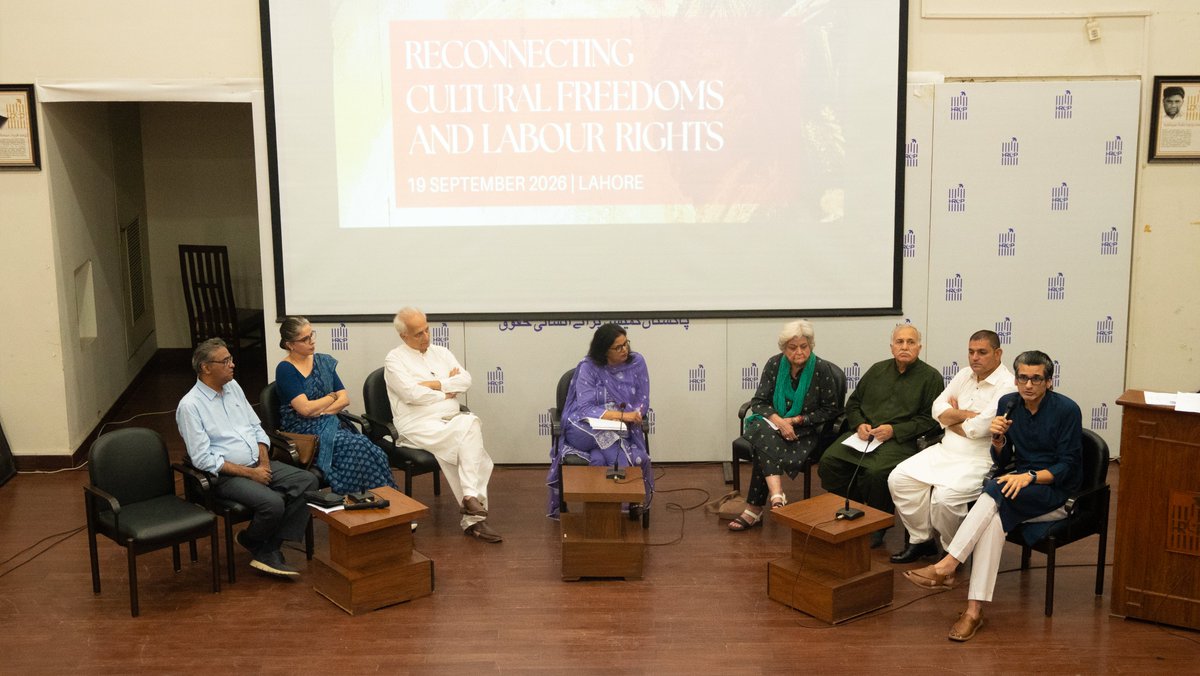
19 ستمبر 2026، لاہور۔ پاکستان کمیشن برائے انسانی حقوق (ایچ آر سی پی) کے زیرِ اہتمام 'ثقافتی آزادیوں اور محنت کشوں کے حقوق کی بحالی' کے عنوان سے منعقد ہونے والے ایک کنونشن میں شرکا نے محنت کشوں اور ثقافتی تحریکوں کے درمیان ایک نئے اتحاد کا مطالبہ کیا ہے۔
انسانی حقوق کے کارکن ذیشان نوئل کی نظامت میں شروع ہونے والے اس کنونشن کا افتتاح اداکار خالد انعم نے میاں محمد بخش اور سچل سرمستکا کلام پیش کر کے کیا۔ ایچ آر سی پی کے چیئرپرسن اسد اقبال بٹ نے کہا کہ جمہوریت اور انسانی حقوق کا تحفظ محنت کشوں کی ایک مضبوط تحریک سے مشروط ہے۔
'یکجہتی کی آوازیں' کے عنوان سے پہلے سیشن میں ماہی گیروں کے حقوق کے کارکن طالب کچھی اور آرٹسٹ عمران اللہ ہُنزائی کے ویڈیو پیغامات شامل تھے، جبکہ نذیر قیصر اور اصغر ندیم سید نے اپنی شاعری پیش کی۔ محنت کشوں کے حقوق کے کارکن بوٹا امتیاز مسیح نے سینیٹیشن ورکرز کے لیے یونین بنانے کا مطالبہ کیا، جبکہ پاکستان کسان رابطہ کمیٹی کے فاروق طارق نے کہا کہ یکجہتی وقت کی اہم ضرورت ہے۔ اداکارہ سمیعہ ممتاز نے فنکاروں کے ساتھ معاشرے کے رویے کا موازنہ ان طبقاتی نظام ہائے کار سے کیا جو دستی مشقت کی تحقیر کرتے ہیں۔
حقوق کی فعال کارکن تنویر جہاں کی زیرِ نظامت پینل میں مؤرخ ڈاکٹر علی رضا نے گفتگو کرتے ہوئے کہا کہ ہم عصر 'ہائپر پولیٹکس' میں ان اداروں اور یونینز کی کمی ہے جو کبھی ترقی پسند روایت کو زندہ رکھتی تھیں۔ صحافی شہزادہ ذوالفقار نے میڈیا کارکنان کی کم اجرتوں کی طرف توجہ مبذول کرائی، جبکہ نیشنل لیبر فیڈریشن کے جنرل سیکرٹری عمر حیات نے بلوچستان میں مزدور یونینز کے کمزور ہونے کا ذکر کیا۔ اسکرپٹ رائٹر بی گل نے کہا کہ سیٹلائٹ ٹیلی ویژن نے انہیں مجبور کر دیا ہے کہ وہ سنجیدہ موضوعات کو غیر سیاسی کہانیوں کے پردے میں چھپا کر پیش کریں۔ صحافی وجاہت مسعود نے دلیل دی کہ محنت کش اور فنکار ایسے مزاحمتی طبقے سے تعلق رکھتے ہیں جو ریاست کے لیے خطرہ سمجھا جاتا ہے۔ اجوکا تھیٹر کے شاہد محمود ندیم نے کہا کہ سماجی موضوعات پر مبنی ڈرامے کے لیے محنت کشوں کی ایک متوازی تحریک کی ضرورت ہے، جبکہ ایچ آر سی پی کی کونسل ممبر سلیمہ ہاشمی نے ایک ایسی حکمت عملی پر زور دیا جو نئی نسل کو اپنا راستہ خود تلاش کرنے کا موقع دے۔
تیسرے سیشن میں رقاصہ شیما کرمانی، موسیقار ہارون باچا اور اداکار مصطفیٰ قریشی اور ندیم بیگ کے ویڈیو پیغامات پیش کیے گئے، جبکہ اداکارہ و ہدایت کار صبا حمید نے یکجہتی کا اظہار کیا۔ آل پاکستان ورکرز فیڈریشن کے صدر گوہر تاج نے کہا کہ پاکستان میں اب بھی مؤثر کم از کم اجرت کا نظام موجود نہیں ہے۔ مصنف شریف اعوان نے کلاسیکی موسیقی پر اپنے خیالات کا اظہار کیا، جبکہ وژوئل آرٹسٹ معصومہ سید نے کہا کہ فنکارانہ مزاحمت اکثر بقا کی قیمت پر ہوتی ہے۔ اداکارہ عائشہ طور نے سرمایہ دارانہ نظام میں فنکارانہ آزادی کے لیے آواز اٹھانے سے متعلق مشکلات بیان کیں۔ ایچ آر سی پی کے خزانچی حسین نقی نے کہا کہ شاعر مایوسی کے لمحات میں حوصلے کا ذریعہ بن سکتے ہیں۔
کنونشن کے اختتام پر ایچ آر سی پی کے سیکرٹری جنرل حارث خلیق نے شرکا کی جانب سے منظور کیا گیا ایک چارٹر پیش کیا، جس میں اس بات کا اعادہ کیا گیا کہ باوقار روزگار کا حق اور آزادانہ تخلیق کا حق ایک دوسرے سے جڑے ہوئے ہیں۔ چارٹر میں غیر رسمی محنت کشوں سمیت تمام مزدوروں کے لیے باوقار اجرت، محفوظ کام کی جگہوں، سماجی تحفظ، یونین بنانے اور اجتماعی سودا کاری کے حق، مساوی حقوق اور اجرت، امتیازی سلوک اور تشدد سے تحفظ، ثقافتی کام کو محنت کے طور پر تسلیم کرنے، لیبر پالیسی میں محنت کشوں کی شمولیت، اور محنت کش طبقات کے لیے ثقافتی پلیٹ فارمز تک منصفانہ رسائی کا مطالبہ کیا گیا۔
فرح ضیا
ڈائریکٹر
🔴 Press release
HRCP convention calls for renewed alliance between labour and cultural movements
19 September 2026, Lahore. At a convention titled ‘Reconnecting Cultural Freedoms and Labour Rights’, hosted by the Human Rights Commission of Pakistan (HRCP), participants called for a renewed alliance between labour and cultural movements.
Moderated by rights campaigner Zeeshan Noel, the convention opened with actor Khaled Anum performing verses by Mian Muhammad Bakhsh and Sachal Sarmast. HRCP chairperson Asad Iqbal Butt said that the preservation of democracy and human rights was contingent on a strong labour movement.
The first session, ‘Voices of Solidarity’, featured video messages from fisherfolk rights activist Talib Kachhi and visual artist Imran Ullah Hunzai, and poetry by Nazeer Qaiser and Asghar Nadeem Syed. Labour rights activist Boota Imtiaz Masih called for a union for sanitation workers, while Farooq Tariq of the Pakistan Kissan Rabita Committee said that solidarity was essential. Actor Samiya Mumtaz traced society’s treatment of artists to hierarchies that degraded manual labour.
A panel moderated by rights campaigner Tanveer Jahan heard historian Dr Ali Raza argue that contemporary ‘hyper-politics’ lacked the institutions and unions that once sustained a progressive tradition. Journalist Shahzada Zulfiqar highlighted low wages for media workers, while National Labour Federation general secretary Umar Hayat described the weakening of labour unions in Balochistan. Screenwriter Bee Gul said satellite television had forced her to camouflage serious subjects within depoliticised storylines. Journalist Wajahat Masood argued that workers and artists occupied a subversive space threatening to the state. Ajoka Theatre’s Shahid Mahmood Nadeem said social drama needed a corresponding workers’ movement, while HRCP Council member Salima Hashmi called for a strategy allowing younger generations to find their own way.
The third session featured video messages from dancer Sheema Kermani, musician Haroon Bacha and veteran actors Mustafa Qureshi and Nadeem Baig, alongside words of solidarity from actor and director Saba Hameed. All Pakistan Workers Federation president Gohar Taj noted that Pakistan still lacked a functioning minimum wage. Writer Sharif Awan reflected on classical music, while visual artist Masooma Syed said artistic resistance often came at the cost of survival. Actor Ayesha Toor described the difficulty of speaking up for artistic freedom in a capitalist society. HRCP treasurer Husain Naqi said poets could provide inspiration in moments of despair.
Concluding the convention, HRCP secretary-general Harris Khalique presented a charter endorsed by participants, affirming that the right to work with dignity and the right to create freely were inseparable. It called for a living wage, safe workplaces, social protection for all workers including informal labour, the right to unionise and bargain collectively, equal rights and pay, protection against discrimination and violence, recognition of cultural work as labour, workers’ participation in labour policy, and equitable access to cultural platforms for working-class communities.
Farah Zia
Director
HRCP is deeply concerned by the increasing terrorist attacks in Khyber Pakhtunwa, the most recent being the bomb blast targeting a mosque in the Police Lines in Kohat, causing loss of life and a high number of casualties. We demand that the federal and provincial authorities take urgent legal and political measures to break the cycle of violence and terrorism.
HRCP demands the immediate release of human rights lawyers @ImaanZHazir and @AdvHadiali and the withdrawal of all cases against them, in line with the decision of the Supreme Court of Pakistan.
We are proud to announce that HRCP secretary-general Harris Khalique has been awarded the Faiz Ahmad Faiz Award for Civil Liberties 2026 in recognition of his many years of work as a writer and human rights defender.
'Faiz Ahmed Faiz Award for Civil Liberties 2026', instituted jointly by the Faiz Progressive Foundation (FPF), UK, and the Voice of South Asian Arts and Literature (VSAAL), UK, is bestowed upon poet, author and secretary-general Human Rights Commission of Pakistan (HRCP) Harris Khalique.
#hrcp #faizsouthasianfestival26
HRCP calls for an immediate, transparent investigation into allegations of harassment and misconduct involving a staff nurse at the Rawalpindi Institute of Cardiology. Reports that the nurse was allegedly kept in a room for several hours and pressured to suppress an incident in which a patient's family had allegedly threatened her after she asked them to abide by hospital regulations concerning visitors.
This raises serious concerns about institutional accountability and the protection of healthcare workers. We urge the Punjab government and relevant authorities to ensure a fair investigation, protect the complainant from intimidation or retaliation, and hold those responsible accountable. The dignity and safety of nurses must be non-negotiable.
HRCP strongly condemns the decision to rusticate and repatriate Afghan students—including women—already enrolled in medical and dental colleges in Pakistan, as well as to bar new admissions. This is no longer simply an education policy; it is also a humanitarian crisis affecting young people whose education, safety and futures are at immediate risk. In Lahore alone, students report that around 100 Afghan medical and dental students may be affected, including an estimated 20–40 women. Some students have now approached HRCP seeking not only legal and institutional support but also safe shelter, underscoring the gravity and immediacy of the situation.
We call on the government urgently to uphold the principle of non-refoulement. Given the well-documented risks faced by Afghans returning to Afghanistan—and particularly by women—no student should be forcibly returned without an individual assessment of the risks they face. Pakistan’s security concerns and strained relations with Afghanistan cannot justify collectively punishing students. The repatriation orders must be suspended immediately, the affected students’ enrolment restored, and urgent arrangements made for those requiring protection and shelter.
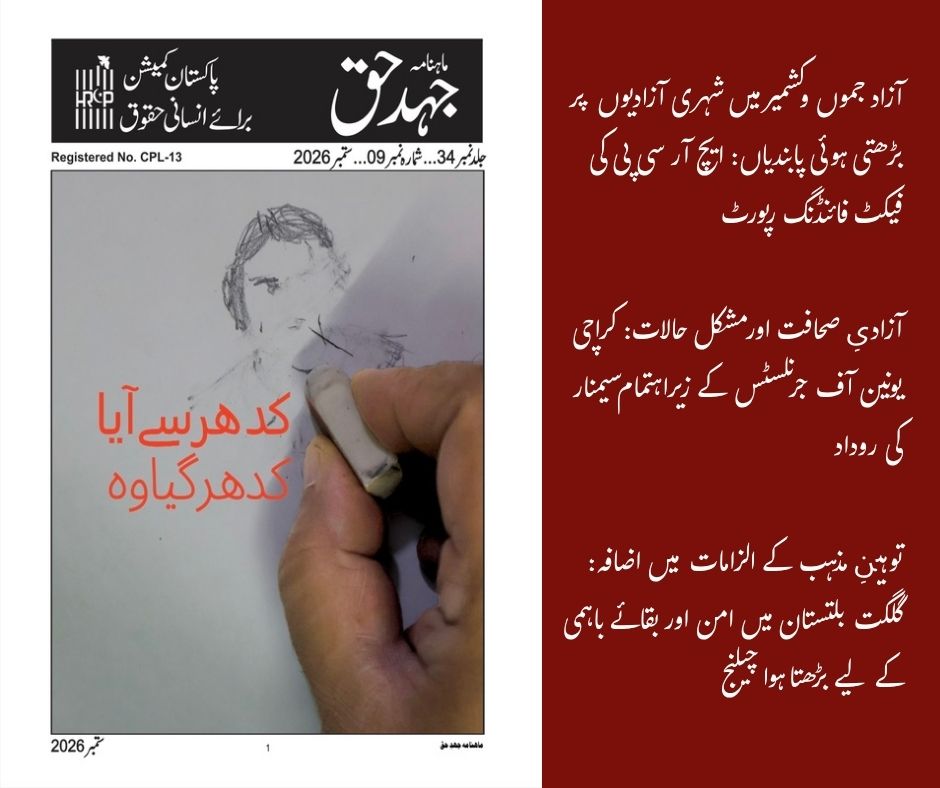
جہدِ حق کا ستمبر کا شمارہ شائع ہو چکا ہے۔
اس ماہ کے ایچ آر سی پی کے نیوز لیٹر میں ہم آپ کے لیے توجہ طلب انسانی حقوق کے مسائل، فیلڈ رپورٹس، ایڈووکیسی کی سرگرمیوں اور زمینی حقائق سے جڑی آوازوں سے متعلق تازہ ترین خبریں لے کر آئے ہیں۔ اس شمارے میں شامل ہیں:
آزاد جموں وکشمیر میں شہری آزادیوں پر بڑھتی ہوئی پابندیاں: ایچ آر سی پی کی فیکٹ فائنڈنگ رپورٹ
آزادیِ صحافت اور مشکل حالات: کراچی یونین آف جرنلسٹس کے زیراہتمام سیمنار کی روداد
توہینِ مذہب کے الزامات میں اضافہ: گلگت بلتستان میں امن اور بقائے باہمی کے لیے بڑھتا ہوا چیلنج
خاموشی تکلیف دہ ہے؛ انسانی حقوق کے نظام کے ذریعے ہراسانی کا تدارک
شمارہ یہاں پڑھیں: https://t.co/0L05TUe6jB
Call for expressions of interest: Campaign on the right of informal labour to engage in collective bargaining
HRCP seeks expressions of interest from qualified individuals or firms/organisations to develop and execute a campaign focused on strengthening the capacity of workers in the informal sector to engage in collective action to demand fair wages, better working conditions, and job security, among other labour rights.
Applicants should have at least five years’ experience of designing and executing rights-based campaigns. Applicants with experience of labour rights advocacy may be given preference.
For TOR, remuneration, and how to apply, see: https://t.co/eVYWUAMcA8
This video may be distressing to some viewers. The brutal killing of Pakistani media professional Hina Javed has caused uproar over violence against women.
Her cousin Sabah Malik tells Al Jazeera that Pakistan faces a femicide emergency.
HRCP expresses concern over the passage of the Punjab Anti-Terrorism (Amendment) Bill 2026, which allows a government-designated officer, whose identity remains confidential, to declare cases ‘special security cases’, after which the identities of judges, prosecutors, police officers, witnesses and defence counsel may be withheld. However, the Bill does not adequately define the circumstances in which these extraordinary powers may be invoked, creating scope for abuse against ordinary citizens, political opponents or protesters in the name of security.
While protecting judicial and investigative personnel from genuine threats is legitimate, the need for such sweeping measures is not established. The secrecy they impose raises serious concerns under Articles 9, 10A and 14 of the Constitution and Article 14 of the ICCPR. A wrongly accused person could be unable to effectively challenge the evidence or proceedings. The Bill also reflects a broader pattern of invoking security justifications to expand state power at the expense of fundamental rights.
We call for the Bill to be reconsidered and brought into conformity with constitutional and international fair-trial guarantees. Moreover, any security measures must be narrowly defined and subject to independent judicial oversight.
Under international law, enforced disappearance is counted as a crime against humanity. Yet families in Pakistan continue to live with uncertainty, fear and unanswered questions about the fate of their loved ones.
On this International Day of the Victims of Enforced Disappearances, HRCP calls on the state to recover all victims safely and promptly, ensure due process and fair trials, criminalise enforced disappearance, and hold all those responsible accountable.
Pakistan must also ratify the International Convention for the Protection of All Persons from Enforced Disappearance, restructure the ineffective Commission of Inquiry on Enforced Disappearances, provide reparations to victims and families, and facilitate a visit by the UN Working Group on Enforced or Involuntary Disappearances.
No disappearance without accountability. No family without answers.
HRCP expresses grave concern over the campaign seeking to implicate academic and rights activist @drfarzanabari by distorting remarks she made highlighting the need for transparent investigation and safeguards against misuse of the blasphemy laws. The Supreme Court has already recognised that calling for safeguards against the misuse of a law does not constitute blasphemy, while warning against false allegations made for ulterior purposes.
Parliament, the National Commission for Human Rights and other institutions have likewise raised concerns over misuse and alleged online entrapment. We urge all political parties, lawyers, civil society, academics, journalists and responsible religious scholars to defend the right to raise legitimate concerns without fear of criminalisation or intimidation.
🔴 Press release
HRCP mission calls for urgent, inclusive political dialogue in AJK
29 August 2026, Lahore. A fact-finding mission to Azad Jammu and Kashmir (AJK), carried out by the Human Rights Commission of Pakistan (HRCP), has traced the recent unrest in the region to institutional distrust, extensive restrictions on freedom of expression and connectivity, and an increasingly confrontational state response, including the disproportionate use of force. Collectively, these measures have deepened polarisation and eroded public trust.
The mission received conflicting accounts of the scale of violence, the Jammu Kashmir Joint Awami Action Committee (JAAC)’s methods of protest, and the conduct of security forces. Nonetheless, it observes broad convergence among political and community stakeholders—including JAAC supporters and critics as well as political leaders—that the underlying dispute required a political, not coercive, resolution.
The mission is particularly concerned by allegations of lethal and excessive use of force against protesters. It has also raised concerns over the addition of at least 147 JAAC activists to the Fourth Schedule and the use of anti-terrorism legislation against persons engaged in political dissent. The arrests of activists and journalists, and pressure on the press from both state authorities and JAAC supporters, has further narrowed civic space.
Having observed the third phase of elections in Bagh, the mission found limited evidence of systematic physical coercion of voters at the polling stations it visited and observed that low turnout in some areas reflected a voluntary boycott and disillusionment rather than obstruction. However, heavy security deployment, communications restrictions, phased polling, and postponed constituencies mean that wider concerns about the credibility of the electoral environment remain unresolved.
The mission has called for an independent and impartial investigation into all alleged deaths and injuries since June 2026, with accountability applying to both state officials and protesters where evidence establishes individual responsibility. It has urged the government to ensure due process for all those arrested, review the use of anti-terrorism and preventive-detention provisions, and end disproportionate restrictions on communications and movement.
The mission has further recommended an inclusive political dialogue involving JAAC, political parties and civil society to address underlying grievances. In the longer term, it has recommended the institution of a permanent mechanism by the region’s political parties for resolving political disputes before they escalate. The mission has also called for a constitutional and consultative process to resolve the status of the 12 refugee seats and an independent review by the Election Commission of the 2026 electoral process.
Asad Iqbal Butt
Chairperson
Read the report here: https://t.co/2UpEhETWtL
@EUPakistan
A law against torture means little without an independent investigation.
Article 14(2) of Pakistan’s Constitution is unequivocal: no person shall be subjected to torture to extract evidence. Pakistan has also been party to the UN Convention against Torture since 2010.
Yet custodial torture and deaths continue to raise serious questions about accountability and the protection of people in state custody.
The Torture and Custodial Death (Prevention and Punishment) Act 2022 was an important step. But legislation alone cannot deliver justice. The Act does not establish standalone offences and penalties for torture, instead relying on existing provisions of the PPC. More fundamentally, allegations against public officials cannot be credibly investigated where the investigating institution lacks independence or faces a conflict of interest.
Investigations into custodial torture and death should therefore be entrusted solely to an independent body, such as the @nchrofficial.
Custody does not strip a person of their dignity. It makes the state’s duty to protect it greater—not less.
@EUPakistan
Torture happens behind closed doors. Transparency is the only cure.
While we do have a law against torture (the Torture and Custodial Death (Prevention and Punishment) Act 2022), this alone cannot end custodial abuse. This is where the Optional Protocol to the Convention against Torture (OPCAT) comes in. If Pakistan ratifies this international legal instrument, it would mean:
1. Designating an independent national preventive mechanism against torture.
2. Ensuring that prisons, jails and detention centres are subject to unannounced, unrestricted inspections.
3. Ensuring that domestic detention is monitored according to international standards, including the Mandela Rules, which restrict solitary confinement to 22 hours.
Pakistan must transition from reactive complaints to systemic prevention.
#HumanRights #PrisonReform #AntiTorture #HRCP
@EUPakistan
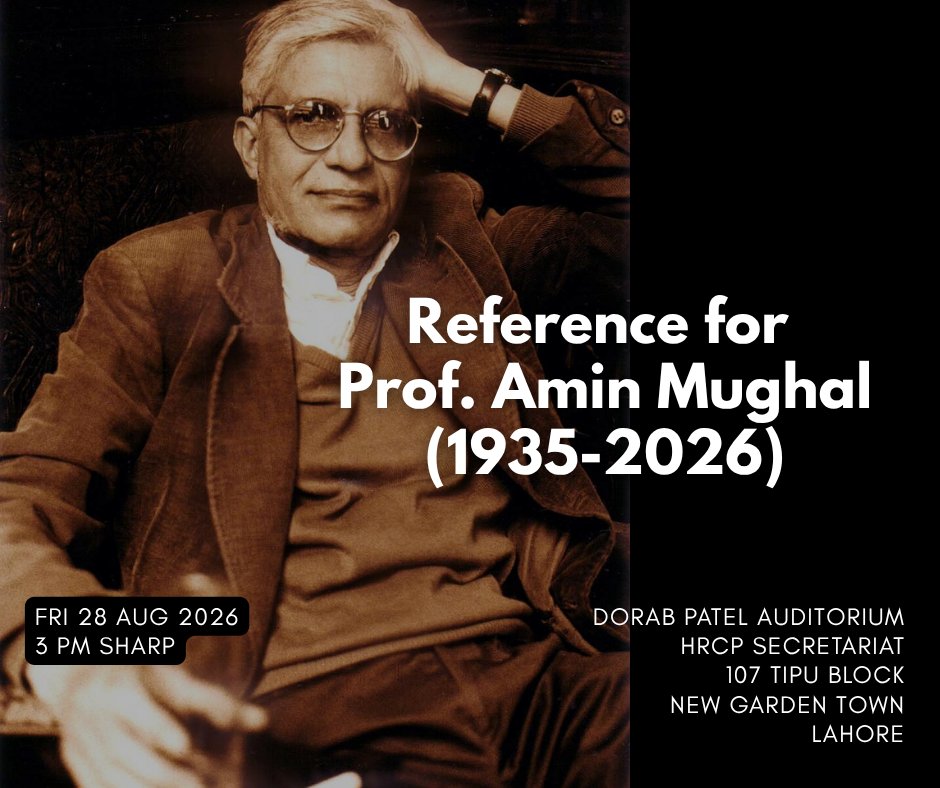
We are holding a reference in Lahore on Friday 28 August 2026, to honour the life and legacy of the late Prof. Amin Mughal.
All are welcome to join us in remembering a veteran Marxist, progressive academic, journalist, and literary critic whose ideas and contributions left a lasting mark on Pakistan’s intellectual and public life.