@RLeeMX_90 I know we made some tentative plans that never have panned out. And for that I’m truly sorry. Let’s see if we can rectify that in the next month or so.
Imagine being given somewhere around 80 years on a planet floating through an incomprehensibly enormous universe, surrounded by billions of people you will never meet, mysteries you will never solve, places you will never see, and more knowledge than you could absorb in a thousand lifetimes...
and spending the whole damn thing worrying about money, arguing with strangers, impressing people you don't even like, and doing something you hate five days a week because somebody convinced you that was life.
I don't know, man.
I think we may have gotten a few things terribly wrong.
The machine is still working overtime to shape people's thinking out there man. So, here is the next installment of our hero railing against the people and machine that is at work in sanitizing Lindsay Clancy:
“You want to know how fucked up this has become?
Look at who they think needs saving.
A mother plans the murder of her three children and carries it out, and these ghouls immediately go to fucking DEFCON 1—not over three murdered children, but over the horrifying possibility that the woman who murdered them might actually be held responsible.
Suddenly it's all hands on deck.
Find an explanation.
Find a diagnosis.
Find a trauma.
Find an expert.
Find something that will convince the world she's really the fourth victim here.
Because being a woman is hard.
Apparently being one of her children was harder.
And this shit doesn't happen by accident.
There's an entire ecosystem devoted to producing it.
The activists create the grievance. The academics intellectualize it. The advocacy groups weaponize it. The media sells it. Social media mass-produces it.
Then the NPC parrots arrive.
Millions of people who've spent fifteen minutes thinking about something repeating the conclusions of people who've spent fifty years teaching them which conclusions are socially permitted.
That's the scam.
They've mistaken being programmed for being educated.
They've been marinating in this shit so long that they don't recognize how fucking bizarre they've become.
A mother murders three children and they're rummaging through her life like defense attorneys at a yard sale.
Depression? Grab it.
Trauma? Put it in the truck.
Hormones? Absolutely.
Patriarchy? Fuck it, take two.
Anything except the one thing sitting right in front of them:
She chose to murder three children.
And somehow I'm supposed to believe they're the sophisticated ones because they can make that sentence complicated.
Well, I have a complication for them.
Where are the kids?
Seriously.
Where the fuck are the kids in all this compassion?
I've seen endless stories about the difficulty of motherhood. The agony of being a woman. Her mental health. Her suffering. Her fears. Her struggles. Her hopes.
Where's the goddamned ten-page story about them?
Tell me what made them laugh.
Tell me what they wanted for Christmas.
Tell me which one was counting down to a birthday. Who loved picnics. Who hated bedtime. What they wanted to be when they grew up.
Tell me their dreams.
I haven't seen one goddamned story about that.
Not one.
She gets psychologists explaining what was happening inside her head.
I'd like somebody to tell me what was happening inside theirs.
What was the oldest one excited about that week?
Was somebody learning to ride a bike?
Was there a birthday coming?
Did one of them have a Christmas present they'd been begging for since July?
Who had a best friend?
Who had a favorite stuffed animal?
What did they think tomorrow was going to be like?
Because children believe in tomorrow.
That's practically their fucking job.
And she took every tomorrow they had.
No birthdays.
No picnics.
No Christmas mornings.
No first dates.
No graduations.
No weddings.
No sitting around a table thirty years from now laughing about the stupid shit they did when they were kids.
Nothing.
She gets a future people are fighting to preserve.
They got futures she erased.
And somehow the media has spent more time asking us to crawl inside the mind of the person who killed them than introducing us to the three human beings she removed from the fucking earth.
That's not compassion.
That's evil with a press credential.
It's an obscene fascination with the perpetrator while the victims quietly disappear beneath the narrative.
And then the people who've swallowed this poison start lecturing everybody else about empathy.
Empathy?
You want to impress me with your empathy?
Remember the fucking children.
Before you explain her, remember them.
Before you diagnose her, remember them.
Before you tell me how difficult her life was you god-damned monsters, tell me about the terror they must have felt when they realized their mother wasn't just playing a game with them
And before you demand mercy for the person who still gets to wake up tomorrow morning—
tell me why nobody seems interested in the three children who never fucking will.”
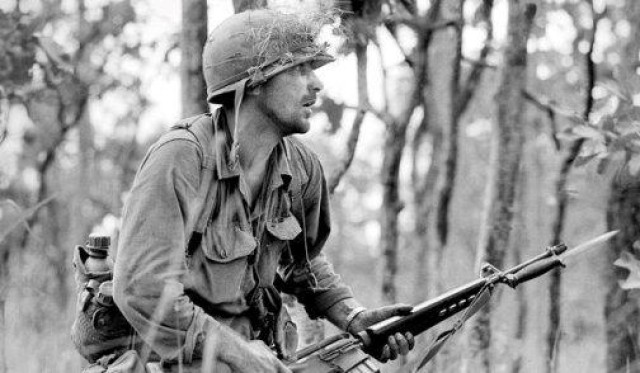
If you own a copy of We Were Soldiers Once... And Young, you are already holding a picture of him. The soldier on the cover, bayonet fixed, coming out of the elephant grass, is Rick Rescorla. Hal Moore called him the best platoon leader he ever saw.
He was born in Hayle, Cornwall, in 1939, a boy who watched American GIs stage through his town before Normandy and decided that was the life. British Parachute Regiment first, then Cyprus, then a uniform from a country he was not yet a citizen of. He joined the US Army in 1963 and by November 1965 he was a lieutenant in the 7th Cavalry in the Ia Drang Valley, the first major battle between American troops and the North Vietnamese Army. His men called him Hard Core. He came home with a Silver Star, a Bronze Star with oak leaf cluster, and a Purple Heart.
Then he became a corporate security director, which is where the story actually starts.
In 1990 Rescorla and an old Vietnam friend named Dan Hill walked the World Trade Center looking at it the way two infantrymen look at terrain. They found the weak point fast. The basement parking garage was wide open. They wrote it up and told the Port Authority that a truck full of explosives could be driven in and parked under the tower. The fix cost money, and it was declined.
On February 26, 1993, a truck bomb went off in that garage roughly thirty feet from the spot the two of them had circled.
Most people would have taken the vindication. Rescorla took the next step. He told Morgan Stanley the building was still a target and that they should get out of it entirely. The lease ran to 2006, so the answer was no. So he did the only thing left to him, which was to assume the attack was coming and train for it.
Every three months, no warning, he ran a full evacuation of every Morgan Stanley floor in the South Tower. Everyone went, down the stairwells, two abreast, at a pace he set. Senior executives went too, and he did not care that they hated it, and they did hate it. Traders being pulled off desks by a 60-year-old Cornishman with a stopwatch. He timed them. He made them do it again.
8:46 on the morning of September 11, 2001. The North Tower is hit. Over the public address system, the South Tower is told to stay put and return to desks.
Rescorla got on his bullhorn and told everyone to get out.
He was 62 years old. He was near the end of his career and he had every reason to be somewhere else that morning. Instead he stood in the stairwells and moved roughly 2,700 Morgan Stanley employees, plus hundreds of other people, down out of the building. To keep them steady he sang into the bullhorn. Men of Harlech. God Bless America. The Cornish songs he grew up on. Grown adults later remembered the strangest thing about the worst day of their lives was the sound of a man singing in a stairwell.
At 9:03 the second plane hit their tower, above them. Most of his people were already low or already out.
He called his wife Susan. She was watching it on television and she was falling apart. What he said to her was this. Stop crying. I have to get these people out safely. If something should happen to me, I want you to know I've never been happier.
Then he went back up.
He was last seen on the 10th floor, climbing, still going against the flow of people coming down. The South Tower collapsed at 9:59. His body was never recovered.
Morgan Stanley had about 2,700 people in that building. Six of them died. Rescorla and members of his own security staff, who stayed with him.
He spent eleven years telling people that an attack was coming and being told it was too expensive to prepare for. Then he spent the last hour of his life proving he had been right, and making sure it did not matter.
In the first days after September 11, thousands of strangers stood on a burning mountain of steel and passed buckets of rubble hand to hand.
One bucket at a time. Sixteen acres. A hundred and ten stories, twice over.
They were looking for people who were still breathing.
Nobody organized it. Nobody could have. The three men who ran the New York Fire Department's emergency command were dead. The Chief of Department. The First Deputy Commissioner. The head of Special Operations. All three had been in the lobby of the North Tower when it came down.
So on the night of September 11, and the morning of the 12th, and the days after, the site was chaos. And into the chaos walked everybody.
Firefighters who had lost their entire companies. Police from precincts across the city. Ironworkers with their own torches. Construction crews who had abandoned job sites in Jersey and driven in. Nurses. Off-duty soldiers. College kids. Men who had never worn a hard hat in their lives and put one on that morning.
They came without being asked and stayed without being told.
The Pile, as they called it, was not solid ground. It was a mountain of collapsed floors, unstable, with fires burning inside it that would not go out for a hundred days. Steel beams were hot enough to melt boots. The dust was so fine it hung in the air like a fog. Most of the people on top of it had paper masks or nothing at all.
They did not use heavy machinery at first. They could not. If there were people alive in the voids beneath them, a crane could crush them.
So they used their hands.
They formed lines. Long, snaking chains of bodies, hundreds of people at a time, from the top of the pile down to the street. A five-gallon bucket of concrete and dust and paper and God knows what would go into the first pair of hands at the top and pass down, hand to hand to hand, to the bottom.
Then the empty bucket went back up the line.
Then again.
They did that for days.
Here is the part almost nobody knows.
There was a rule on the pile, and everyone obeyed it instantly, without question.
One blast on an air horn meant silence.
Every generator was cut. Every crane stopped. Every saw. Every voice. Thousands of people stood absolutely still on a smoking mountain and listened.
They were listening for tapping. For a voice. For anything under the rubble that meant somebody was alive down there.
Two blasts meant work could resume.
Three blasts meant run, the buildings next door are moving.
Picture that silence. Thousands of people, at once, holding their breath on top of the dead, hoping to hear the living.
They heard almost nothing.
Twenty people came out of that pile alive. Twenty. Out of the thousands who were in the buildings when they fell. Most were pulled out in the first hours.
The last one was a woman named Genelle Guzman.
She was 30 years old, from Trinidad, working as an office temp for the Port Authority on the 64th floor of the North Tower. She had made it down to the 13th floor of the stairwell when the building came down on top of her.
She fell, with the building, something like 130 feet.
And she lived. Pinned under concrete, in the dark, able to move only her left arm. Her head was wedged. She could not turn it. She could not see.
She lay there, she said later, and prepared herself to die.
She prayed. She thought about her daughter. She listened to the silence and the settling of the steel and the fires. She waited.
After a long time, she felt something. A hand. Someone had reached down through a crack in the concrete and taken her hand and held it.
The man said his name was Paul. He told her everything was going to be okay. He told her to hold on.
She held on.
Above her, a German shepherd named Trakr had signaled a live hit over a gap in the debris. His handler was a Canadian police officer named James Symington who had driven 15 hours from Halifax, with no authorization from anyone, because he thought his dog might help.
The bucket line stopped. The air horn blew once. Everyone went quiet.
They dug her out by hand. It took hours. When she came up into the light, it had been 27 hours since the North Tower fell.
She was the twentieth person pulled alive from the World Trade Center.
She was the last.
Nobody after her. Not one. The thousands of people on the pile kept digging for eight more months, and never found another living person.
Genelle spent years trying to find the man named Paul who held her hand. She never did. Rescuers have their own memories of who was there. She has decided to call him her angel and leave it at that.
The Pile ran for 261 days. Nearly two million tons of debris. More than three million hours of labor. Almost a hundred thousand people worked it.
Twenty survivors.
That is the arithmetic nobody talks about. Thousands of people, on a mountain of fire, passing buckets hand to hand, in silence when the horn blew, for eight and a half months.
For twenty.
And they would have done it for one. 🇺🇸
At Ground Zero, after the last living person was pulled out, the search dogs stopped eating.
So the police did something nobody had written down in any manual.
They climbed into the rubble, lay down, and pretended to be alive.
More than 300 dogs worked the World Trade Center site. They came from every corner of the country, on trucks and in cargo holds, with handlers who had been trained to do one thing. Find people who are still breathing under the ground.
That is what a search and rescue dog is built for. Not bodies. Life. They are trained on live human scent. When they find it, they bark, they dig, they light up, and the handler rewards them, and the whole thing means something.
The last living person recovered from Ground Zero was a woman named Genelle Guzman-McMillan. She had been buried for 27 hours. A dog found her.
She was the last.
After that, the dogs kept going out on twelve-hour shifts, across sixteen acres of smoldering steel, at temperatures that burned their paws, and they found nobody.
Nobody.
Day after day.
The handlers noticed it first. The dogs were changing. Their tails were down. They were not eating. They would come off the pile and lie flat and not look at anyone.
A veterinarian named Cindy Otto, who spent ten days there working night shifts to care for the animals, put it plainly. The dogs had been sent to find life, and every day they were finding the opposite.
It was breaking them.
An NYPD officer named Famiglietti described what happened next.
They pulled everybody off the rubble. Then they asked for volunteers.
The volunteers, police officers, went out into the debris and hid themselves. Under beams. In voids. Curled up in pockets of concrete. They were told to lie down like they were hurt. Then the handlers sent the dogs in.
Picture that.
A grown man with a badge, a man who had spent the last week pulling friends out of that same pile, lying down in it on purpose. Face down. Holding still. Waiting for a dog.
And the dog comes over the top of the wreckage, and catches the scent, and barks, and digs, and finds a person who is warm and moving and alive.
And the handler says good girl, good boy, and the whole team celebrates.
They called them mock finds.
They did it for the dogs.
They did it so the dogs would remember what they were for.
One of those dogs was a two-year-old golden retriever named Bretagne. She came from Texas with her handler, Denise Corliss. It was her first deployment. They worked ten days at Ground Zero. They found no survivors.
But firefighters would come off the pile, stone-faced, not speaking, and see the dog, and something would break open in them. They would kneel down. They would put their face in her fur.
One day a man walked up to Bretagne and started petting her. He told Corliss his best friend loved golden retrievers.
Corliss asked where his friend was.
The man pointed at the pile.
"He's in there somewhere."
He kept petting the dog.
Bretagne went on to work Hurricane Katrina and Rita. She retired at 10. She was the last known surviving search dog of 9/11.
On June 6, 2016, at age 16, she was carried into a veterinary office in Texas to be put to sleep.
Outside, a dozen firefighters from her fire department stood in a line in their dress uniforms, in the heat, and saluted as she went past.
They draped her in an American flag on the way out.
Three hundred dogs went into that pile looking for the living.
They found one.
And when they could not find any more, the men they worked beside laid down in the rubble and let themselves be found, so the dogs would not lose heart.
That is the whole story of Ground Zero, really.
Nobody could save the dead.
So they saved each other. 🇺🇸