Maintaining long-term cryptographic security requires periodic key rotations. While invisible to most users, the upcoming KSK rollover requires operational attention from everyone running a DNS resolver.
⬇️ Learn more via the link below.
In the last 24 hours, government has announced plans to eviscerate the Privacy Commissioner’s office, cut off debate on a lawful access bill that includes metadata retention, and reversed age verification privacy safeguards 5 days after introducing them.
https://t.co/1OjFH1yab2
🚨The government is moving to shut down lawful access hearings and consideration of amendments on mandatory metadata retention, security backdoors, and weakened encryption today. All amendments to Bill C-22 would be kept secret and voted on without debate.
https://t.co/sxgD7dsZ3r
You can just do things:
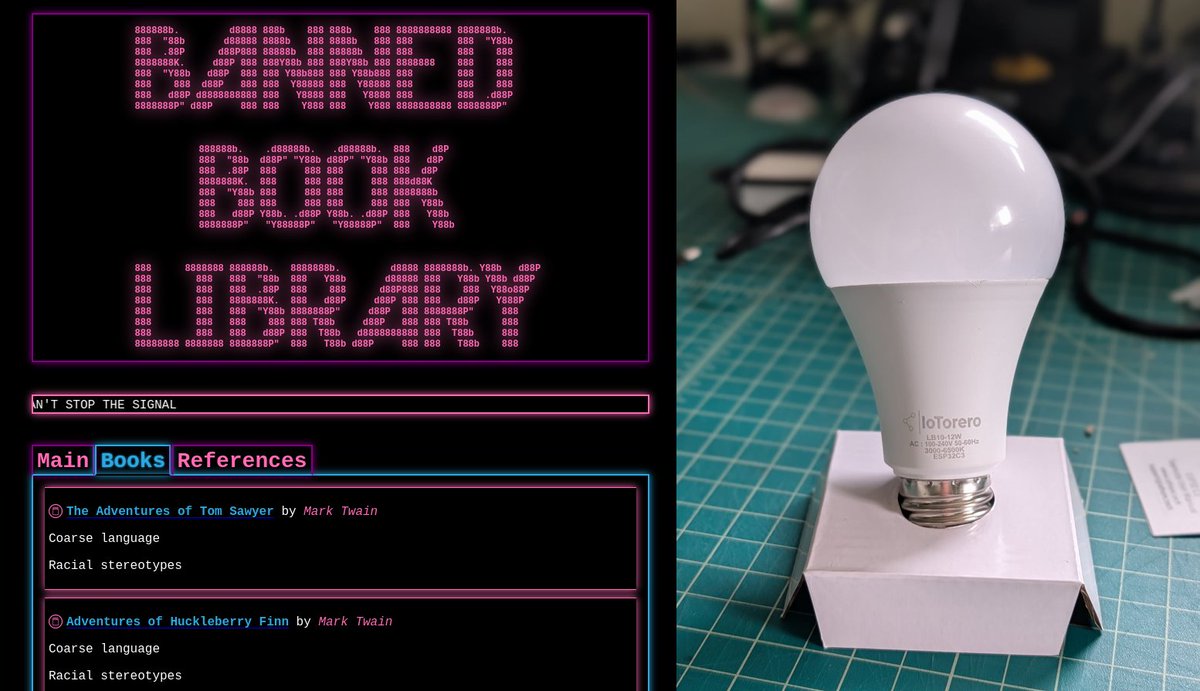
This guy turned a cheap smart light bulb into a secret banned book library. It creates its own open WiFi hotspot + web server full of EPUBs.
"As long as the light bulb is switched on, then anyone in the vicinity can still access the banned material assuming they have an electronic device with WiFi. Since the device is a light bulb, it would be difficult to detect and likely to go unnoticed."
Awesome!
‼️🚨 This is alarming: Researchers found a one-click data exfiltration vulnerability in M365 Copilot. A single click on a trusted microsoft[.]com link let attackers pull emails, MFA codes, meeting notes, and SharePoint/OneDrive files, no permissions or second click required.
Microsoft has patched it as CVE-2026-42824, rated critical.
AMD acaba de dar un golpe fuerte en la IA local.
Lisa Su subió al escenario con un mini PC del tamaño de un libro grueso en una sola mano y ejecutó en vivo un modelo de 235 mil millones de parámetros. Sin datacenter. Sin cloud. Sin alquilar GPUs.
El protagonista es el Ryzen AI Max+ 395 (Strix Halo). Es el primer chip x86 que une CPU y GPU con 128 GB de memoria unificada. En Linux, el GPU puede usar hasta ~110 GB de esa memoria.
Para ponerlo en contexto: una RTX 5090 tiene 32 GB y una 4090 tiene 24 GB. Este pequeño equipo ofrece más del triple de memoria accesible para modelos grandes, en un chasis compacto.
En pruebas específicas de inferencia (como DeepSeek R1), superó en más de 3x al rendimiento de una RTX 5080 cuando el modelo no cabe en la VRAM de la tarjeta de Nvidia.
El precio real del equipo con 128 GB (GMKtec EVO-X2) suele estar entre $1,800 y $2,500 según ofertas (el kit oficial de AMD es más caro).
Para quien usa mucho IA, esto cambia las cuentas: en vez de pagar cientos de dólares al mes en suscripciones (Claude, ChatGPT Pro, Cursor, etc.), puedes correr modelos potentes localmente con Ollama, LM Studio o similares. Privacidad total, sin límites de tokens y sin que te corten el servicio a las 3 a.m.
No es que las suscripciones vayan a desaparecer mañana, pero para muchos casos de uso (RAG con documentos privados, prototipos, agentes locales, etc.) esta opción se vuelve muy atractiva.
Estamos viendo el inicio de una nueva etapa de IA local accesible y potente??
Microsoft just made Docker Desktop optional on Windows.
WSL Containers was announced at Build 2026 and it is coming to public preview this month.
Linux containers will now run natively inside WSL. No Docker Desktop. No third party runtime. No background service eating your RAM. Just WSL.
Here is what it actually does:
→ Run any OCI compatible Linux container directly on Windows through WSL
→ A new CLI called wslc.exe ships with the next WSL update automatically. Same syntax as Docker so zero learning curve.
→ A full developer API lets Windows apps run Linux containers silently in the background without the user ever touching a terminal
→ Enterprise ready out of the box. Works with MBE, Intune and every enterprise management tool your IT team already uses
→ No separate installation. It arrives as part of your next regular WSL update.
WSL started as a way to run Linux tools on Windows. With WSL Containers the line between the two keeps getting thinner.
Docker Desktop costs $21 per month per developer for commercial use. WSL Containers is built into Windows and costs nothing.
Microsoft is not just making Windows more Linux friendly. They are quietly making every reason to leave Windows for Linux a little harder to justify.
Full details here:
https://t.co/CKPbLf8Byc
A Japanese programmer looked at every existing programming language in 1993, decided none of them made him happy, and spent two years building his own the language he built became the foundation GitHub, Shopify, Airbnb, and Coinbase were all built on.
His name is Yukihiro Matsumoto.
Everyone in the programming world calls him Matz. He was born in 1965, studied information science at the University of Tsukuba, and graduated in 1990 with a head full of ideas about what programming languages could be and a quiet frustration with what they actually were.
He knew Perl. He did not like it. He said it had the smell of a toy language. He knew Python. He did not like it either, because he felt its object-oriented features were add-ons bolted onto a language that was not designed around them from the start. He wanted something that was genuinely, completely object-oriented, easy to use, and built for the person writing the code rather than the machine running it.
He looked for that language. He could not find it.
So on February 24, 1993, he opened a chat window with his colleague Keiju Ishitsuka and typed: "Let us decide the codename now."
They wanted to name it after a gemstone, inspired by Perl. Ishitsuka suggested Coral. Matsumoto suggested Ruby. Ruby was shorter by one letter. Ruby won.
He spent the next two years building it alone, working through the architecture piece by piece. The object system. The string class. The IO streams. He later said he talked through specific features while speaking to his baby daughter, using her as a sounding board the way programmers use rubber ducks. In August 1993, he finally wrote the line of code that produced "Hello, world." on the screen.
The first public version, Ruby 0.95, was released to Japanese domestic newsgroups on December 21, 1995. No press release. No launch event. Just a quiet post to a mailing list.
The design principle underneath everything was the one nobody else had ever made primary. Matsumoto called it programmer happiness. He believed programming languages should be built for the joy and productivity of the person writing the code, not optimized purely for machine efficiency. Every decision in Ruby's design ran through that filter. If it made the programmer's life harder, it was wrong.
That philosophy attracted a small but devoted following in Japan through the late 1990s. Then in 2003, a Danish programmer named David Heinemeier Hansson discovered Ruby and used it to build an internal project management tool for his company. He called the tool Basecamp. He extracted the framework underneath it and released it publicly in 2004.
He called it Ruby on Rails.
Within a year of that release, the framework had changed how web applications were built. Rails introduced the principle of convention over configuration, meaning developers could make decisions about structure quickly because the framework had already made sensible defaults. What used to take weeks of setup took days. What used to take days took hours.
Shopify started on Rails in 2005. GitHub built on Rails a couple of years later. Airbnb, Twitch, Coinbase, SoundCloud, and Zendesk all followed. The first generation of consumer internet companies that defined how people think about software products were largely built by small teams moving fast on a framework that traced directly back to one Japanese programmer who was dissatisfied with his tools in 1993.
Shopify now processes over $200 billion in annual commerce volume. It still runs on Rails. GitHub became the largest code hosting platform on earth and was acquired by Microsoft for $7.5 billion in 2018. It started on Rails.
Matsumoto has said many times that he created Ruby for selfish reasons. He was so underwhelmed by every available option that he built something that would make himself happy. The programmer happiness he was chasing was his own.
The community that grew around Ruby adopted a motto that says everything about who he is. Matz is nice and so we are nice. They abbreviated it MINASWAN. It spread because it was true. He answered emails from strangers. He engaged with the community with patience. He treated the language as a gift, not a product.
He is still the chief designer of Ruby today. The language is 31 years old. It is still being improved.
The last stable release was Ruby 4.0.4, shipped on May 11, 2026.
One programmer, unhappy with his tools, built something better in the evenings in 1993. The companies you use to buy things, to store code, to book travel, and to watch streams were built on top of what he made.
He just wanted to be happy while he worked.
Did you know Ruby was behind the tools you use every day?
‼️🚨 BREAKING: Amazon researchers snitched to the US government about jailbreaking Fable 5 and Mythos 5, forcing Anthropic to immediately shut down worldwide access.
A security export control directive from Commerce Secretary Howard Lutnick enforced the action.
Anthropic is fighting the directive and calls it a misunderstanding.
This isn't the first clash. The Trump administration had already tried to get Anthropic to pause the release of its latest models before this directive landed.
One of the astronauts just announced for Artemis III, Luca Parmitano, once came terrifyingly close to dying during a spacewalk.
In 2013, water began leaking into his helmet during a spacewalk outside the ISS. The leak got so bad that his eyes, ears, and nose were submerged, leaving him nearly blind and struggling to breathe as he fought his way back to the airlock. NASA later described it as one of the most serious spacewalk incidents ever.
Now, more than a decade later, Parmitano is selected for Artemis III pilot.
From nearly drowning in space to helping lead humanity’s return to the Moon. What a remarkable full-circle moment.
A striped skunk walks through a meadow at two in the morning carrying the most effective chemical weapon in North American wildlife. Two glands under its tail can spray a sulfur compound called butyl mercaptan up to fifteen feet with accuracy, and the smell is detectable by a human nose from over a mile downwind.
The spray causes temporary blindness, nausea, and a burning sensation that does not wash off with soap or water. Every predator in the eastern forest knows what a skunk smells like and what happens if you get too close. Coyotes leave them alone unless starving. Foxes avoid them. Bobcats will kill one occasionally and spend the next hour rubbing their face in the dirt regretting it. The skunk walks through the night with the confidence of an animal that has solved the predation problem.
Then something drops out of the sky that cannot smell anything.
The great horned owl is the skunk's primary predator. Not occasional predator. Not opportunistic predator. Primary. Great horned owls eat skunks with enough regularity that wildlife biologists use skunk remains in pellets and nests as a reliable indicator of owl activity.
Taxidermists and nest surveyors can identify a great horned owl's nesting site before they see it because the tree stinks. The scent glands that keep every ground predator in the county at a safe distance do nothing to an animal attacking from thirty feet above at forty miles per hour with no functional sense of smell.
Most birds have limited olfactory capability compared to mammals. Great horned owls are on the extreme end of that spectrum. The olfactory region of their brain is small relative to their total brain volume, and their olfactory bulbs are reduced compared to bird species that do rely on smell, like turkey vultures.
The owl can detect enough scent to taste food, but the concentration of butyl mercaptan that would send a coyote gagging into the next drainage registers as background noise in the owl's nervous system. The skunk sprays. The owl does not care. The spray hits feathers that the owl will preen clean within hours. The skunk's entire defense, the product of millions of years of evolutionary pressure, is neutralized by an attacker that lacks the hardware to process it.
The mechanics of the kill compound the problem for the skunk. A skunk defends itself by turning its back,raising its tail, and spraying in a directed stream aimed backward and slightly downward. The defense is designed for ground-level threats approaching from behind or from the side. A fox circling a skunk gets sprayed in the face. A dog lunging at a skunk gets sprayed in the eyes. The spray's targeting geometry assumes the threat is on the ground.
A great owl attacks from above and behind in near-total silence. Owl flight feathers have serrated leading edges that break up turbulence and suppress the sound of air moving over the wing. A great horned owl in a hunting dive is functionally silent. The skunk does not hear it coming. The strike hits the back of the skull or the shoulders,and the talons,which can exert roughly 300 pounds per square inch of crushing force, kill or immobilize the skunk before it can orient its spray glands toward the threat. The attack comes from the one direction the skunk cannot aim, delivered by the one predator that would not be affected if it could.
A striped skunk can weigh up to nine pounds. A great horned owl averages three. The owl routinely kills prey that outweighs it by a factor of 2 or 3, including rabbits, marmots, and house cats. Its talons are strong enough to sever the spinal cord of a skunk on contact, and the owl has been documented carrying prey weighing more than itself back to a nest. A 3-pound bird killing and carrying a 9-pound mammal that is chemically armed with one of the most repulsive substances in the animal kingdom is not a fair fight. It is a design mismatch where one animal's primary defense is irrelevant to the only predator that hunts it consistently
‼️🚨 BREAKING: ServiceNow has been breached. Customers are reporting unauthorised access to their instances.
One customer states their security team reported this vulnerability to them, and they closed the case twice, saying they had already known since the 7th of April.
Dennis Ritchie invented C in 1972, co-built Unix in 1969, and his code is running inside every device you are reading this on right now and the colleague who announced his death had to do it through a Google+ post because no journalist thought to check.
He worked at Bell Labs in New Jersey for 44 years. He never gave a keynote. He never ran a company. He never appeared on a magazine cover. He just wrote code that became the invisible foundation everything else is built on.
Here is what he actually built, and why it matters more than almost anything that happened in tech.
In 1969, Bell Labs had just walked away from one of the most ambitious computing projects in history. The Multics project, a joint effort between MIT, Bell Labs, and General Electric, had collapsed under its own weight. Too complex. Too expensive. Too slow. Bell Labs pulled out.
Ken Thompson and Dennis Ritchie refused to let the ideas die.
Working in a small office in Murray Hill, New Jersey, Thompson wrote the first version of Unix in three weeks during the summer of 1969. One week for the file system. One week for the process management. One week for the command shell. Ritchie was working alongside him, and when the system needed a language that could express what they were building, he built one.
In 1972 he completed C.
C was not just another programming language. It was a different philosophy about what a programming language should be. Before C, most systems code was written in assembly, which meant every program was tied to the specific hardware it ran on. You could not move code between machines. You rewrote it from scratch every time.
C changed that. It sat close enough to the hardware to be fast, but abstract enough to run on anything. When Thompson rewrote the Unix kernel in C in 1973, it became the first operating system that could be picked up and moved to a completely different machine without starting over. Portability was a new idea. Ritchie made it real.
The branching that followed is almost impossible to overstate.
Unix spread from Bell Labs to universities. At Berkeley, it became BSD. BSD became the foundation of macOS and iOS. Unix influenced Linus Torvalds, who built Linux in 1991. Linux now runs every Android phone, every major web server, every supercomputer on the Top500 list, and the overwhelming majority of cloud infrastructure at AWS, Google, and Microsoft.
C became the parent language of C++, Java, JavaScript, Python, and Objective-C. Rob Pike, who worked across the hall from Ritchie at Bell Labs for 20 years, said it plainly: "The browsers are written in C. The Unix kernel that the entire internet runs on is written in C. Web servers are written in C, and if they're not, they're written in Java or C++, which are C derivatives, or Python or Ruby, which are implemented in C."
Ritchie won the Turing Award in 1983. He won the National Medal of Technology in 1998, presented by President Clinton. He was head of System Software Research at Bell Labs for decades.
He answered emails from strangers with technical questions until the end of his life. His home address stayed listed in the phone book. His colleague Brian Kernighan, who co-authored the definitive C textbook with him, said Ritchie was a private person who did no self-salesmanship. That was not false modesty. It was just who he was.
He died on October 12, 2011, at his home in Berkeley Heights, New Jersey. He was 70. He had been ill for some time. The world did not notice until Rob Pike posted a quiet announcement on Google+, and the news spread through the programming community in hushed tones.
No front pages. No tributes from heads of state. No candlelight vigils outside corporate campuses.
The device you are reading this on runs code that traces directly back to what he built. So does the server that delivered it to you. So does the browser or app you opened to get here.
Most people will never know his name.
The ones who built everything you use every day do.
CNAME cloaking is a tracking method most people, including many developers, don’t know about. Today, it’s used on some of the largest websites. It was built to avoid detection by the privacy tools you rely on.
Let’s break down how it works.
Adblockers usually stop requests to well-known tracker domains like google-analytics[.]com, doubleclick[.]net, and oracle-bluekai.[]com. But if a tracker convinces a website to set up a DNS alias, the site’s subdomain points to the tracker’s server. For example, oracle-bluekai[.]com can appear as analytics[.]yourbank[.]com. Both your browser and adblocker trust it, but the tracker gets through.
It gets even trickier. Since the request appears to come from the website itself, any cookies it sets are trusted like your bank’s own cookies. These cookies last longer, have more access, and are harder to delete. You don’t have to click anything; just loading the page is enough.
Companies like Adobe, Oracle BlueKai, Criteo, and Eulerian Analytics all use this method. These are not small ad networks, their code is used by some of the world’s biggest organizations.
As major browsers phase out third-party cookies, the industry has promoted this as a privacy improvement. Meanwhile, CNAME cloaking was quietly developed to replace them. The tracking continues with a new approach.
Now, let’s look at the defenses. @windscribecom ROBERT feature blocks CNAME cloaked trackers at the VPN server level before the request reaches your browser.
At the browser level, @Brave checks CNAME records before blocking. It was the first browser to do this and is still the only one that does it by default.
uBlock Origin on Firefox blocks about 70%, since Firefox is the only major browser that lets extensions access the DNS API. On Chrome, no extension can detect CNAMEs because the platform blocks this access.
📌 Chrome Patches 429 Vulnerabilities Including 22 Critical Ones – Update Now!
Source: https://t.co/QIjA2fHsJ9
Chrome users should treat the latest stable update as an urgent security priority, with Google patching 429 vulnerabilities, including 22 rated critical, in Chrome 149.0.7827.53 across Windows, macOS, Linux and Chrome for iOS.
Google has promoted Chrome 149.0.7827.53 to the stable channel with one of the largest security patch bundles seen in a single release cycle, covering 429 distinct vulnerabilities.
#cybersecuritynews