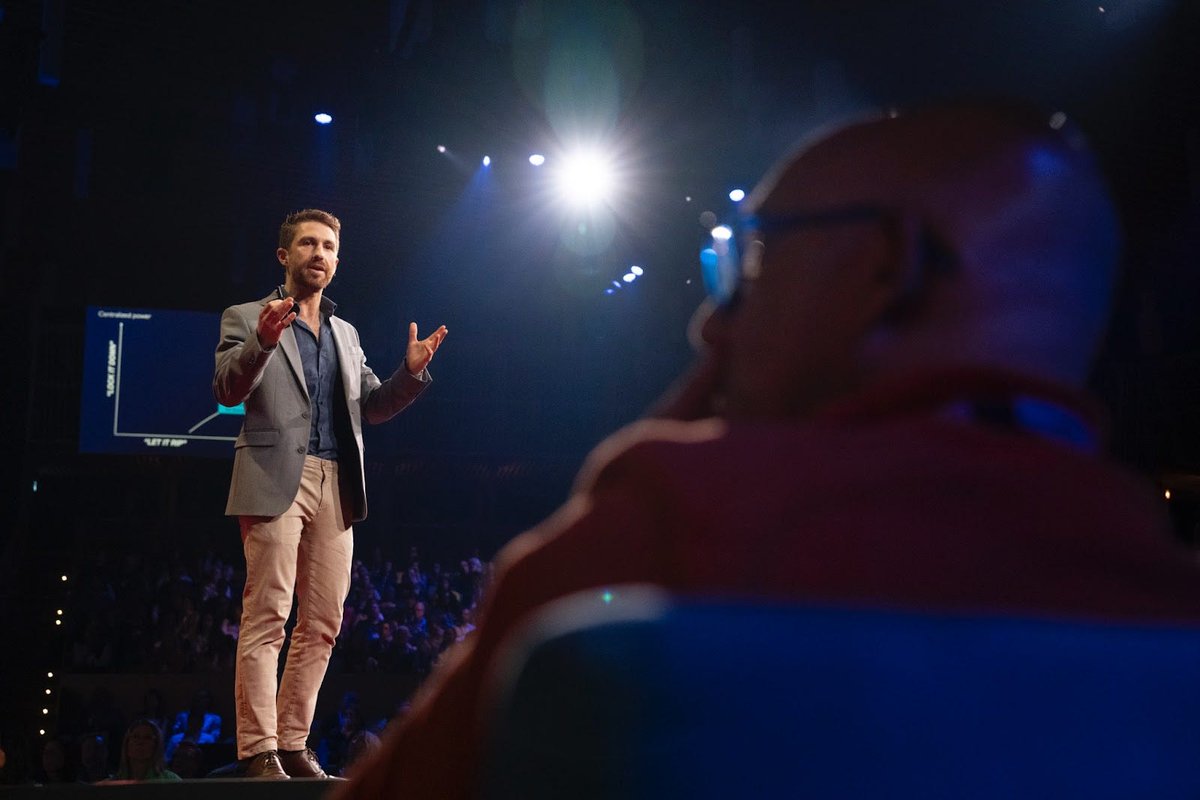
AI’s potential benefits are incredible. But right now, we’re sleepwalking into a dangerous world that no one wants. As @tristanharris argues in an urgent new TED Talk, this doesn’t have to be inevitable. It’s essential we snap out of the trance, face the dangerous implications of our current path, and coordinate toward a new path for AI.
Watch the talk: https://t.co/OiYDroVfnN
Read the text version here: https://t.co/sWsWQdxh2u
We often think of the challenges created by technology as separate and disconnected, so trying to solve them feels like playing the world's hardest game of Whac-A-Mole.
What if, instead, we tackled them at the root by identifying the patterns in design, development, and deployment that are causing these issues? Once we understand what's driving inhumane tech, we can develop a set of principles for building humane tech.
In this week’s episode of Your Undivided Attention, @aza Raskin sits down with fellow CHT co-founder Randy Fernando to walk through CHT's Seven Principles of Humane Technology. For each principle, they draw on real-world examples from the podcast and beyond to clearly illustrate how these principles (and their absence) show up in the world. Check out their full conversation:
Watch - https://t.co/Nh2VKIYzPu
Listen - https://t.co/Bp4l9SN7F9
Read - https://t.co/iDPTdtudrY
"When has a handful of people ever concentrated all the wealth and then consciously redistributed it to everyone else?"
The CEOs of the top AI companies admit that their products may take your job. In return, they promise to share the economic gains of AI with the rest of us. Do you trust that promise?
CHT co-founders @tristanharris and @aza Raskin joined @GavinNewsom for a wide-ranging discussion on the stakes of the disastrous default path we're on with AI, and how we can still grab the wheel and steer towards a better future.
Check out their full conversation: https://t.co/SirnAKx9xk
As CHT has outlined in the AI Roadmap, getting to a better future with AI will require a whole-of-society approach. National security assessments of frontier models are one critical component of a set of necessary actions. We look forward to seeing this Executive Order implemented in the coming months and to this administration and Congress continuing to build upon its foundation. (6/6)
Read our AI Roadmap: https://t.co/xBicDUIZEp
We're encouraged by the White House’s Executive Order directing federal agencies to evaluate frontier AI models and establish a framework for government oversight before these models are released to the public. (1/6)
https://t.co/P4d7bBs6CI
The administration has emphasized in this Executive Order that it wants to support the deployment of the “best and most secure technology”; delivering on that goal will require clear standards for assessing frontier models and concrete measures to protect all Americans from unsafe AI products. (5/6)
"Does it sound like a good idea for you and your family to only be able to pay your bills because an AI company that took your job is gonna pay you?"
Over half of Americans believe the risks of AI outweigh the benefits. Tristan Harris went on @OneNationFNC with @kilmeade to discuss why people aren't buying the vision of AI they're being sold today — and what a different path might look like.
"We are truly witnessing an eclipse of the sense of what it means to be human" — Pope Leo XIV
AI has been reshaping what it means to be human, and this week @Pontifex gave much-needed voice to what many of us have been struggling to articulate. We're grateful for his clarity, and for the moral weight he's bringing to a conversation that so deeply needs it.
Pope Leo's speech — and new encyclical on AI — adds to the growing chorus of demands for a more human-centered future with technology. At CHT, we've argued in "AI and What Makes Us Human" that we need to strengthen and reinforce our humanity for the age of AI, and work as a collective to establish new norms, rights, and legal protections to ensure that this technology genuinely serves us. If we don't, we risk AI eroding the very things that give human life meaning.
Real change with AI will require a whole-of-society approach. The Vatican's work around AI is proof that institutions around the world are sounding the alarm on the unique threats of this technology. We thank Pope Leo for using his platform to educate the public on AI's risks, and to emphasize the importance of human dignity amid a technological revolution.
Our co-founder, @tristanharris, is honored to have been invited to The Vatican to meet with @Pontifex ahead of the release of his first encyclical titled “Magnifica Humanitas (Magnificent Humanity)," which warned against AI's erosion of human dignity, identity, and agency. We also screened @theaidocfilm to an audience of senior leaders at The Vatican, which further energized their deep engagement with AI.
AI is being built and deployed without wisdom and care for humanity, and without adequate measures to protect a human future. Our hope is that the arms race to dominate AI will be recognized as the fundamental driver behind AI companies' race to replace, rather than augment, humanity. To solve this challenge, we must address the root cause of this arms race.
In his 1963 encyclical titled “Pacem in Terris (Peace on Earth)”, Pope John Paul XXIII named the arms race of nuclear weapons as a grave threat to peace. We are grateful to Pope Leo and the Vatican for their leadership on AI, and we are hopeful that this encyclical will help the world recognize what is at stake and the urgent need to change course.
Center for Humane Technology is pleased to see the Illinois State Senate pass SB 315 — the Artificial Intelligence Safety Measures Act.
Sponsored by @SenEdlyAllen and endorsed by CHT last month, SB 315 takes meaningful steps to ensure that developers of the most capable AI systems are transparent about their systems' risks and subject to independent oversight. What's more, SB 315 aims to provide whistleblower protections to AI employees who raise safety concerns about these systems and products.
Illinois policymakers are demonstrating that it's possible to hold AI companies accountable in common-sense ways while still supporting innovation.
We urge the Illinois House of Representatives to pass this critical piece of legislation without delay.
What is the future of human meaning in the age of AI?
Camille Carlton, CHT’s Senior Director of Strategy and Impact, laid out for the TEDxMiami audience last week how AI is eroding critical pillars of our humanity — and what can be done to protect the things we cherish as humans.
Building on CHT’s new work area “AI and What Makes Us Human,” Camille’s TED Talk interrogated the “messy middle” of technological revolutions, and why this moment with AI is different from the arrival of other transformative technologies.
Stay tuned for the full video of Camille’s TED Talk in the coming weeks.
The wait is over! Starting today, May 15, you can stream @theaidocfilm on @peacock.
This film takes the dizzying complexity of AI — the promise, the peril, the competing ideologies, the economic incentives — and creates a shared experience we can all see and respond to.
Then, after you've watched, head to https://t.co/AQ5JkWwrOO to explore concrete actions we can all take to build a better future with AI.
Your bank balance lives in a database. Your medical records sit on a server. Your car is an operating system on wheels.
Modern life depends on digital security. So what happens when an AI model holds a skeleton key to our digital world? Anthropic's new model, Mythos, found thousands of previously unknown zero-day vulnerabilities in the software that runs the world in just hours —including flaws in every major operating system and web browser, some of which had survived decades of human review.
On this week's episode of Your Undivided Attention, Tristan sits down with cybersecurity experts @josephinecwolff and @fredheiding to talk through what Mythos actually means — for governments, for companies, and for all of us who rely on digital security to go about our lives.
Watch - https://t.co/kEj6GIPmZc
Listen - https://t.co/W1o08ogTkR
The heads of leading AI companies have promised that superintelligent AI will cure cancer. Physician, public health researcher, and futurist Dr. @Emilia_Javorsky argues that this promise is not only false — it's siphoning resources from research and technology that might actually make a difference.
Read our producer Julia Scott's key takeaways from our conversation with Dr. Javorsky: https://t.co/PqXDTxk9o9
To mark America's 250th birthday, @TIME asked 25 tech insiders — including CHT co-founders @tristanharris and @aza — to name a technology that's "defining American life today." Read the full piece to see what they picked: https://t.co/JchJQqGaKU