In five years, HumAngle has become a powerhouse for truth seekers, journalists, and storytellers who dare to ask the hard questions.
As we mark our anniversary, here is how far we have come and how far we are willing to go.
#HumAngleAt5
A farmer whose village was burned does not find emotional comfort in hearing that a former insurgent helped identify buried bombs. A displaced family living with hunger in an abandoned resettled community does not easily understand why former insurgents appear to receive rehabilitation support while survivors struggle alone.
https://t.co/dCoGIy2XgI
In times of conflict and crisis, accurate reporting becomes a lifeline.
Help us keep you informed with facts you can trust.
Donate to HumAngle here: https://t.co/yO6ebTk7LN
For victims, however, these battlefield contributions rarely erase memory. A widow whose husband was executed does not easily accept that the man who once terrorised her community now works alongside soldiers.
https://t.co/Hoo4V5AdlD
“Whenever soldiers go for operations,” one explained, “some of us move ahead because we know the roads, the bushes, and where bombs are planted. We tell them which road not to use.”
https://t.co/Hoo4V5AdlD
When HumAngle spoke with soldiers and intelligence officers who served in the North East, their language was different. They do not romanticise former Boko Haram insurgents nor do they describe them as heroes, but they call them assets.
https://t.co/Hoo4V5AdlD
How does a state track men who have left the insurgency but not entered any formal process? How does it distinguish between a deserter seeking anonymity and one rebuilding operational networks elsewhere? How does it protect communities without criminalising everyone who once lived under insurgent rule?
Nigeria has not answered those questions through a coherent national framework. Instead, it improvises.
https://t.co/dCoGIy2XgI
In Kano and several urban areas, Boko Haram deserters and affiliates blended into urban life. Some became labourers, mechanics, phone repairers, commercial drivers, or petty traders. Some drifted into robbery and informal criminal economies, while others married and completely concealed their past.
https://t.co/dCoGIy2XgI
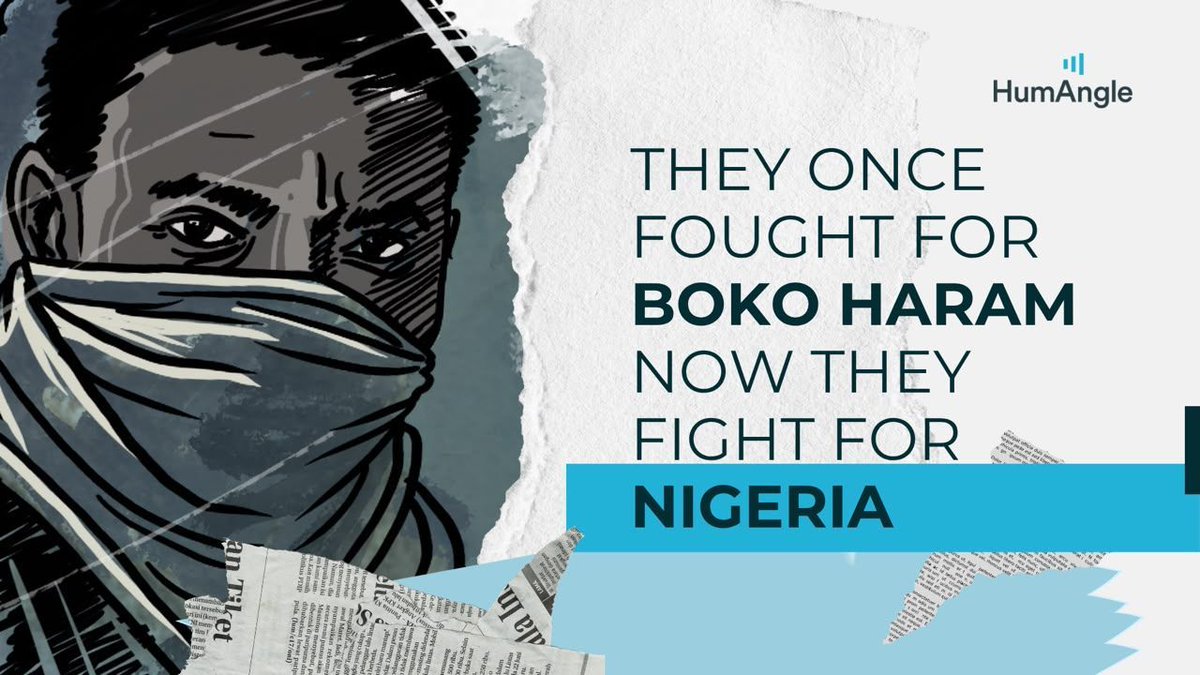
Officials say that former insurgents are helping in the fight against terrorism in Nigeria. But for people who suffered Boko Haram’s violence, seeing these men return as state allies brings back painful memories.
What are the benefits and risks? @A_Salkida spoke to defectors, soldiers, and experts.
https://t.co/dCoGIy2XgI
When the Nigerian government announced the rehabilitation of terrorists, it didn't just shock the nation; families who still suffer the consequences of the insurgency expressed concerns.
But can a terrorist truly change sides and fight against an ideology they once fought for?
@A_Salkida spoke with all sides involved.
Stay tuned. Out tomorrow.
Terrorists stormed an off-campus hostel in Zamfara, northwestern Nigeria, today, and abducted at least six students from the Federal Polytechnic, Kaura Namoda.
Many students had moved into off-campus housing precisely for safety.
https://t.co/9xxVMLvI9V
Thank you, @HumAngle_, for deleting and reframing your initial tweet.
We also look forward to your forthcoming investigation into Nigeria’s use of “repentant terrorists” in counterterrorism operations. However, we urge you to get the facts right and clearly distinguish between the Borno Model, other state-led DRR programmes, and Operation SAFE CORRIDOR (OPSC). More importantly, where allegations are made regarding the use of “repentant terrorists” in counterterrorism operations, kindly state clearly which programme or model is involved.
Having gone through all the reports attached to your tweet, it is noteworthy that none of the individuals referenced passed through Operation SAFE CORRIDOR. The experiences described, the rehabilitation processes highlighted, and the DRR locations mentioned are not part of OPSC.
For example, in one of the reports, you stated that an ex-terrorist was handed over to an official of the Borno Model, yet later referenced payments of ₦3,000 under OPSC. You also mentioned rehabilitation at Hajj Camp, which you know is not OPSC. The OPSC DRR camp is located in Gombe.
These distinctions are not mere technicalities. Inaccurate reporting on such a sensitive issue misleads the public, undermines institutional credibility, and contributes to the stigmatization of individuals who have passed through lawful rehabilitation and reintegration processes. Public discourse is best served when facts are presented accurately and programmes are assessed on the basis of what they actually do, rather than being conflated with entirely different initiatives.
In times of conflict and crisis, accurate reporting becomes a lifeline.
Help us keep you informed with facts you can trust.
Donate to HumAngle here: https://t.co/yO6ebTk7LN
Are schools in Nigeria safe?
Under the Safe School Initiative, a "safe school" means perimeter fencing, trained security personnel, alarm systems, CCTV cameras, rapid-response linkages to security forces, and emergency-trained school committees.
But the reality is far different. Here is how: https://t.co/laojzSPfls
Between the struggles of reintegration, poverty, and fighting on the other side of the war, exiting the terror group has also placed a target on their back, and defectors are being tracked and assassinated.
https://t.co/JHCW0Y8sDl
This Thursday, HumAngle is releasing an investigation into Nigeria’s use of “repentant terrorists” in counterterrorism operations.
Until then, here are some of our reporting on Nigeria’s rehabilitation programmes for defectors and their attempts at reintegration.
For others like Manzir Lawan, who surrendered and joined the programme, the struggle to reintegrate into society persists, and they have been repurposed for military-backed operations against their former comrades.
https://t.co/vi3gKxcP6Y