Week 2 points are here.
200,000 RISE Points have been allocated across 5,889 accounts.
View your points and begin your Week 3 journey: https://t.co/s3RKAiUYR2
Today at 07:21 UTC an unauthorized withdrawal occurred from the RWA strategy associated with the XLP vault. The issue has been patched and XLP depositors have been made whole, with the full amount covered by a portion of the fees generated in July on RISEx.
XLP depositors’ funds are not affected by this event. RISEx is entirely independent and is operating as normal. More below:
The withdrawal of 673,011.56 USDC was caused by a misconfiguration in the RWA strategy, present since its deployment on July 13. We detected the issue within minutes of the withdrawal, patched it by 08:09 UTC, and covered the full amount. This was not a novel attack or a dependency failure.
Transaction in question: https://t.co/GFW0JzeYLT
We have reviewed every transaction and deployment and this is the only unauthorized withdrawal in that period. We have also reviewed the configuration of every other strategy in the vault and found no equivalent issue. A postmortem will be published.
The RISE bridge, RISEx and the XLP vault each have withdrawal throttles to reduce the impact in an exploit event. However, in this circumstance the amount was below the throttling thresholds.
We are engaging SEAL 911 and tracing is underway. We are attempting to make contact with the address involved regarding a return of funds.
@risextrade is the only official source of information. We will never DM you first. There is no recovery form and no claim process. Do not connect your wallet to any link about this incident.
Week 1 drop is here. 200,000 RISE Points distributed across 5,886 accounts.
Additional 25,000 RISE Points distributed across 5,120 accounts as part of the Genesis Pool to Season 0 users.
Track yours here: https://t.co/s3RKAiUYR2
Our Season 0 retro points dropped last night. A total of 1.6M points were allocated to the early users of the venue!
While some users are stoked with the outcome, others received below their expectations. I suspect our model differs from most venues, so a clarification is warranted.
As a product builder I like to ship incrementally, test features, iterate and adapt. You can't do that with a drop like this. A large chunk total allocation goes out in one shot, you get one chance to set the incentive structure for everything that follows.
So rather than looking at how others did it, we took a first-principles approach.
Retro allocation
Our goal was to ensure a smooth transition between the seasons while giving an increased boost to early users given they participated on the venue when it was less mature.
We landed on 1.6M points directed to the retro drop followed by a 200k weekly emission for season 1. Given S0 had a $47M daily average, and we’re now tracking for a ~$98M daily average during the first week of S1, meaning S0 traders received a 40% bonus on pts-per-volume relative to S1 so far.
Depending on the length of the program, we expect this will be 15-20% of the total points allocation. We checked this number against other programs. Our pre-season was 12 weeks, relative to competitors this was generous. We felt this was a good way to reward the early users.
Retro points model
So what are the goals of the retro drop? Here’s what we prioritised:
- Genuine traders, the kind we want on the venue regardless of points
- Reward genuine economic spend
- Reward earlier users for trading on a less mature venue
- Reward retention and encourage more of it
Now I can’t share too many specifics because we intend to continue using a similar model, albeit with tweaks and different weights and boosts, but I’ll share enough to add clarity to our approach.
The primary contributors to the model are:
- Trading & Liquidation Fees: What the users spent on the venue
- Slippage: Rewards high value whale takers who provide good flow to the exchange.
- Maker Adverse Selection: Makers who were adversely selected actually got paid back on it
- OI Carry: Cost-of-capital to hold market exposure on the venue
Additional contributors include a retention boost and user segmentation. Referrals follow the same logic. If you refer someone, you earn 10% of the points they generate, not their raw volume. They keep every point they earn, and you earn an additional 10% alongside them.
Retention
The retention boost is simple. The more you use the product, and the longer you have used it, the more boost you receive, and the more you will continue to receive as season 1 continues.
Slippage
Traders who are willing to put large orders directly into the book create opportunity for market makers, but also lead to skew in the book, which in turn attracts more sophisticated traders, like systematic traders and funding-rate arbitragers. This diverse user base is what creates a really healthy venue.
Additionally, we found this rewarded the most active click traders, in particular scalpers, swing traders, momentum traders and traders who put large orders directly into the book. This cohort is a priority.
Note: Slippage is potentially gameable so we’re quite cautious about it.
Per-week distribution
We decided against a fixed-weekly allocation. Why?
During Season 0 the daily volume ranged from $10M per day to . Given the variance in activity week-to-week, a fixed-weekly distribution would lead to very large outliers, leading to grossly underpaying and overpaying for the same activity. Rather, we boosted the early traders relative to their baseline. Week 1 starting with the largest multiplier, linearly declining to no multiplier for the last week.
Why have users received vastly different drops based relative to their volume?
Volume is considered, but only through fees and other metrics. Consider two users. Fred, a swing trader who puts larger taker orders in the book, vs an algo market maker, John.
Fred’s costs will be fees (3bps taker) and slippage. Depending on how large the order is and how thin the books are, the cost of slippage can vary greatly. This is a real cost Fred has to pay to participate on the venue.
John’s costs, however, will be a 1bps maker fee plus any adverse selection they experience by holding limit orders on the book. The best measure of adverse selection is markouts, you essentially look at how bad your execution is relative to the price in a short period of time. Negative maker markouts capture genuine economic contribution to the venue, but they are much smaller than slippage on aggregate.
As a result, Fred's cost will often be over 4x John's per unit volume.
Concentration
The top 100 HL traders generate ~35% of fees, top 1,000 users generate ~70%. That reflects the healthiest market structure among perps DEXs. The fact is, perpetual exchanges are concentrated, and RISEx is no exception. We took measures to reduce the concentration and flatten out the distribution. However, this increases the sybil attack surface, so it’s difficult to do well.
Additionally, RISEx has one big benefit here, we have one primary market maker, the XLP vault, which receives no points for trading activity. XLP is almost 50% of the volume on the venue and received zero points for trading.
The Genesis Pool
The Genesis Pool is a 100k-point pool reserved exclusively for season 0 traders and will be distributed over the first 4 weeks of Season 1 (In addition to the 200k weekly Season 1 drops)
Genesis Traders who stay active on the venue will earn from the pool. Distribution is weighted by activity and skewed toward the earliest traders.
This is a way for us to reward the early users that continue trading on the venue and reinforcing retention
What next?
Season 0 laid the scaffolding and rewarded the users who helped us get here. Season 1 is about building a world class exchange, realising the vision of atomic composability and unlocking a new wave of DeFi. We’re optimising for quality traders, deeper books and a healthy venue.
Season 1 is live, the genesis pool is running. See you in the books.
RISE Points retro drop is complete.
1,500,000 RISE Points distributed to Season 0 traders. Another 100,000 RISE Points are reserved for the Genesis Pool.
Details below.
My primary focuses right now are:
- Listing more RWAs
- Cont. scaling up liquidity on Majors
- Building competitive RWA liquidity
- Solving spot market making
- Shipping Spot
- Following with Portfolio Margin
Once we nail this list, things start to get very very interesting, and the design space for creative DeFi here is massive.
Think market-making vaults which create borrow demand for tokenised equities, thus yield on equities, alongside equity basis vaults?! DeFi lost its spark, but this is what makes me hopeful.
Outside of this list, we have ongoing improvements and QoL features like TWAP, scaled orders, onramping and others.
We are hosting a live AMA this Thursday to talk Ignite, RISE Points and product.
Got questions? Drop them below and we will answer them on the show.
Thursday, 23 July, 12:00 PM UTC. Live on YouTube and X.
https://t.co/yBWEKUEZKh
Our core thesis. Build the product RISE could uniquely deliver. Meet users where they already are. Move product and distribution responsibility to the chain itself.
Over $1M in revenue and $3B in perpetual volume later, RISE is a proven product in the market, ready for growth into spot, tokenised RWAs, and unified margining to tie the ecosystem together.
It's time to double down on the strategy.
Today, that strategy gets its next chapter. RISE Points are live. Earned exclusively through RISEx.
More on RISE Points: https://t.co/l9ZFAjxzci
Our Season 1: Ignite is officially live!
Points have begun accruing on Monday, 20 July 2026 at 00:00 UTC. Points are distributed weekly, with the first distribution at 14:00 UTC on Tuesday, 28 July 2026.
200k points will be allocated per weekly distribution.
I'm asked about points a lot.
There’s a reason why we haven’t launched an incentive program yet. We are the first to build a fully onchain EVM orderbook that can actually compete in performance with centralised exchanges. I have deep conviction that atomic composability and fully programmable books will be a game changer, and is potentially the missing link holding onchain spot back.
However, with any new innovation there comes challenges and risks, and many of those are unknown unknowns. We are realistic about this. We aspire to build a world-class venue, but that will take time. Much to the frustration of our growth team, I’ve been adamant that we cannot launch an incentives program until we’ve reached some very important product milestones. If we’re fuelling the engine, it must perform.
Milestone 1: Core features live and stable
Onchain reduce-only GTC was a particularly curly one, but we got it live and it’s been in use for over 4 weeks. We launched with TPSL, and we had some early stability issues. Thanks to improving liquidity, latency and adding retries, TPSL is much more stables. Netted-margining is the last key core feature I had on my list. This allows for better capital efficicency when quote both sized of a book. This is will go live this week.
Milestone 2: Listing engine
Listing in an operational art form. The goal we set: the top 10 crypto assets and our first RWA listings. RWAs are the direction we want to focus, and the first listing is the hardest, particularly given we’re bootstrapping liquidity in-house. I’m excited to share, RWAs will be live on RISEx this week!
Milestone 3: Public XLP vault and quality liquidity
Early on we made the tough decision to bootstrap liquidity on the venue ourselves. At the end of the day, liquidity is the product, it’s too crucial not to have control of it’s quality. Prior to launch, the XLP vault and our market making talents had yet to be publicly tested. Being the dominant maker of a venue is an interesting challenge, typically when market making capital preservation is the undeniable priority, uptime is secondary. However, when the exchange user experience is the top priority, uptime is extremely important and wicks should be considered critical failures.
After a lot of work, I’m happy to share the 99.9% uptime target we set has been met comfortably and we have our eyes set on 99.99%.
As for depth, this will continue to improve over time. The targets we set for points are: $100k 1bps, $300k 2.5bps and $600k 5bps. Our order replacement rate has already been pretty good, so with this traders can comfortably load up a 10-20 BTC positions with a few orders. Today we’re about halfway there, but we will reach it by the end of the week. Consider this the MVP to hit our stride for growth, however, we have every intention to grow to world class liquidity levels.
Commencing
In summary, we are on track to hit all our core milestones this week. Additionally, in less than 3 months we’ve processed $2.9B in volume, secure $13M in TVL, the venue holds >$17M in open interest and the XLP vault has yielded over 50% APY. The team and I are happy with where the core features are, and we’re ready to kick off growth and shift our product focus to the features that will make RISEx unique, namely EVM Spot, AutoYield and Permissionless Portfolio Margin.
Points are here, we’re ready.
Week 1 begins Monday the 20th, 00:00 UTC. All activity up until the 20th will be eligible for retroactive points.
More details coming.
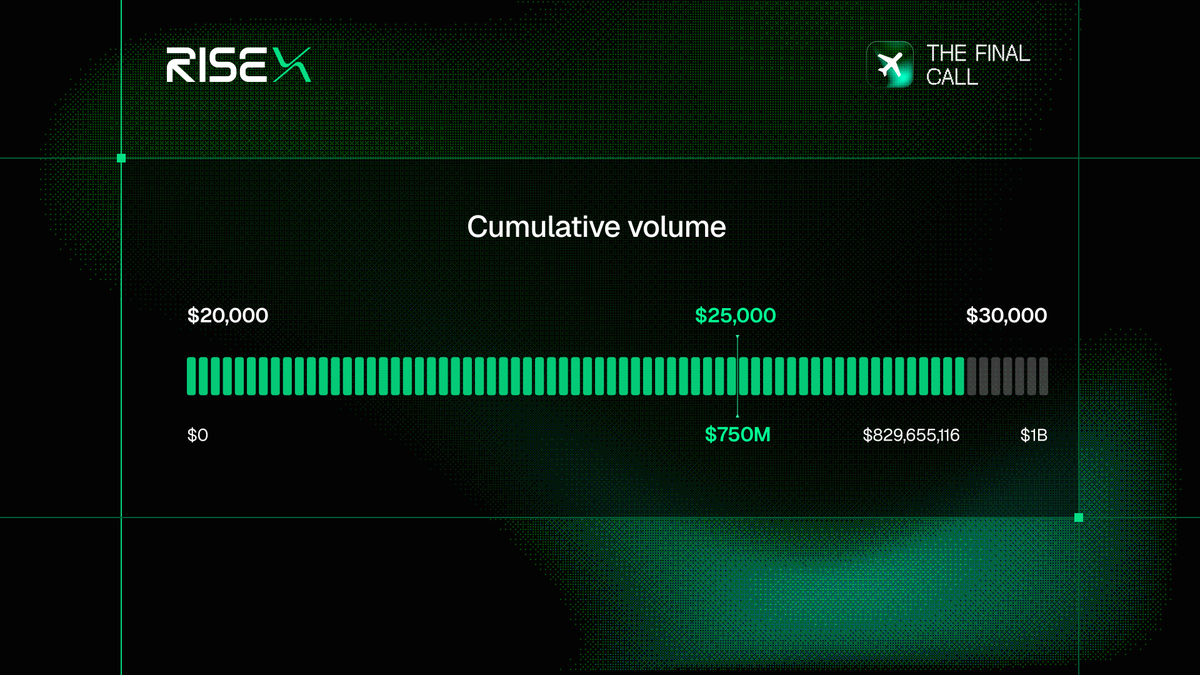
Boarding for The Final Call is now complete.
A huge thank you to everyone who traded hard. Collectively, we reached over $900M, taking the prize pool up to $25,000.
Winners will be announced and prizes distributed within 7 days.