Commentary:
The Omid Hospital Attack: A Reckoning with Evidence and Impunity
In a damning investigative report, Amnesty International has characterized the Pakistani military regime’s airstrike on Omid Hospital as an act of war, urging that the assault be probed as a potential war crime. This verdict is not born of conjecture but of meticulous examination—of satellite imagery, video footage, and on-the-ground accounts—that collectively dismantle the regime’s official justifications. The United Nations Assistance Mission in Afghanistan (UNAMA) has confirmed the staggering human toll: on 16 March 1404, at least 269 civilians, many of them drug addicts undergoing treatment, were martyred, and 122 others wounded. What transpired at Omid was not a tactical strike but a massacre of the vulnerable, cloaked in military rhetoric and executed with impunity.
The Pakistani military regime has long contended that the Omid Center served as a weapons and ammunition depot—a claim that, if proven, might lend a veneer of legitimacy to the bombardment. Yet Amnesty International’s investigation finds no conclusive evidence to support this assertion. Satellite images taken mere days before the attack reveal routine medical activity: patients and staff moving about a civilian health facility, with no sign of militarization. No secondary explosions, which would typically accompany the destruction of an ammunition store, were observed. The regime’s narrative, therefore, collapses under the weight of its own contradiction—a propaganda edifice erected on assertion rather than proof.
This pattern of justification without evidence is not an aberration but a recurring tactic. For years, Omid operated transparently as a center for treating addiction, its civilian character undisputed. The regime’s attempt to retroactively redefine it as a military target is an exercise in distortion, one that has now been exposed as baseless on the international stage. Independent investigations, echoed by global outcry, have reinforced what the evidence makes plain: the attack was not a response to a tangible threat but a calculated act of aggression against a defenseless population. If the regime insists on its military rationale, it bears the burden of producing clear and convincing proof—a burden it has consistently failed to meet.
More troublingly, Amnesty’s findings suggest that the Pakistani military regime is deliberately targeting Afghan civilians, using health facilities as staging grounds for its security failures. Such attacks do not signal strength; they betray a profound political and military impotence. To bomb a hospital and claim victory is to mistake atrocity for achievement—a grotesque admission that the regime cannot secure its own borders or resolve its internal crises through means other than bloodshed. The hundreds of patients and civilians who perished at Omid are not casualties of war; they are victims of a regime that has lost its moral and strategic compass.
Yet the regime’s calculus appears to rest on a fatal illusion: that violence against Afghans can insulate Pakistan from its own deepening contradictions. Killing civilians in a neighboring country cannot guarantee Pakistan’s safety, nor can it mend its fractured economy, quell domestic unrest, or obscure the failures of its ruling elite. On the contrary, such brutality only begets deeper opposition, erodes trust, and intensifies international pressure—both political and legal—against the regime. The path to security does not run through the rubble of a hospital; it runs through accountability, dialogue, and respect for human life.
The findings of Amnesty International must now serve as a catalyst for impartial international action. The families of the Omid victims—those who lost fathers, mothers, sons, and daughters to the inferno—demand justice, not empty condolences.
Read more ...
https://t.co/h7p4x3wMg3
Mediation for sale? Pakistan asks Washington for $10 billion amid economic crisis
Reuters, which occasionally sheds light on rare developments, has reported in a new special report that Islamabad has requested a $10 billion fund from the US Treasury Department following its mediation efforts between Tehran and Washington.
Analysts suggest that the Pakistani regime is now believed to be capitalizing on every crisis in the region, and that its mediation role may be driven by material considerations.
If Washington agrees to this request, it would serve as a vital financial tool for Islamabad, which is currently grappling with a cash crunch, Reuters noted, citing a confidential source.
The request came after Pakistan acted as a mediator in the Iran-US tensions, raising expectations that Islamabad might secure economic benefits from Washington and other partners.
The US Treasury Secretary has asked Pakistan to provide $10 billion in facilities over five years to support currency stability.
The US Treasury Department declined to comment on the reported request.
It is worth noting that Pakistan is currently facing severe economic challenges, which have compelled it to seek assistance from every wealthy nation.
TAPI pipeline extended 106 kilometers across Afghan territory
The Ministry of Mines and Petroleum has announced that the TAPI gas transmission project in Afghanistan is making rapid progress, with 106 kilometers of pipeline already laid so far.
According to the ministry's press release, 127 kilometers of road have been prepared for pipeline extension, 108 kilometers of monitoring road have been constructed, 78 kilometers of excavation have been completed, and 36 kilometers of pipeline have been buried underground.
The source further stated that 98 kilometers of pipeline have been transferred to the project's first camp.
The ministry also noted that negotiations are underway with Afghan companies for the construction of a gas distribution network in Herat, with one private firm having expressed readiness to invest approximately $420 million in the venture.
According to the press release, 595 Afghans are currently employed in security, administrative, and technical roles within the TAPI project.
Refugees facing serious problems, urgent assistance needed
The head of the Ministry of Refugees, Maulvi Saeed Ahmad Banuri, has held discussions with the representative of the International Organization for Migration (IOM) regarding the construction of shelters for refugees, finding solutions to their challenges, continuing bilateral cooperation, and providing assistance to returnees.
According to the Ministry of Refugees, Mr. Banuri stated during the meeting that refugees are facing significant difficulties and require urgent assistance that must be addressed without delay.
In response, the IOM representative reaffirmed the organization's commitment to supporting refugees and assured that aid programs are being implemented to address the needs of returnees.
Scholars should eradicate practices of ignorance from society
The leadership of the Islamic Emirate, during a meeting with scholars from districts and urban areas of Kandahar province, emphasized the need to strengthen and consolidate the Islamic system, urging scholars to carry out their duties with firm resolve and determination to eliminate societal vices and the remnants of pre-Islamic traditions.
The Islamic Emirate's leadership advised the scholars to foster a spirit of obedience among themselves and the general public, in order to further reinforce unity and shut the doors to sedition.
They also called on the scholars to increase their participation in solidifying the Islamic system alongside the Islamic Emirate and to extend full cooperation in this regard.
Meanwhile, the scholars reaffirmed their allegiance to the leader of the Islamic Emirate and pledged to spare no effort in upholding the rule of the Sharia system.
New oil refinery goes operational in Balkh
A new oil refinery has been established in Mazar-e-Sharif city with an investment of approximately $30 million by an Afghan investor.
Refinery officials have stated that the facility has a daily processing capacity of around 600 tons of crude oil and has created job opportunities for 150 workers.
Meanwhile, officials confirmed that 14 oil refineries are currently operating across the country, which process and supply oil extracted from the Amu Darya oil basin daily after undergoing necessary laboratory testing.
According to available data, Afghanistan's daily oil demand stands at 10,000 tons, of which 1,300 tons are currently extracted each day from the Qashqari, Angot, and Zumrud Sai fields within the Amu Darya basin, with the remainder being imported from abroad.
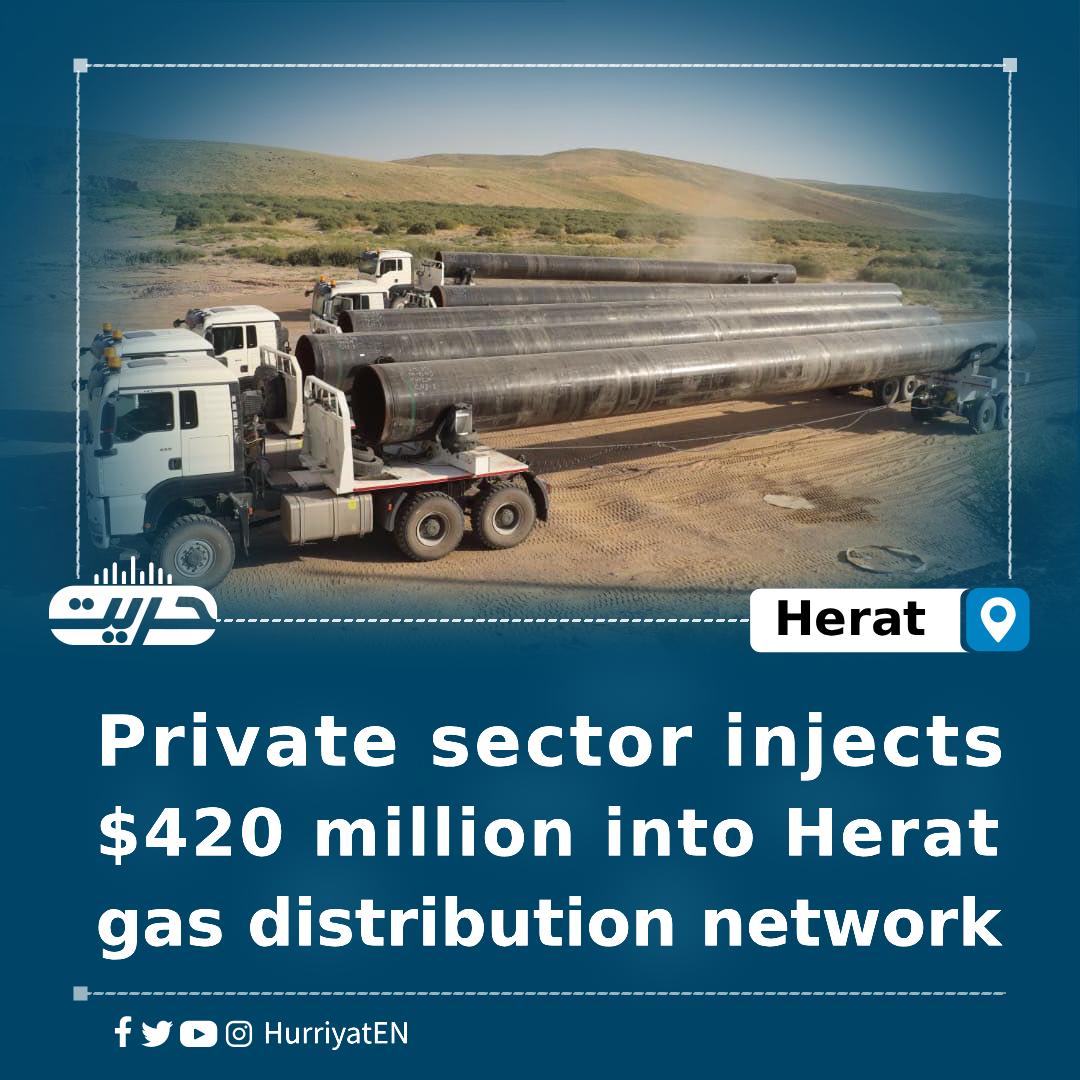
Private sector injects $420 million into Herat gas distribution network
The Ministry of Mines and Petroleum has announced that the TAPI gas pipeline project in Herat is progressing at a rapid pace, with significant headway made across multiple sectors.
According to the ministry, 127 kilometers of the 153-kilometer pipeline route in Herat have been cleared, and 106 kilometers of pipe have already been laid.
The Ministry stated that negotiations are underway with Afghan firms for the construction of gas distribution networks in Herat, and one company has already expressed its commitment to invest $420 million in the venture.
Under the company's proposed plan, an estimated 73,000 individuals are expected to gain direct and indirect employment.
Is Pakistan on Risk of Permanent Rift With Neighbor Iran
Pakistan has declared that any menace to Riyadh directly contradicts its own national security and core interests, according to a fresh official statement.
The announcement comes amid escalated tensions, following threats from Iran-backed Houthi forces to target Saudi commercial vessels and oil tankers at sea.
In response to the Yemeni Ansarullah movement’s provocations, Islamabad firmly rejected any hostility toward Saudi shipping, labeling it wholly inadmissible.
The communiqué stressed that aggressive acts against Saudi maritime assets or interests would be viewed as antagonistic to Pakistan’s own safety and strategic priorities.
Previously positioning itself as a mediator between Tehran and Washington, Pakistan now signals, through this decisive stance, its practical alignment as a key U.S. strategic partner in a moment of regional crisis.
Disaster Update: Search Continues for 84 Missing After Nuristan Floods
Rescue operations have entered their third day in Nuristan, following devastating floods in the region, according to a Hurriyet Radio correspondent on the ground.
Search teams recovered two more bodies this morning, raising the total number of recovered victims to 21. A 100-member unit from the Ministry of Defense has now joined the efforts.
Of the 105 people initially reported missing, 84 remain unaccounted for as the search continues.
60,000 IV solutions and syringes produced daily in #Herat.
A multi-million dollar investment boosting local pharma.
Products meet international standards, says factory management.
300 direct jobs created for Afghans.
Trade halt with Pakistan fuels local industry boom.
U.S. Plans Trial for Kidnapped Venezuelan Leader Next Year
Documents obtained by RIA Novosti reveal that Washington intends to bring Venezuelan President Nicolás Maduro to trial in June 2027.
According to the reports, U.S. forces stormed the Venezuelan presidential palace on January 3, abducting Maduro and his wife and transferring them to New York. President Donald Trump has stated that the couple will face drug trafficking charges.
Maduro and his wife have already appeared in a New York court, where they denied all allegations against them.
Trump Admin Seeks $87B from Congress for Iran War
The ongoing military campaign against Iran has driven a sharp spike in Defense Department expenditures, prompting the Pentagon to request an additional $87 billion from Congress to sustain operations.
In testimony before the Congressional Budget Committee, Defense Secretary Pete Hegsett revealed that $37.5 billion has already been obligated for the conflict to date. He cautioned that failure to approve the new funding would expose the United States to "serious security challenges."
The request follows a recent Senate resolution that curbed President Trump's war authorities, reflecting majority opposition among senators to the administration's strikes on Tehran.
Pakistan's Kabul Hospital Strike Must Be Probed as War Crime
Amnesty International has called for a war crimes investigation into the Pakistani military regiem March 16 airstrike on a Kabul addiction treatment center. The group stated it found no evidence supporting Pakistan’s claim that the Omid facility was used for weapons storage or military purposes at the time of the attack.
Describing the strike as a violation of international humanitarian law protecting medical sites and civilians, Amnesty said the assault may constitute a war crime. The organization urged Pakistan’s government to prosecute all responsible for planning and executing the attack, citing insufficient evidence for its justification.
The March 16 raid on the Omid camp killed over 400 people and wounded many more, according to reports.
ICU Inaugurated at Kandahar's Aino Mina Hospital
The Ministry of Public Health announced that Minister Maulvi Noor Jalal Jalali has inaugurated a new 15-bed Intensive Care Unit at the 350-bed Aino Mina Hospital during his visit to Kandahar. The project, valued at $1.5 million, was funded by the UNDP.
Minister Jalali described the ICU’s opening as a key advancement in health service delivery and emergency care, reaffirming the Ministry’s commitment to expanding quality medical services. The facility is expected to serve emergency patients from Kandahar and neighboring provinces.
Azizi Energy Completes Equipment Purchase for 10,000 MW Electricity Output
Deputy Prime Minister for Economic Affairs, Mullah Abdul Ghani Baradar Akhund, held a meeting today with Mirwais Azizi, Director General of Azizi Energy Investment Company, along with his technical team, to discuss a range of energy and infrastructure projects.
According to an official press release, Azizi informed the Deputy Prime Minister that his company has procured all necessary technical equipment for the production of 10,000 megawatts of electricity and will soon begin the process of transporting it into the country.
He further announced that construction of a major cancer hospital in Afghanistan is also set to commence in the near future.
Separately, a technical committee chaired by the Deputy Prime Minister for Economic Affairs, comprising representatives from relevant Emirati agencies and Azizi Energy Investment Company, presented its report. The report confirmed that feasibility studies for three solar power projects — 100 megawatts in Naghlu, Kabul; 100 megawatts in Barikab, Parwan; and 131 megawatts in Ghazni province — have been completed, with power purchase agreements already signed.
The report also noted that technical discussions are nearing finalization on several additional initiatives, including 165 megawatts of coal-fired electricity generation in Takhar, 350 megawatts in Baghlan, the construction of substations in Naghlu and Ghazni, and the extension of the transmission line from Kabul's Tarakhel area to Sanayi Sabz.
Japan Embassy Offers Condolences to Nuristan Flood Victims
The Embassy of Japan in Afghanistan has expressed its condolences over the casualties caused by yesterday's deadly floods in Nuristan province, offering its sympathies to the families of the victims.
In a statement posted on its website, Ambassador Masamoto conveyed his deepest condolences to the bereaved families and extended wishes for a swift recovery to those injured in the disaster.
It is worth noting that the Iranian Embassy in Kabul and the European Union Delegation to Afghanistan have also expressed their condolences over the loss of life and injuries resulting from the floods in Nuristan.
EU Delegation Offers Condolences to Nuristan Flood Victims
The European Union Delegation to Afghanistan has extended its condolences to the families of those who lost their lives in yesterday's floods in Nuristan, while also assuring support to affected households.
In an official statement, the delegation expressed hope for the swift recovery of individuals still missing as a result of the devastating floods.
The statement further affirmed that the EU stands in solidarity with all those impacted by the disaster.
It is worth noting that yesterday afternoon, severe floods struck the provincial capital of Parun and several other areas of Nuristan, resulting in dozens of casualties and heavy financial losses, with more than a hundred people still unaccounted for.
50 Million Afghani Hospital Project Launched in #Kandahar
The Ministry of Public Health has announced that the foundation stone of the General Hospital in Daman District, #Kandahar Province, was laid by Minister Mawlawi Noor Jalal Jalali.
According to a statement issued by the ministry, the hospital project, valued at approximately 50 million Afghanis, is scheduled to be completed within 18 months.
Mawlawi Noor Jalal Jalali emphasized the importance of the hospital in addressing patient needs and delivering essential health services, adding that the implementation of such projects will enhance the quality of healthcare in remote areas and ensure timely access to services for the local population.
He further stated that the Ministry of Public Health is striving to provide standardized health services across all regions of the country, with particular focus on underserved districts.
2,500-year-old Kafar Qala fort registered in #Parwan.
Perched on Ghorband mountains, its battered walls still stand.
Local lore links it to wars from ancient times to the British era.
Dating to ~300 BC, it's now officially documented.
Elders pass down tales of its battle-scarred past.
Residents urge reconstruction to save the fading site.
Officials say it's Buddhist-era; restoration to start soon.
More undiscovered #Parwan sites await registration.
#Hurriyat_Radio