Look at Christ's hand in this painting.
Not the wound. The hand.
Jesus has Thomas by the wrist. He is pulling the man's finger into the hole in His own side.
Thomas isn't forcing his way in. Look at his arm. It's slack. Led. His hand goes where it's taken.
Caravaggio painted this around 1602, and it scandalized people, because he painted the apostles the way they actually were. No halos. No gold. Three working men with sunburned necks and dirt under their fingernails, crowding in like farmers inspecting a wound on livestock. Thomas's forehead is folded into furrows you could plant seed in.
And Caravaggio hid a detail in Thomas's clothes.
Look at his shoulder. The seam of his garment is torn open. Split at the shoulder, a small, ragged opening in the fabric.
The same shape as the wound in Christ's side.
The doubter is torn too. He just doesn't know it yet.
Now the part everyone gets wrong about Thomas.
He wasn't a coward. When Jesus decided to walk back into Judea, where men were waiting to stone Him, the disciples tried to talk Him out of it. One of them said: Let's go anyway.
John 11:16. Then said Thomas, which is called Didymus, unto his fellow disciples, Let us also go, that we may die with him.
That's Thomas. First volunteer to die.
His problem was never courage.
His problem was that he watched them do it. He saw the man he was ready to die for get taken apart in public. And when the others came running with we have seen the Lord, something in Thomas refused to open the door again.
Except I shall see in his hands the print of the nails, and put my finger into the print of the nails, and thrust my hand into his side, I will not believe.
That's not skepticism. That's a man protecting the last unbroken piece of himself. Hope had already killed him once.
He held that line for eight days.
Eight days of the other ten glowing. Eight days of being the only man in the room who missed it.
Then the doors were shut again. And Jesus stood in the middle of them.
And He went straight to Thomas.
Reach hither thy finger, and behold my hands; and reach hither thy hand, and thrust it into my side: and be not faithless, but believing.
Word for word. The exact demands Thomas had made, in a room Jesus was not standing in.
He heard the doubt spoken in His absence. And instead of answering it with a rebuke, He answered it with His body.
Now read John 20 carefully. Slowly.
The text never says Thomas touched Him.
Look for it. It isn't there. Jesus makes the offer, and the very next verse is Thomas answering, My Lord and my God. The touch is never recorded. For two thousand years, readers have argued about whether his finger ever reached the wound, or whether the offer alone broke him.
Caravaggio read that silence and made a decision.
He painted Jesus closing the gap Himself.
Because that's what the whole scene is. Thomas set the terms: I will not believe unless and Jesus, instead of being insulted, took the man's wrist and brought his hand to the proof. He didn't wait for Thomas's faith to grow strong enough to reach. He reached.
And think about what had to be true for that moment to happen at all.
He rose in a glorified body. Death couldn't hold it. Locked doors couldn't stop it.
And it still has the holes in it.
He kept the wounds. The one thing He carried out of the grave was the damage. He kept them so that a man drowning in doubt would have somewhere to put his hand.
Then He said one more thing, and this is where you walk into the scene.
Thomas, because thou hast seen me, thou hast believed: blessed are they that have not seen, and yet have believed.
They that have not seen.
He's not talking about anyone in that room. Every man in that room saw. He's talking past them through the locked door, down twenty centuries to the ones who would have to do it the hard way.
That's you. You're in the sentence.
So bring Him the doubt. The real one. The one you don't say out loud in church. He's heard it already. He hears the ones spoken when He's not in the room.
He is not threatened by your unless.
The wounds are still open for inspection.
And if your faith can't reach that far, look at the painting one more time.
He'll take your hand.
Peter warmed his hands over the fire that ruined him.
John 18:18. The servants and officers had made a fire of coals, for it was cold. And Peter stood with them and warmed himself.
A charcoal fire. In the courtyard of the high priest. In the dark.
That's where it happened. Not on a battlefield. Not under torture. Next to a fire, warming his hands, when a servant girl looked at him too long.
I know not the man.
He said it three times. The third time, he was cursing and swearing while he said it. Fisherman's mouth coming back out of him like the old life never left.
Then the rooster.
Luke 22:61. And the Lord turned, and looked upon Peter.
Jesus was being beaten inside that house. Face already swelling. And through a doorway or across a courtyard, He turned His head and found Peter's eyes.
He didn't say anything. He just looked.
And Peter went out and wept bitterly.
This is the man who walked on water. The man who pulled a sword on an armed detachment. The man who said I will lay down my life for thy sake.
He folded in front of a servant girl. Beside a fire. In the cold.
Now watch what the Bible does.
The Greek word for that charcoal fire is anthrakia.
It appears exactly twice in the entire New Testament.
Once in the courtyard where Peter denied Him.
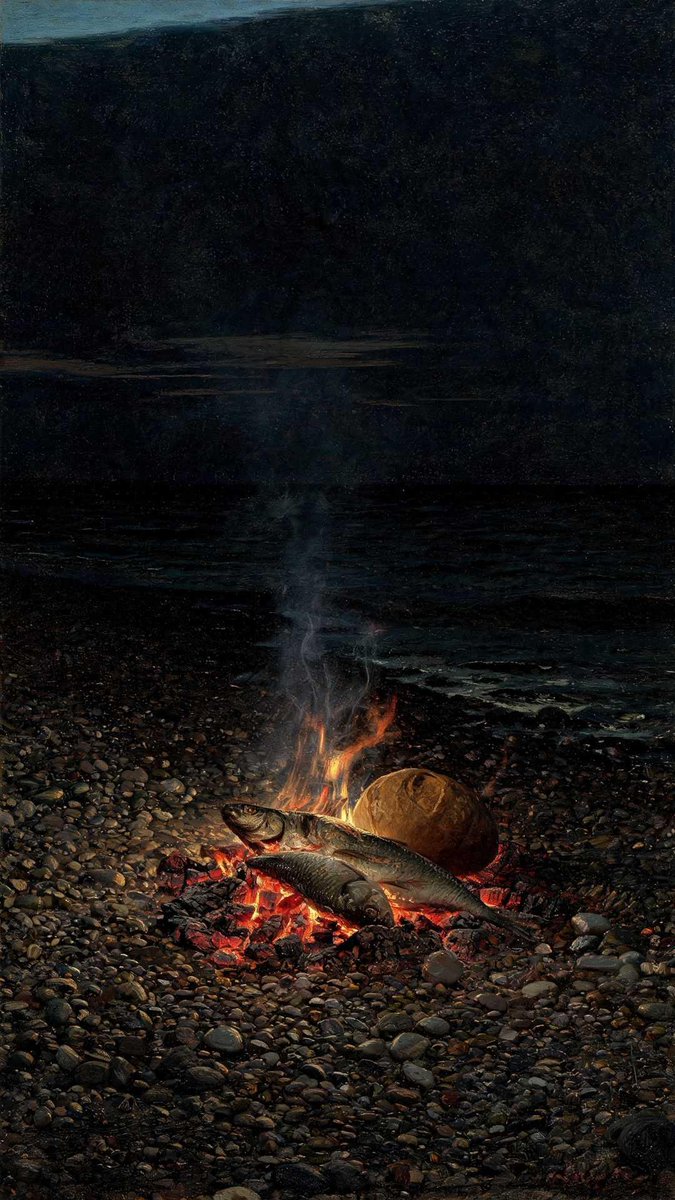
And once on a beach in Galilee. After the resurrection. John 21:9. As soon as they were come to land, they saw a fire of coals there, and fish laid thereon, and bread.
Jesus built it Himself.
He rose from the dead, conquered the grave, held the keys of death and hell, and then He gathered driftwood on a beach and built a charcoal fire and cooked breakfast.
For Peter.
He rebuilt the scene. The smell of the coals. The cold morning air. Everything Peter's body remembered from the worst night of his life, Jesus put it back in front of him on purpose.
And then He asked him three times.
Lovest thou me. Lovest thou me. Lovest thou me.
One question for every denial.
He didn't ask Peter to explain himself. Didn't make him relive the cursing. Didn't say I told you so, even though He had told him so, word for word, rooster and all.
He stood him next to the same fire and gave him three chances to say the opposite of what he said last time.
Peter was grieved the third time. He felt the arithmetic. He knew exactly what was being counted.
And every answer Jesus gave him wasn't punishment.
It was a job.
Feed my sheep.
The man who denied Him three times preached at Pentecost, and three thousand souls were saved. The coward from the courtyard died on his own cross, and the tradition says he asked to be hung upside down because he wasn't worthy to die like his Lord.
That's what Jesus does with failure.
He doesn't avoid the place where you fell. He doesn't tiptoe around it. He doesn't pretend it didn't happen.
He builds a fire in that exact spot and waits for you there.
The thing you did, the night you're still ashamed of, the words you can't take back, the moment you found out what you were actually made of.
He's not going to make you crawl past it.
He's going to meet you in it.
There's a fire on the beach.
He already cooked.
Come and dine.
Este tipo es un alemán que se hizo famoso en este país por pasear con muchos perros y que estos, sin el método de dominancia, lo sigan y hagan caso a lo que él pide, como por ejemplo en este video que quiere que se quiten del medio del camino para dejar pasar a la gente. ♥️♥️♥️
Today, my students are being taught Dick Winters’ 10 principles for leadership success….what a leader. 😎
- 2 combat jumps 🪂
- 4 Campaign Stars ⭐️
- CIB 🪖
- Distinguished Service Cross 🇺🇸
- 2 Bronze Stars 🎖️
- Purple Heart 💜
- French Croix de Guerre 🇫🇷
Egyptian singer performs a song in the language of ancient Egypt. Egyptian singing dates back to around 4500 BCE, with music playing a central role in rituals, religious, royal and everyday.
I see a sparkle,
Through the trees,
Can you see it,
Can you please,
Tell me what,
It is you see,
Sun-lit green,
Diamond-like gleam,
Or is it just,
A terrestrial dream,
Upon which,
The Forest preens,
Jewels floating,
In coniferous, serene.
poem by Harry Vann Phillips