Jim Rogers found one strategy that made him 4,200% with George Soros in 10 years: buy what everyone is afraid to touch
with it - he has traded through 6 global crash in history
right now he's doing the opposite - shorting AI while everyone is buying
everyone said Austria has no stock market - he flew there and bought every single stock
everyone said Zimbabwe is a disaster - he bought it
everyone is buying gold right now - so he is buying silver
60 years on Wall Street in 35 min - his secrets to successful investing in one free video
bookmark & watch today ↓
A normal American student just bought an iPad and Mac Mini for $2,200. Connected them to his MacBook.
Three computers on one desk - dorm roommates thought he was mining crypto.
He just set up the automation and went to sleep.
In the morning the system had already processed hundreds of leads, written personalized emails to each one and filled the CRM without a single touch.
The team that did this before him- cost $7,000 a month
He paid $2,200 once.
There are 360 million companies in the world and 310 of them still pay people for what a machine does better.
And only 100,000 people on the planet know how to use AI and set this up.
Happy big 23 to my day 1 trading bro @dhesi_trades
We believed in ourselves, when no one else did.
From college dorms at 17, to multi millionares at 23.
Give him a follow if you haven't, he is the few legit traders on this app!
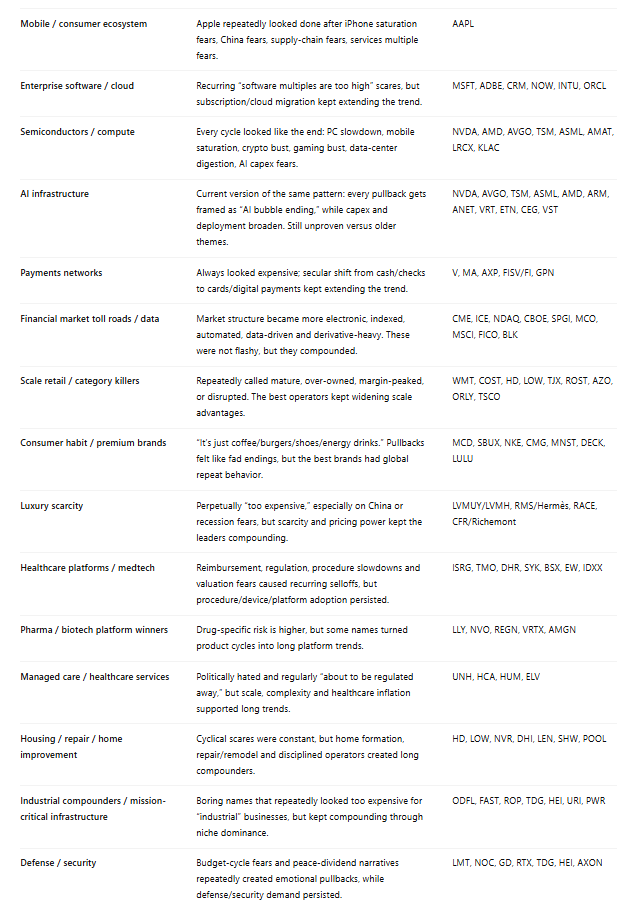
The first time you think you have missed something, when something 'already had its move', has gone too far, is too extended, too high, or too low, it is often only phase one of a much larger move.
Major trends rarely make people capitulate immediately. They unfold in waves.
First, the person who avoided the move feels smart.
Then, as the trend keeps going without them, that confidence turns into doubt.
Doubt becomes frustration.
Frustration becomes disgust.
Disgust becomes pain.
And eventually, after enough repeated confirmation, they capitulate and join the trend near the top.
"There is nothing so disturbing to one's well-being and judgment as to see a friend get rich."
– Charles Kindleberger
That rhythm is very painful but holds a core truth, when a big trend forms, when a wide array of people make money in a field or when you feel yourself pushing against an idea simply because you aren't in it...
There usually is time to join at first or there will be another opportunity.
Being able to let go of ego and join the trend despite the emotional conflict yields very big results. This is especially true for the big trends, the big themes that encapsulate years of growth. (Will this be way bigger/smaller in xyz years?)
A few examples to illustrate the point, which logically will have survivorship bias and include failures along the way. On average though, the point stands.
Overall the theme remains moat, brand power, switching costs, economies of scale, network effects.. All within real multi-year growth backwinds.
People often want the new thing while the new thing is often in one of its first phases.
a quant who started as a technical trader explained what changed everything for him
he stopped trying to predict where price goes
he started measuring the probability of each market state and betting only when the math was asymmetric
that shift took him from drawing trendlines to writing models at 22
the realization was simple but brutal: technical analysis gives you a narrative
quantitative analysis gives you a number
one feels right
the other is testable, repeatable, and either works or doesn't across 10,000 trades
the setup on his desk tells the whole story
no TradingView. no candlestick charts. just code, data, and a terminal
he didn't go to MIT
he didn't intern at Goldman
he learned Python, statistics, and probability theory on his own and built something that actually worked
> the math: free in any stats textbook
> the data: free on Yahoo Finance, FRED, exchange APIs
> the code: Python, 200 lines, running on a laptop
> the barrier: not intelligence. just knowing this path exists
most people spend years staring at indicators from the 1970s
wondering why they can't find consistency
the answer was never a better indicator
it was a completely different framework
one that treats trading as a math problem, not a prediction game
full breakdown in the video below
Jensen Huang told a room of global investors that AI is not one industry. It is five stacked on top of each other. Most people are investing in layer four and ignoring layers one through three entirely.
He called it the five-layer cake.
Layer one is energy. Jensen said this is the single greatest opportunity for the energy industry in a hundred years.
The first time in a century that the grid in most countries can actually attract serious capital. Nuclear, solar, wind, hydrogen, it does not matter what form. If it produces energy, it gets funded. Siemens, GE Vernova, Mitsubishi. That is why they are all doing so well right now.
Layer two is chips, computers, networking, and silicon photonics. Everything that processes the intelligence.
Layer three is infrastructure. Land, power, buildings, data center operations. Every single one in short supply today.
Layer four is the model layer. OpenAI, Anthropic. The layer everyone talks about.
Layer five is applications. Every startup applying AI to financial services, legal, healthcare, logistics, transportation. Last year alone, a hundred billion dollars of venture capital went into this layer. The single largest VC year in the history of humanity.
Then he said the number that stopped me cold.
We are putting one trillion dollars into this five-layer cake this year. That sounds enormous. Jensen thinks the AI industry will eventually run at twenty trillion dollars per year.
We are one trillion in of a twenty trillion dollar per year ecosystem.
Most people watching AI are staring at layer four. Jensen was describing layers one through five as a single compounding system where every layer feeds the one above it.
The people who understand that will invest differently than the people who do not.
Just finished The Market Wizards: The Next Generation. Incredible read.
Here are the top lessons that stuck with me.
-Take the first small loss. The first loss is almost always the cheapest one. The longer you wait, the more it costs you, both in money and in the mental energy spent hoping it turns around.
-Any stock can do anything. No matter how strong your thesis is, the market does not care. A stock can defy logic, fundamentals, and every chart pattern you know. Respect that uncertainty and never bet like you have it figured out.
-Being early is being wrong. You can have the right idea and still lose if your timing is off. The market can stay irrational longer than your account can stay solvent, so wait for confirmation instead of trying to predict the turn.
-Stop out quickly. When the trade goes against your plan, exit fast. Hesitation turns a small, manageable loss into a damaging one. The stop is there to protect you, so honor it.
-Try to get green as fast as possible to prove you are in the right trade.
-Focus on defense more than offense. Protecting your capital matters more than chasing big wins. You cannot make money if you blow up your account, so survival comes first and the gains follow.
-Don’t hope, just get out. Hope is not a strategy. The moment you find yourself praying a trade comes back, that is your signal to close it. Hope keeps you in losers far too long.
-Size based on how attractive the trade is. Not every setup deserves the same size. Push hard when the odds are clearly in your favor and stay small or pass when they are not. Your best ideas should carry the most weight.
-Scale back once you have made it. A common pattern among the Market Wizards: after achieving real success, many traders deliberately pull back the time and energy they pour into the markets so they can live more balanced lives. The goal was never to trade forever. It was to win and then enjoy it.
I was especially mesmerized by Simon Russo’s story.
@jackschwager@gfc4
Google's former CEO just said what everyone in AI already knows
Building wealth is getting easier if you actually learn the tools
Not by scrolling AI threads
By understanding agents, Codex Code, prompts, memory, skills, MCP, and routines
Save this before it disappears from your feed
Everything below is free:
ChatGPT basics
https://t.co/p1ZEv4vG4f
OpenAI Academy
https://t.co/5AVN9CgCZq
Prompt engineering
https://t.co/gFV0OAXnQo
GPT-5.5 prompting guide
https://t.co/TJOxZ77Y6C
OpenAI API docs
https://t.co/24OlDTxEcA
Responses API
https://t.co/DLnWfUZEUS
Agents SDK
https://t.co/irt7DTJ745
Agents SDK quickstart
https://t.co/Mm2kgeMs39
Tools + function calling
https://t.co/A40Dege36x
Structured outputs
https://t.co/Jawb4njrJa
Conversation state
https://t.co/YkbSXmUk3A
ChatGPT memory
https://t.co/ojhvlLbVWp
ChatGPT projects
https://t.co/Svo7ATFTGc
Custom GPTs
https://t.co/chrd6IBz8L
Tasks in ChatGPT
https://t.co/pIEnCC5K8F
Codex overview
https://t.co/CVPKvEz9MY
Codex quickstart
https://t.co/sKNEmSMCXF
Codex CLI
https://t.co/kUySSiEBL5
Codex GitHub repo
https://t.co/FoiGgP5ash
Codex best practices
https://t.co/E1PtLvDDaj
AGENTS.md
https://t.co/eaAJkQDp4x
Codex skills
https://t.co/OsrLujQnkX
Codex MCP
https://t.co/uHCuY9Ram7
Codex subagents
https://t.co/QboZoCEzHT
ChatGPT Apps SDK
https://t.co/keDQV4wPUp
Apps SDK quickstart
https://t.co/OYKfU6EXaW
ChatGPT developer mode + MCP
https://t.co/iUE04OldHB
OpenAI Cookbook
https://t.co/LxteqEFzWZ
All of this costs $0
Most people will keep asking AI one question at a time
Save this and start learning the stack
Starting in the near future, you will see a shift in Lanto.
I’ve found my blue print with trading for a while now.
Now it’s time to just to what I find the most fun. Content.
One thing I’ve always loved growing up, was doing content.
My initial direction in life, was me moving to LA to become a content creator.
(Obv didn’t work lol, I was also 16)
Now, thanks to trading, I can focus on that more.
Expect to see a lot more trading content to come!
Overtime, we will set the standard on that side, as we did on the trading side!
AMD CEO Lisa Su just killed Nvidia’s $4,000 AI box with a $1,499 lunchbox.
She walked on stage, held it in one hand, and ran a 235 billion parameter model live. No data center. No cloud. No rented GPU.
The chip inside is something nobody saw coming. AMD’s Ryzen AI Max+ 395 is the first x86 silicon where CPU and GPU share the same 128GB of memory. That single trick lets a desktop run models that used to need a server rack.
Out of those 128GB, Linux hands the GPU 110GB to play with. For context, an RTX 5090 gives you 32GB. A 4090 gives you 24. This box gives you more than three times either of them, in a chassis the size of a thick paperback.
The benchmark that broke the room: this chip beat an Nvidia RTX 5080 by more than 3x on DeepSeek R1 inference. A $1,499 lunchbox outrunning a $1,000 discrete graphics card on a real AI workload. Nvidia spent a decade convincing the world you needed their hardware for serious AI. AMD just put that on a desk for half the price.
Here is what nobody is telling you. A heavy AI user right now pays $200 for Claude Code Max, $200 for ChatGPT Pro, $20 for Cursor, $20 for Gemini. That is $5,280 a year leaving your account. The box pays itself off in 9 months and then runs free for the rest of its life.
Install Ollama. Pull Qwen3 235B. Point Claude Code at localhost. Same interface you already use, except now nothing leaves your machine, nothing costs per request, and no company throttles your usage at 3am when you finally have time to build.
This is the moment every AI subscription becomes optional. Lawyers stop fearing OpenAI leaks. Developers stop watching the token meter. Founders stop renting H100s for prototypes that never ship because the bill scared them.
The first thousand people to figure this out will own the next two years of private AI consulting.
Save this, and read the full breakdown article below you are watching the next shift hit before everyone else does.
Everyone obsesses over RR and win rate.
I don't.
The most important stat in my trading is MAE (Maximum Adverse Excursion).
MAE tells you the deepest drawdown a trade experiences before it either recovers or gets closed.
The real edge isn't finding more setups.
It's asking:
"How can I reduce MAE while maximizing Profit Factor?"
Lower MAE.
Higher Profit Factor.
That's where systems go from profitable to elite.
If models are too dangerous to be accessible by foreign countries than the question probably becomes are we entering an government led AI push to intelligence superiority?
This goes from military, research, medicine, economical use, and more.
Countries left behind will not have the same economical advantage that first-mover gain (switching costs, brand, resource control, network effects, data, patents..).
The AGI race works for the benefit of a country as a whole, which we briefly got a taste for through the Venezuela operation.
This is one of the most dangerous ways AI will likely grow. If more intelligence is better, than we will likely put safety aside, prioritizing having AGI in front of other countries which will do the same.
Incentives are all pointing towards a massive AGI race. I do believe it’s the nr1 biggest risk to humanity in the end, which will start by major progress in all fields but will expose us to an Ants vs Humans (humans vs AI) problem.
Barriers of safety will latest drop when people realize they’ll have to let AI loose to fend off attacks by other aggressive AIs as humans won’t be intelligent enough to do so. (You see this via recent Mythos exploits and new hacking methods found which weren’t found by humans ).
People are dismissing very real developments…