Acknowledging that specific government planners in specific cities made decisions in the 1950s and 60s that disproportionately impacted Black neighborhoods is a completely different claim from the video's framing which implies this is some ongoing systemic conspiracy that explains present day disparities and that anyone who says get over racism is ignoring it. Those are three separate leaps being presented as one continuous logical flow.
The other problem is that this line of reasoning is used to shut down any conversation about present day personal and cultural accountability by pointing at 70 year old infrastructure decisions. Even if every highway claim were completely accurate it still wouldn't explain the specific crime statistics, educational outcomes, and cultural patterns being discussed in these conversations today. Redlining ended. The Civil Rights Act passed. Affirmative action has been in place for decades. At some point the conversation has to include what's happening now and why rather than exclusively pointing backward at Robert Moses.
Documented history isn't the same as a complete explanation for everything happening in 2026 and presenting it that way is intellectually dishonest regardless of how many likes the TikTok gets.
You can think the joke was disgusting. That is completely fair. But that is still your opinion, not an objective fact everyone else has to agree with.
Dark humor exists whether people like it or not. People joke about death, war, murder, disease, religion, and every horrible thing imaginable. You are allowed to hate dark humor and think a joke is tasteless, insensitive, or unfunny. That is your right. But trying to destroy someone’s livelihood over an edgy joke online feels wildly disproportionate.
And before anyone brings up real tragedies involving specific people, there is an important distinction people keep ignoring.
There is a major difference between dark humor about a horrible subject in general and directly mocking a real person who was harmed.
If someone makes a joke about rape in the abstract, you can absolutely think it is gross or offensive. But that is not the same thing as specifically mocking an actual victim and their suffering. In the same way, making fun of a named individual who was murdered, assaulted, traumatized, or harmed is obviously more personal and malicious than a dark joke about a broader subject.
That principle should apply consistently no matter who the person is or what politics are involved. If your standard is “do not mock real victims or celebrate real suffering,” then apply that standard equally. But if your standard is simply “someone said something offensive, therefore they deserve to lose their job,” that becomes a dangerous road very quickly because eventually everyone says something offensive to somebody.
You can condemn a joke. You can think it is vile. You can call it stupid or insensitive. What you should not do is act like someone deserves to have their livelihood destroyed over an edgy joke you personally found offensive.
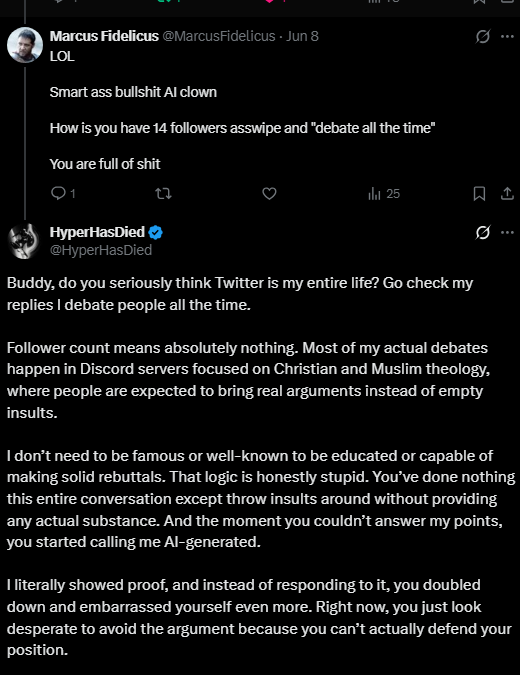
This dude’s entire playbook is just insults. I’m genuinely convinced he doesn’t even read responses. I already answered him under a different thread and he never addressed a single point I made. Eventually I lost interest in the debate because it stopped being a debate at all it was just him repeating the same talking points and throwing insults every other sentence.
I’ve debated quite a few atheists on Twitter lately, and aside from one person who actually gave thoughtful replies and engaged honestly, most of them act exactly the same. It genuinely feels manufactured. Like they all came out of the same factory with the same script and the same smug “holier-than-thou” attitude.
How do you type this stuff out with a straight face? The pattern is always identical:
**asks the exact same question with slightly different wording
throws another insult
declares victory
misrepresents the other person
refuses to engage with the actual answer**
Then when someone finally gives a real theological response, instead of engaging with it, they pivot immediately and go right back to insults.
“Look at this idiot making excuses!”
No, dude, it’s not an excuse. It’s literally part of the theology and context of the book you’re criticizing. But you people don’t actually care about context. Half the time you strip a single verse out of its chapter, ignore the surrounding passages, and then pretend you’ve dismantled an entire religion because of one out-of-context line you saw in a Twitter screenshot. It's like talking to a brick wall.
https://t.co/bBFH59rjXA
Sorry I had work, unlike some people apparently who have been refreshing my thread all day waiting to declare victory on a question I answered three times.
You're still asking what the children did to deserve to die as if I haven't answered that repeatedly. So one final time. They didn't do anything. That's the point you keep missing because you're not actually listening and clearly don't care. Death in Christian theology isn't punishment for personal sin in every instance. God is the author of life and every human being dies. The Egyptian children weren't condemned to hell, they weren't being tortured, they weren't suffering eternal separation from God. They died. Which every single one of them was going to do anyway. You're treating death as the ultimate evil because your materialist framework has nothing beyond it. Christian theology fundamentally disagrees with that premise and you screaming the question louder doesn't make your framework the correct one for evaluating the answer.
And you still haven't answered the grounding problem. Not once. You've been asserting that conscious suffering just objectively matters, couldn't explain why, called me AI, blocked me, unblocked me, and have now posted multiple times calling me a loser while the actual philosophical question sits completely untouched.
Everyone reading our threads watched you rage quit, come back, and then declare victory for asking the same question repeatedly while ignoring every answer.
Also the endless dipshit and clown routine is genuinely strange. I get that it plays well for the crowd that already agrees with you and maybe it gets a reaction out of people you can screenshot and use to make them look bad. But you're clearly not a stupid person and you could have just said something like "clearly you haven't grasped what Christian theology actually claims here" rather than spending half the conversation on insults. At least it would have looked like you came to debate rather than perform.
@punchkicker2017 Woah dude, you are a piece of work. I'd genuinely love to have a deep debate with you if you can actually engage with it, but I have work right now. I'll give a proper response once I get out so I can sit down and respond thoughtfully.
I did respond before seeing everything. And honestly you're one of the more consistent people in this thread because you're not pretending to have objective moral ground while secretly standing on it. You're just a genuine moral nihilist and you own it which is more than most people manage.
Where I'd push back one final time is that there's a difference between understanding a position intellectually and actually living it. You clearly care about this conversation enough to be in it. You have real reactions to things you consider wrong even while acknowledging the universe doesn't care. That tension between what your philosophy says and how you actually move through the world is worth sitting with at some point. Not as a gotcha, genuinely. Because most people who arrive at hard nihilism don't stay there once they actually follow it into their own life rather than just their debate replies.
But I'm not going to keep hammering someone who's being straight with me. I 100000% respect you for actually having a consistent position I don't see many people have that.
Just got blocked by @MarcusFidelicus after dismantling every argument he made. No gods needed for morality he said, then couldn't explain why conscious suffering has objective moral significance beyond just asserting it does. Called me AI when the responses got too detailed to dismiss, then blocked me before I could respond.
This is what it looks like when someone who built their entire personality around being the "smart" atheist guy runs into an actual argument they can't meme their way out of. Called me dipshit and clown about fifteen times, contributed zero philosophical substance, and rage quit the conversation he started. The irony of someone who mocks religious people for having faith making a blind faith assertion that conscious suffering just objectively matters and then blocking anyone who asks why is genuinely something. If anyone was in that thread feel free to keep going, I'm still here.
Fair enough, at least you're being consistent which is more than most people in these conversations manage. You're a genuine moral nihilist and you're owning it rather than pretending you have objective ground to stand on while secretly borrowing from a framework you've rejected. That's intellectually honest in a way that most atheists in these debates aren't you have my complete respect.
But to me where it still falls apart practically. You're in this conversation. You're arguing. You're pushing back. You're clearly invested in whether these ideas are right or wrong. If the universe genuinely doesn't care and morality is just opinion all the way down then this entire conversation is just two arrangements of matter exchanging noise that means nothing beyond what we personally feel about it. You can't simultaneously believe that and care enough to spend this much time on it.
And the history is written by winners point actually proves too much. You've essentially said that moral reality is just whoever has the most power at any given moment. Which means right now the moral consensus that the Holocaust was evil exists purely because the Allies won. Not because six million people were actually wronged in any real sense. Just because the winning side wrote it that way. If you're genuinely comfortable sitting with that conclusion then fair enough. Most people aren't when they actually think it through rather than stating it as a clever debate point.
You think the Holocaust was wrong. That's your opinion. But you feel it as more than an opinion and that gap between what your philosophy says and what you actually feel.
You've just added more ingredients to the same dish and it still doesn't taste like objective morality.
Empathy plus survival plus opinions. Okay. But empathy is selective and varies between individuals and cultures. Survival instincts produced the Holocaust. And opinions are by definition subjective. You've taken three subjective inputs, combined them, and are presenting the output as something more stable than any of its components. That's not how that works. Adding three rivers of subjectivity together doesn't produce a lake of objectivity.
And you already conceded the fatal point without realizing it when you said you can call the Nazis evil because you don't identify with them. That means if your empathy, survival instincts, and opinions happened to align with Nazi ideology you'd have no basis to call it evil. The only thing separating your moral condemnation of the Holocaust from someone else's moral endorsement of it is which group you happened to be born into and which opinions and empathies you happened to develop. That's not morality. That's just circumstance.
The deeper problem is that you clearly do believe some things are genuinely wrong regardless of what any group thinks about them. I can tell because you're in this conversation arguing about it rather than just shrugging and saying well that's their subjective framework. Something in you insists that certain things are actually wrong not just unpopular. That instinct is pointing at something your philosophical framework can't account for and the honest move is to follow it rather than keep defending a position you don't actually live by.
Brother you've been asking this question over and over and getting the same answer you keep ignoring so let's try one more time.
You're asking me to justify child death using a moral framework you've spent this entire conversation telling me doesn't exist. You told me morality is just conscious suffering mattering, couldn't ground why it matters objectively, and now you're demanding I answer your moral question as if we share a framework. We don't. You abandoned yours and never replaced it with anything that actually works.
But within the Christian framework you're asking about, God is the author of life itself. Every human being that has ever lived has died. Every single one. The question isn't whether death happened, it's what death means and in Christian theology it isn't the ultimate evil you need it to be for this argument to land. Those children weren't condemned. They weren't tortured for eternity. They died, which is something every Egyptian child was going to do anyway, in the context of a civilization that had been systematically murdering Hebrew children for decades.
You want a specific answer so here it is. Within Christian moral theology God doesn't require justification for death the way a human murderer does because God isn't taking something that didn't already belong to him. That's not a comfortable answer for modern sensibilities but it's the actual theological position and you've been demanding the actual theological position for days.
What I'm still waiting for is your answer. You've called God a child killer using a moral framework you can't ground. So tell me specifically, using your framework, why the death of those children was objectively wrong rather than just something you personally find upsetting. That question has been sitting here the entire time.
No Christian follows Mosaic civil law and hasn't for two thousand years. The New Testament couldn't be more explicit that the old covenant was fulfilled in Christ. Hebrews, Galatians, Acts 15, this isn't a modern dodge invented to avoid uncomfortable questions, it's what the text has said since the first century. If you think Christians are supposed to be consulting Leviticus before purchasing servants you fundamentally don't understand the religion you're mocking and that's a pretty significant gap when your whole contribution to a thread is mocking it.
The slavery regulations you're sneering at also existed in a world where slavery was universal across every culture on earth and the alternative wasn't abolition, it was the same institution with zero protections. Kidnapping someone into slavery was a capital offense in Exodus 21. Servants were freed after seven years. Masters who injured slaves had to release them. You've taken ancient near eastern legal code that was pushing toward greater humanity in its historical context and presented it as if it's a divine endorsement of antebellum plantation slavery. Those aren't the same thing and you know it.
Come back when you have something original.
This is actually a more honest position than most people in these conversations are willing to take and I'll give credit for that. You're not pretending morality is objective while refusing to ground it. You're just saying it's subjective all the way down and owning it. But that position has a consequence I don't think you have fully reckoned with.
You said you can call the Nazis evil because you don't identify with that group but the group of humans as a whole. So evil just means what the majority of humans don't identify with. That's it. That's your entire moral framework. Which means if the Nazis had won, successfully indoctrinated enough of humanity, and become the dominant human group, then the Holocaust wouldn't have been evil anymore. Not because anything changed about what happened to the victims but because the identification shifted. You've made morality a popularity contest and called it a philosophical position.
Your point about moral questions having objective answers is actually interesting but it concedes more than you realize. If some moral questions have objective answers then there are moral facts. And if there are moral facts then the question of what grounds them is exactly the one we've been having this whole time. You can't have objective moral answers floating free without anything anchoring them.
And your last point, why do moral intuitions need to track something real if nobody can prove it is the most revealing thing you've said. You've just admitted that if morality is purely subjective then there's no actual difference between a society that tortures children for fun and one that doesn't, just different preferences. You clearly don't believe that in practice. The fact that you called the Nazis evil even under your own framework shows you believe some things are genuinely wrong rather than just unpopular. That gap between what your philosophy says and what you actually believe is exactly where the real conversation lives.
Sorry I had work, unlike some people apparently who have been refreshing my thread all day waiting to declare victory on a question I answered three times.
You're still asking what the children did to deserve to die as if I haven't answered that repeatedly. So one final time. They didn't do anything. That's the point you keep missing because you're not actually listening and clearly don't care. Death in Christian theology isn't punishment for personal sin in every instance. God is the author of life and every human being dies. The Egyptian children weren't condemned to hell, they weren't being tortured, they weren't suffering eternal separation from God. They died. Which every single one of them was going to do anyway. You're treating death as the ultimate evil because your materialist framework has nothing beyond it. Christian theology fundamentally disagrees with that premise and you screaming the question louder doesn't make your framework the correct one for evaluating the answer.
And you still haven't answered the grounding problem. Not once. You've been asserting that conscious suffering just objectively matters, couldn't explain why, called me AI, blocked me, unblocked me, and have now posted multiple times calling me a loser while the actual philosophical question sits completely untouched.
Everyone reading our threads watched you rage quit, come back, and then declare victory for asking the same question repeatedly while ignoring every answer.
Also the endless dipshit and clown routine is genuinely strange. I get that it plays well for the crowd that already agrees with you and maybe it gets a reaction out of people you can screenshot and use to make them look bad. But you're clearly not a stupid person and you could have just said something like "clearly you haven't grasped what Christian theology actually claims here" rather than spending half the conversation on insults. At least it would have looked like you came to debate rather than perform.
You held the racism "equal" and changed only one thing, the population ratio, and concluded the minority suffers more. Fine. Probably true as far as it goes. But notice what you actually demonstrated. The harm tracks being outnumbered. It does not track being any particular race. In your own scenario the white people have it worse for one reason only, that they're the minority. Race dropped out of your argument the second you made the ratio the deciding factor. What you've really argued is that in any society the minority bears the heavier cost of mutual prejudice. That's a claim about minorities, full stop.
Then you try to land it on actual America by saying Black Americans are "vastly outnumbered." But that's the sleight of hand, because now you need the real numbers instead of your 98 to 2. And if being outnumbered is the metric, your own framework ranks Asian Americans, Native Americans, Jewish Americans and every smaller group as suffering worse racism than Black Americans. I doubt that's the flag you want to plant.
Here's the part you skipped past. You conceded the prejudice is equally wrong. Good. That's the actual moral question and we agree on it. What you added is a claim about consequences, and then you quietly relabeled it as a claim about which racism is worse. Those are not the same thing. The wrongness of a racist act lives in the act and the heart behind it, not in a census. A man who hates his neighbor over the color of his skin is doing the identical evil whether that neighbor is 2 percent of the country or 98 percent of it.
And the deeper problem is this. The whole exercise of ranking racisms by demographic share is the racist move in miniature. It treats people as units of a bloc instead of as individuals. The entire case against racism was always that you judge the man, not the group he was sorted into at birth. Your framework requires the sorting. You've just bolted a scoreboard onto it.
Four times. Four separate times I've laid out the necessary versus contingent distinction, explained why before doesn't require temporal sequence, shown you mathematical and logical examples where before operates with zero reference to time, and pointed out that modern cosmology itself agrees that time had a beginning. You've responded each time by typing the same sentence slightly louder.
That's not debate. That's not skepticism. That's not the brave rational free thinking you think it is. That's just a person who walked into a conversation with their conclusion already written and has been auditioning for the role of someone who won ever since.
You haven't moved the argument one inch. You've just orbited it repeatedly while calling it names and apparently that's enough for you to declare victory which is honestly the funniest thing about this whole exchange. The guy who mocks religious people for believing things without evidence is out here believing he won a debate without providing a single substantive response to anything said to him.
Some conversations are worth having. Some people are genuinely wrestling with hard questions and deserve real engagement. You're not one of them. You decided before you typed your first reply and nothing was ever going to change that. So yeah, take the win, sleep well, touch grass, whatever you need. The argument is still there whenever you eventually feel like actually engaging with it.
You've been given the same answer multiple times now and each time you've responded by repeating yourself with slightly more capitalization.
But let's actually do this one final time with complete clarity.
Isaiah 44:6. God says he is the first and the last and besides him there is no God. Not he arrived first on a pre-existing timeline. He IS the first. The alpha point of existence itself. That's an ontological claim about the nature of being not a timeline admission.
You're insisting that the word before requires a temporal framework. But you haven't argued for that. You've just asserted it repeatedly. Meanwhile I've shown you three concrete examples, mathematical ordering, logical ordering, ontological ordering, where before operates completely independently of time. You haven't addressed a single one of those examples. Not one. You came in claiming the cosmological argument creates infinite regress. It doesn't because it specifically applies only to contingent beings. You came in claiming Isaiah admits God is contingent. It doesn't because the language is establishing ontological supremacy not temporal sequence. You've had both of these responses multiple times and your entire reply each time has been to restate your original claim in slightly different words.
At some point repeating an assertion doesn't make it an argument. You've had four chances to engage with the necessary versus contingent distinction and you've ignored it every single time.
No it doesn't and this is demonstrable without any theology at all.
In mathematics we say two comes before three. That's not a temporal claim. Two didn't exist at some earlier point in time before three showed up. It's a statement of logical and ontological ordering that has nothing to do with time.
In logic we say premises come before conclusions. That's not temporal either. The premise doesn't exist at an earlier moment in time than the conclusion. It's prior in the order of reasoning not in the order of events.
Before has multiple meanings in the English language and in philosophical discourse specifically. It can mean temporally prior, logically prior, or ontologically prior. Classical theism uses it in the ontological sense meaning God is the ground upon which everything else depends for existence. Not that he showed up earlier on a pre-existing timeline.
And here's what makes your position particularly difficult. You're insisting that before always requires time. But time itself began to exist. Modern cosmology is explicit about this. The Borde Guth Vilenkin theorem demonstrates that any universe with an overall positive expansion rate must have had an absolute beginning including time itself. So if before always requires time and time itself had a beginning then your question what came before God simply has no coherent meaning. You've inadvertently argued that the question you're asking can't be asked.
You're not catching Christianity in a contradiction. You're revealing that you haven't thought carefully about what time actually is.
You've now said the same thing three times without addressing the response once so let me be as clear as possible.
Before does not require time. This is not a complicated point. It's a basic philosophical distinction that anyone engaging seriously with the cosmological argument has to grapple with. Saying God existed before creation doesn't imply a temporal framework within which God was preceded by something else. Time itself is a feature of the physical universe. Before the universe existed there was no time. Augustine established this in the 4th century and modern cosmology actually agrees with him. Stephen Hawking and Roger Penrose's singularity theorems demonstrate that time itself began at the Big Bang. So asking what existed before God in a temporal sense is asking what happened before time existed which is a category error not a theological gotcha.
The phrase in Isaiah is establishing ontological priority not temporal sequence. God is before all things in the sense that everything else depends on him for existence not in the sense that he showed up earlier on a timeline that was already running. You keep insisting it's a temporal admission because that's the only reading that produces the conclusion you want. But that's not what the text says and it's not what classical theism has ever claimed.
You've been given the necessary versus contingent distinction three times now. A necessary being has no beginning and requires no cause. Your response has been to repeat your original claim with slightly different emphasis each time. That's not an argument. That's just stubbornness dressed up as philosophy. Deal with the actual distinction or concede you can't.