We welcome today’s CFTC actions: approval of the first U.S.-listed perpetual derivatives contract, an accompanying Commission policy statement on the listing of perpetual derivatives, related interpretive guidance and no-action relief from the Market Participants Division, and a Staff Advisory on 24/7 Trading, Clearing, and Settlement, as a long-overdue acknowledgment that perpetual derivatives are a legitimate and essential tool for price discovery and risk management.
For too long, regulatory ambiguity drove these markets offshore, depriving American traders and institutions of access to regulated venues and undermining U.S. competitiveness in the global derivatives markets.
Today’s actions chart a new path forward. We look forward to engaging closely with the Commission to ensure that the framework it develops is workable not only for centralized intermediaries, but for the onchain protocols where the most significant perpetuals activity actually occurs.
I spent the past few days in Washington with @hyperliquidpc meeting with policymakers during the historic advancement of the Clarity Act. We discussed Hyperliquid, the benefits that it offers to American consumers, and the regulatory path to bring onchain derivatives markets into the United States.
Some conversations were technical with an impressive baseline understanding of Hyperliquid. Discussions included how onchain trading is a financial innovation that has clear global user demand. Other conversations focused more on a first principles introduction to defi and the promise of onchain markets. It was encouraging to see bipartisan support for thoughtful regulation of crypto. I look forward to continuing discussions in DC and working hard to make American access to Hyperliquid a reality.
Today, Bloomberg reported on certain incumbent traditional exchanges raising concerns about the integrity and impact of markets for perpetual derivatives on Hyperliquid.
These concerns are unfounded.
Hyperliquid offers enhanced market transparency, publishing a complete onchain record of every transaction in real time, making it a uniquely hostile environment for insider trading or price manipulation. Hyperliquid’s transparency serves as a strong deterrent for misconduct and facilitates surveillance, detection, and investigation by regulators and law enforcement.
Hyperliquid also offers 24/7 trading, an innovation that substantially increases market efficiency. Prices move whether traditional exchanges are open or not. Continuous trading eliminates gaps and discontinuities between legacy market hours, improving price discovery for all participants.
Bloomberg correctly reports that U.S. law is not currently tailored for derivatives markets on public blockchains like Hyperliquid. We look forward to continuing our work with policymakers in Washington to bring onchain markets inside the regulatory perimeter.
The bipartisan passage of the Clarity Act out of the Senate Banking Committee is historic: the first time a comprehensive crypto market structure bill has advanced to the Senate floor.
We appreciate all of the effort that went into this success, but more work is needed before the bill is ready to become law. We look forward to engaging on Capitol Hill and with the administration as the process continues.
HPC strongly supports @ChairmanSelig's vision for the future of onchain markets:
“I think it’s really critical that we set in place clear regulations and clear statutory protections for software developers, for people who hold their own crypto assets through self-custody or using a custodial wallet, exchanging your assets... That’s what this administration is really focused on.”
Clear rules protecting developers and self-custodial users are the foundation of any workable framework for onchain markets.
Americans deserve future‑proof digital asset market structure legislation that protects their right to self-custody crypto assets and transact peer-to-peer using blockchain networks.
More on @1MarkMoss:
Today, @SECPaulSAtkins laid out his priorities for providing clarity to onchain markets, including this on clearing and settlement:
"When settlement is near-instantaneous and counterparty risk is managed algorithmically, the traditional clearing agency model requires fresh analysis."
Onchain clearing and settlement is one of the most significant financial infrastructure innovations of our generation.
HPC is encouraged to see a Chairman willing to map these systems to existing legal frameworks on their own terms, rather than force them into legacy categories built for legacy architecture.
Prediction markets work better onchain.
Our comment letter to the @CFTC explains why, and makes the affirmative case for a pathway for Americans to access decentralized prediction markets.
Read about HPC’s submission here:
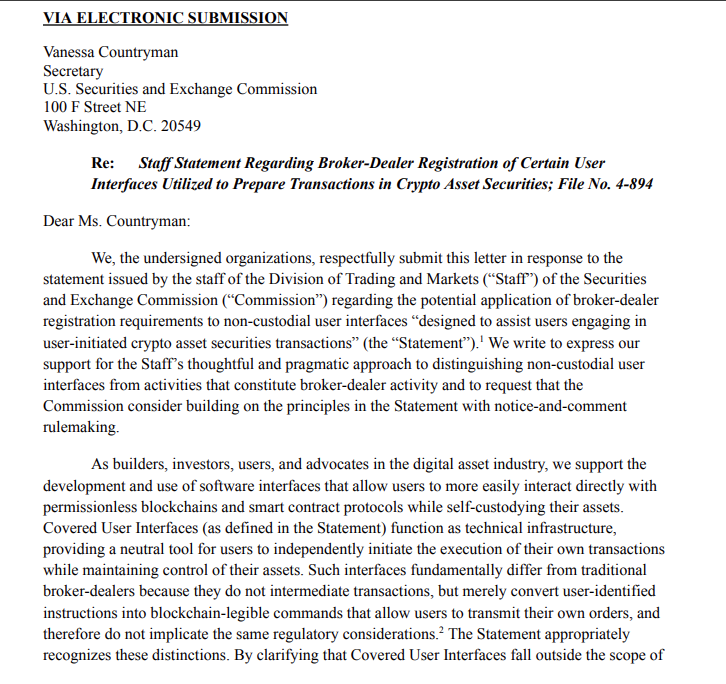
Today, DEF (@fund_defi) asked the SEC to codify the recent staff guidance on front-end interfaces and wallets through rulemaking.
@HyperliquidPC strongly supports that effort.
Here's what the statement says and why it matters for Hyperliquid. 🧵
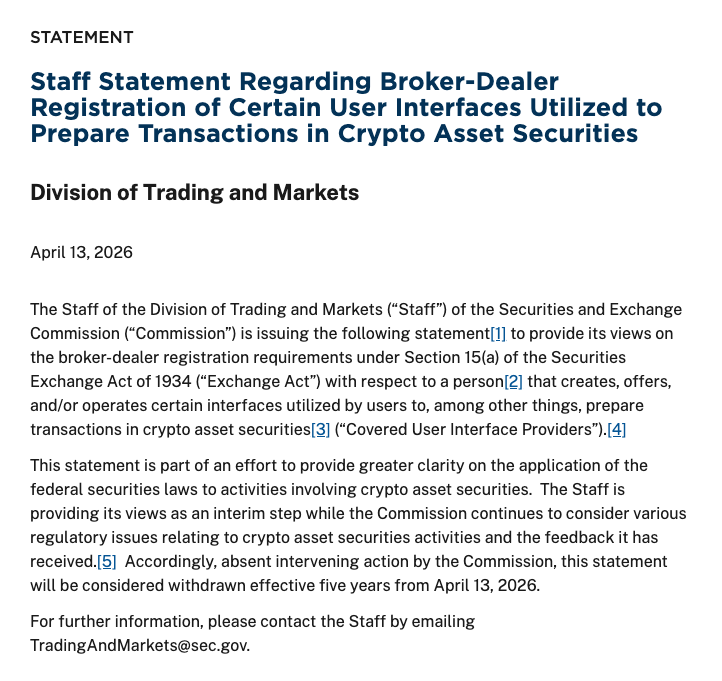
Non-custodial front-end interface providers are not brokers, as the SEC rightly clarified in its excellent Staff Statement on April 13.
Today, HPC joined DEF (@fund_defi) and dozens of others in requesting that the SEC formalize that Statement in notice-and-comment rulemaking.
The SEC took an important step on UIs - and now we’re asking them to lock it in.
On April 13, 2026, the SEC published a staff statement with a thoughtful, practical approach for distinguishing non-custodial user interfaces from activities that constitute broker-dealer activity.
DEF and 35 industry leaders are now requesting the SEC formalize the principles in the statement in notice-and-comment rulemaking, so we have durable regulatory clarity that lasts.
Onchain perpetuals are the next evolution in derivatives markets, but U.S. law provides no pathway for Americans to participate.
HPC exists to change that.
Read more about our mission to advance new rules for decentralized markets in the United States:
Hyperliquid entered the Congressional record for the first time today.
@ChairmanSelig testified before the House Agriculture Committee and received a question about "decentralized exchanges like Hyperliquid."
He said:
"[O]ur goal is always going to be to onshore those markets and to have the markets subject to our regulation here in the United States and accessible to our U.S. persons here in the U.S. ..."
We appreciate Chairman Selig's commitment to ensuring Americans can benefit from decentralized markets. It will take some effort to adapt the commodities laws, but we're confident this CFTC and its capable staff are up to the task.
HPC commends the SEC Staff and the Crypto Task Force for today's staff statement on front-end interfaces and broker-dealer registration. This is an important step toward regulatory clarity for crypto builders and market participants.
The guidance reflects a commonsense principle: software developers who do not perform the customary functions of intermediaries should not be regulated as such.
We look forward to continued engagement with the Commission on these issues.
NEW 🚨: As part of Project Crypto, the Division of Trading and Markets issued a staff statement providing its views on broker-dealer registration requirements in connection with certain interfaces used to prepare transactions in crypto asset securities.
https://t.co/8jCwFOJZcw
Treasury Secretary @SecScottBessent is absolutely right:
"There is one way to give developers and entrepreneurs the comfort to reshore: durable law. Congress acted decisively with Genius, and the Clarity Act is the necessary next step."
Congress has spent the better part of half a decade trying to pass a framework to onshore the future of finance.
It is time for @BankingGOP to hold a markup and send the CLARITY Act to President Trump’s desk.
Senate time is precious, and now is the time to act.
Years ago, the CFTC was suing DeFi protocols. Now, @ChairmanSelig is championing what permissionless networks and onchain systems can do for the future of American finance.
That vision, paired with the rules to match, is what will make America the crypto capital of the world.
Current financial systems are outdated, and blockchain networks are exactly what we need to bring it into the 21st century. Decentralized applications and systems will help America return to the era of creativity and endless possibility, and under my leadership at the @CFTC, we’re committed to turning that into reality.
"What we need to do is upgrade the laws and regulations in the US so that Americans, individuals and institutions, can trade on Hyperliquid." - @jchervinsky
Real-world assets on-chain with @HyperliquidX
"We used to say that someday, real-world assets are going to trade on-chain - well, it's happening. Real-world assets trading 24/7. Our view is within a few years, every asset is going to be trading on-chain."
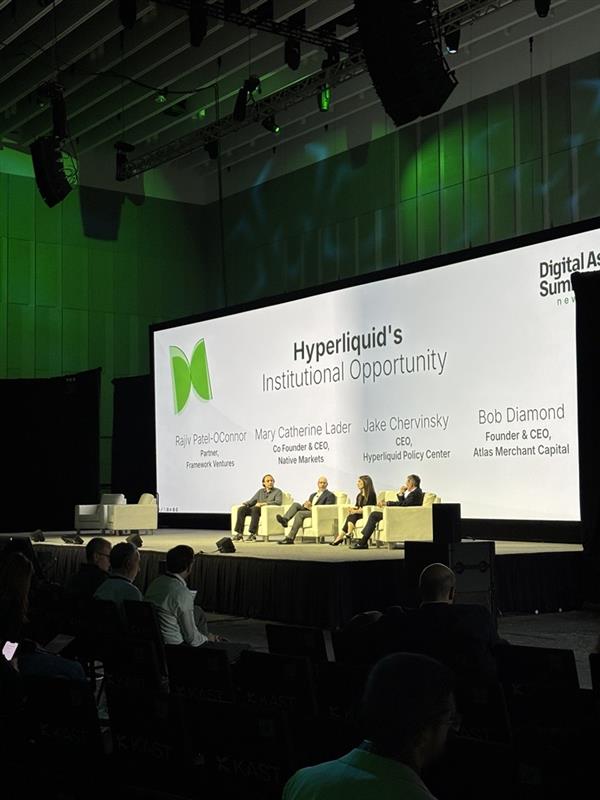
$HYPE at @Blockworks Digital Asset Summit today.
"We need to upgrade the laws and regulations in the US so that Americans — individuals and institutions — can trade on Hyperliquid."
@jchervinsky@HyperliquidPC
CFTC @ChairmanSelig laid out an exciting roadmap for the Commission's top priorities at @MilkenInstitute's Future of Finance 2026 today:
"I view Project Crypto as a historic initiative between the agencies to upgrade and modernize our rules and regulations and future-proof them for technologies like crypto...."
"Many of the firms want to move onchain. The prior administration drove a lot of these firms and the liquidity offshore. The perpetuals markets are a great example of this. We've had perpetual futures contracts in crypto assets for a very long time[,] but they've developed offshore[.] We've got to bring that back to the United States. We need to have that liquidity here in the U.S...."
"We're working towards getting perpetual futures, true perpetual futures, not long-dated contracts, here in the U.S. within the next month or so.... We're also working towards onchain markets, so we're looking to have clear guidance as to what sort of digital wallets would implicate our regulations. The prior administration really went after firms that were just offering software products...."
"We're also working towards regulations that accommodate onchain software systems, so decentralized finance protocols and other types of blockchain networks.... We're going to make sure it's very clear as to what implicates the CFTC's regulations and what doesn't, and to the extent that an onchain software system or front-end does implicate our rules or regulations, we're modernizing and future-proofing those rules so that there's a place for all of that."
HPC applauds Chairman Selig's forward-thinking approach to regulation and stands ready to support his crucial work ensuring that decentralized markets for perpetual derivatives thrive in the United States. 🇺🇸