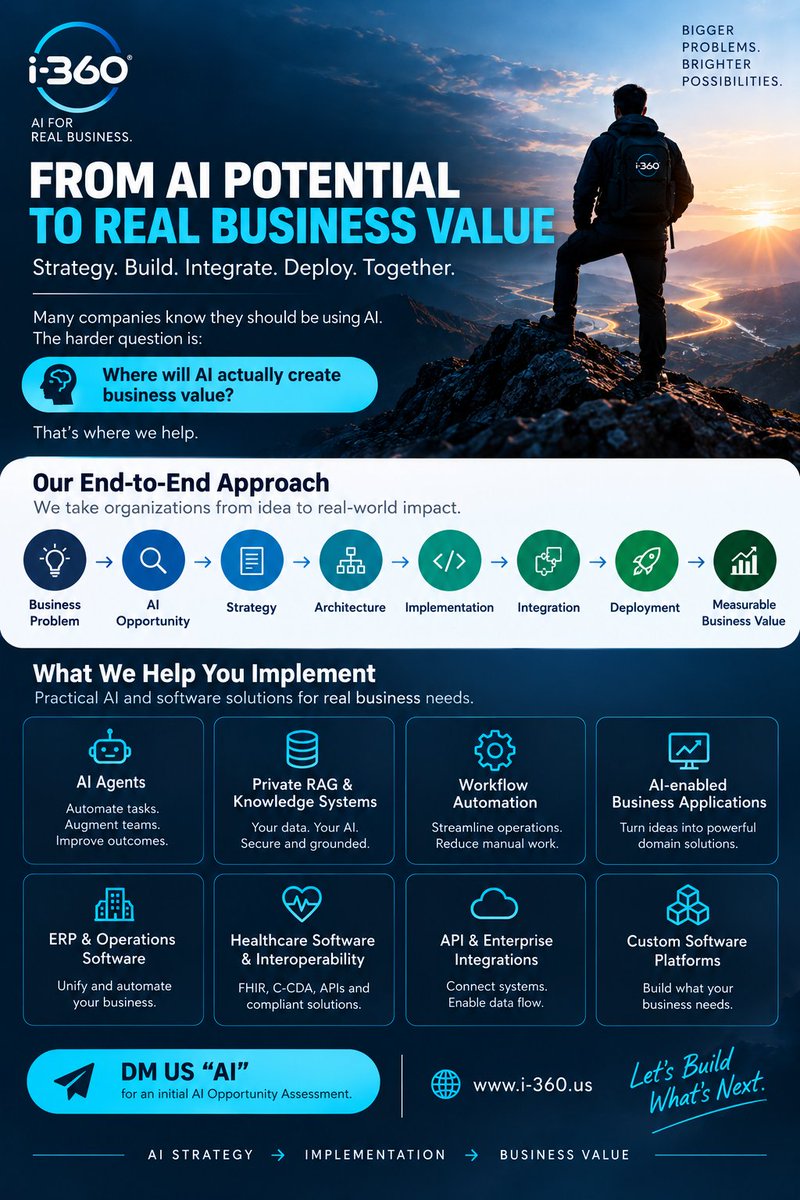
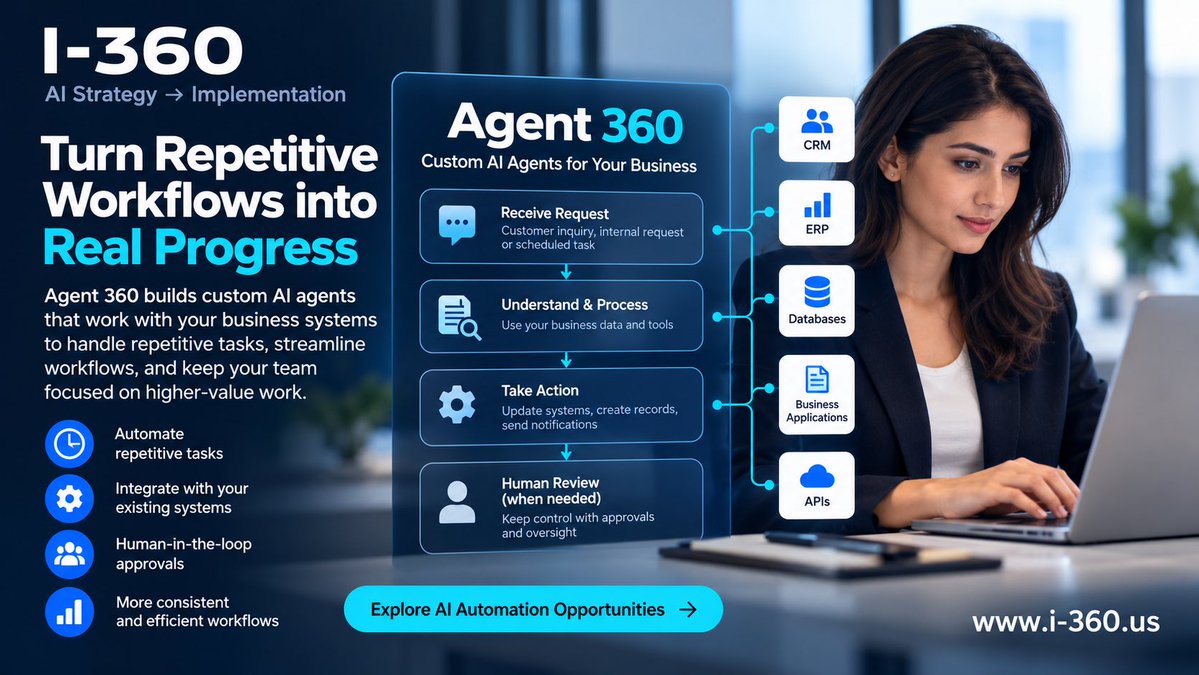
Most companies know they should be using AI.
The real question is:
Where will AI create measurable business value?
At i-360, we take businesses from:
AI Strategy → Architecture → Implementation → Integration → Deployment
We build:
• AI Agents
• Private RAG systems
• Workflow Automation
• AI-enabled applications
• ERP & enterprise software
• Healthcare & interoperability solutions
We don’t stop at strategy.
We build and deploy the solution.
Want to identify where AI can create value in your business?
DM us “AI” for an initial AI Opportunity Assessment.
🌐 https://t.co/SpXYheLvek
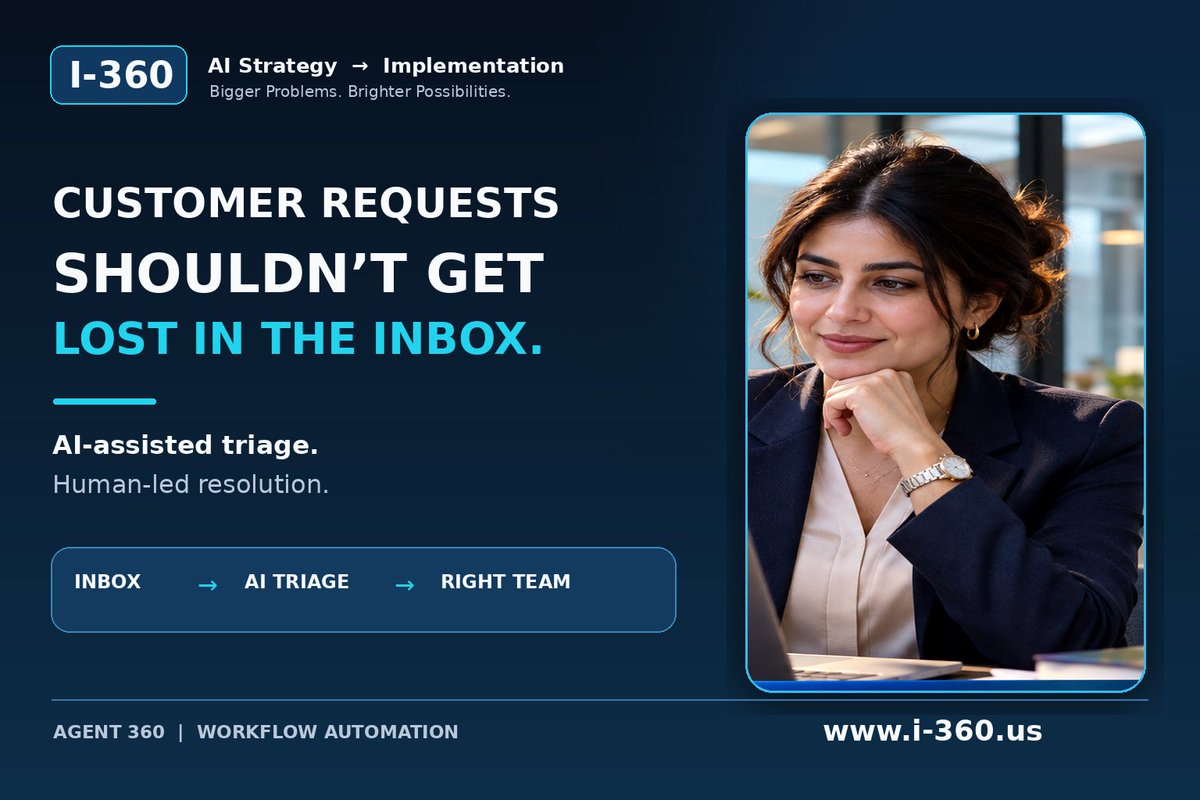
A customer complaint reaches the right person—three days after it arrived.
The issue may not be a shortage of staff. It may be the journey from a shared inbox to the person who can actually resolve the request.
Consider a growing service business handling customer emails, website forms, and support tickets. Teams manually classify requests, ask for missing details, and forward messages between departments. Urgent cases can sit beside routine questions without clear ownership.
An AI-assisted workflow could identify the request type, gather missing information, suggest the appropriate team, and flag time-sensitive cases. Employees would still review sensitive responses and approve consequential actions.
The value is not replacing your support team. It is helping them spend less time sorting messages and more time resolving customer problems.
At I-360, we approach Agent 360 and custom AI agent development through process analysis, system integration, permission controls, human oversight, and practical implementation.
Before adding another chatbot, ask: where do customer requests lose momentum?
Explore a Free AI Automation Gap Assessment at https://t.co/N2LSo0QqQE.
#AIAgents #CustomerExperience #WorkflowAutomation #EnterpriseAI
Would your finance team paste next quarter’s pricing strategy into a public AI tool to get a faster answer?
Many organizations want AI to analyze contracts, procurement policies, and internal reports. But the first design decision isn’t which model sounds smartest. It’s where sensitive information travels, who can access it, and what gets retained.
A self-hosted language model can be one option. Deployed on infrastructure the organization controls, it can support document Q&A, drafting, or internal analysis without automatically routing every request to an external model provider.
I-360 helps assess private AI architecture, local LLM deployment, and integration with existing business systems. We examine data classification, access controls, network egress, logging, updates, model performance, and operational ownership before recommending a setup.
Local does not mean risk-free. A poorly configured server, an unnecessary plugin, or permissive user access can still create exposure.
The business objective is practical: give teams useful AI capabilities while making deliberate choices about confidentiality, governance, and cost.
Evaluating on-premises AI? Discuss a Private AI Deployment Assessment with I-360.
https://t.co/N2LSo0QqQE
#PrivateAI #DataGovernance #EnterpriseAI
A clinician reviews a draft SOAP note. Can they quickly tell which details came from the conversation—and which need another look?
That distinction matters when healthcare teams evaluate AI documentation tools. Speed alone is not enough. Clinicians need a clear review process before information becomes part of a signed record.
This Sunday, we’re spotlighting Clinic 360 / CDOC 360, I-360’s AI-assisted clinical documentation workflow.
In a product walkthrough, an encounter recording becomes a transcript, which can be used to prepare a structured SOAP draft. The clinician reviews the content, makes corrections, and can use optional checks to flag potentially missing details or conflicts against the transcript. Reviewed and signed versions support a traceable documentation process.
These checks are aids, not clinical verdicts. The provider remains responsible for verifying accuracy and approving the final note.
For healthcare leaders, the opportunity is to assess whether this workflow can reduce repetitive documentation effort without compromising oversight.
Interested in seeing the review-and-approval journey? Request a Clinic 360 demonstration.
https://t.co/N2LSo0QqQE
#HealthcareAI #ClinicalDocumentation #HealthIT
Your AI pilot answered the demo questions. Can it handle a real Monday morning?
A promising proof of concept can still fail when it meets incomplete records, changing permissions, slow APIs, and the exceptions employees deal with every day.
For business leaders, that gap matters more than a polished demonstration. A pilot only deserves further investment when it tests the conditions under which the solution would actually operate.
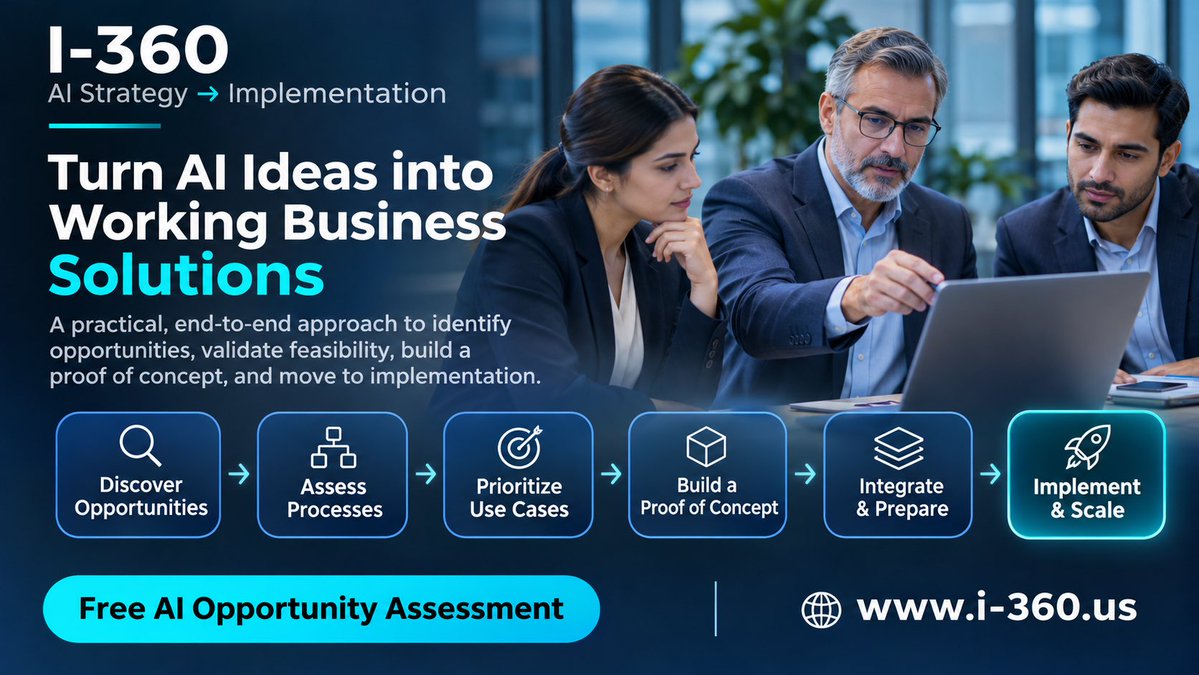
I-360 helps organizations move from AI strategy to implementation by defining a bounded use case, identifying integration dependencies, and agreeing on practical acceptance criteria before development expands.
Consider an AI assistant that prepares responses to customer inquiries. A useful pilot should test whether it can retrieve approved information, recognize unanswered questions, respect user access, and hand uncertain cases to a person. It should also measure response quality, processing time, and operational effort against the current workflow.
The result is a more informed build-or-stop decision—not a promise that every AI idea belongs in production.
Have an AI pilot that needs a realistic implementation plan? Start with a Free AI Opportunity Assessment.
https://t.co/N2LSo0QqQE
#AIStrategy #AIImplementation #EnterpriseAI
Has your organization developed an AI prototype that demonstrated potential but never reached production? What is holding it back: integration complexity, data readiness, operational ownership, or implementation costs?
A patient is referred to a specialist. Why does the receiving team still have to reconstruct the clinical story?
When referral details, medications, laboratory results, and visit notes sit in different systems, staff may spend valuable time requesting records and reconciling information. Delays and incomplete context can complicate care coordination.
Interoperability is more than sending a file. The receiving system needs information in a usable format, with appropriate patient matching, permissions, and clear handling of missing or conflicting data.
Standards such as HL7 FHIR and C-CDA can support structured exchange, but integration design must reflect the actual referral workflow. Clinicians still need to validate information before relying on it for care decisions.
At I-360, we help healthcare organizations plan and implement EHR/EMR integrations, healthcare APIs, and interoperable clinical workflows—from requirements and architecture to development and testing.
The business opportunity is a more connected process, with less manual chasing and better access to relevant information.
Where does information exchange slow down your referral process?
Explore I-360 healthcare integration services at https://t.co/N2LSo0QqQE.
#HealthcareInteroperability #FHIR #HealthIT #HealthcareIntegration
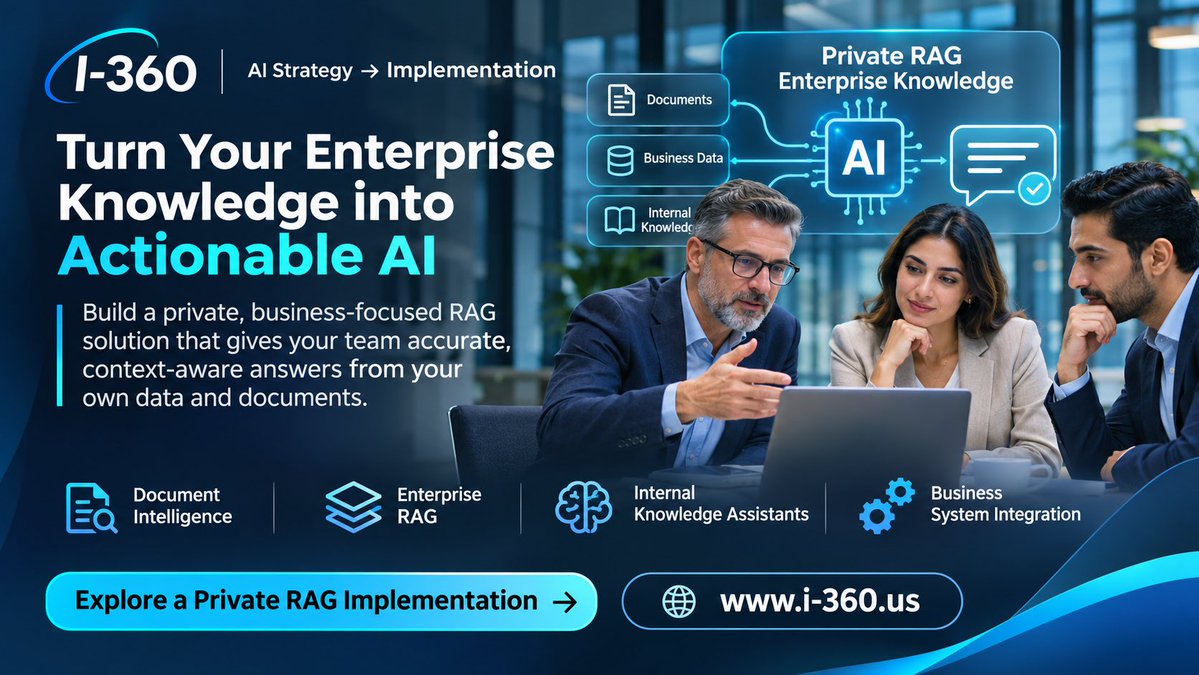
Would your organization benefit from AI-assisted analysis of confidential contracts, financial documents, or internal knowledge without relying entirely on externally hosted AI services?
A useful AI answer can still be the wrong answer to share.
Imagine a regional sales manager asking an internal assistant about a customer contract. The assistant finds the latest document—but it also retrieves confidential pricing terms intended only for finance and legal.
The retrieval worked. The access control failed.
For executives considering private enterprise AI, that distinction matters. Connecting documents to an AI model is not the same as designing a governed knowledge system.
A practical rollout should define who can access each source, how permissions carry into retrieval, which documents are approved, and how responses can be traced back to evidence. Teams also need a process for revoking access when roles or policies change.
With Wisdom 360 and our private RAG development services, I-360 helps organizations plan these controls alongside knowledge ingestion, solution architecture, integration, and deployment.
The business objective is straightforward: make useful information easier to find without widening access beyond what employees are authorized to see.
Before connecting your document library to AI, ask: can the assistant enforce the same boundaries as your business?
Explore a Private AI Opportunity Assessment at https://t.co/N2LSo0QqQE.
#PrivateAI #EnterpriseRAG #KnowledgeGovernance #AIImplementation
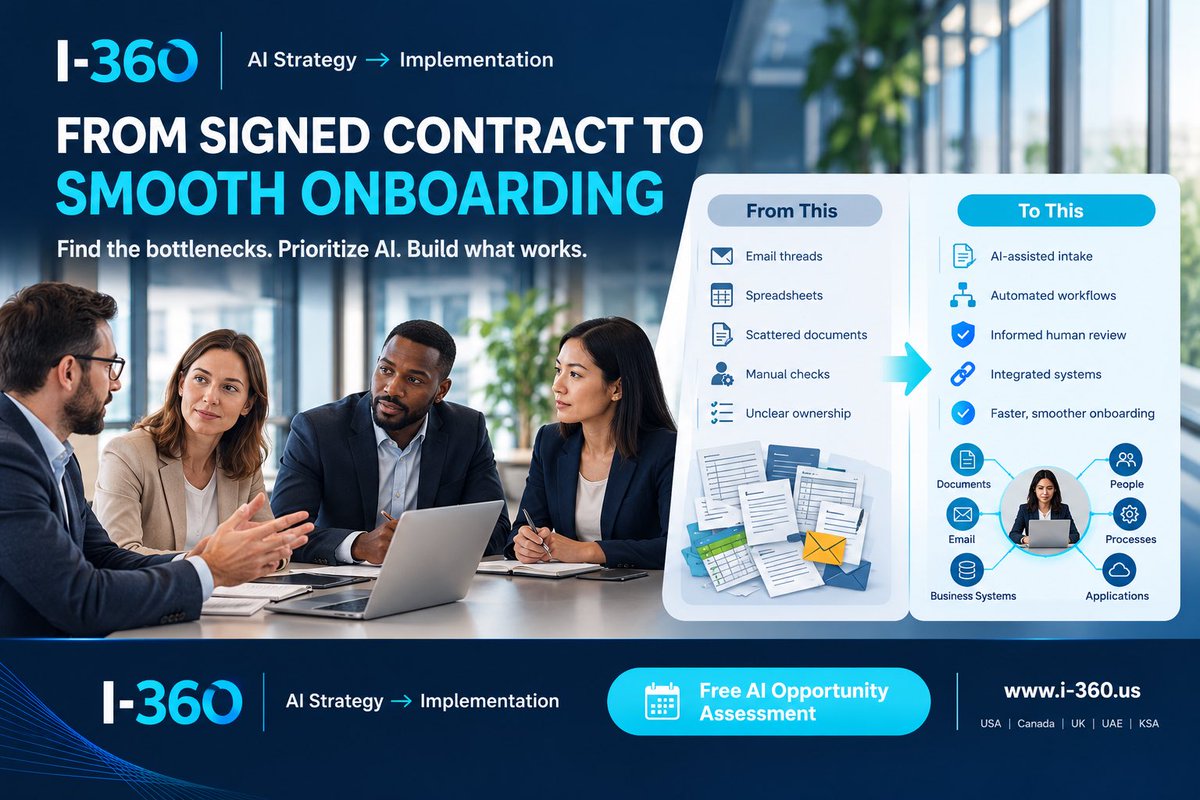
After a customer signs a contract, which part of your onboarding process creates the most delays: document collection, internal approvals, system integration, or task coordination?
A new client says yes. Why does onboarding still take a maze of emails?
Imagine a growing professional-services firm. Sales closes the agreement, then operations requests documents, finance creates the billing account, and delivery waits for approval to begin. Each team has its own checklist. Nobody can see which handoff is holding up the start.
That is an illustrative scenario, but the operational question is familiar: how much of your onboarding process depends on people chasing updates?
A connected workflow could collect documents through a secure portal, check for missing fields, route exceptions to the right employee, and trigger account setup after required approvals. AI-assisted document extraction could reduce retyping, while people retain responsibility for verification and decisions.
Before: scattered inboxes, repeated requests, and unclear ownership.
After: a shared view of outstanding tasks, accountable owners, and a traceable approval path.
I-360 helps organizations assess these bottlenecks, design the integrations, and build practical automation around existing systems.
Where does your client onboarding slow down?
Explore a Free AI Automation Gap Assessment at https://t.co/N2LSo0PT16.
#BusinessAutomation #ClientOnboarding #EnterpriseIntegration #AIImplementation
Your customer support inbox isn’t just full of questions. It’s full of work waiting to be routed.
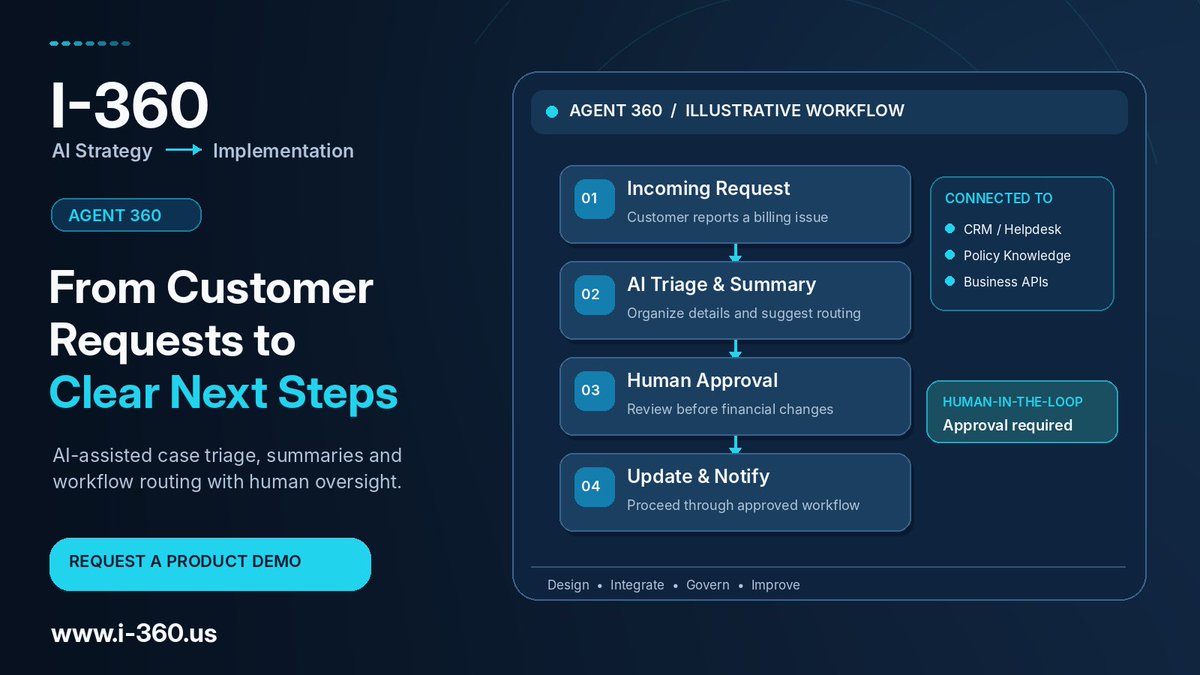
A customer reports a billing discrepancy. Someone reads the message, checks account details, searches policy documents, assigns a case, and asks a manager to approve a credit. The delay often comes from handoffs—not the original question.
This Sunday’s I-360 product spotlight is Agent 360, our approach to managing task-oriented AI agents and business workflows.
In an illustrative demonstration, an agent could classify an incoming request, retrieve relevant guidance, prepare a case summary, and propose the next step through connected systems. A designated employee would review any account change or financial adjustment before execution.
The value to assess is straightforward: less repetitive triage, clearer ownership, and a more consistent path from request to resolution. Integration quality, permissions, audit trails, and exception handling matter as much as the AI itself.
Want to see how this workflow could be designed for your business?
Request an Agent 360 product demonstration at https://t.co/N2LSo0PT16.
#AIAgents #WorkflowAutomation #EnterpriseAI
A clinician finishes an appointment. The conversation is over, but the documentation work is not.
For clinic leaders, that gap affects more than provider time. Notes must capture the encounter accurately, remain reviewable, and fit the existing clinical workflow.
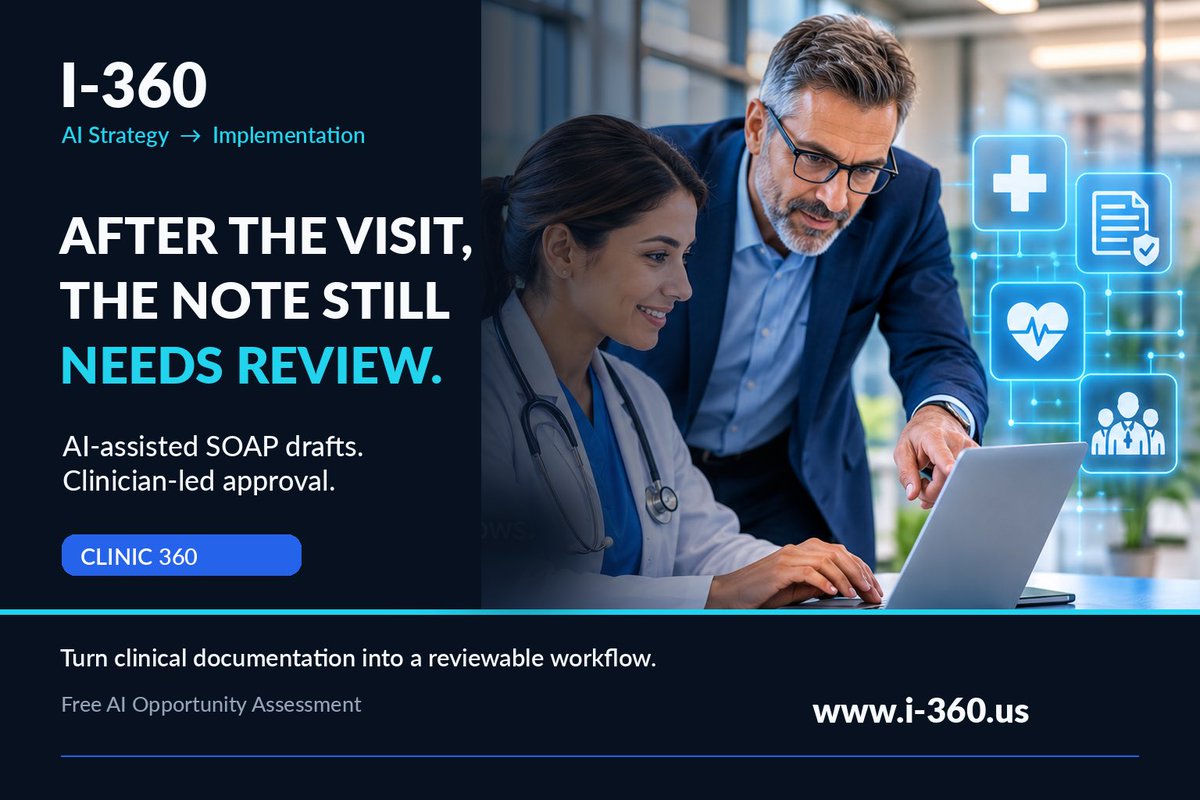
Consider an AI-assisted documentation process: the visit audio is transcribed, a draft SOAP note is prepared, and the clinician reviews the content against the conversation. Missing details or inconsistencies can be flagged for attention before approval and signing.
The key word is draft. AI should support documentation—not invent findings, make clinical decisions, or bypass professional review.
This is the workflow I-360 is developing with Clinic 360 (CDOC360): separating transcription from AI note generation, supporting clinician corrections, and maintaining a review-and-sign process.
For healthcare executives, the evaluation should include note quality, provider control, integration requirements, security, and how exceptions are handled—not just how quickly a draft appears.
If documentation is taking attention away from patient care, start by mapping where the work accumulates.
Explore I-360’s healthcare AI and integration services at https://t.co/N2LSo0PT16.
#HealthcareAI #ClinicalDocumentation #HealthIT #WorkflowAutomation
Is clinical documentation taking valuable time away from patient care? What is your biggest challenge: preparing SOAP notes, reviewing documentation, or integrating information with your EHR?
How many supplier onboarding requests are sitting in someone’s inbox waiting for the next document?
A vendor submits registration details. Procurement asks for missing paperwork. Finance checks payment information. Compliance reviews required evidence. Each handoff happens in a different system, and nobody has a reliable view of what is pending.
A chatbot can explain the process. A task-oriented agent can help move it forward.
With I-360’s Agent 360 approach, we design AI-assisted workflows that can collect required information, compare submissions against an approved checklist, retrieve relevant internal guidance, and prepare the next action through connected business applications.
Crucially, bank-detail changes, supplier approvals, and other consequential decisions should remain behind defined permissions and human review. The agent assists; accountable teams decide.
For operations leaders, the opportunity is fewer repetitive follow-ups, clearer exception queues, and better visibility into onboarding progress—subject to the quality of the underlying integrations and controls.
Where does your supplier onboarding process stall today?
Request a Free AI Automation Gap Assessment at https://t.co/N2LSo0QqQE.
#AIAgents #ProcurementAutomation #EnterpriseAI
What is the biggest obstacle preventing your organization from implementing AI today: identifying the right use case, proving business value, accessing reliable data, or integrating with existing systems?