Respect to Artifacts of Claude 3.5 Sonnet!
DeepSeek-Coder-V2 can do the same cool stuff directly in your browser.
Visit https://t.co/fl3rfHi0DB -> select "Coder V2" -> input prompt -> click “Run HTML” to see the magic happen!
#DeepSeekCoder #Claude
Introducing Instant SDXL Turbo Gradio Web App
Just published a super simple @gradio app that lets you play with the newly released SDXL Turbo.
And you too can play with it, right now.
We have over 250+ guides to help you build simple-to-advanced LLM/RAG apps over your data.
But if you’re looking for a unified resource, this guide by @nanonets is one of the best that we’ve seen 👇
It’s concise yet comprehensive, covering 12+ parts including:
✅ Data management (docs, chunks)
✅ Data indexing/storage
✅ Querying (top-k RAG)
✅ Structured outputs
✅ Chat (w/ memory)
✅ Agents (w/ tool use)
Check it out: https://t.co/NZ1BAVelEa
🕹️ The way of creating anything in real time with LCM-LoRA technology is so natural that it's here to stay. That's for sure!
💡 This is just a quick test I did using Krea to build an RPG dungeon.
Imagine creating a video game in REAL TIME!
Trending repository of the day 📈
gpt-crawler
Crawl a site to generate knowledge files to create your own custom GPT from a URL
Last 24h: 2413 ⭐
Total: 3722 ⭐️
https://t.co/OhyGJGbvxI
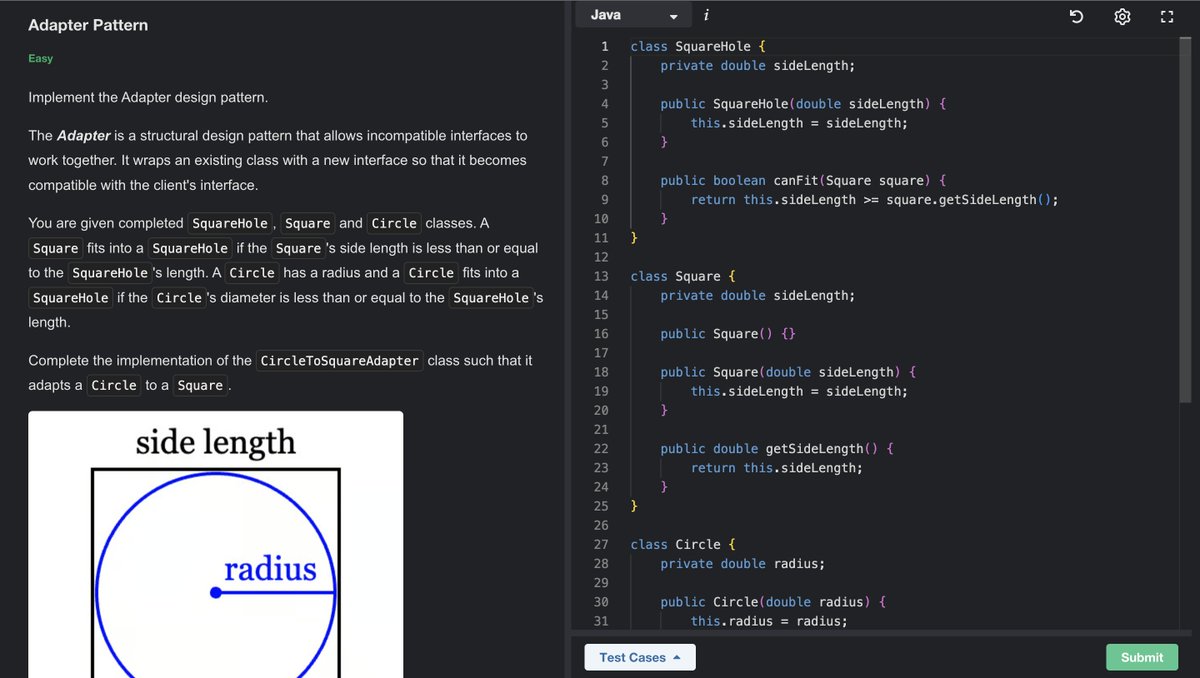
I coded "Leetcode for design patterns"
Everyone hates on leetcode, but I always liked that problems were "self-contained". It's so easy to jump in and finish a problem without a lot of context.
Leetcode-style problems for OOP design patterns make it so easy to practice 1 or 2 problems a day.
"Real-Time #Gaming Infrastructure for Millions of Users with #ApacheKafka and #WebSockets"
=> This blog post shows a real-time #gamification demo to integrate gamers via WebSockets to the #datastreaming backend infrastructure.
https://t.co/ExSoellFQx"
New open-source photo blog just dropped: https://t.co/2axgXHudQ0
Features:
◆ Built in admin panel
◆ Infinite scroll w/ pagination
◆ Beautiful route transitions + next/image blurhash
◆ Dark mode
Built with @nextjs App Router + full-stack @vercel by the amazing @sambecker ▲
How do services communicate with each other?
This is an important decision when designing the implementation of any multi-service architecture.
Here’s a quick guide to the most commonly used techniques, use it as a starting point for your decision:
gRPC is an open-source remote procedure call framework developed by Google. It uses Protocol Buffers to define service and message types which make data compact and efficient to transmit and store. It supports bi-directional streaming and offers flow control features.
WebSockets provide a full-duplex channel over a TCP connection. They allow both the client and server to send messages to each other at the same time. WebSockets require an open connection which is more resource-intensive than stateless options.
RESTful APIs provide an interface for services to communicate with each other. It uses the standard HTTP methods GET, POST, PATCH, and DELETE. It is stateless in nature which means requests must contain all the information required to process it.
GraphQL is another API-based approach. It is a data query and manipulation language that provides a way to consolidate APIs so that services can communicate via a single API endpoint. This simplifies communication with a consistent and unified interface.
In an event-driven approach, services respond to changes in state (referred to as an event). Services send events to a message broker or an event bus which forwards the event to relevant services. This promotes loose coupling, allows services to scale independently, and improves resilience.
A service mesh adds an infrastructure layer to each service. It adds a network proxy (called a sidecar) where network traffic is routed through. Because it does this to each individual service, features such as authentication and load balancing can be done on a very granular level.
Choosing the right approach for a system can be challenging, given the many options available and their varying use cases. Understanding your system’s requirements is essential, and often the best approach requires a mix of the options above to accommodate for different components in your system.
Collection framework is one of the most important topics when learning Java.
But there's so much to learn that beginners find it intimidating.
Here's a guided roadmap to help you master the collection framework: