As the Director, Research & Litigation of Equity Chambers, I deemed it appropriate to introduce something new which is to change the dimensions of our moot, departing from the long-standing procedure and venturing into the realm of interlocutory applications, and this ideal was welcomed by the Principal Partner Equity Chambers, in person of Abubakar Abdullahi Raji, SABUK and other managing Partners.
Twelve sets of facts were produced and all required filing of interlocutory applications both in civil and criminal trials, a call for applications was made, and I had a session with them titled “On Interlocutory Applications.” I equally deemed it appropriate not just to organise, but to appear, and I did so by leading this team of counsel.
My team filed a Motion for misjoinder. I moved and adopted the motion, after which my junior counsel were to canvass the substantive arguments.
Interestingly, My Lord Isah Labaran Mukhtar who presided over the moot asked one of my junior counsel, Ismail Sulaiman to move the said motion for misjoinder before proceeding to argue it. And he did so excellently. My Lord even had to commend me for his performance, particularly considering that Ismail is only a Level One student, that indeed I carried them along.😂
My Lord also commended his use of “big grammars” and mentioned that he must have Learned that from me.😂😂
A very engaging afternoon at Equity Chambers BUK moot.
Hey... Let it be an History: Equity Chambers started this "MOOTS ON INTERLOCUTORY APPLICATIONS" and the whole aim is learning the craft of advocacy.
The juniors are watching. The seniors are teaching. And, in the process, we are all learning.
Isah Bala Garba, is my name, I am inter alia: a Senior Advocate of Bayero University Kano, (SABUK) and Director Research and Litigation, Equity Chambers, Bayero University Kano.
The SC in Noble Drilling (Nig.) Ltd. v. NIMASA (2026) 14 NWLR, held that the requirement under sections 97 and 98 of the Sheriffs and Civil Process Act for leave and endorsement of processes for service outside jurisdiction applies to the High Court of a State and the High Court of the FCT, but not to the Federal High Court. This is because the Federal High Court has nationwide territorial jurisdiction; its judicial divisions are merely administrative. Therefore, for purposes of the Federal High Court, a process served anywhere within Nigeria is served within jurisdiction and no leave is required. It is only when the process is to be served outside Nigeria that it is served outside the jurisdiction of the Federal High Court. Consequently, the earlier decision of the SC in Arabella v. N.A.I.C. (2008) 11 NWLR, which held otherwise, was held to be per incuriam and has been overruled to that extent.
Idris, J.S.C., in A.-G., Osun State v. A.-G., Fed. (2026) 14 NWLR (Pt. 2060) 191, while delivering the lead judgment in a case concerning the withholding of statutory allocations due to the Local Government Councils in Osun State, and particularly the binding effect of the Supreme Court’s earlier decision in A.-G., Federation v. A.-G., Abia State (2024) 17 NWLR (Pt. 1966) 1, had this to say concerning the Federation’s constitutional duty to comply with the orders of the Court.
His Lordship put it ad literam:
“Before I conclude, it is pertinent to issue a stern admonition to the Federation. This Court’s judgment in A.-G., Federation v. A.-G., Abia State & Ors (supra) remains a subsisting and binding order of this Court. As the executive arm of government, the Federation is under a constitutional and legal duty to give full and faithful effect to the directives of this court. It is imperative that the Federation ensures strict and immediate compliance with the terms of that judgment, without evasion, delay, or partial performance. In particular, the Federation is hereby reminded that it is bound to remit, in full and without further obstruction, all outstanding statutory allocations due to all democratically elected Local Government Councils across Nigeria.
Any failure to comply with the orders of this court will constitute a deliberate disregard of the rule of law. The Federation is enjoined to take immediate and effective steps to discharge its constitutional and statutory responsibilities in accordance with this Court’s directives in A.-G., Federation v. A.-G. Abia State & Ors (supra), thereby reinforcing the principles of democratic governance, ensuring accountability, and upholding the supremacy and sanctity of the Constitution.”
Per Idris, J.S.C., at p. 291, paras. C–F.
It is, to say the least, disheartening that a judgment of the apex Court delivered in 2024 would after a year still require such a stern reminder to the Federation on the need for compliance.
One would expect that an order of the Supreme Court, once made, needs no further persuasion to be obeyed. Sadly it's not.
This. Is. Just. So. Unfortunate.🤧 (Punctuation, for emphasis.)
@itumomartins I doubt if Rules of Court can prevail over an Act. The requirement for the leave is pursuant to Sherrifs and Civil process Act, so I doubt if Court Rules could prevail over the said Act.
A Landmark Victory for BUK Comrades! 😁🙌⚖️
Upon resuming last session as a Level 3 student, one of my first acts as a Student Legal Practitioner was to institute Suit No. UC/SUG/028/25 before the Students’ Union Court, BUK, challenging the constitutionality of Section 46(5) of the SUG Constitution. The provision empowered BUKIECO to disqualify candidates for violating electoral rules, but contained no safeguard requiring notice of the allegation or an opportunity to be heard before disqualification.
What propelled the action was the concern that BUKIECO has relied on that provision to disqualify candidates even a Night to an Election, without first giving the affected candidate notice of the allegation and an opportunity to be heard, which I considered to be inconsistent with Right to fair hearing pursuant to section 36 of the 1999 Constitution of Nigeria, the Supreme Law that has binding effect upon all other Laws, interestingly by virtue of section (1) of the said SUG Constitution, it subjected its self to the provisions of the 1999 constitution. The matter was commenced by way of originating summons, supported with an affidavit, exhibits and a written address.
The then Attorney-General of the Students’ Union Government entered conditional appearance and filed a Counter-Affidavit and Written Address. A Preliminary Objection was also filed, principally contending that BUKIECO ought to have been joined as a party, having regard to the reliefs sought against it. I responded to the objection, and the matter proceeded through several adjournments before the then Justices of the Union Court,
The first suit was struck out, not on the substance of the complaint, but because BUKIECO, whose powers were directly in issue, had not been joined.
I took the lesson, corrected the procedural defect and refiled the action as Suit No. UC/SUG/030/25, this time joining BUKIECO as a Defendant.
Today, the Court agreed with the substance of our argument.
The germane holding of the Court, per Hon. Justice S.A. Ambali, JUC III, was that the provision empowering BUKIECO to disqualify a candidate without reasonable notice and an opportunity to be heard is null and void to that extent. BUKIECO must therefore afford an affected candidate reasonable notice and an opportunity to be heard before disqualification, within a period that still allows the candidate to pursue available judicial remedies. The Court also recommended amendment of the relevant provision by the SRA.
For me, this is more than a victory. It is a lesson in litigation: lose, learn, correct the mistake, return to court, and fight again.
Alhamdulillah. ⚖️😁🙌
P.S. It was already late and dark after judgment, so we couldn’t take a group picture. Hence, the old picture. 😂
Not really, sir. Among the cases I can vividly remember is Tukur v. Government of Gongola State (1988) 1 NWLR (Pt. 68) 39, where Chief Gani Fawehinmi, a private legal practitioner, appeared for the Gongola State Government. His authority to appear was challenged, but the Supreme Court upheld the appearance.
For the avoidance of doubt, Oputa, JSC, put it verbatim:
“It is not in dispute that Chief Gani Fawehinmi led E. D. Audu, Director of Civil Litigation, Ministry of Justice, Yola, Gongola State. Two of them could not have appeared together on one side, the side of the Gongola State Government, if Chief Fawehinmi had not been authorised to conduct this case for the Gongola State Government.”
Simply put, the Court is saying the very fact of Chief Gani Fawehinmi appearing with the Director of Civil Litigation was sufficient proof that he was duly authorised to appear for the State Government.
So, I guess this tells us that Gani did, in fact, make it into the government-client space. 😂
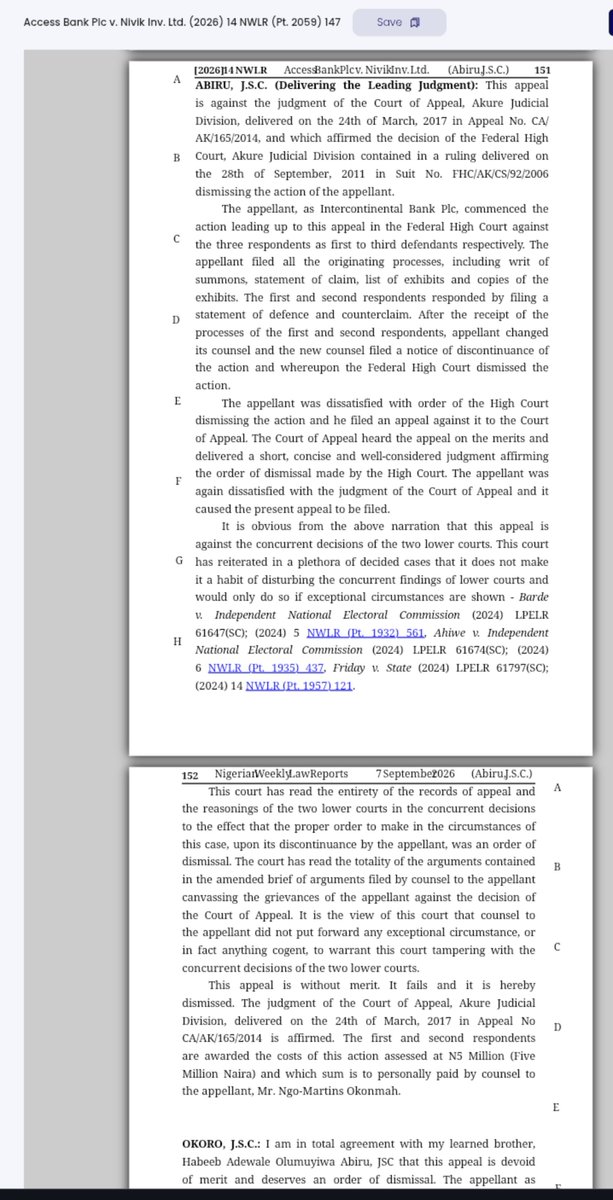
The briefest Supreme Court judgment I have read in a while. ⚖️😂
Just 4-minutes Read.
The story is simple: He filed a case, issues were joined, and he applied to discontinue it. The Court dismissed it. Surprisingly, he then appealed to the Court of Appeal, challenging the dismissal. Perhaps he preferred a strike-out, so he could bring the action again whenever convenient.😂 The Court of Appeal affirmed the dismissal.
He went to the Supreme Court, dismissed again. The Supreme Court equally affirmed that where issues have been joined and a party thereafter applies to discontinue the action, the proper order is one of dismissal.
And for the grand finale: ₦5 million costs personally against his counsel. 😂
Fair point, Sir. I think the distinction between applying the concurrent-finding principle and actually settling the underlying legal controversy is important. The judgment may dispose of the appeal, but whether it conclusively settles the wider point of law is another question entirely.
@_Ayiisha Thank you so much, Ma. I am deeply grateful for these kind words. It was truly an honour working with you.
I am glad I could contribute, and I’m always rooting for you too, Ma. 🙌❤️