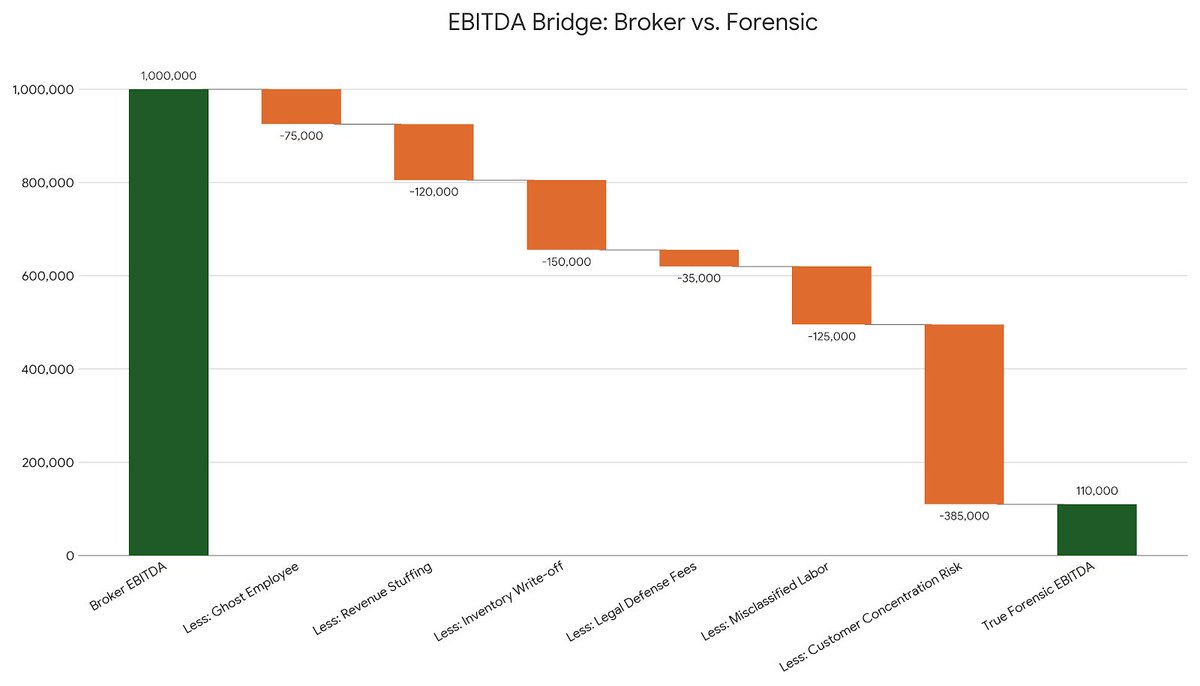
CASE STUDY: How a $4.5M SMB acquisition fell apart pre-LOI
Broker pitch: $1.0M “Adjusted EBITDA” (4.5× multiple)
Forensic reality: $110k true EBITDA
The deal was overvalued by $3.9M.
Here’s the EBITDA bridge 👇
Was $MSFT building ahead of demand or was demand simply waiting for capacity to come online?
One quarter doesn't settle that debate
The complete research memorandum is in the Featured section of my LinkedIn profile.
https://t.co/olLLW83tRd
The most interesting part of $MSFT earnings was not revenue or EPS.
It was this.
Azure grew 43% while Microsoft continued investing at an extraordinary pace in AI infrastructure.
For months, the dominant debate has been that Microsoft is spending too much.
These results suggest we may have been asking the wrong question.
What if the real constraint was never demand but capacity?
In June, I published a research memorandum arguing that this earnings release would be the first meaningful test of that hypothesis.
I think every industry has one sentence that completely changes how you see it
Mine:
AI Infrastructure: Every solved bottleneck creates the next trillion dollar bottleneck.
CPUs → GPUs → Networking → Power.
What's the sentence that took you years to believe in your industry?
If you’re reviewing SMB acquisitions right now:
I help search fund principals and SMB acquirers run pre-LOI red-flag screens before committing time or capital.
DMs are open if you’d like to see a redacted memo or discuss a live deal confidentially.
#SMBTwit#SearchFund#ETA
CASE STUDY: How a $4.5M SMB acquisition fell apart pre-LOI
Broker pitch: $1.0M “Adjusted EBITDA” (4.5× multiple)
Forensic reality: $110k true EBITDA
The deal was overvalued by $3.9M.
Here’s the EBITDA bridge 👇
Outcome:
The buyer walked away.
$3.9M of overpayment avoided.
Months of wasted diligence avoided.
Sometimes the highest-ROI decision is saying no early.
Most analysts I meet think financial modeling starts in Excel.
That’s the first sign they’re not ready for the buy-side.
When I was working in a family office, the first investment meeting never involved a spreadsheet. In fact, my CIO once told me:
“If your thesis can’t survive a whiteboard, don’t bring me a financial model.”
That hit hard.
Because I realised
Retail traders and even many junior analysts believe conviction comes from complex Excel sheets.
But in reality, institutional conviction is built before the first cell is typed.
Here’s what actually happens on the buy-side:
We stress-test the core business logic before forecasting revenues.
We ask “What would need to be TRUE?” before touching a multiple.
And more importantly, we first decide whether this business even deserves the effort of modeling.
Most models fail not because of wrong formulas, but because they’re built on businesses that should have been rejected in the first 15 minutes.
I’ve packaged the exact 3 filters we used before touching Excel at the family office.
If you want it, comment “THESIS” below.
I’ll send it personally.
#equityresearch #buyside #financialmodeling
Recently I asked @Google Bard to create a long term portfolio and this is the reply I got
Portfolio for a 27-year-old with 10000000 rupees
Investment Criteria
Age: 27
Amount in rupees: 10000000
Risk Appetite: 30% (Medium Risk)
Investment Goals: Long Term (Retirement)
Conclusion
This portfolio is a good starting point for a 27-year-old with 10000000 rupees who is looking to invest for the long term. However, it is important to consult with a financial advisor to create a portfolio that is tailored to your specific needs and risk tolerance.