BOOM 💥 THE SITUATION IN NIGERIA.
The lecturer who demands sex from a young girl before she can pass is complaining about the rot in Nigeria.
The pastor who pays a driver with a family ₦30,000 a month in Lagos or Port Harcourt, while his own son schools abroad, is complaining about the hopelessness in Nigeria.
The trader who removes two bowls of rice from a bag, re-bags it and sells it as a “full” bag is complaining about wickedness in Nigeria.
The civil servant who comes to work once a week and only shows up at the end of the month to collect salary is complaining about politicians who do nothing.
The lawyer defending an alleged serial killer in court is doing his professional duty, but if that same lawyer then calls Nigeria a lawless country simply because a defendant is being defended, there is a contradiction. A fair justice system requires a defence for the accused.
The Bishop preaching charity but putting a password on the church Wi-Fi is complaining about selfishness.
The student who spends the weekend partying and then posts on Instagram about how Nigeria is stealing their dreams is complaining about a country they refuse to contribute to.
The motorist who cannot join a simple queue, constantly shunting and forcing his way through traffic, is complaining about disorderliness in Nigeria.
Some doctors on government payroll who abandon patients in public hospitals while prioritising their private practices are complaining that Nigeria is hopeless.
Some people involved in recruitment who demand exorbitant payments for slots are complaining that the Nigerian government is corrupt.
And this is the uncomfortable truth:
Nigeria is not just the government.
Nigeria is also the lecturer.
The trader.
The civil servant.
The driver.
The doctor.
The lawyer.
The pastor.
The student.
The businessman.
The ordinary citizen.
If dishonesty, indiscipline, exploitation and corruption are tolerated at the individual level, changing the people at the top alone will not magically transform the country.
We cannot keep demanding a better Nigeria while reproducing the same problems in our homes, workplaces, businesses and communities.
Government has a responsibility.
But citizens have responsibilities too.
A better Nigeria will require both better leadership AND better citizenship.
Stop the blame game.
Start with yourself.
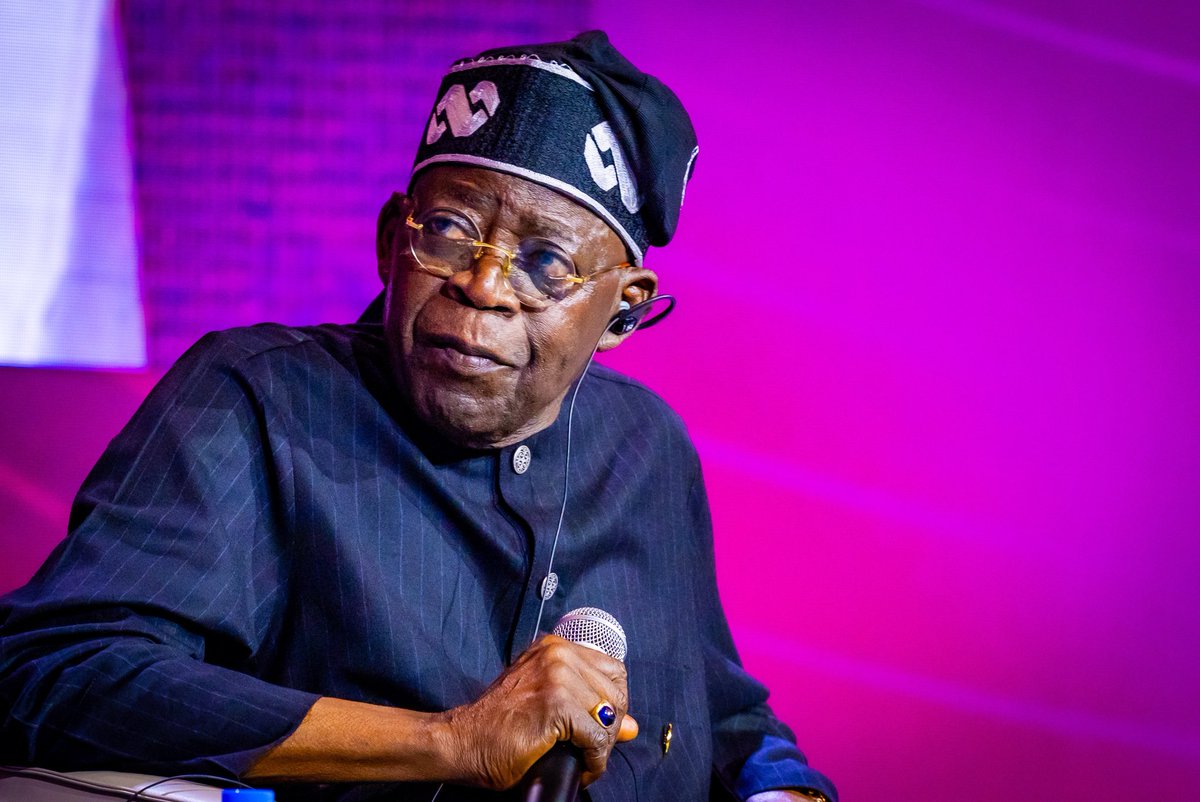
The more I listen to President Tinubu speak on Africa, the more I understand why some people are genuinely uncomfortable with him beyond ordinary politics. The man is not speaking like someone chasing social media applause or emotional claps from angry citizens. He is actually talking like someone who understands power, economics, history and the systems that have kept Africa mentally and financially dependent for generations.
When he said Africa cannot continue being a “price-taker” on its own resources, that line hit me personally because that has been the tragedy of this continent for decades. Africa holds about 30% of the world’s mineral reserves, yet contributes less than 3% to global manufacturing output. Think about that deeply. We own the raw materials but others control the processing, pricing, shipping, exchanges and profits.
Africa exports crude oil and imports refined fuel. Africa exports cocoa and imports expensive chocolate. Africa exports lithium and cobalt, then buys back batteries and electronics at premium prices from countries that barely have those resources naturally. Somewhere along the line, Africans became workers inside a system designed for others to remain owners.
And the painful part is that many Africans themselves are comfortable with this structure. They complain about colonialism every day but panic anytime an African leader starts talking about African-controlled systems, African commodity exchanges, African currencies and African bargaining power. One foreign rating agency coughs and African elites start shaking immediately.
Tinubu saying “Why don’t you start one?” when asked about Africa building its own exchange platform is exactly the kind of mindset this continent has lacked for years. Direct. Bold. Unapologetic. No begging. No victim mentality.
People don’t realize that commodity exchanges are part of how global power is controlled. London, New York and Chicago help determine prices for resources produced in Africa while intra-African trade still struggles below 20%. That is structural dependence.
This is why I laugh whenever some Nigerians reduce Tinubu to ordinary local politics and Twitter insults. While many politicians are still trapped inside “Nigeria is finished” speeches every week, Tinubu is discussing industrialization, African markets, manufacturing, commodity exchanges and continental economic influence with global investors and African leaders. That conversation is bigger than local politics.
Honestly, many people attacking him do not even know that they are defending the same dependency structure that has kept Africa weak for decades. Some Africans trust foreign validation more than they trust their own continent. That inferiority complex is one of Africa’s biggest problems.
Africa can never become powerful while exporting raw materials cheaply and importing finished products at expensive prices. Africa can never negotiate from strength while Africans themselves do not believe in African-owned institutions.
For the first time in a long while, I am hearing a Nigerian President stand confidently on international stages and speak less like a local politician and more like somebody thinking about the future economic power of Africa itself.
I'm so happy to say that Nigeria is in safe hands with President Bola Ahmed Tinubu!!
Ever heard of Africa’s first Narco-state? Where a president was assassinated because of drug disputes and a former president’s son funded a coup to establish a ‘drug regime’.
This story will help you understand what is happening in Guinea-Bissau right now.
NIGERIA UPDATE - EVERY NIGERIAN SHOULD READ THIS INSIGHTFUL PIECE:
Think Naija: The Reform Notebook.
THE NARRATIVE BEFORE THE INTERVENTION: HOW WASHINGTON IS SHAPING NIGERIA’S STORY. - November 21, 2025 - Part 1
Foreign intervention never begins with airplanes, sanctions or soldiers. It begins with stories. It begins with how a country is described, framed, understood and judged by powerful nations.
Iraq did not begin with missiles. It began with a narrative about weapons of mass destruction. Libya did not begin with bombs. It began with a narrative about protecting civilians. Syria did not begin with airstrikes. It began with a narrative about humanitarian responsibility.
The same pattern is now forming around Nigeria, and the speed is alarming.
The life sentence delivered to Nnamdi Kanu on November 20, 2025 is a perfect example. A Nigerian court, after years of legal proceedings, found him guilty on seven terrorism related charges, including directing violence, issuing sit at home orders, caused hundreds of deaths, and guiding bomb making. The court described him as an international terrorist and chose life imprisonment instead of the death penalty.
Within hours, a US lawmaker declared that the conviction was evidence of religious persecution.
A terrorism judgment became a faith narrative in a single step. This did not happen randomly, it is structural and it is how congressional narratives are built.
A legal event happens. American lawmakers interpret it through a moral lens that suits domestic politics. The narrative becomes a talking point. Talking points become resolutions. Resolutions become sanctions or conditions. And at the end of that chain lies the justification for foreign intervention.
This is the architecture we are watching being built around Nigeria.
What makes the situation even more concerning is that this narrative did not start yesterday. It has been shaped for years, intentionally and deliberately, through structured lobbying.
Foreign Agents Registration Act filings in Washington show that IPOB and its affiliates hired American lobbying firms to promote a narrative of Christian persecution in Nigeria. The message was clear: Nigeria is killing Christians, the Nigerian state is complicit, and the South East faces genocide. These claims were crafted to appeal to the American evangelical and conservative network that sees global Christian victimhood as a core political issue.
This lobbying created a permanent narrative frame. Even after contracts ended, the impression remained inside congressional offices, in briefing notes, in staff memory and in committee debates. Lobbying does not disappear when the cheque stops. It leaves a shadow.
This is why the same Congress that invokes Christian persecution rarely mentions certain facts.
It ignores that Boko Haram has killed more Muslims than Christians. It ignores that banditry in the North West is driven by economic motives, not religion. It ignores that many Christian communities in the Middle Belt are attacked, but Muslim communities across the North and Middle Belt also suffer the same fate in even larger numbers. It ignores that IPOB and ESN splinter groups killed over 700 Christians in the South East and enforced violent sit at home campaigns. It ignores that Finland, a Western nation, convicted a key Biafran agitator for terrorism in September 2025. It ignores that the Nigerian court conviction of Kanu was based on evidence, not on faith.
And it ignores the deaths of Muslims who are also victims of the same terror networks. Only days before some US lawmakers repeated the Christian genocide narrative, terrorists abducted and murdered the Ameer of the Muslim Students Society of Nigeria in Kebbi State, Alqasim Uthman Ibrahim. He was kidnapped and killed in captivity, without media attention, international outrage or congressional concern.
https://t.co/2Q8z3cwKHS