GTA 6 is rolling out right now, PS5 and Xbox only. No PC version announced
So "clip your own gameplay" means a console and a capture setup, not a YouTube link. Worth sorting out before your region unlocks at midnight
And keep a real voice on the clips. YouTube doesnt pay for mass-produced, repetitive videos, and one prompt clip stacks fit that description closely
GTA 6 IS GOING TO MAKE MORE CREATORS RICH THAN PLAYERS.
And they won't even touch a controller
This guy connects Claude to a clipping tool, drops in one YouTube gameplay link and gets a stack of Shorts with voiceover scripts from a single prompt
Not my video, but it's the most useful AI workflow for GTA 6 launch week I've seen
One warning before you copy it. Clip your own gameplay. Reuploading someone else's GTA videos is the fastest way to get your channel struck
You'll waste your first hour in GTA 6 like everyone else.
Or paste this into ChatGPT tonight.
"You're my GTA 6 launch-night planner.
Before you plan anything, ask me 5 quick questions in one message.
1. How much time do I have tonight
2. What I love most in open worlds, story, driving, chaos, exploring, photo mode or online
3. Zero spoilers, or are light hints fine
4. Solo or with friends
5. What usually ruins a first session for me
Then build my first hour in 15-minute blocks. For each block tell me what to do, why it fits me and one thing to skip. Add 3 settings to check before I start and a stop point so I'm not still playing at 4 am.
No story spoilers, nothing past the opening, and don't invent features. If you're not sure something is in the game, say so and give me a general tip instead."
Save it for launch night.
$NVDA guided $108B for tonight. Wall Street expects about $109B. But Nvidia beat its own guide by roughly 5% in each of the last four quarters, and 5% on top of $108B is $113B.
That gap is the real bar.
What's on the table after the close:
- First report without Jensen Huang. He resigned last week. Colette Kress presents as interim CEO while still serving as CFO
- Revenue guide: $108B, plus or minus 2%. A year ago this quarter was $57B
- Gross margin guide: 74%, down from 75% last quarter as memory costs rose faster than expected
- China: zero data center compute revenue assumed in the guide
- Consensus EPS sits above the top of Nvidia's own EPS guidance range
- The stock closed Nov 13 about 32% below its Oct 6 close
Four numbers decide the reaction:
1. Revenue vs $113B, not vs $108B. A plain $109B "beat" would break the pattern
2. Gross margin. Below 74% would show memory prices squeezing even the most profitable company in AI
3. Q4 guide. Full-year consensus implies about $125B next quarter
4. Who is paying. Most AI agents, model launches and chatbots this year run on this hardware. The question is how much of that spend comes from customers with real revenue, and how much from funding rounds
Nvidia's revenue is the closest thing AI has to a single invoice. Tonight shows how big it is and how many companies can still afford it.
Packed calendar and it starts tonight.
Today: $NVDA reports after the close, first quarter without Jensen Huang. Street wants ~$109B on a $108B guide, margins near 74%.
Tomorrow: FOMC minutes from the October hold. Cook and Hammack already wanted a hike, i wanna see how many more did.
Thursday: Trump, Xi and Putin meet in Shenzhen. First three-way sit-down between them, agenda still not public.
Nov 25: October PCE.
Dec 9: Fed decision. Kalshi has a hike at 96%.
Dec 10: November CPI, a day after the Fed already decided.
Jan 3: new Congress, Democrats run both chambers.
BTC already swept 62K on the way here. Which one moves it most?
Upwork's total freelance volume fell 10% last quarter. Volume from freelancers with AI skills grew 55%.
Q3 2026 numbers, out Nov 2:
Total volume: $914M, down 10.1% year over year
Freelancers with AI skills: $112M, up 55%
That AI slice now runs at nearly $450M a year
Everything else: about $802M, roughly 15% lower than a year ago (simple arithmetic from the reported figures)
So the platform is shrinking and the AI part is growing inside it. Same marketplace, two different markets.
Two details from the earnings call matter more than the headline.
1. Clients stopped writing "AI" in job posts
Upwork dropped its old AI metric because it relied on clients asking for AI. Clients now just assume the freelancer uses it. The new metric counts talent with AI skills on their profiles. AI speed is the baseline now, not a bonus you can charge extra for.
2. A new type of client showed up: AI agents
Upwork launched an MCP server, a connection that lets AI agents search and start work on the marketplace. Work started through it grew more than 150% month over month in October.
What to do with this:
- Put the AI tools you actually use on your profile, with the result each one produces. That is now how Upwork itself sorts the growing side of the market
- Sell fixed-scope offers with a clear deliverable and price. A person skims those fast and an agent can read them the same way
- Price the outcome. If the client assumes AI, hourly billing just punishes you for being fast
- Be careful with work AI already does well enough that a client can skip hiring for it
Less money is moving through freelancing in total. The part that is still growing belongs to people who can show what they deliver with AI.
Jamie Oliver's YouTube channel tripled its views after adding dubbed audio tracks.
YouTube opened multi-language audio to millions of creators in September 2025. On average, creators using it got over 25% of their watch time from viewers in other languages.
Most mid-size channels still publish in one language. That gap is a service you can sell with AI.
Why creators would pay when YouTube has free auto-dubbing:
Auto-dubs are raw machine output that nobody checks. A creator with a brand wants the right slang, correct terms and a voice that fits the channel. That human layer is the job.
How the service works:
1. Pick a niche with evergreen videos: cooking, tutorials, tech reviews, personal finance. English channels with 20k to 300k subscribers are big enough to pay and small enough to answer DMs
2. Start with languages that have huge YouTube audiences: Spanish, Portuguese, Hindi
3. Workflow: transcript, AI translation, a native speaker checks it, AI voice, timing fixes, then upload as an extra audio track with a translated title and description
4. Ask the creator first, then dub one of their top videos as a free sample
5. Charge per minute of video, or a monthly package: their top 10 videos plus every new upload
The part that sells it for you: YouTube Analytics shows views and watch time by audio language. The creator sees exactly what your tracks brought in.
A one-off job becomes a retainer once the creator sees that number grow.
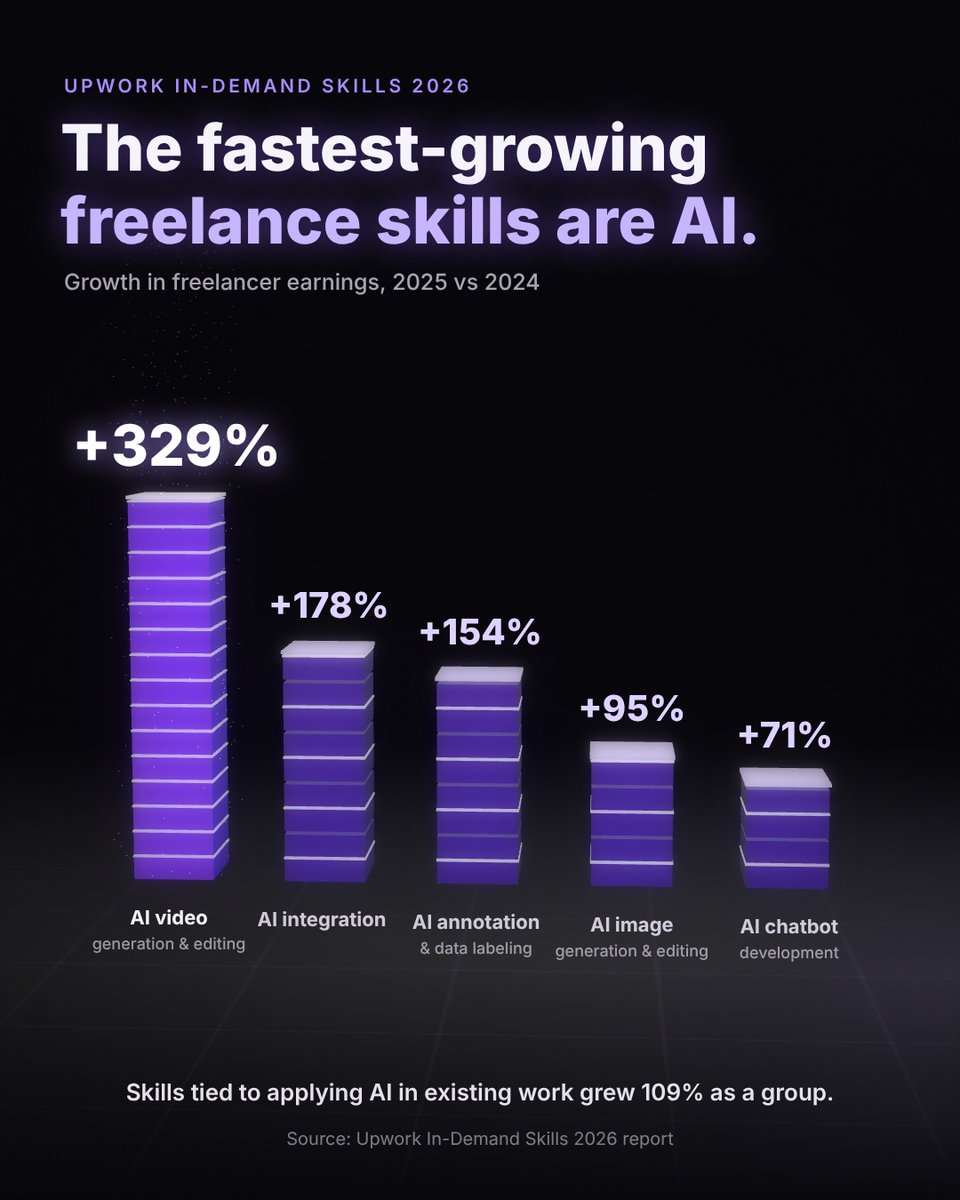
Freelancer earnings in AI video editing grew 329% in a year. That topped Upwork's 2026 list of fastest-growing skills.
The rest of the top of that list is AI too:
AI video generation and editing: +329%
AI integration: +178%
AI data annotation and labeling: +154%
AI image generation and editing: +95%
AI chatbot development: +71%
As a group, skills built around using AI inside existing work grew 109%.
Here is what each one looks like as a first paid gig.
AI video
Brands want short ads and product clips without a film crew. Offer 10 vertical ad cuts for one product, edited and captioned. The client pays for editing and taste. The model only makes raw footage
AI integration
Connecting a model to tools a business already uses. First gig: an inbox that drafts replies from the help docs, or a lead form that drops a summary straight into the CRM
AI annotation and labeling
Checking and labeling the data models learn from. Lowest entry barrier on the list. Domain knowledge in medicine, law or code is what pushes the rate up
AI images
Product shots, mockups, ad visuals. The low end is crowded, so sell a full set for one campaign instead of single images
AI chatbots
Support bots trained on a company's own docs. Charge for setup plus a monthly fee to keep the answers current
One warning from Upwork's own data: generative AI and creative gigs grew 90% in new contracts while pay per contract fell 13%. A fast-growing skill brings more buyers and more sellers at the same time. The people who keep their rates sell a finished result for a specific business.
Pick one skill. Build three samples this week. Pitch them to businesses in a niche you already understand.
Generative AI gigs on Upwork grew 90% in a year. The pay per contract fell 13%.
Freelancers doing complex work with AI saw the opposite: earnings up 45%.
Same tools. Same platform. Two very different paychecks.
The cheap end is filling up
Anyone can generate a logo, a blog post or a product shot now. So clients post more of those jobs and pay less for each one. More volume, lower price.
The skilled end is getting paid
AI-augmented professional services, where people use AI inside a field they already know, grew 72% in volume with earnings up 22%. Across the marketplace, freelancers doing AI work earn 34% more per hour than those who don't.
The third lane most people skip: teaching the models
Mercor pays its 30,000 contractors more than $4M a day, per the New York Times. Its experts average $85+ an hour, and one US medical listing shows $130 to $180.
The catch: once a model learns a skill, projects in that specialty dry up. Contractors complain about it constantly. Treat it as bursts of income, not a salary.
If you want to earn with AI in 2026:
1. Stop selling "AI content". Sell a result in a niche you understand: support automation for an online store, bookkeeping cleanup for a small agency, ad creative testing for a local clinic
2. Price the result, not the hours. AI cut the hours. The value of the result stayed the same
3. Have a credential (law, medicine, finance, engineering, a PhD)? Apply to expert training platforms like Mercor, Handshake AI or Alignerr and keep the profile ready for when projects open
4. Leave the 90% more contracts, 13% less money pile to everyone else
The premium now goes to people who understand the problem and use AI to solve it faster.
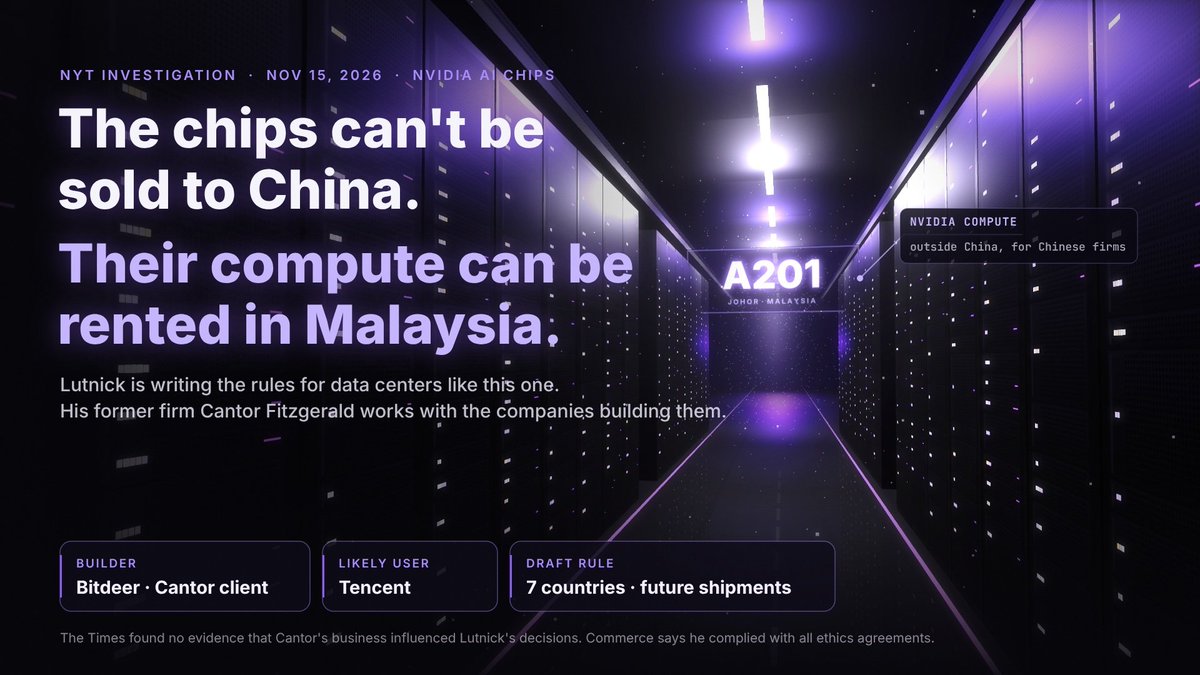
The US won't sell Nvidia's top chips to China. Tencent will likely rent that compute in Malaysia instead.
The company building that data center, called A201, is a client of Cantor Fitzgerald. The man who ran Cantor for decades is now writing the rules for it.
His name is Howard Lutnick. He's the Commerce Secretary, and his sons run Cantor today.
What the New York Times reported on Nov 15:
- Chinese firms can't buy top Nvidia chips but can rent them from data centers abroad. Southeast Asia is where those are being built
- Lutnick has pushed a narrower version of new controls on those data centers
- His version would cover 7 countries and only future chip shipments. Data centers already filled with US hardware would be exempt
- Operators would notify the government when Chinese customers train AI models there. No automatic license required
- Cantor was a sales agent on a Bitdeer stock offering of up to $1B this year and helped arrange one of up to $250M in 2024. Bitdeer is the developer behind A201
- Cantor also worked with Gorilla Technology, which builds data centers in Thailand and Indonesia and has a compute contract with Freyr AI, a Singapore firm that filings and job ads link to China
The other side:
- The Times says it found no evidence that Cantor's business influenced Lutnick's decisions
- Commerce says he fully divested, complied with his ethics agreement and never discussed Nvidia with the firm
So there is no proven link between the deals and the policy. What the report shows is the overlap: the official deciding whether Chinese labs keep renting US chips just outside China has a family firm earning fees from the companies that build that access
For anyone tracking AI, this rule matters more than most chip headlines. It decides whether the remote-compute route to frontier GPUs stays open
Fiverr searches for Claude Code specialists jumped 938% in six months. Businesses don't need more prototypes. They need someone to make them work
That's the AI job almost nobody talks about: cleaning up after AI
Why it exists
Veracode gave 80 coding tasks to more than 100 AI models. 45% of the time the code shipped with a security flaw, and newer models weren't doing better on security
anyone can now build an app in a weekend. Then come the bugs, the leaked keys and code nobody on the team understands
a Seattle dev firm told KUOW it had "20 or 30" rescue contracts lined up, one of them for a national hospital chain
What clients actually pay for
an audit: what's broken, what's dangerous, what can stay
security fixes before real users show up
tests, so the next AI edit doesn't break it again
turning a demo into something that survives real traffic
How to get into it
you need real engineering skills. This is not a beginner gig
learn the tools your clients used: Claude Code, Cursor, Lovable, n8n. You can't fix what you don't understand
sell a fixed-price audit first. It's an easy yes for a nervous founder
post your before and after: the bug, the fix, what it would have cost
The better AI gets at writing code, the more code there is for someone to own.
Claude Duet will draft the follow up to your unpaid invoice at 3 am. It just won't touch the money, even if you beg
It's Anthropic's always on agent. Runs on Opus 5.5, checks your accounts every few hours, no extra cost on a $20 plan during the preview. Here's what it does for a freelancer, and the catch
Where it saves you time
sorts client email and drafts replies
follows up on overdue invoices and unanswered threads
spots calendar clashes and proposes a fix
keeps a running list of what it's doing and what it needs from you
What it won't do on its own
it asks before it sends, pays, signs or deletes anything, and shows you the exact action first
payments go through a one-time card locked to one merchant and one amount
it refuses to trade securities, move money between your accounts or get into someone else's account, even if you approve
The catch
it checks every few hours, so something urgent can land between checks
US only, Pro or Max plan, through a waitlist
it uses the same usage limits as your chats
Gmail and Google Calendar are the core. Slack works with limits, Microsoft 365 isn't supported yet
no calls, no texts, no local files
Every's Dan Shipper called it the first personal agent I'd call a pro tool, but rated its email drafts below ChatGPT's dot
If your clients live in Gmail and your week drowns in follow-ups, it's worth the waitlist. If you need instant replies or work in Outlook, wait