Tracking the power behind the Internet Computer: NNS governance, voting blocs, whale influence & verified exchange flows. On-chain facts, not narratives
Yesterday at 02:09 UTC, 670,251 internet-computer:native came into existence in a single ledger moment.
That's the monthly node-provider reward batch — every provider's reward, minted at once. 4.4% lower than last month's batch.
Where did it go? Not directly to exchanges: 0.0% of it. Every single reward passes through intermediate wallets first — and we track those doors too.
ICPulse watches the ICP ledger and NNS governance 24/7 — whale flows, voting blocs, node concentration. Every number verifiable on-chain, every label verified by a human.
This is what we do. More findings every week.
https://t.co/XB3BzQYU74
#InternetComputer #ICP
@CW8900 On-chain context: net locked stake grew 555K ICP over the past 30 days, and our 43 labeled exchange addresses show ~241K ICP net outflow over the past 6 days. One counter-signal: on Jul 22, ~984K ICP was disbursed from fully dissolved neurons into liquid wallets.
Where does newly minted ICP go?
🎯 We track every mint of 100 ICP or more and follow it for 7 days. Last 30 days: 895,390 ICP minted, 47.5% left the recipient within a week. Every destination ranked, labeled only after human review. 260 verified labels.
internet-computer:native #InternetComputer
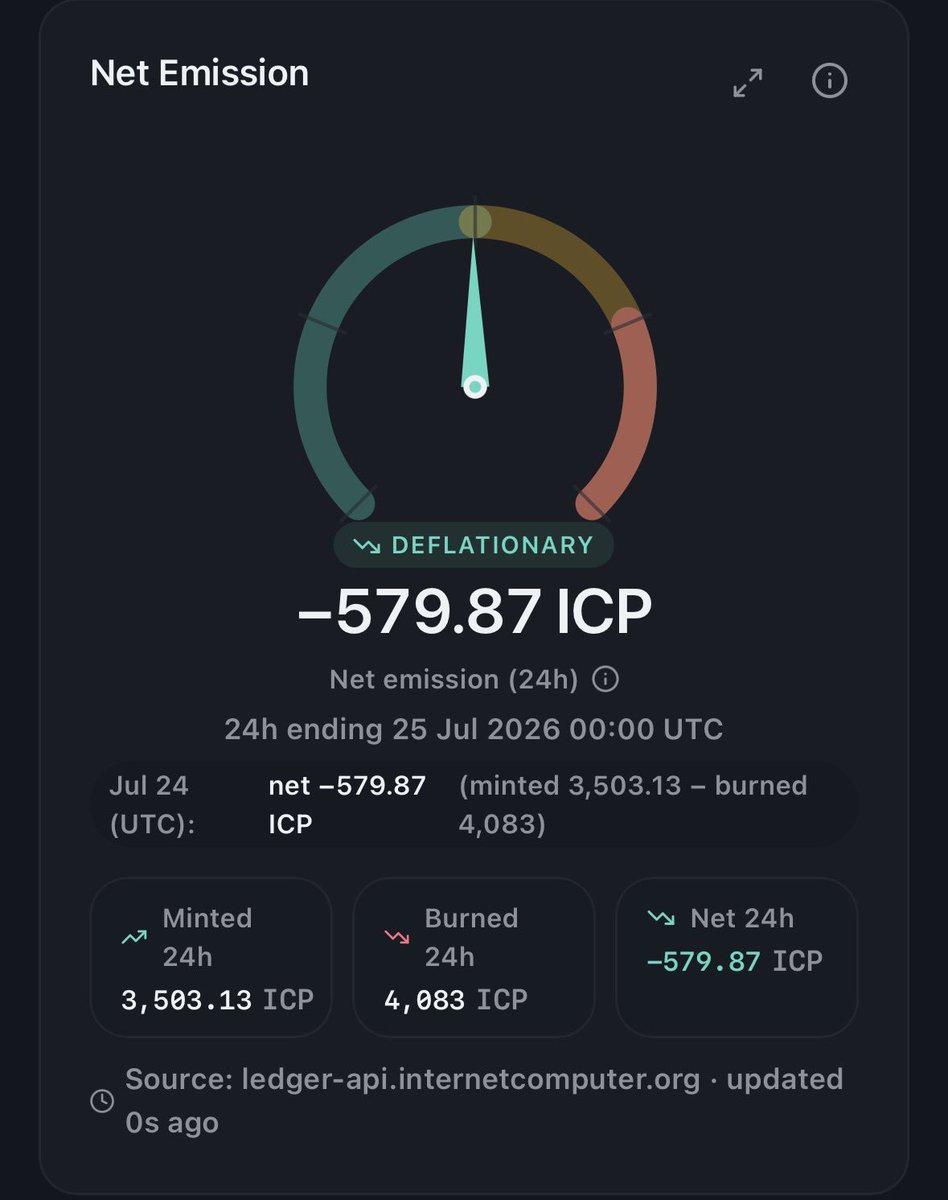
Yesterday the ICP ledger burned more than it issued.
Jul 24 UTC: 3,503.13 ICP minted. 4,083 ICP burned. Net -579.87 ICP.
Three days ago the ratio was 78 to 1 in favour of issuance. On Jul 23 it was 9.4 to 1. Yesterday it inverted.
Both sides moved at once: node reward mints were unusually low and burn was unusually high.
One closed day, not a trend. Counted directly from the ledger.
Live gauge: https://t.co/XB3BzQYU74
$ICP #InternetComputer
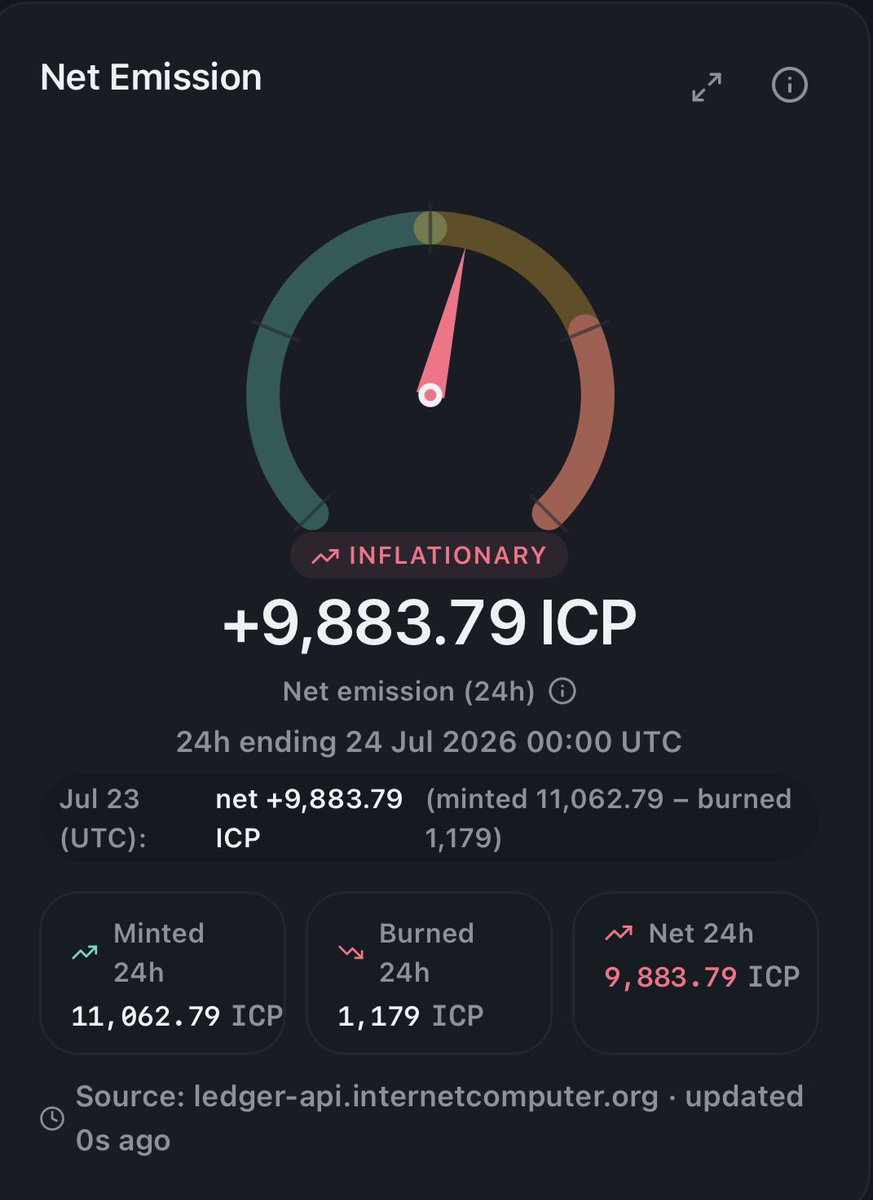
The other side of cheap fees: almost nothing gets burned.
Last 24h on the ICP ledger: 11,062.79 minted in node rewards, 1,179 burned in fees. Net emission +9,883 ICP.
Fees this low mean burn covers about 11 percent of new issuance. The rest is net new supply.
Live gauge: https://t.co/XB3BzQYU74
internet-computer:native #InternetComputer
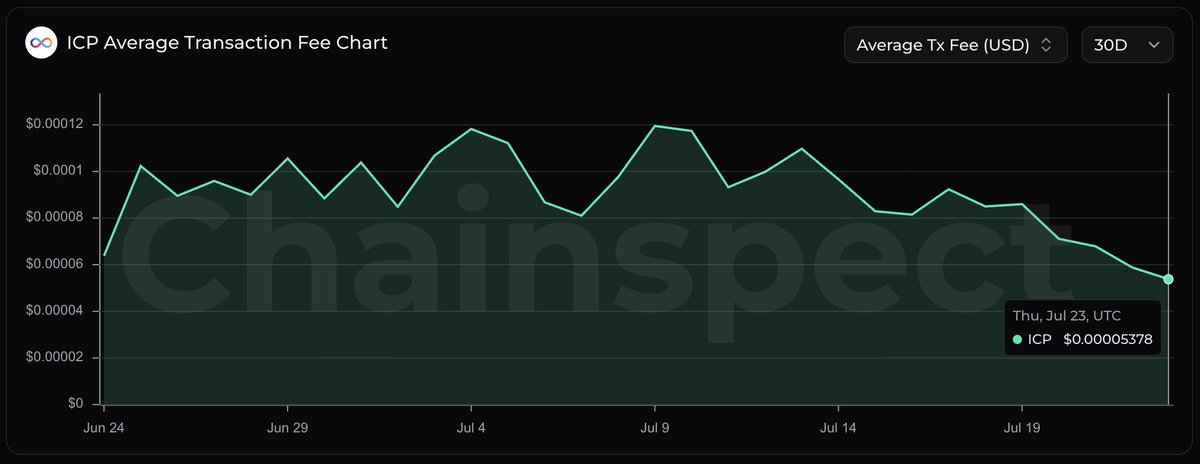
💸 The cost of using ICP keeps falling
@dfinity just reached another 30-day low, with the average transaction fee dropping to $0.0000538
That's less than one cent for over 180 transactions
📊 https://t.co/u0ajgBPEDI
+9,883 ICP net emission in the last 24 hours.
11,062.79 minted in node rewards. 1,179 burned in fees. Ratio 9.4 to 1.
Two days ago that ratio was 78 to 1. Burn is up twelve fold since, from 92 ICP to 1,179.
Every mint and every burn counted directly from the public ledger. Live gauge: https://t.co/XB3BzQYU74
internet-computer:native #InternetComputer #ICP
0.0001 ICP, twenty seconds after 14,714.
Yesterday a whale address received a large transfer. Twenty seconds later it received dust from an address it had never interacted with. That timing is not a coincidence.
This is address poisoning. The attacker seeds your transaction history and waits for you to copy their address the next time you send.
We checked the attacker address. Zero real inflows, spray only. The scheme pays only when someone copies from history. Do not be the first.
Never copy addresses from your transaction history. Verify all 64 characters at the source.
Live flows: https://t.co/XB3BzQYU74
internet-computer:native #InternetComputer #ICP
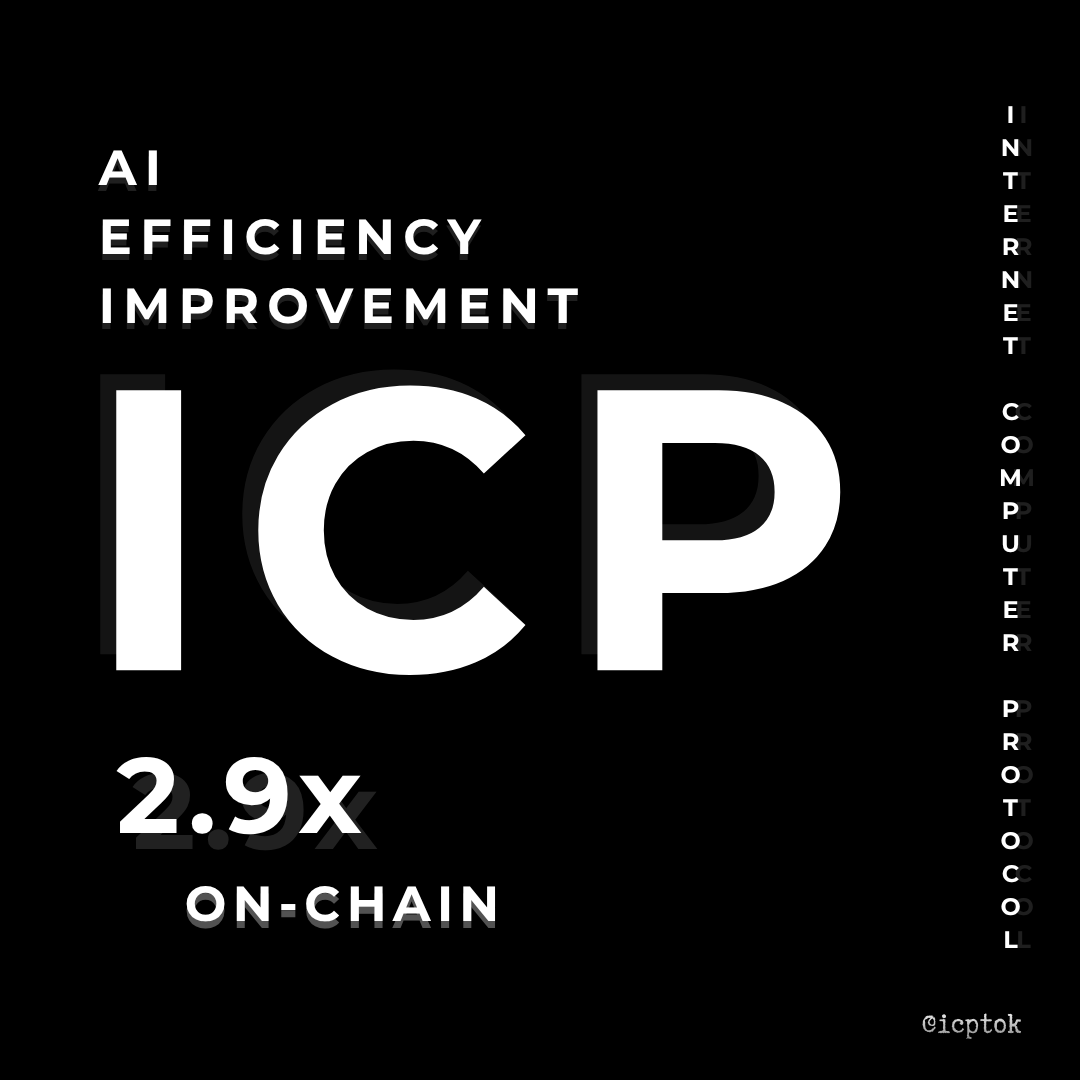
AI just became 2.9× more efficient on ICP.
Researchers from Meotis, Kaizen Corp and ORIGYN ran a small AI language model entirely inside ICP canisters without relying on external cloud servers.
Under the same computing limit, the optimized model generated 29 tokens instead of 10.
Why does this matter?
It’s another step toward AI agents and services that can run directly onchain, where their operation can be verified by the network instead of controlled by one company.
This is still research using a relatively small model, not “ChatGPT running on ICP.” But the results are transparent, with the paper, measurements and code publicly available.
Research: https://t.co/INn4PebxED
Paper: https://t.co/gMaUKtC5cX
Code: https://t.co/yLkXJ1S2CK
Fun corollary: at $0.0000679 per tx, and with every fee burned, even 98M transactions in a day burn only a few hundred ICP. Yesterday's ledger: 481 ICP burned vs 1,097 minted. Ultra-cheap compute and meaningful fee burn pull in opposite directions, and right now the ledger shows which one is winning.
@beincrypto@dfinity The decentralization claim is measurable. Right now: 696 active node machines, 79 independent providers, 130 locations worldwide, no single data center or jurisdiction. All of it public in the IC registry.
For the annualization question: a single day is a poor basis here. Node provider rewards cluster at the start of each month, so daily emission swings hard.
Over the past 30 days our indexer counted ~801K ICP minted. Annualized against the current total supply of 555.1M ICP, that is a gross emission rate of roughly 1.76% per year. Burn is negligible at current levels (under 0.01% annualized), so net is effectively the same.
We compute this mint by mint from our own indexer, not from aggregate feeds.
+7,082 ICP net emission in the last 24h.
7,174 minted for node providers and voting rewards. 92 burned. That is a 78:1 ratio of new supply to burn.
Live gauge: https://t.co/k9GlTr4XIN
$ICP #InternetComputer#ICP
The result of a 48 hour investigation run: verified exchange reserves on ICP grew from 63.5M to 77.8M across 12 exchanges and 43 labeled addresses.
Reserves, wallet architecture cards, and our new Sell Pressure page tracking freshly minted ICP, all live and free: https://t.co/XB3BzQZrWC
internet-computer:native #InternetComputer #ICP
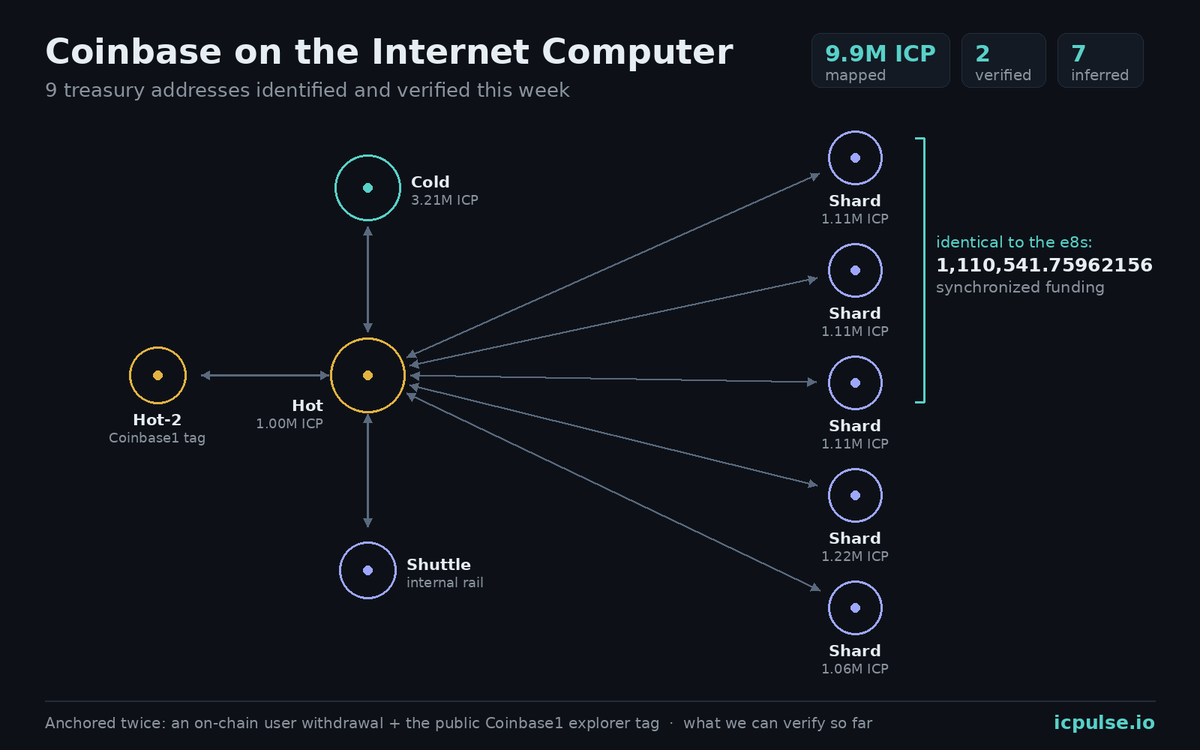
A 10 ICP withdrawal led us to 9.9M.
This week we identified and verified nine Coinbase treasury addresses on the Internet Computer, none of them publicly tagged before. Here is how it unfolded. 🧵
These nine addresses are what we can verify today. We make no claim this is the full picture. Our automated chaser is still walking the graph, and every address it surfaces goes through human review and cross verification before anything is published.
Facts only, no intent attributed.
This lands in the middle of an active debate. Dominic said this morning the network can and should go much further in reducing printing. BSCN covered the 9.72% to 5.42% policy numbers today. What was missing was the measured side: the cut is already on the ledger, and deeper than ICP charts show.
Every month, all node-provider rewards on the Internet Computer mint in a single ledger event. We tracked the last 7 batches.
In internet-computer:native they look noisy. In XDR, the unit the rewards are actually set in, they tell a clear story:
Jan: 1.73M XDR
Feb: 1.75M
Mar: 1.82M
Apr: 1.75M
May: 1.36M ← Mission70 cut lands
Jun: 1.31M
Jul: 1.10M
July is 37.7% below the pre-cut average. Proposal 140888 approved a ~40% reduction for Gen-1 providers. The cut is real, and it's still deepening: July fell just 4.4% in ICP terms, but 16.5% in XDR.
Token price masks all of this. More ICP minted doesn't always mean higher rewards, and smaller cuts in ICP can hide bigger real ones.
Data: mint events on the public ledger, rates from the icp-xdr conversion API. Every number verifiable on-chain.
https://t.co/XB3BzQZrWC
internet-computer:native #InternetComputer #ICP
Both numbers are real, they just measure different things. The ~18% is cumulative net growth over 5 years (after burns). The 9.72% figure is the current gross annualized issuance rate that Mission70 targets. Also worth noting: circulating and total supply aren't equal on ICP, a large share is locked in neurons. The supply question is exactly why we track the monthly mint events directly on the ledger.