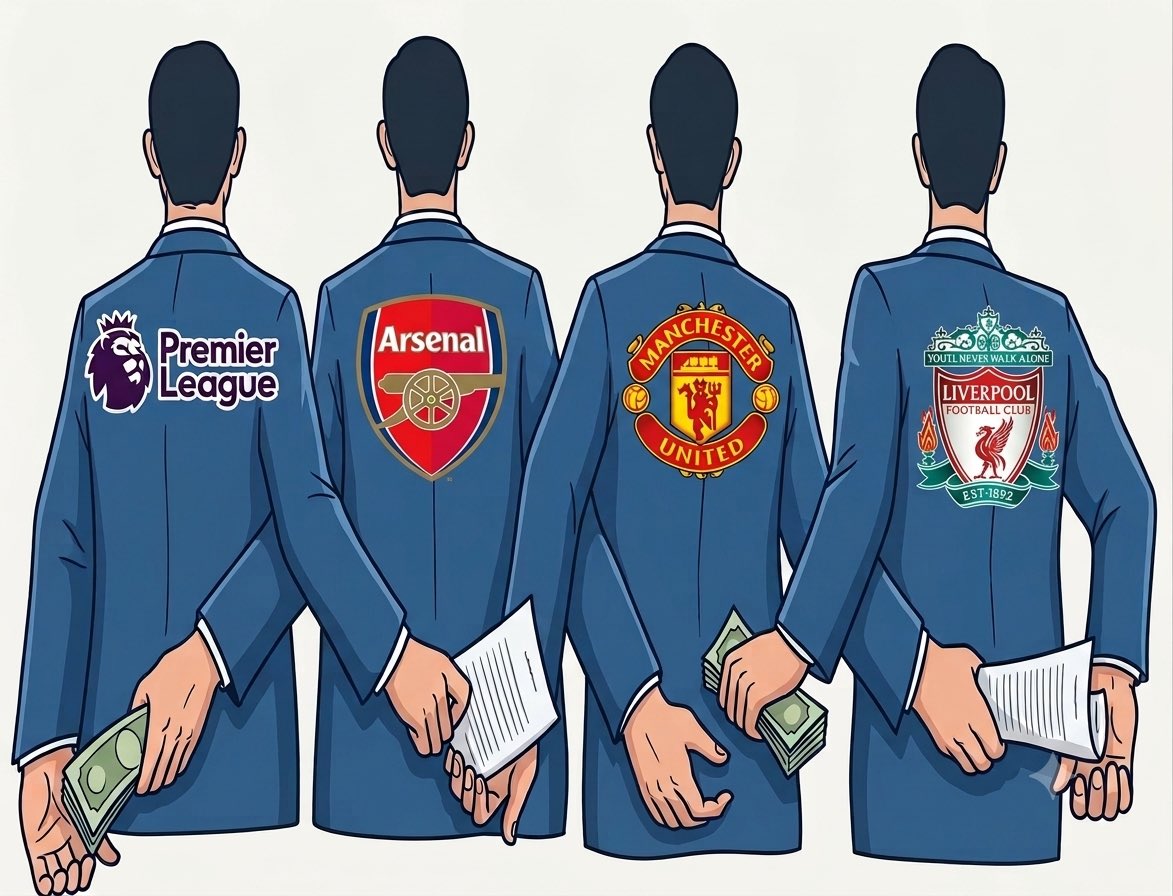
“Financial Fair Play” was never really about making football fair. It was about protecting those already at the top.
As Kieran Maguire points out, clubs that spend the most on wages and transfers tend to finish in the top three. So when City arrived with the financial backing to challenge that established hierarchy, suddenly the rules became a matter of existential importance.
City didn’t create football’s financial inequality they challenged who was allowed to benefit from it.
That’s why the real question isn’t simply whether City broke the rules. It’s whether the rules are genuinely about fairness, or about protecting the old order from being disrupted.
Financial Fair Play was sold as a way to protect clubs from reckless owners. In reality, it tied what you're allowed to spend to what you already earn. Think about what that means. The clubs with the biggest historic revenues, the ones who'd been dining at the top table for decades, got to keep spending. Everyone else was told to know their place. Ambition from below was reclassified as a threat.
Look at the hypocrisy. An owner putting his own money into a club, clearing debt and building it up, gets treated as the villain. But an owner who buys a club with borrowed money and loads the debt onto the club itself? Perfectly acceptable. The Glazers took over Manchester United through a leveraged buyout, and that club has since poured well over a billion pounds into interest, debt repayments and dividends. Nobody drew up 115 charges for that.
Then remember who these supposed guardians of fairness actually are. In 2020, Liverpool and Manchester United pushed “Project Big Picture”, a plan to hand more voting power to the biggest clubs. In 2021, the same elite tried to walk away from English football entirely with the European Super League, a closed shop with no relegation. City were part of it too and withdrew, but the architects and the loudest voices came from the traditional cartel. These are the people lecturing everyone else about the integrity of the game.
Even the Premier League's newer rules haven't stood up. In 2024, an independent tribunal found parts of the Associated Party Transaction rules unlawful after City challenged them. That wasn't City escaping justice. That was a legal body confirming the rules themselves were flawed.
City were never the problem. City were the proof. Proof that a club outside the old establishment could be invested in, built properly, run brilliantly, and beat the aristocracy on the pitch. Academy, infrastructure, a city regenerated, a team that won everything. That's what they can't forgive.
These rules were never about protecting football. They were about protecting a hierarchy. And we will keep fighting them, in every forum, for as long as it takes. We are Manchester City.
Are the PSR rules fair for everyone or do they favor the red cartel to keep the status quo; anti-competitive rules that prevent any other ambitious small clubs from competing with the big boys...??
Sorry to keep sharing, but if you’re not a City fan, take a listen and see if you can understand why folks take the position they do on FFP.
And this is why it’s difficult - even with an apparent guilty verdict - to really give a crap about FFP breaches.
It’s a closed shop.
Why are @ManUtd fans jumping on the Man City bandwagon Man U cheated there whole way through the 90s had referees in there pockets and still till this day are financially cheating they are £1.5billion in debt & are allowed to carry on as normal cos of the corrupt @premierleague
I wonder why @talkSPORT have deleted this? Have they been told by @prorefofficial to take it down? 🤔
We all saw what a joke the decision was. VAR will be ‘Light touch’ according to Webb!
🚨 Crystal Palace are attempting to beat Sunderland to the signing of Malick Fofana, as per @Santi_J_FM
💰 🤝 #SAFC have agreement in place with Lyon for £30m package, but Palace are now in direct talks with the winger.
❌ Despite reports, Fofana has yet to undergo a Sunderland medical, but he had been given permission by Lyon to do one.