This year's El Niño will dwarf the six other super El Niño events on record.
A projected +4.1°C rise in central Pacific Ocean temperatures by Dec. 2026 would leap past previous peaks of +2.8°C to +3.0°C in 1877, 1997 and 2015.
No one alive has witnessed an El Niño this strong.
Journalistic integrity takes another hit.
At a press conference in Belgrade during Volodymyr Zelensky’s visit to Serbia, a country long regarded as a traditional Russian ally that has refused to fully join Western sanctions, German FAZ correspondent Michael Martens @Andric1961 asked the Ukrainian president this question:
“But can you tell us Europeans what can we concretely do to help you to kill more Russians, more Russian soldiers, of course?”
Journalists do not casually blurt out phrasing like this. Questions at high-profile press conferences are prepared, refined, and often cleared in advance. “Kill more Russians” is not a slip of the tongue; it is deliberate language. Delivered in Belgrade, of all places, it functions as intentional provocation, testing boundaries, signaling alignment, and framing the war in the most visceral terms possible while standing on the soil of a nation still culturally and historically tied to Russia.
Zelensky answered by focusing on practical support: more money from Europe, directed specifically so Ukraine’s defense industry can produce twice as much (because the capacity already exists); stronger sanctions on Russian arms manufacturers and energy to prevent Moscow from funding the war; and faster licenses for Ukraine to manufacture both American and European weapons. He noted gratitude for existing packages but said they were insufficient, especially for defending against ballistic missiles whose components come from partners worldwide.
Now consider the double standard. Imagine any Russian-allied-country journalist standing at a Moscow press conference and asking Vladimir Putin: “What can we, your allies, concretely do to help you kill more Ukrainians?” The reaction would be immediate and overwhelming, universal condemnation, career-ending outrage, diplomatic protests, and wall-to-wall coverage framing it as bloodthirsty warmongering or worse. All hell would break loose.
Yet the actual reaction from mainstream Western, European, and American media to Martens’ question has been near-total silence. No major outrage pieces in the @nytimes, @washingtonpost, @BBC, @CNN, @Reuters, @Guardian, or even sustained scrutiny from most German outlets beyond social media and the journalist’s own defense on X (where he confirmed the wording and argued it is necessary so Russia runs out of soldiers). Coverage has largely been confined to alternative accounts, Serbian and Ukrainian reporting of Zelensky’s reply, and pro-Russian amplification. The @faznet itself has issued no public statement.
When a senior correspondent for one of Germany’s leading newspapers can openly solicit advice on maximizing enemy body counts in a sensitive diplomatic setting and face almost no institutional pushback from the Western press, it raises a straightforward question about consistency and standards. Prepared questions reveal priorities. Silence from the usual guardians of journalistic norms reveals something else.
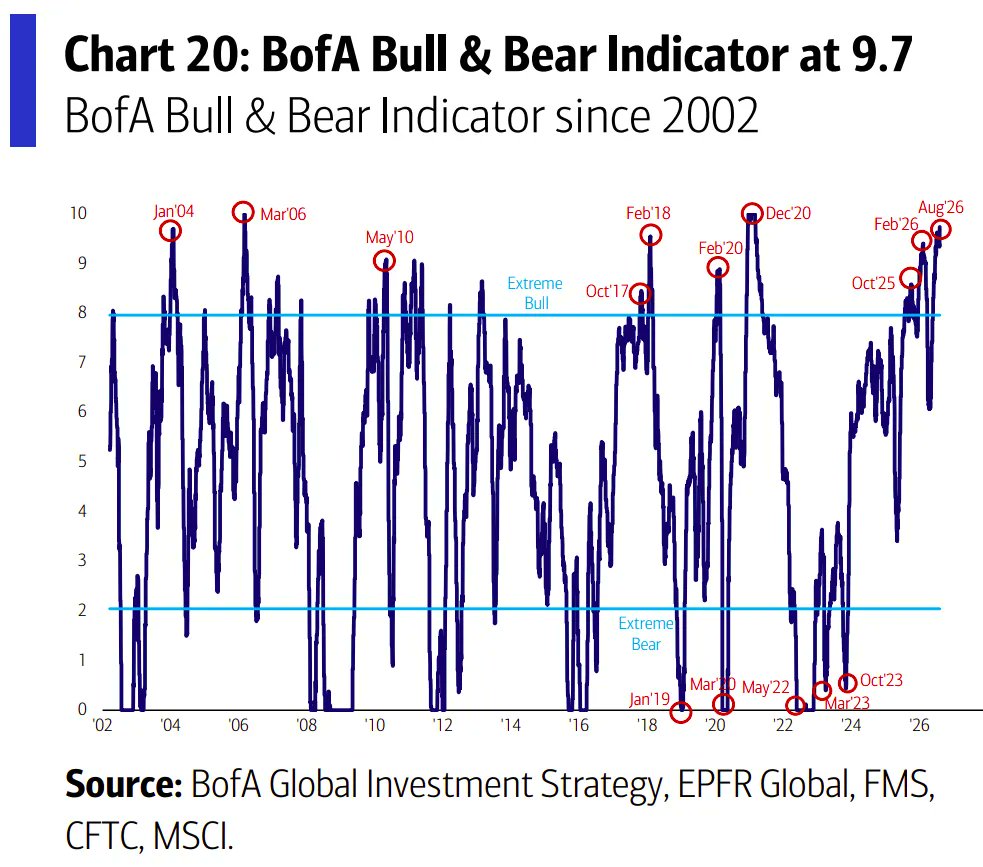
@ChristianKIC@Barchart Public history of the BofA Bull & Bear Indicator (0–10 gauge from BofA / Hartnett) starts ~2002; no detailed readings exist for 2000–2001.
THE PYRAMID THEORY SO SIMPLE WE ALL MISSED IT
A newly detailed external counterweight elevator system for the Great Pyramid is circulating, and once you see the logic it feels almost embarrassingly straightforward.
The core idea is not brand new. Versions of counterweight-and-track lifting for the heaviest stones have been floated for years by independent researchers and engineering sites. What is new is the clean, fully worked-out popular synthesis that pulls the pieces together.
That synthesis comes from the YouTube channel eureka effect. After months of research the creator presents a coherent system: wooden track systems running up the faces, counterweights descending on one face while the load stones rise on the opposite face, multi-rope arrays sized for ordinary blocks versus the 80-ton granite beams, and the Capstan Effect used to control holding force so the ropes never fight the full dead weight alone.
Temporary handles carved into the fine Tura casing stones support the tracks during construction, then get chipped off and polished smooth. The materials already existed. The Palermo Stone records large cedar imports under Snefru. The Khufu ship proves sophisticated joinery. Thick plant-fiber ropes recovered at Giza show the tensile capacity. The Diary of Merer confirms regular barge transport of multi-ton blocks with wood and rope systems that could be adapted on land.
Ordinary 2.5-ton blocks stay well inside modest rope arrays. The ceiling beams of the King’s Chamber (around 80 tons at roughly 160 feet) require denser redundancy, still within the engineering range the Fourth Dynasty demonstrably possessed.
Traditional mile-long ramps have always had a quiet problem: the missing spoil heaps. This external elevator-and-track model simply removes that problem. Gravity becomes the engine. Friction becomes the brake and the control system. No exotic technology required.
The general principle of counterweights and tracks predates this video. The clear, self-contained presentation that makes the whole system click for a wide audience is the contribution of eureka effect.
Does this version of the external system finally resolve the heaviest-stone problem for you, or do the internal sliding-ramp models still look stronger?
Link to video in the comments 👇
@katrinkristiina@TonySeruga@mattgaetz@BenSwann_ All the informations is out there in so many factually correct videos and articles by different journalists. Most western media corporations and governments decided to burry it and support what is happening since then. The real questions is why?
@NachDenkSeiten China did two more things:
1. They showed that we have no idea how big their reserves are. One does not do what they did without having enough to wait out any crisis comfortably.
2. Now the world and especially the US know that the Malacca Strait is not a strategic choke point.
Iran's FARS posts details of the initial text of the strategic plan for managing the Strait of Hormuz
According to this plan:
The passage of vessels belonging to the United States, the Zionist regime, and other hostile countries through the Strait of Hormuz will be prohibited.
Consignments related to the Zionist regime, whether military or civilian, will not have the right to transit this area.
Vessels or cargoes that play a role in actions against the Resistance Front will also be subject to the ban.
Countries and individuals that have caused damage to Iran will not receive permission to pass through the Strait of Hormuz and the Persian Gulf until compensation is paid.
Heavy fines, including up to 20 percent of the value of the cargo, are foreseen for lawbreakers.
The government will be required to assume responsibilities such as guiding navigation, monitoring vessel traffic, and protecting the security and environment of the Persian Gulf, in cooperation with the armed forces.
This plan is still in the expert review stage, and the parliament has asked experts to submit their suggestions for completing it.
* * *
Salimi, member of the Majlis Presidency: The initial text of the plan “Strategic Action to Ensure the Security and Sustainable Progress of the Strait of Hormuz and the Persian Gulf” is under review by the National Security Commission.
https://t.co/YAyxG135g5
BREAKING: Call option volume in the S&P 500 spiked to a record 4.0 million contracts on Tuesday.
This figure has more than doubled over the last several weeks.
By comparison, daily call option volume never exceeded 2 million contracts until Q4 2023.
Furthermore, call option volume averaged ~700,000 contracts a day in 2020-2021.
Meanwhile, the S&P 500 put/call skew, measuring the relative demand for downside protection versus upside exposure, posted its largest two-day decline since 2017.
Risk appetite is absolutely exploding.
No surprise here: Korea's soon-to-be-impeached president Lee Jae Myung is a "former failed day trader" who "repeatedly encouraged Koreans to invest in equities instead of property"
Eine KI durchsucht seit 2021 das Netz nach mutmaßlich rechtswidrigen Äußerungen. Sie heißt KIVI. Und sie hat gerade ein Problem bekommen: Post.
Entwickelt wurde KIVI im Auftrag der Landesmedienanstalt NRW, finanziert von der Staatskanzlei NRW, gebaut von der Condat AG. Das Tool durchforstet in mehreren Sprachen soziale Medien und Webseiten. Was für relevant gehalten wird, geht an Polizei und Verfassungsschutz. Inzwischen nutzen alle Landesmedienanstalten das Programm.
Halten wir kurz fest, was das heißt: Behörden, die niemand von uns bestellt hat und die aus dem Rundfunkbeitrag bezahlt werden, betreiben KI-gestützte Rasterfahndung im öffentlichen Meinungsraum und leisten Zuarbeit für Sicherheitsbehörden. Die Rechtsgrundlage? Bleibt auffällig vage – man verweist auf Beobachtungspflichten aus Medienstaatsvertrag, JMStV und Landesmediengesetzen. Parallel dazu prüfen dieselben Anstalten, ob sich alternative Medien an das halten, was sie für journalistische Sorgfaltspflichten halten. Bei Nichtgefallen drohen Kostennoten und Verfahren. Die Verfassungsmäßigkeit von §19 MStV ist unter dem Aspekt der Meinungsfreiheit umstritten – aus gutem Grund.
Betroffen ist damit im Grunde jeder, der sich im Netz öffentlich äußert.
Nun hat Norbert Häring am 2. Juli bei der für ihn zuständigen Landesmedienanstalt Hessen nach Art. 15 DSGVO Auskunft verlangt: Welche Daten wurden erfasst, woher, zu welchem Zweck, auf welcher Rechtsgrundlage, wie lange gespeichert, an wen weitergegeben – Condat AG, andere Anstalten, Verfassungsschutz, Polizei, Staatsanwaltschaft? Gab es Profiling oder automatisierte Entscheidungen?
Die Antwort vom 30. Juli ist die eigentliche Nachricht: Die Monatsfrist reiche nicht, man brauche zwei Monate länger. Begründung: die Vielzahl der DSGVO-Anfragen zu KIVI und die Komplexität, weil das Tool gemeinsam genutzt wird und Rechte Dritter zu berücksichtigen sind. Bearbeitet werden die Anfragen offenbar von der Condat AG – also vom Entwickler, als kostenpflichtiger Dienstleister.
Und hier wird es hübsch: Der Anteil der Landesmedienanstalten am Rundfunkbeitrag ist fest gedeckelt. Jeder Euro, der in die Beantwortung von Auskunftsersuchen fließt, steht nicht mehr für Schikanen gegen Blogger und für Schnüffeldienste zur Verfügung. Die vermeintliche Effizienz einer gemeinsamen Zensur-KI fällt ihren Betreibern gerade auf die Füße.
Wir würden selbstverständlich niemandem nahelegen, sein völlig legales, in Art. 15 DSGVO verbrieftes Recht auf Auskunft bei der für ihn zuständigen Landesmedienanstalt in Anspruch zu nehmen. Ein formloser Brief genügt, die Adressen stehen frei im Netz, eine Antwortfrist läuft automatisch. Rein hypothetisch natürlich.
Aber man stelle sich einmal vor, es täten es sehr viele. Sehr sehr viele.
Ein guter Text von @norberthaering:
https://t.co/3qmBWWLNQE
#KIVI #Landesmedienanstalten #Zensur #DSGVO #Meinungsfreiheit
BREAKING: Iran's Foreign Ministry says a "joint announcement" by Iran and Oman regarding the Strait of Hormuz is in its final stage "if certain parties do not interfere."
Iran and Oman say they have agreed on the geographic characteristics of a route in the Strait of Hormuz.